J/22 Sailboat Review and Used Buying Guide
Rod Johnstone's 22-foot trailerable keelboat, still the least expensive way to race a serious international one-design in America.
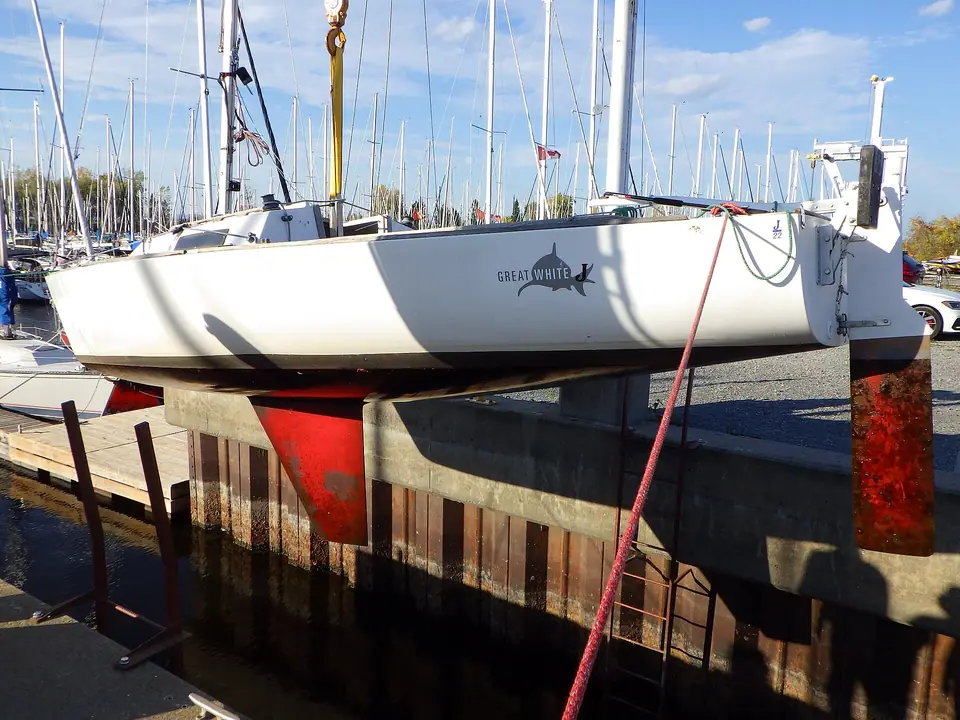
- Length
- 22.5 ft6.86 m
- Beam
- 8 ft2.44 m
- Draft
- 3.8 ft1.16 m
- Cabins
- Small cuddy
- Used price
- $3K to $22K
On this page
- Overview
- The J22 in one paragraph, from someone who has sold a lot of them
- Rod Johnstone's 1983 brief, a smaller and simpler J/24
- How heavy is a J22, and why the number matters at the ramp
- Three or four crew, 605 pounds, and a rule that rewards technique
- Where the speed comes from on a J22
- Women's match racing, sailing schools and club fleets
- What it really costs to race a J22 for a season
- A 40-year-old balsa-cored hull and why that is mostly fine
- Specifications
- Price and value
- Strengths and weaknesses
- Used buyer checklist
- Rivals
- Our verdict
- FAQ
A 22.5-foot, 1,790-pound fractional keelboat designed in 1983. More than 1,550 were built, it holds World Sailing international status, and used boats trade for a few thousand to the low twenties.
- Club racers on a budget
- Dinghy sailors moving to keelboats
- Sailing schools and match racing programs
- Do-it-yourself owners
J/22 by the numbers
- Sail area to displacement
- 24.6Racing level power, needs active reefing as the breeze builds.
- Displacement to length
- 117Ultralight. Built for speed, keep payload to a minimum.
- Theoretical hull speed
- 5.8 knThe practical top speed of a displacement monohull under normal sailing, based on waterline length.
- Ballast ratio
- 39%A typical ballast ratio for a cruising monohull.
- Capsize screening
- 2.64Above 2.0, so this hull leans toward coastal stability over ultimate offshore resistance.
- Motion comfort ratio
- 8.6A quicker motion in waves, typical of light, beamy hulls.
- Length to beam ratio
- 2.81 : 1A beamy hull with lots of volume for its length.
The J22 in one paragraph, from someone who has sold a lot of them
The J22 is the boat I point people toward when they say they want to race keelboats but do not want a second mortgage. It is 22 and a half feet long, weighs 1,790 pounds, sails with three or four people, fits on a trailer behind an ordinary pickup or SUV, and still has World Sailing international class status with a world championship that rotates between North America and Europe and has also visited South Africa. More than 1,550 were built, and J/Boats counts boats racing in 65 fleets across 18 countries.
It is not a glamour boat. There is no planing hull, no carbon, no asymmetric spinnaker on a sprit. What the J22 gives you instead is a fleet of near-identical boats, decades of tuning knowledge, and a used market where a competitive hull costs less than a new set of sails for a 35-footer. For a club racer, a college graduate who misses dinghy racing, or a sailing school, that combination is hard to beat.
Rod Johnstone's 1983 brief, a smaller and simpler J/24
By 1983 the J/24 had already become the most popular keelboat in the world, but it was getting expensive to campaign at the top and it was more boat than many clubs needed. Rod Johnstone drew the J22 as a lighter, cheaper, easier-to-tow sibling: shorter waterline, 8-foot beam so it trailers without permits, a smaller fractional rig and a fixed fin carrying 700 pounds of lead.
Tillotson Pearson built the boats for J/Boats in Rhode Island using the same hand-laid, balsa-cored construction as the J/24. Later boats came from Waterline Systems in Portsmouth, Rhode Island, which had stopped building them by 2017. There has been no active US production since, so every J22 you buy today is a used boat, and its condition matters more than its hull number.
The class was organized in 1983, ran International J/22 Class Championships from 1990 to 1993, and had international status by 1994, when Richard Sherwood counted 61 fleets. The first World Sailing-recognized world championship followed in 1994, and the strongest fleets today are in North America, Europe and South Africa.
How heavy is a J22, and why the number matters at the ramp
The published displacement of a J22 is 1,790 pounds (812 kg), of which 700 pounds is the lead keel. That is the boat itself. On the road you also carry the trailer, the outboard, sails, a cooler and whatever gear lives in the cabin, so plan your tow vehicle and hitch rating around the total, not the brochure figure. North Sails puts the all-up towing weight at about 4,000 pounds, which a minivan or light SUV can handle.
Because the keel is fixed and draws 3 feet 10 inches, the J22 is not a true ramp-launch boat at most venues. Clubs and regatta sites use a hoist or crane with a lifting strap attached to a bar in the keel sump. If you are buying a boat for a lake without a hoist, check the ramp depth before you commit. This is one of the practical reasons some trailer sailors move to the J/70, which has a lifting keel.
Three or four crew, 605 pounds, and a rule that rewards technique
The J22 class caps total crew weight at 605 pounds, and the boat is raced with three or four people. In practice that means a light team of four or a heavier team of three, and the choice changes with the venue. Breezy, choppy places reward a fourth body on the rail; flat-water lakes often favor three.
The rules are permissive on modern equipment while keeping costs in check. Boats carry a main, a jib and a spinnaker, and the measurement certificate stays with the boat and must be reissued to a new owner. Serious one-design racers strip lifelines and pulpits for racing and run an unpainted, faired bottom. The SSA fleet describes the J22 well: a keelboat with the sensitivity of a dinghy.
- Crew of 3 or 4, combined maximum 605 lb
- Three-sail inventory: main, jib, spinnaker
- Class measurement certificate required for sanctioned events
- International class championships from 1990, World Sailing-recognized Worlds since 1994, with recent Worlds in Annapolis (2018 and 2024), Corpus Christi (2021 and 2022), Travemunde (2023) and Naples, Italy (2025)
Where the speed comes from on a J22
Every J22 is the same shape, so speed is about rig setup, weight placement and sail trim. North Sails' speed guide starts the forestay at 4 feet 11.75 inches and notes that keel position can shift the correct headstay length by up to three quarters of an inch, which is why top teams measure their own boat rather than copying numbers blindly.
Upwind the helmsman sits as far forward as practical, the heaviest crew trims the jib just aft of the cabin house, and the bow person slides between the shrouds in light air and back toward the trimmer as the breeze builds. Backstay and vang are the two controls that matter most as pressure changes. Downwind the boat will surf and briefly plane near the top of the wind range, but most of the gains come from driving low and catching waves rather than reaching for speed.
The upshot for a buyer is encouraging. A well-sailed 1985 boat with good sails can beat a 2010 boat with a lazy crew, which keeps old hulls valuable and means you can start cheap and spend money on sails and coaching instead of the boat.
Women's match racing, sailing schools and club fleets
The J22 has a second life beyond fleet racing. J/Boats notes that it has been used for women's and men's championship regattas for more than 15 years and is especially popular in women's match racing, where its quick tacking, short turning circle and three-person crew make for close, tactical racing that is easy to umpire.
Sailing schools and clubs like it for the same reasons owners do: it is simple, tough enough to survive beginners, and cheap to maintain in a fleet. In Annapolis, Fleet 19 runs a packed calendar that includes the NOOD regatta, the East Coast and Mid-Atlantic championships, Thursday night racing and the Annapolis Yacht Club frostbite series. That density of racing is what keeps a 40-year-old design relevant.
What it really costs to race a J22 for a season
Ownership costs are low by keelboat standards. Most boats live on trailers in club yards, so there is no slip to rent, and the outboard is a small portable unit. Expect $2,500 to $4,000 a year for a local club program covering dry storage, insurance, class dues, minor hardware and a new jib every season or two.
A traveling regatta program costs more. Racing jibs get tired quickly from rubbing the mast and shrouds, spinnakers can last two seasons with care, and a new main every couple of years keeps you competitive at the national level. Add tow fuel, hotel rooms and entry fees, and an active circuit campaign runs $6,000 to $9,000 a year. That is still a fraction of what a J/70 or J/80 team spends at the same level.
A 40-year-old balsa-cored hull and why that is mostly fine
The J22 is a simple boat with few systems, which makes it one of the best do-it-yourself projects in sailing. The class forum's long-running buyer checklist makes the point plainly: most problems can be fixed at home for far less than a yard would charge, as long as you are willing to put in the hours.
The weak spots all trace back to water getting into balsa or plywood. Leaky chainplates rot the main bulkhead and the deck core around the chainplate covers. Poorly bedded cam cleats and fairleads on the sea hood let water into the deck. Leaks at the rudder gudgeon bolts soak the transom core. None of this is unique to J/Boats, but on a boat that has sat on a trailer for decades it is common, and it is the main thing that separates a $4,000 boat from a $12,000 one.
J/22 specifications
| Length overall | 22.5 ft6.86 m |
|---|---|
| Waterline length | 19 ft5.79 m |
| Beam | 8 ft2.44 m |
| Draft | 3.8 ft1.16 m |
| Displacement | 1,79 lbs812 kg |
| Ballast | 7 lbs318 kg |
| Sail area | 227 sq ft21.1 m² |
| Cabins | Small cuddy |
| Berths | 4 (basic, in the cuddy) |
| Heads | None |
| Standard engines | Small outboard of about 3 to 6 hp on a transom bracket |
| Hull type | Fiberglass monohull keelboat with transom-hung rudder |
| Keel | Fixed lead fin keel bolted to a molded sump |
| Rig | Fractional sloop, aluminum mast and boom, symmetric spinnaker |
| Hull construction | Hand-laid fiberglass with Baltek balsa core in hull and deck |
| Builder | Tillotson Pearson (TPI) for J/Boats, later Waterline Systems, United States |
| Naval architect | Rod Johnstone |
| Production | 1983 to present |
| Status | Discontinued |
Figures come from builder documentation and independent tests where available. Displacement is usually quoted light, so a loaded cruising boat will weigh more. Compare these specs with another model.
How much does a J/22 cost?
Price is driven far more by preparation than by model year. A tired 1980s TPI hull with bottom paint, old sails and a rusty single-axle trailer trades at the bottom of the range, while a measured, faired, unpainted race boat with a recent North or Quantum inventory and a good trailer brings the top. The Severn Sailing Association fleet in Annapolis quotes $8,000 to $12,000 as typical for a usable class boat, which matches what we see on the brokerage side.
Estimate your yearly cost
A planning estimate using common rules of thumb: insurance near 1.5 percent of value, maintenance near 3 percent, haul out and bottom paint by length. Your marina, region and use will move these numbers. Open the full cost calculator.
J/22 timeline
- 1983Rod Johnstone designs the J22 and Tillotson Pearson begins building it for J/Boats; the class association is formed
- 1990First International J/22 Class Championship held; World Sailing-recognized Worlds follow from 1994
- 1994Class reports 61 fleets worldwide and the first numbered J/22 World Championship is sailed
- 2017Waterline Systems, the later US builder, has ceased production
- 2024World championship returns to Annapolis, Maryland
- 2025J22 Worlds sailed in Naples, Italy
Strengths and weaknesses
What owners like
- Cheapest route into international one-design keelboat racing
- Trailerable with an 8-foot beam and modest towing weight
- Large used fleet keeps prices low and parts available
- Old hulls stay competitive, so you can buy cheap and spend on sails
- Simple construction rewards do-it-yourself owners
- Established match racing and sailing school use
What to weigh up
- No new boats being built, so every purchase is a used boat
- Balsa-cored deck and wooden bulkheads rot if leaks are ignored
- Fixed keel needs a hoist at most venues
- Symmetric spinnaker and displacement hull feel dated next to sportboats
- Cuddy cabin is for gear, not overnighting
Used J/22 buyer checklist
Take this list to a viewing. Your ticks are saved in this browser so you can come back to it.
Always commission an independent marine survey and an engine survey before you buy. How a marine survey works.
Rivals to consider
J/24
Bigger fleets and a stronger world circuit, but heavier, needs five crew and costs more to campaign.
Compare side by sideJ/70
Lifting keel, carbon rig and asymmetric spinnaker make it far more modern and ramp-launchable, at three to five times the price.
Compare side by sideCatalina 22
A cruising trailer sailor with a swing keel and a real cabin, built for comfort rather than one-design racing.
Compare side by sideSonar
A 23-foot open-cockpit keelboat with a strong adaptive sailing program, more comfortable but slower and less widespread.
Our verdict on the J/22
The J22 is the best value in American keelboat racing and will stay that way as long as its fleets survive, and in Annapolis, Texas, the Great Lakes and Europe they are very much alive. Buy the driest hull you can find, check the bulkhead and transom before anything else, and put the savings into sails and coaching. If you want a planing boat, a lifting keel or a modern asymmetric kite, look at the J/70 and accept the much higher price. If you want close racing for a few thousand dollars a year, this is the boat.
J/22 questions answered
How heavy is a J22?
A J22 displaces 1,790 pounds (812 kg), including a 700-pound lead keel. North Sails puts the towing weight with trailer, sails and gear at about 4,000 pounds.
How much does a J22 sailboat cost?
Used J22s generally sell for about $3,000 to $22,000 in 2026. Usable club boats typically fall around $8,000 to $12,000, with fully prepared race boats at the top.
How many people sail a J22?
Three or four, with a class maximum combined crew weight of 605 pounds.
Is the J22 still built?
No. Tillotson Pearson and later Waterline Systems built about 1,550 boats, and Waterline had stopped production by 2017, so today's market is entirely used boats.
Can you trailer and ramp launch a J22?
It trailers easily with an 8-foot beam, but the fixed keel draws about 3 feet 10 inches, so most owners launch with a hoist of a ton or more rather than a ramp.
Is the J22 a good first keelboat?
Yes. It is forgiving, inexpensive and responsive like a dinghy, and the fleets are full of sailors happy to share tuning advice.
More performance sailboats to explore
Pearson Ensign
Performance Sailboats, 23 ft
Used $2K to $35K
J/70
Performance Sailboats, 23 ft
Used $30K to $70K
Ontario Yachts Sonar
Performance Sailboats, 23 ft
Used $8K to $35K
Beneteau First 235
Performance Sailboats, 23 ft
Used $5K to $14K