Beneteau Performance Sailboats
Beneteau First 345 Review, a 1980s Berret Racer-Cruiser for Today's Buyer
Jean Berret's masthead 34-footer, built from 1984 to 1988, was a club racer with a family interior and a PHRF rating of about 120.
- Length
- 34.6 ft10.55 m
- Beam
- 11.5 ft3.5 m
- Draft
- 6.2 ft1.9 m
- Cabins
- 2 or 3 (forward V-berth with one aft cabin, or a smaller forecabin with two aft cabins)
- Used price
- $20K to $45K
On this page
- Overview
- Why the Beneteau 345 First still shows up on start lines
- Masthead power, running backstays and a PHRF of about 120
- Cruising package or racing package
- One aft cabin or two, the layout decision
- What the surveyors found in the build
- Under power, the weak spot owners mention
- Value then and now
- The 345 and the Berret boats that followed
- Specifications
- Price and value
- Strengths and weaknesses
- Used buyer checklist
- Rivals
- Our verdict
- FAQ
The Beneteau First 345 is a Jean Berret designed 34 ft 7 in masthead racer-cruiser built from 1984 to 1988. Roughly 460 to 500 were sold, almost all built in France, with one or two aft cabins.
- Budget PHRF racing
- Couples or small families cruising coastal waters
- Partnerships mixing racing and cruising
- Owners willing to take on a repower or refit
Beneteau First 345 by the numbers
- Sail area to displacement
- 20.9Plenty of sail for the weight, the boat should feel lively in light air.
- Displacement to length
- 217Moderate displacement, a classic cruising balance between load carrying and speed.
- Theoretical hull speed
- 7.2 knThe practical top speed of a displacement monohull under normal sailing, based on waterline length.
- Ballast ratio
- 36%A typical ballast ratio for a cruising monohull.
- Capsize screening
- 2.00Below 2.0, the traditional threshold for offshore suitability.
- Motion comfort ratio
- 23.6A quicker motion in waves, typical of light, beamy hulls.
- Length to beam ratio
- 3.01 : 1Moderate proportions.
Why the Beneteau 345 First still shows up on start lines
Practical Sailor put it neatly: the Beneteau First 345 is a racing boat that contains a cruising interior. Designed by Jean Berret, whose office also drew the 1985 Admiral's Cup winning Beneteau one-tonner Phoenix, it was built from 1984 to 1988 as a moderate displacement racer-cruiser for owners who wanted to win on Wednesday night and take the family away on the weekend.
It arrived just as a strong US dollar made French boats look like bargains, and it helped establish Beneteau in the American market. Practical Sailor reports that more than 500 were sold, all but about 20 built in France; sailboatdata gives 460 and Yachting Monthly says over 400. Whatever the exact number, the 345 was common enough that parts knowledge and owner experience are easy to find, and searches for beneteau 345 first still turn up boats racing in PHRF fleets.
Masthead power, running backstays and a PHRF of about 120
Unlike the fractional Firsts that followed, the 345 carries a masthead sloop rig, with a mainsail of about 258 sq ft and a genoa of about 431 sq ft. Sailboatdata lists 12,125 lb of displacement and 4,409 lb of cast iron ballast, a ballast ratio of about 36 percent, and a displacement to length ratio of about 217, which is moderate for its era. Practical Sailor's figure of 12,600 lb suggests a typical boat in cruising trim.
Practical Sailor gives a PHRF rating of 120 in four of the largest US fleets, which made it about 20 seconds a mile faster than a Tartan 34 or Pearson 34 and quicker than the Cal 34 and Catalina 34. The rig carries running backstays as well as a permanent backstay, apparently to steady the tall mast going to windward in heavy air. Racers accept them; a cruising couple will find them a chore.
On Practical Sailor's test sail out of Narragansett Bay, the boat sailed close to its 7.1 knot hull speed on a close reach and ran at close to seven knots. Owners reported a tendency to round up in gusts and some weather helm, and the review notes the boat flattens out when reefed before 20 knots of wind.
Cruising package or racing package
The 345 was sold with either a cruising or a racing package. Practical Sailor explains that the racing version has a mast about a foot taller, a tiller in place of the wheel and the mainsheet traveler across the after end of the bridge deck instead of on the cabin top. The magazine's view was that unless you insist on a wheel, the racing version makes more sense because the traveler is easier to reach.
Sailboatdata also records a tall rig with an I of 45 ft and P of 38.7 ft, and Practical Sailor heard from the owner of a 1987 boat with a cutter rig who reported excellent heavy weather performance under staysail and reefed main. Check exactly which rig a listed boat carries, because it changes both rating and handling.
One aft cabin or two, the layout decision
Yachting Monthly notes that the 345 was designed with one eye on the charter market and was an early example of offering one or two aft cabins. The owner's layout has a single aft cabin to starboard, the head aft to port, an L-shaped galley, a good-sized chart table, a saloon with twin settees and a surprisingly roomy V-berth forward, which most owners use as the master cabin. The charter layout squeezes in two small quarter cabins, a smaller forecabin and moves the head amidships.
Practical Sailor preferred the single aft cabin for ordinary cruising, and so do most US buyers. Headroom is a little over six feet in the saloon. Natural light comes through a one-piece smoked acrylic panel over fixed ports, which looks sporty but does not open, and owners on the test boat found the original fluorescent lighting dim. Fresh water capacity is generous at about 100 gallons in tanks under the settees, though some boats have flexible bladder tanks that will eventually need replacing.
What the surveyors found in the build
Hulls are solid fiberglass laid up with chopped strand mat and woven roving in polyester resin, reinforced by stringers, structural bulkheads and an interior liner. The deck is balsa-cored, and on the 1985 boat Practical Sailor inspected the surveyor found water-saturated core visible from the chain locker, a warning sign for delamination. The rudder also showed excessive moisture.
The hull to deck joint uses an inward flange bedded in 3M 5200 and an aluminum toe rail that is riveted rather than bolted, which Practical Sailor disliked because it complicates repairs. The cast iron keel is attached through a laminated plate, and the keel bolts on the test boat were rusty. The surveyor also found non-marine gate valves on the galley drain and engine intake, which should be replaced on any boat that still has them.
Blistering is the other historic concern. Beneteau told Practical Sailor that a defective catalyst affected several models built between 1983 and 1985, which overlaps the first 345s, so ask about blister history and any repair records on early hulls.
Under power, the weak spot owners mention
The most common complaint in Practical Sailor's owner survey was poor speed and maneuverability under power, with owners of boats fitted with the standard Volvo 2002 describing a strong helm and marginal performance. The owners of a boat with the three-cylinder Volvo 2003 of about 28 hp had no complaints. Engine access, through the aft cabin and behind the companionway steps, is very good.
Many of these original Volvos are near the end of their service life, so a repower is a realistic line item. A modern three-cylinder diesel transforms the boat's handling under power and is one of the best investments an owner can make, but it adds $15,000 or more to the cost of a boat that may only be worth $30,000.
Value then and now
Practical Sailor called the 345 good value when new, priced somewhat above a Hunter 34 and slightly below a comparable Tartan. That logic still holds on the used market. Our 2026 estimate for US asking prices is roughly $20,000 to $45,000, and Yachting Monthly's 2009 UK price guide of 35,000 to 42,000 pounds shows how far values have since eased.
Yearly costs of about $5,000 to $13,000 cover a slip or mooring, haul-out, insurance and maintenance. The big swing items are the ones identified above: deck core repair, keel bolt and keel fairing work, a repower and new sails. Price those before you make an offer, not after.
The 345 and the Berret boats that followed
The 345 belongs to the first wave of Berret Firsts that also included the First 35 of 1980 and the First 38 of 1982. It was followed by the First 375 of 1985 and then by the First 35s5 of 1988, a Berret design with an interior styled by Philippe Starck and a fractional rig. If you like the 345's sailing but want a more modern interior, the 35s5 is the logical next step, though it is a different boat with different specifications.
Within the 345 class itself, there is only one hull. Variations come from keel (deep or shoal), rig (standard, tall or the occasional cutter conversion), steering (wheel or tiller) and interior (one or two aft cabins).
Beneteau First 345 specifications
| Length overall | 34.6 ft10.55 m |
|---|---|
| Waterline length | 29.2 ft8.9 m |
| Beam | 11.5 ft3.5 m |
| Draft | 6.2 ft1.9 m |
| Displacement | 12,125 lbs5,5 kg |
| Ballast | 4,409 lbs2, kg |
| Sail area | 689 sq ft64 m² |
| Fuel capacity | 22 gal83 L |
| Fresh water | 106 gal401 L |
| Cabins | 2 or 3 (forward V-berth with one aft cabin, or a smaller forecabin with two aft cabins) |
| Berths | 5 to 7 depending on layout, including saloon settees |
| Heads | 1 |
| Standard engines | Volvo Penta 2002 diesel (as reported by owners); some boats have the three-cylinder Volvo 2003 of about 28 hp |
| Hull type | Moderate displacement fiberglass monohull with fin keel and spade rudder |
| Keel | Cast iron fin, about 6 ft 3 in deep; shoal versions quoted at 4 ft 5 in to 4 ft 10 in |
| Rig | Masthead sloop with permanent backstay and running backstays; racing version has a mast about one foot taller |
| Hull construction | Solid fiberglass hull, balsa-cored deck, cast iron keel |
| Builder | Beneteau, France |
| Naval architect | Jean Berret (Berret-Racoupeau) |
| Production | 1984 to 1988 |
| Status | Discontinued |
Figures come from builder documentation and independent tests where available. Displacement is usually quoted light, so a loaded cruising boat will weigh more. Compare these specs with another model.
How much does a Beneteau First 345 cost?
When new in the 1980s, Practical Sailor says the 345 sold for under $50,000. Today the spread is set almost entirely by condition: original sails, a wet deck or an engine at the end of its life put a boat near $20,000, while a refit boat with new rigging, sails and a modern diesel can ask $40,000 or more. The single-aft-cabin owner's layout is usually easier to sell in the US than the charter-style two-aft-cabin version.
Estimate your yearly cost
A planning estimate using common rules of thumb: insurance near 1.5 percent of value, maintenance near 3 percent, haul out and bottom paint by length. Your marina, region and use will move these numbers. Open the full cost calculator.
Versions and options
- Cruising package
- Wheel steering, mainsheet traveler on the cabin top and the standard height masthead rig.
- Racing package
- Mast about one foot taller, tiller steering and the traveler across the after end of the bridge deck.
- Owner's layout
- Single aft cabin to starboard, head aft to port and a large V-berth forward.
- Charter layout
- Two small aft cabins, a smaller forecabin and the head moved amidships.
Beneteau First 345 timeline
- 1984First 345 enters production in France
- 1985Berret-designed Beneteau one-tonner Phoenix wins the Admiral's Cup
- 1988Production ends; the First 35s5 arrives as the next Berret mid-size First
Strengths and weaknesses
What owners like
- Fast for its era, PHRF about 120
- Good stiffness with a 36 percent ballast ratio
- Roomy V-berth and good saloon headroom
- Large fresh water capacity for a 34-footer
- Excellent engine access
- Low purchase price
What to weigh up
- Running backstays are a nuisance for cruising couples
- Weak handling under power with the original Volvo 2002
- Riveted toe rail and iron keel complicate maintenance
- Fixed portlights and limited ventilation
- Deck core and rudder moisture are common on older boats
Used Beneteau First 345 buyer checklist
Take this list to a viewing. Your ticks are saved in this browser so you can come back to it.
Always commission an independent marine survey and an engine survey before you buy. How a marine survey works.
Rivals to consider
J/35
Lighter American masthead racer with a strong one-design record and a more basic interior.
Catalina 34
Roomier and more cruising oriented, with a large owner base but less pace.
Compare side by sidePearson 34
US-built contemporary that Practical Sailor rated about 20 seconds a mile slower.
Beneteau First 35s5
The later Berret and Starck design with a fractional rig and a more stylized interior.
Our verdict on the Beneteau First 345
The First 345 is a genuine racer with a family-friendly interior, and it still sails well enough to be competitive in PHRF. Its age shows in the details: a riveted toe rail, an iron keel, a balsa deck that may have taken on water and an engine that may need replacing. Buy the best-surveyed boat you can find, ideally with the owner's single aft cabin layout and a modern diesel, and the 345 delivers a lot of sailing for very little money.
Beneteau First 345 questions answered
Who designed the Beneteau First 345?
Jean Berret, the French designer who also drew the Admiral's Cup winning Beneteau one-tonner Phoenix.
What is the PHRF rating of a First 345?
Practical Sailor reported a PHRF rating of 120 in four of the largest US fleets, a little higher in some others.
How many cabins does the Beneteau 345 have?
Either two (a V-berth and one aft cabin) or three (a smaller forecabin and two aft cabins) depending on the layout.
How much is a used Beneteau 345 worth?
We estimate 2026 US asking prices of about $20,000 to $45,000, depending on refits, engine and deck condition.
Does the First 345 have running backstays?
Yes, Practical Sailor notes running backstays in addition to the permanent backstay, used to support the mast when beating in heavy weather.
Where was the First 345 built?
Almost all were built in France; Practical Sailor says all but about 20 of the boats sold were French-built.
Photos from the Beneteau range
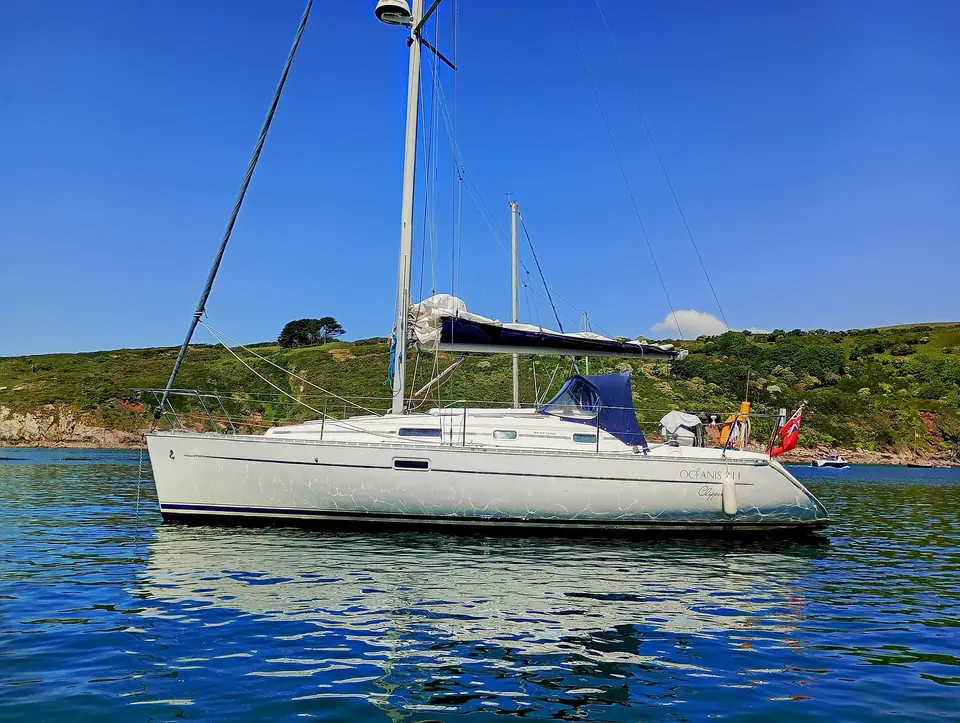
We have not found a freely licensed photo of the Beneteau First 345 yet, so these show other Beneteau boats, each captioned with the boat pictured.
More performance sailboats to explore
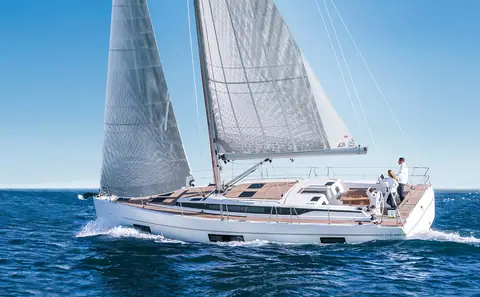
Bavaria 35 Match
Performance Sailboats, 35 ft
Used $45K to $75K
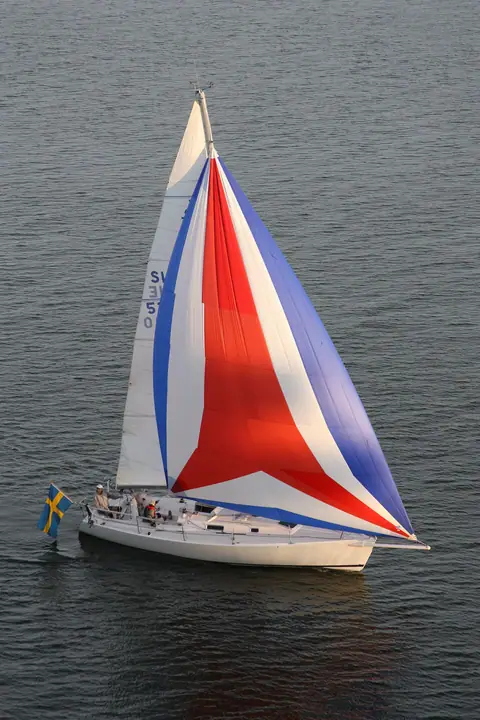
J/105
Performance Sailboats, 35 ft
Used $40K to $135K
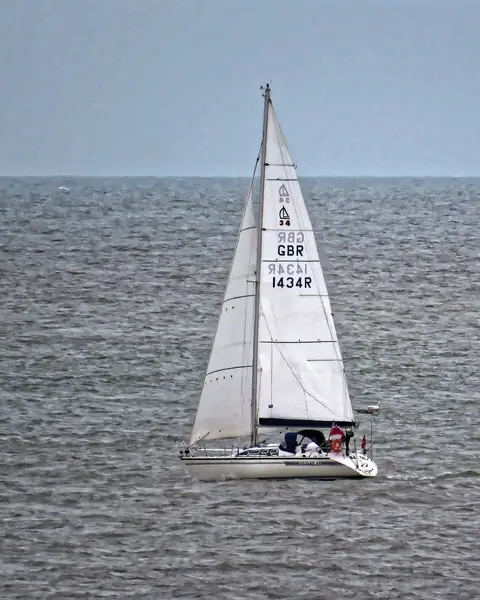
Dehler 35
Performance Sailboats, 34 ft
Used $70K to $125K

Elan 350
Performance Sailboats, 35 ft
Used $85K to $135K
Other Beneteau models
- Beneteau 49
- Beneteau 50
- Beneteau 57
- Beneteau 343
- Beneteau Antares 5.80
- Beneteau Antares 6
- Beneteau Antares 6.80
- Beneteau Antares 7
- Beneteau Antares 7.30
- Beneteau Antares 7.60
- Beneteau Antares 7.80
- Beneteau Antares 8
- Beneteau Antares 8.00
- Beneteau Antares 8.05
- Beneteau Antares 8.60
- Beneteau Antares 8.80
- Beneteau Antares 9
- Beneteau Antares 9.80
- Beneteau Antares 10.80
- Beneteau Antares 11
- Beneteau Antares 12
- Beneteau Antares 13.80
- Beneteau Antares 30
- Beneteau Antares 32
- Beneteau Antares 36
- Beneteau Antares 42
- Beneteau Antares 620 HB
- Beneteau Antares 650 HB
- Beneteau Antares 750 HB
- Beneteau Cyclades 39.3
- Beneteau Cyclades 43.3 and 43.4
- Beneteau Cyclades 50.5
- Beneteau First 18 SE
- Beneteau First 20
- Beneteau First 21.7
- Beneteau First 24
- Beneteau First 25
- Beneteau First 25.7
- Beneteau First 27
- Beneteau First 27.7
- Beneteau First 30
- Beneteau First 31.7
- Beneteau First 35
- Beneteau First 36
- Beneteau First 36.7
- Beneteau First 38
- Beneteau First 40
- Beneteau First 40.7
- Beneteau First 44
- Beneteau First 45
- Beneteau First 47.7
- Beneteau First 53
- Beneteau First 211
- Beneteau First 235
- Beneteau First 285
- Beneteau First 305
- Beneteau First 310
- Beneteau Flyer 6
- Beneteau Flyer 7
- Beneteau Flyer 8
- Beneteau Flyer 9
- Beneteau Flyer 10
- Beneteau Flyer 12
- Beneteau Flyer 500
- Beneteau Flyer 550
- Beneteau Flyer 650
- Beneteau Flyer 701
- Beneteau Flyer 750
- Beneteau Grand Trawler 62
- Beneteau Gran Turismo 32
- Beneteau Gran Turismo 36
- Beneteau Gran Turismo 40
- Beneteau Gran Turismo 41
- Beneteau Gran Turismo 44
- Beneteau Gran Turismo 45
- Beneteau Monte Carlo 6
- Beneteau Oceanis 30.1
- Beneteau Oceanis 31
- Beneteau Oceanis 34
- Beneteau Oceanis 34.1
- Beneteau Oceanis 35
- Beneteau Oceanis 35.1
- Beneteau Oceanis 36 CC
- Beneteau Oceanis 37
- Beneteau Oceanis 38
- Beneteau Oceanis 38.1
- Beneteau Oceanis 40
- Beneteau Oceanis 40 CC
- Beneteau Oceanis 41
- Beneteau Oceanis 41.1
- Beneteau Oceanis 42
- Beneteau Oceanis 42 CC
- Beneteau Oceanis 43
- Beneteau Oceanis 44 CC
- Beneteau Oceanis 45
- Beneteau Oceanis 46
- Beneteau Oceanis 46.1
- Beneteau Oceanis 48
- Beneteau Oceanis 50
- Beneteau Oceanis 51.1
- Beneteau Oceanis 54
- Beneteau Oceanis 55
- Beneteau Oceanis 58
- Beneteau Oceanis 311
- Beneteau Oceanis 320
- Beneteau Oceanis 321
- Beneteau Oceanis 323
- Beneteau Oceanis 331
- Beneteau Oceanis 350
- Beneteau Oceanis 351
- Beneteau Oceanis 370
- Beneteau Oceanis 390
- Beneteau Oceanis 400
- Beneteau Oceanis 411
- Beneteau Oceanis 423
- Beneteau Oceanis 430
- Beneteau Oceanis 440
- Beneteau Oceanis 461
- Beneteau Oceanis 473
- Beneteau Oceanis 500
- Beneteau Oceanis 510
- Beneteau Oceanis Clipper 361
- Beneteau Oceanis Clipper 373
- Beneteau Oceanis Clipper 381
- Beneteau Oceanis Clipper 393
- Beneteau Oceanis Yacht 54
- Beneteau Oceanis Yacht 60
- Beneteau Oceanis Yacht 62
- Beneteau Sense 43
- Beneteau Sense 46
- Beneteau Sense 50
- Beneteau Sense 55
- Beneteau Swift Trawler 30
- Beneteau Swift Trawler 34
- Beneteau Swift Trawler 35
- Beneteau Swift Trawler 41
- Beneteau Swift Trawler 44
- Beneteau Swift Trawler 48
- All Beneteau models