RS Sailing Performance Sailboats
RS Zest Sailboat Review, the Trainer Dinghy for Clubs and Families
An 11-foot 9-inch rotomolded dinghy designed by Jo Richards and RS Sailing, roomy enough for two and simple enough for one.
- Length
- 11.8 ft3.59 m
- Beam
- 4.8 ft1.47 m
- Cabins
- None (open dinghy)
- Used price
- $3K to $6K
On this page
- Overview
- The RS Zest is a trainer dinghy, and that is the point
- Jo Richards' brief, room for two and sailable by one
- Rotomolded PE3 construction and why programs like it
- Rig and foils, roller-furling main and a kick-up rudder
- On the water, SAIL's blustery test off Annapolis
- How sailing programs and families use the Zest
- Zest, Tera, Feva or Quest, choosing inside the RS range
- Buying, pricing and keeping one for a decade
- Specifications
- Price and value
- Strengths and weaknesses
- Used buyer checklist
- Rivals
- Our verdict
- FAQ
The RS Zest is an 11-foot 9-inch, 161-pound training and family sailing dinghy launched by RS Sailing in 2017. It has a rotomolded polyethylene hull, a reefable roller-furling main, an optional jib, a pivoting centerboard and kick-up rudder, and sells for about $7,000 in the US.
- Yacht club and community learn-to-sail programs
- Families with children starting to sail
- Adult beginners and casual lake sailing
RS Zest by the numbers
- Sail area to displacement
- 41.1Racing level power, needs active reefing as the breeze builds.
- Displacement to length
- 67Ultralight. Built for speed, keep payload to a minimum.
- Theoretical hull speed
- 4.3 knThe practical top speed of a displacement monohull under normal sailing, based on waterline length.
- Capsize screening
- 3.54Above 2.0, so this hull leans toward coastal stability over ultimate offshore resistance.
- Motion comfort ratio
- 2.9A quicker motion in waves, typical of light, beamy hulls.
- Length to beam ratio
- 2.44 : 1A beamy hull with lots of volume for its length.
The RS Zest is a trainer dinghy, and that is the point
Most boats on this site have engines, cabins and price tags in the hundreds of thousands. The RS Zest is none of those things. It is an 11-foot 9-inch open sailing dinghy that weighs 161 pounds, built from rotomolded plastic by RS Sailing of Romsey, Hampshire, for sailing schools, yacht club junior programs and families who want a first sailboat. We cover it because it is one of the most searched small sailboats in the US, and because it is genuinely good at its job.
We file it under performance sailboats for lack of a dinghy category, but be clear about what that means here: the Zest is a forgiving trainer that happens to be lively, not a racing machine. Nobody buys a Zest for speed records. They buy it to teach a 10-year-old to tack, to give an adult beginner confidence, or to have a boat at the lake that two people can rig in minutes and sail all afternoon.
Jo Richards' brief, room for two and sailable by one
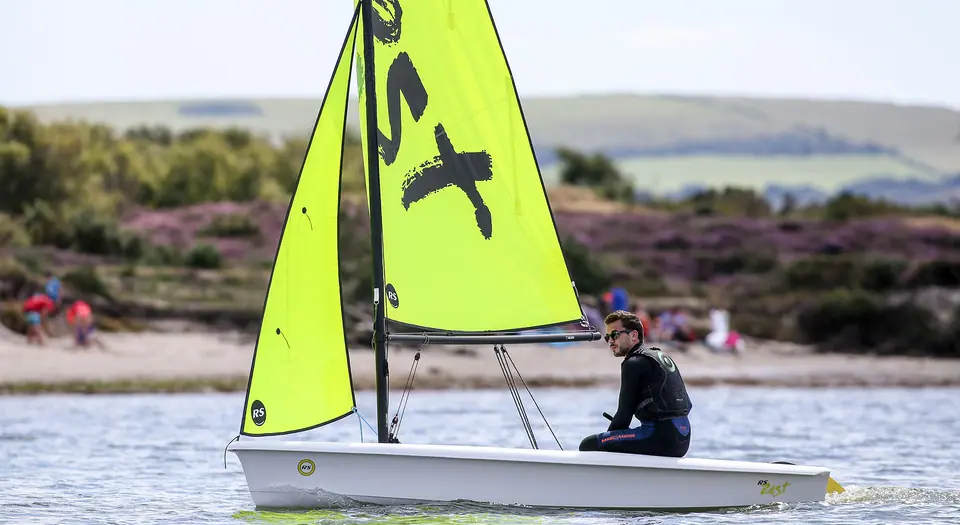
RS credits the design to Jo Richards and its own team. The central idea is a cockpit that comfortably holds two sailors, or three small ones, while the boat remains easy to single-hand. RS calls it a mini double-hander that can be sailed solo, and argues that many boats in this class are sailed by two but really suited to one.
Seating comes in three stages so a beginner can progress. A bright yellow sculpted thwart gives a nervous crew a secure inboard seat, intermediate side seats come next, and the contoured side decks with padded hiking straps are there for when the sailor is ready to get weight outboard. The boom is set high to reduce bumped heads, and moulded-in grab points on the hull make it easier to climb back in after a capsize.
RS Sailing launched the Zest in 2017, and SAIL magazine named it a winner in its 2018 Best Boats contest, singling out the ergonomics, the easily handled rig and the high-visibility sail that makes a drifting beginner easy to spot.
Rotomolded PE3 construction and why programs like it
The hull is built with RS's Comptec PE3 process, a three-layer rotomolding system with a tough outer skin, a foam middle layer for stiffness and buoyancy, and a strong inner skin. RS adds thickness in high-load areas and molds brass inserts into the hull for fittings, so hardware is not simply screwed into plastic.
For a sailing program, that means a boat that shrugs off dock rash, beaching and the occasional collision with a coach boat, and needs almost no maintenance. An aluminum rail on the bottom doubles as a skid when the boat is dragged up a beach and as a handhold for righting it after a capsize. Built-in tow points let an instructor tow six boats at once.
Rig and foils, roller-furling main and a kick-up rudder
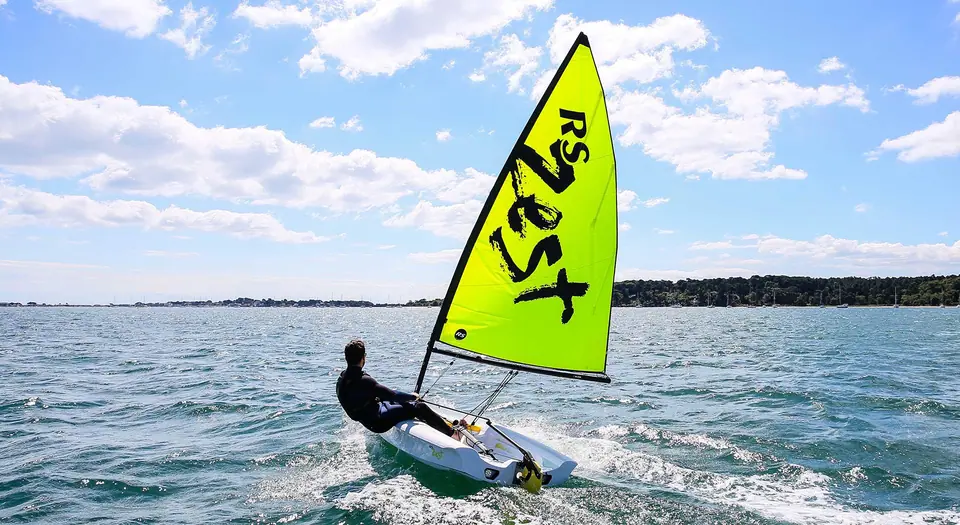
The Zest sails as a una-rig with a 6 square meter (64.6 square foot) Dacron main, or as a sloop with the optional 1.1 square meter jib. The main roller-furls around the mast, so it can be reefed from the boat or from an instructor's RIB when the breeze builds. The mast is a two-part aluminum section with a foam-filled top, and a masthead float is offered as an option.
Two details stand out for beginners. The hinging mast step and a clunk-click mast gate lock let young sailors raise the mast without dropping it, and the lock stays secure in a capsize. A pivoting centerboard replaces the usual daggerboard, so hitting the bottom in shallow water lifts the board instead of breaking it, and the lift-and-lock rudder kicks up on grounding.
- Length 3.59 m (11 feet 8 inches per RS; SAIL lists 11 feet 9 inches)
- Beam 1.47 m (4 feet 8 inches per RS; SAIL lists 4 feet 10 inches)
- Hull weight 73 kg (161 lb); maximum crew weight 225 kg (496 lb)
- Main 6 square meters, optional jib 1.1 square meters
On the water, SAIL's blustery test off Annapolis
SAIL's reviewer took a Zest out from the Severn Sailing Association, across from the US Naval Academy, on a blustery day on Chesapeake Bay, and admitted he was worried about tacking and gybing in the chop. He found the foils offered the right mix of control and forgiveness, that maneuvers were easy, and that the space between boom and cockpit sole made it simple to move from side to side.
His conclusion was that he forgot he was sailing a trainer. SAIL calculated a sail area to displacement ratio of 25 and a displacement to length ratio of 79, figures that include 150 pounds of crew and both sails, and that explain why the boat feels sprightly rather than sluggish.
How sailing programs and families use the Zest
RS quotes three British training organizations on the Zest. The Sea Cadets use boats two-up for beginner sessions and like the thwart as a confidence-building seat; UKSA uses the same boat for adult tuition one day and children's taster sessions the next, sometimes three-up; and the Hengistbury Head Outdoor Education Centre says the centerboard lets it sail through more of the tide in shallow water.
West Coast Sailing, which sells the boat in the US, says the Zest has become a staple of yacht club learn-to-sail programs and community sailing centers since its launch. For a family, the appeal is simplicity: the boat fits on a small trailer or cart, the sail furls away and there is no varnish to maintain.
Zest, Tera, Feva or Quest, choosing inside the RS range
RS sells several boats to the same buyers, so choose by crew and ambition. The 2.87-meter RS Tera is a smaller single-handed trainer and an international class. The 3.64-meter RS Feva is a youth double-hander with a gennaker and its own international class. The RS Quest is what the company calls its most popular teaching and family boat. The Zest sits in the middle: roomier than a Tera, simpler than a Feva and, in our view, the easiest of the group for a mixed-age family to share.
Buying, pricing and keeping one for a decade
New, expect around $7,000 at a US dealer before options; SAIL's 2018 sailaway figure of $4,274 shows how much prices have moved. Used boats from club fleets turn up regularly, usually with some cosmetic scuffing that does not matter on polyethylene. Running costs are minimal: storage, a cover, occasional replacement of lines, the sail every few seasons and dinghy insurance or club fees.
When buying used, look at the rudder stock and lift-and-lock mechanism, the centerboard pivot, the mast step and gate lock, and the furling main for UV damage. Check that the hull has no soft spots or deep gouges that expose the foam core.
RS Zest specifications
| Length overall | 11.8 ft3.59 m |
|---|---|
| Beam | 4.8 ft1.47 m |
| Displacement | 161 lbs73 kg |
| Sail area | 76 sq ft7.1 m² |
| Cabins | None (open dinghy) |
| Berths | None |
| Heads | None |
| Standard engines | None (sail and optional rowing kit) |
| Hull type | Open dinghy hull, rotomolded, with moulded-in buoyancy |
| Keel | Pivoting polypropylene centerboard; kick-up rudder with lift-and-lock system |
| Rig | Una-rig with 6 square meter reefable roller-furling Dacron main on a two-part aluminum mast; optional 1.1 square meter jib for sloop rig |
| Hull construction | Comptec PE3 rotomolded polyethylene (three-layer with foam core) |
| Builder | RS Sailing, United Kingdom |
| Naval architect | Jo Richards and RS Sailing |
| Production | 2017 to present |
| Status | In production |
Figures come from builder documentation and independent tests where available. Displacement is usually quoted light, so a loaded cruising boat will weigh more. Compare these specs with another model.
How much does a RS Zest cost?
West Coast Sailing lists the RS Zest at $6,999, and SAIL quoted $4,274 sailaway when it reviewed the boat in 2018, so the US price has risen substantially. The optional jib, rowing kit, launching trolley, road trailer base and covers add to the total. Used boats from club fleets are common; condition of the hull skin, foils and sail matters more than age, since the polyethylene hull is very durable.
Estimate your yearly cost
A planning estimate using common rules of thumb: insurance near 1.5 percent of value, maintenance near 3 percent, haul out and bottom paint by length. Your marina, region and use will move these numbers. Open the full cost calculator.
Versions and options
- Una-rig
- Single reefable roller-furling main for solo sailing or beginners.
- Sloop rig
- Adds the optional 1.1 square meter jib for two or three crew.
- Accessories
- Rowing kit with oars and rowlocks, top cover, mast and sail sock, launching trolley, road trailer base.
RS Zest timeline
- 1957H. Taylor and Son (Brockley) Ltd, the company that trades as RS Sailing, is incorporated
- 2017RS Zest launched and nominated for SAIL's Best Boats 2018
- 2018SAIL names the Zest a Best Boats winner and prices it at $4,274 sailaway
- 2026US dealer West Coast Sailing lists the Zest at $6,999
Strengths and weaknesses
What owners like
- Roomy cockpit for two or three, still easy to single-hand
- Rotomolded PE3 hull is nearly maintenance free
- Roller-furling, reefable main
- Pivoting centerboard and kick-up rudder forgive groundings
- Mast step and lock designed for young sailors
What to weigh up
- Not a racing class boat
- Polyethylene hull is heavier than a composite racing dinghy
- US price has risen sharply since launch
- Experienced sailors may outgrow it quickly
Used RS Zest buyer checklist
Take this list to a viewing. Your ticks are saved in this browser so you can come back to it.
Always commission an independent marine survey and an engine survey before you buy. How a marine survey works.
Rivals to consider
RS Tera
Smaller single-handed trainer from the same builder.
RS Feva
Youth double-hander with a gennaker and racing class.
Laser Pico
A long-established rotomolded trainer and family dinghy.
Our verdict on the RS Zest
The RS Zest is not a yacht and does not pretend to be. It is one of the best-designed training dinghies on the market: roomy, nearly indestructible, easy to rig and forgiving when things go wrong, yet lively enough that an experienced sailor enjoys it too. For a club building a learn-to-sail fleet or a family buying a first boat, it is easy to recommend; for anyone who wants to race, look at the Feva or a class boat instead.
RS Zest questions answered
What is the RS Zest?
It is an 11-foot 9-inch rotomolded sailing dinghy from RS Sailing, designed for training centers and families.
How much does an RS Zest cost?
West Coast Sailing lists it at $6,999 in the US; SAIL quoted $4,274 sailaway in 2018.
How many people can sail an RS Zest?
It is designed for one or two sailors and can take three small crew, with a maximum crew weight of 225 kg (496 lb).
How much does the RS Zest weigh?
The hull weighs 73 kg, or 161 pounds.
Who designed the RS Zest?
RS Sailing credits the design to Jo Richards and the RS Sailing team.
Is the RS Zest a good family sailboat?
Yes. Its stable hull, roomy cockpit, furling main and kick-up foils make it one of the easier boats for families to learn on.