J/88 Review, a 29-Foot Speedster With a Family Side
Alan Johnstone's 29-footer bridges the gap between trailer sportboats and big-boat racing, with an inboard diesel, a head and a one-design class.
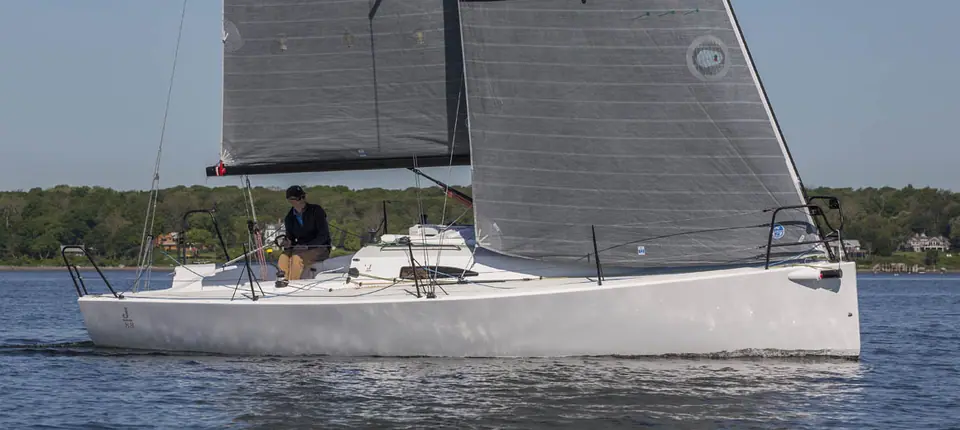
- Length
- 29.2 ft8.9 m
- Beam
- 9.5 ft2.9 m
- Draft
- 6.5 ft1.98 m
- Cabins
- 1 plus forward head compartment
- Used price
- $80K to $150K
On this page
- Overview
- The gap the J88 was built to fill
- A long waterline, an L-shaped keel and a carbon stick
- Two sea trials, 11 knots on Narragansett Bay and 20 on the Chesapeake
- Below deck, a weekend boat in disguise
- How the J88 class keeps racing amateur-friendly
- Where the fleets are
- What a J88 costs to keep
- Specifications
- Price and value
- Strengths and weaknesses
- Used buyer checklist
- Rivals
- Our verdict
- FAQ
A 29-foot, 4,990-pound carbon-rigged sprit boat built from 2013. About 130 built, roughly 60 in North America, with strict one-design rules and used prices from about $80,000 to $150,000.
- Owner-driver one-design racing
- Families who want to race and daysail
- PHRF and ORC racing on lakes and bays
- Sailors stepping up from a J70
The gap the J88 was built to fill
By 2013 J/Boats had a hit with the J70 and a proven 36-footer in the J111, but nothing in between for the sailor who wanted to race hard on Saturday and take the family out on Sunday with a real head and an engine that starts with a key. The J88 is that boat. At 29 feet 2 inches overall, 9 feet 6 inches of beam and 4,990 pounds, it is big enough for open water but still light enough to trailer and lift with a single-point sling.
It made a quick impression. Sailing World's judges tested it in October 2013 and named it Best One-Design in the 2014 Boat of the Year awards, and it finished second in class in its first Chicago-Mackinac race in 2014. The production run was small, about 130 boats according to US Sailing, and J/Boats now files the J88 under its classic models rather than its current range, so it remains a niche choice, but one with an unusually loyal owner group.
J/88 by the numbers
- Sail area to displacement
- 24.1Racing level power, needs active reefing as the breeze builds.
- Displacement to length
- 115Ultralight. Built for speed, keep payload to a minimum.
- Theoretical hull speed
- 6.9 knThe practical top speed of a displacement monohull under normal sailing, based on waterline length.
- Ballast ratio
- 37%A typical ballast ratio for a cruising monohull.
- Capsize screening
- 2.22Above 2.0, so this hull leans toward coastal stability over ultimate offshore resistance.
- Motion comfort ratio
- 14.0A quicker motion in waves, typical of light, beamy hulls.
- Length to beam ratio
- 3.07 : 1Moderate proportions.
A long waterline, an L-shaped keel and a carbon stick
Alan Johnstone gave the J88 a waterline of nearly 27 feet on a 29-foot hull, so almost all of its length is working. Under it hangs a 6.5-foot L-shaped fin with a lead bulb that carries 1,840 pounds of ballast low, which is where the boat gets its stiffness and its ability to stand up to a breeze better than lighter sportboats.
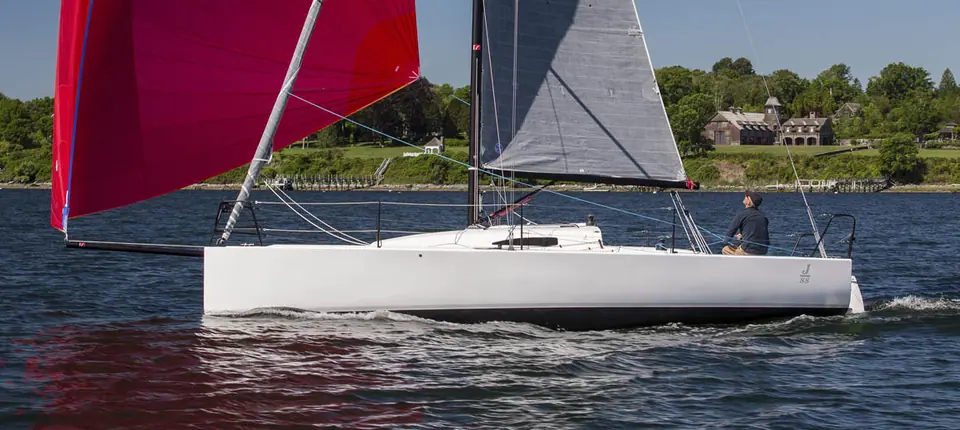
The rig is a double-spreader carbon mast, deck-stepped so it can be raised and lowered for trailering, with non-overlapping jibs, an aluminum boom high enough for crew to pass under, and a retractable carbon sprit for the asymmetric. Hull and deck are cored and infusion molded to ISO 12215 standards at CCF Composites in Bristol, Rhode Island, and joined with adhesive on an inward-turning flange. SAIL's reviewers summed up the build as sparse but solid.
Two sea trials, 11 knots on Narragansett Bay and 20 on the Chesapeake
SAIL Magazine sailed the J88 in an 11-knot easterly on Narragansett Bay with North 3Di sails and saw better than 5 knots close-hauled and over 7 knots on a reach. The testers singled out the deep, powerful transom-hung rudder, saying the helm felt almost like a dinghy.
SAILING Magazine tested hull number 57 off Annapolis in a steady 20 knots after the US Sailboat Show, in a test published in April 2015. That is a lot of breeze for a 29-footer, and the review came back positive: fast, fun and in control, with all lines led aft to a T-shaped, open-transom cockpit and the traveler on the cockpit sole within reach of the helmsman. The mainsheet has both gross and fine trim, which matters on a boat this responsive.
Below deck, a weekend boat in disguise
The interior is what separates the J88 from every sportboat its size. There are two full-length settee berths of about 6 feet 4 inches, a private enclosed head forward of the main bulkhead with sail storage, a mini-galley and a small navigation area, plus a large cooler near the companionway. A V-berth package was offered as a factory option.
It is not a cruiser, but two adults can comfortably spend a weekend aboard, and a family can daysail with a toilet and shelter from the weather. The small inboard diesel on a saildrive (a 14-horsepower Yanmar on the boats SAILING tested, a 13-horsepower Volvo Penta D1-13 in J/Boats' later spec, with a 10-gallon tank) makes docking and getting home in a calm far less stressful than an outboard on a bracket.
How the J88 class keeps racing amateur-friendly
The J88 class rules are closed rules: if a change is not specifically allowed, it is banned. They require factory interior furnishings to stay in place when racing, which keeps boats equal and stops owners from gutting them for weight.
Professional sailors are tightly limited. Except for a 100 percent owner, no more than one World Sailing Group 3 competitor may race on a boat, and a driver who is not the sole owner must be Group 1. Crew is limited to the driver plus five, or at championship events the board can switch to a 1,110-pound maximum crew weight with no limit on numbers.
- Racing inventory of five sails: one main, a #1 and #2 jib, and two spinnakers
- Sail purchases limited to a full inventory in the first year, then four sails per calendar year
- Jibs delivered after March 2023 must use vertical battens
- Forestay cannot be adjusted once the boat leaves the dock for the day
- Bowsprit must be retracted except when the spinnaker is being set, flown or doused
Where the fleets are
US Sailing lists the main J88 regions as Youngstown and Buffalo on Lake Ontario, Long Island Sound, New Rochelle, New England, San Francisco and Lake Michigan around Chicago. J/Boats says the class has active racing schedules in both the USA and the UK, with 100-plus boats sailing worldwide.
Fleet size matters for resale. In regions with active J88 fleets, boats change hands within the class and rarely sit on the market. Elsewhere, the J88 races under PHRF, ORC or IRC and does well, but a buyer outside the fleet areas should plan on handicap racing.
What a J88 costs to keep
Unlike the J70 or J80, most J88s live in the water during the season, so slip fees now enter the budget. Add insurance, a saildrive service with diaphragm and seal checks on the manufacturer's schedule, bottom work, and sails under the class purchase limits, and a club racing program runs about $9,000 to $15,000 a year. A full regatta schedule with new sails each season and travel pushes past $25,000.
The good news is that the class sail limit caps the arms race, the inboard is small and economical, and the boat can be hauled and stored on its trailer in winter to save yard fees.
J/88 specifications
| Length overall | 29.2 ft8.9 m |
|---|---|
| Waterline length | 26.8 ft8.18 m |
| Beam | 9.5 ft2.9 m |
| Draft | 6.5 ft1.98 m |
| Displacement | 4,99 lbs2,263 kg |
| Ballast | 1,84 lbs835 kg |
| Sail area | 439 sq ft40.8 m² |
| Fuel capacity | 1 gal38 L |
| Cabins | 1 plus forward head compartment |
| Berths | 2 settee berths, optional V-berth |
| Heads | 1 |
| Standard engines | 14 hp Yanmar diesel with saildrive on early boats; later J/Boats spec lists a 13 hp Volvo Penta D1-13 with SD-20 saildrive |
| Maximum power | 14 hp |
| Hull type | Fiberglass monohull with transom-hung rudder and open transom cockpit |
| Keel | Fixed L-shaped fin with low-VCG lead bulb, 6.5 ft draft |
| Rig | Fractional sloop, deck-stepped double-spreader carbon mast, non-overlapping jibs, retractable carbon sprit |
| Hull construction | Infusion-molded cored composite hull and deck built to ISO 12215 |
| Builder | CCF Composites for J/Boats, United States |
| Naval architect | Alan Johnstone |
| Production | 2013 to present |
| Status | Discontinued |
Figures come from builder documentation and independent tests where available. Displacement is usually quoted light, so a loaded cruising boat will weigh more. Compare these specs with another model.
How much does a J/88 cost?
With only about 130 boats built, the J88 trades in a thin market, and asking prices for 2014 and 2015 boats have run roughly $85,000 to $145,000. The spread is about equipment more than age: a boat with a recent class sail inventory, a trailer, a lifting point setup and modern instruments sells quickly, while a boat with original 2014 sails and no trailer needs a discount. SAILING Magazine quoted a base price of $125,500 in 2015, and with J/Boats now listing the J88 among its classic models, the brokerage market is the realistic way in.
Estimate your yearly cost
A planning estimate using common rules of thumb: insurance near 1.5 percent of value, maintenance near 3 percent, haul out and bottom paint by length. Your marina, region and use will move these numbers. Open the full cost calculator.
J/88 timeline
- 2013J88 introduced, designed by Alan Johnstone and built by CCF Composites in Bristol, Rhode Island; tested for Sailing World Boat of the Year in October
- 2014Named Best One-Design in Sailing World's 2014 Boat of the Year awards and second in class in its first Chicago-Mackinac race
- 2015SAILING Magazine publishes its test of hull No. 57, sailed in 20 knots off Annapolis
- 2020Class tightens sail purchase limits for one-design events
- 2023Vertical battens required on new class jibs
Strengths and weaknesses
What owners like
- Inboard diesel and enclosed head make it a genuine family boat
- Stiff, fast and controllable in a breeze
- Strict sail limits and pro rules keep costs in check
- Trailerable with a deck-stepped carbon mast
- Strong owner loyalty in fleet areas
What to weigh up
- Only about 130 boats, so used supply is thin
- 6.5-foot draft limits shallow harbors
- Needs a slip or mooring in season, unlike smaller trailer boats
- Few fleets outside the Northeast, Great Lakes and San Francisco
Used J/88 buyer checklist
Take this list to a viewing. Your ticks are saved in this browser so you can come back to it.
Always commission an independent marine survey and an engine survey before you buy. How a marine survey works.
Rivals to consider
J/80
Smaller, cheaper and outboard-powered, with bigger European fleets but no head or inboard.
Compare side by sideJ/70
A ramp-launchable sportboat with huge fleets, but no accommodations and much wetter in a breeze.
Compare side by sideBeneteau First 27
A more cruising-friendly small performance boat with a lifting keel, without the J88's one-design class.
Compare side by sideJ/105
Bigger, cheaper on the used market and with much larger fleets, but older and heavier.
Compare side by sideOur verdict on the J/88
The J88 is one of the best-balanced boats J/Boats has drawn: fast enough to win, simple enough for an amateur crew, and civilized enough to bring the family. Its weakness is scale. With only about 130 boats, fleets are concentrated in a few regions, and good used boats are hard to find. If you live near a fleet, it is an outstanding owner-driver racer. If you do not, it is still a superb PHRF and daysailing boat, but price it accordingly.
J/88 questions answered
How much is a used J88?
Used J88s typically ask about $80,000 to $150,000, with 2014 and 2015 boats listed around $85,000 to $145,000 depending on sails and equipment.
Does the J88 have an engine?
Yes, a small inboard diesel on a saildrive, a 14-horsepower Yanmar on early boats and a 13-horsepower Volvo Penta D1-13 in the later builder spec, which sets it apart from smaller J one-designs that use outboards.
How many J88s have been built?
About 130, with roughly 60 in North America according to US Sailing.
How many crew race a J88?
The driver plus up to five crew, or at championships the class can switch to a 1,110-pound crew weight limit with no limit on numbers.
Can you trailer a J88?
Yes. It has a deck-stepped carbon mast and a single-point lift, but the 6.5-foot keel means you need a hoist or crane to launch.
Can you sleep aboard a J88?
Yes, two adults can weekend comfortably on the settee berths, with a private head forward and an optional V-berth.
J/88 photos
More performance sailboats to explore
Dehler 29
Performance Sailboats, 29 ft
Used $35K to $70K
J/30
Performance Sailboats, 30 ft
Used $8K to $35K
Alerion 28
Performance Sailboats, 28 ft
Used $38K to $95K
Beneteau First 27.7
Performance Sailboats, 28 ft
Used $25K to $55K