J/120 Sailboat Review and Used Buying Guide
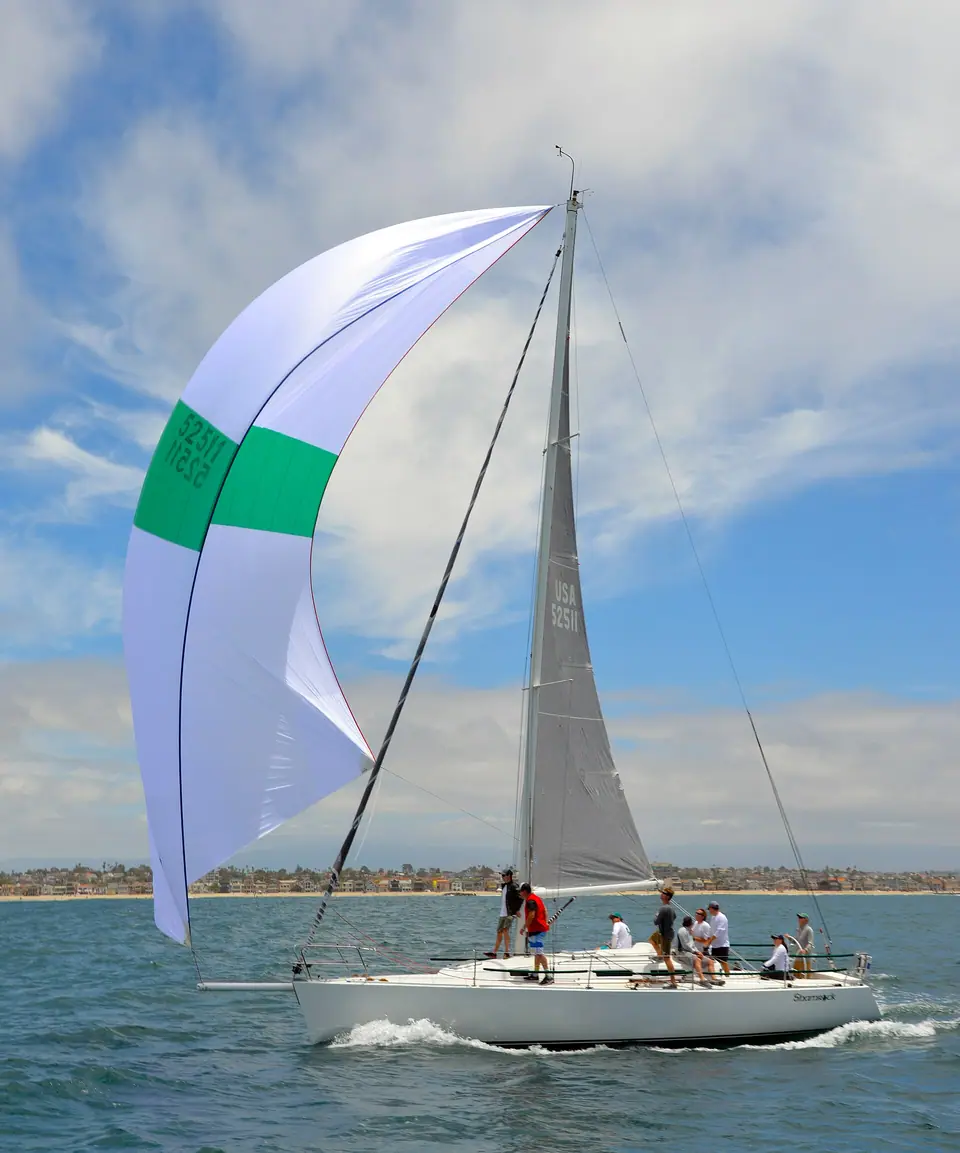
The 40 footer that proved a couple could fly an asymmetric offshore from a retractable sprit, and still win PHRF titles with a full crew.
- Length
- 40 ft12.19 m
- Beam
- 12 ft3.66 m
- Draft
- 7 ft2.13 m
- Cabins
- 2 double cabins (fore and aft)
- Used price
- $85K to $200K
On this page
- Overview
- The J120 sailboat that brought the sprit to 40 feet
- Hull, keel and the numbers behind the speed
- Short-handed cruiser one day, Key West winner the next
- Under power, at the dock and on the mooring
- Below: enough for two couples for a fortnight
- Construction details to understand before survey
- What a J/120 for sale costs to buy and keep
- Specifications
- Price and value
- Strengths and weaknesses
- Used buyer checklist
- Rivals
- Our verdict
- FAQ
The J/120 is a 40 foot Rod Johnstone racer-cruiser with a retractable carbon sprit, built by TPI from 1994 to 2006 with about 230 hulls. Cruising World made it Overall Boat of the Year, and it remains a strong one-design and PHRF boat.
- Couples who race on weekends and cruise on vacations
- PHRF racers wanting a 40 footer with an interior
- Short-handed coastal sailors
- Owners stepping up from a J/105 or J/109
J/120 by the numbers
- Sail area to displacement
- 21.6Plenty of sail for the weight, the boat should feel lively in light air.
- Displacement to length
- 145Light displacement for its length, quick but sensitive to added cruising weight.
- Theoretical hull speed
- 7.9 knThe practical top speed of a displacement monohull under normal sailing, based on waterline length.
- Ballast ratio
- 43%A high ballast ratio, so the boat stands up well to a breeze.
- Capsize screening
- 2.00Below 2.0, the traditional threshold for offshore suitability.
- Motion comfort ratio
- 21.5A quicker motion in waves, typical of light, beamy hulls.
- Length to beam ratio
- 3.33 : 1Moderate proportions.
The J120 sailboat that brought the sprit to 40 feet
In 1994 J/Boats took the retractable bowsprit and asymmetric spinnaker it had popularized on smaller boats and put them on a proper 40 foot cruising boat. Rod Johnstone's J/120 has a 7 ft retractable carbon J/Sprit, a snuffer led to the cockpit and a cruising interior, and the pitch was simple: two people could fly a spinnaker offshore without anyone going on deck. Cruising World named it Overall Boat of the Year and Best Value in a full-size cruising boat, according to J/Boats.
J/Boats records that the J/120 was built to hull 230 with the last model year in 2006. Tillotson Pearson Inc. built the boats in Rhode Island, and sailboatdata notes that some were finished in France. Its dual-purpose brief, fast enough to race and comfortable enough to cruise coastally, is why it still has a following.
Hull, keel and the numbers behind the speed
J/Boats' tech specs list 40 ft overall, 35 ft on the waterline, 12 ft of beam, 7 ft of draft and 13,900 lb displacement with 6,000 lb of ballast. Sail area is 780 sq ft with a 100 percent foretriangle on a fractional rig, giving a sail area to displacement ratio of 22 and a displacement to length ratio of 145. Cruising World noted the narrow fins on both the 7 ft and optional 5 ft 9 in keels carry elephant-foot bulbs for stability and lift.
The builder attributes the performance to a low center of gravity, a narrow waterline, the deep keel, and SCRIMP balsa-cored laminate with 65 to 70 percent glass content. The optional Hall Spars carbon mast saves about 120 lb aloft, which J/Boats compares to two 200 lb crew on the rail. In SAIL's launch review Tom Dove described a vinylester outer skin, solid glass L-beam framework and an aluminum I-beam keel step under the mast.
Short-handed cruiser one day, Key West winner the next
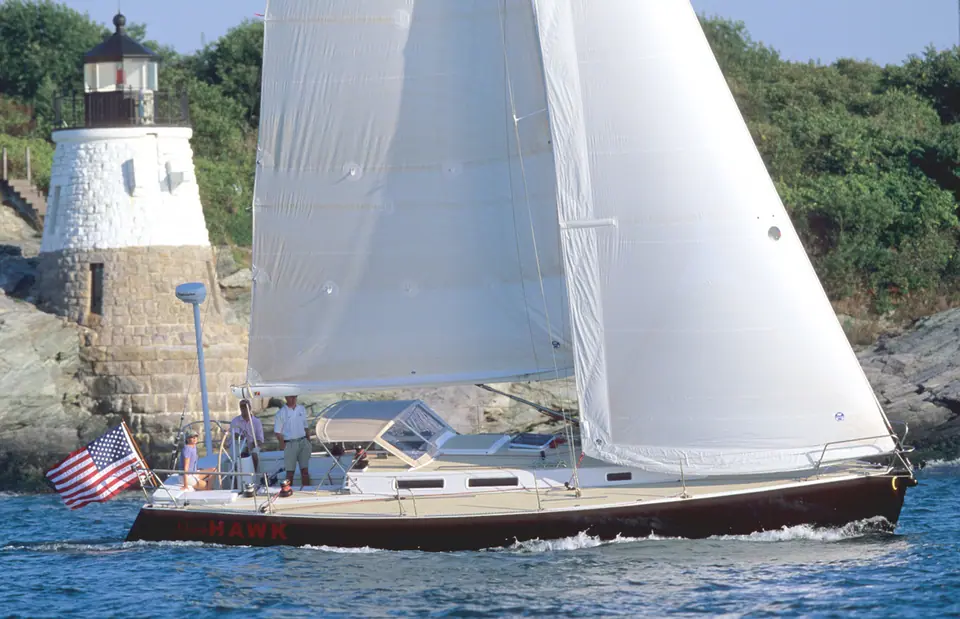
Cruising World's tester found the boat came alive the moment the jib was unrolled. Downwind under the asymmetric, the tester found that the boat drags the apparent wind forward and has to be sailed like a catamaran, jibing through angles rather than running square. All spinnaker work, including the snuffer, happened from the cockpit, and Harken 44 self-tailers on each side of the double-ended mainsheet let either the helmsman or a crew trim.
The same boat races seriously. Rick Wesslund's J/120 El Ocaso won its division and PHRF Boat of the Week at both Key West and Miami Race Weeks, reported in Sailing World in 2006. He described it as a heavier boat that needs runway at the start, an aggressive mainsheet trimmer in breeze, and a huge spinnaker of 1,776 sq ft that lets it sail deep and hot against symmetric-spinnaker boats. Regional J/120 one-design fleets developed, especially in Southern California, which J/Boats credits to how easily the boat is handled by smaller crews.
Under power, at the dock and on the mooring
Cruising World's test began with the boat motoring away from a Newport dock at 8.6 knots flat out, confirmed by GPS, on a 38 hp Yanmar turning a Martec two-blade folding propeller. Optimal cruising speed is a little lower, but the figure shows the J/120 is not underpowered for coastal schedules. Sailboatdata lists 27 gallons of fuel and 75 gallons of water, adequate for weekends and short cruises.
Under main alone the boat stays responsive and maneuverable, which makes picking up a mooring or sailing through a crowded harbor straightforward, and J/Boats pitched the boat as one that could be off the mooring in three minutes with novice guests. The 48 inch Edson wheel lets the helmsman sit well outboard for visibility, and the semi-balanced rudder gives a fingertip helm that keeps autopilot loads low.
Below: enough for two couples for a fortnight
Cruising World called the interior light and airy, with double cabins fore and aft and two long, straight saloon settees that make proper sea berths with lee cloths. Both doubles are on the small side, and the inboard end of the sprit takes some space in the forward cabin, where the snuffed spinnaker also tends to live. The galley is compact but adequate, with a 6 cubic foot icebox and a non-pressurized Origo alcohol stove and oven as standard. The companionway ladder is a generous 60 degree slope.
Many cruising items were options: hot and cold pressure water, shore power, refrigeration, propane stove, opening ports in the cabin trunk and an anchor well with bow roller. The tester saw this as a strength, since buyers did not pay for gear they did not want, but it means used J/120s vary a lot in cruising equipment. Count what is aboard before comparing prices.
Construction details to understand before survey
The hull and deck were built with TPI's SCRIMP resin-infusion process under ABS-approved plans. The hull-to-deck joint uses an extra wide 4.5 inch flange bonded with urethane elastomer adhesive, with mechanical strength where rail hardware and bulkheads are through-bolted. Cruising World acknowledged that some buyers find a mostly glued joint unsettling but argued that the whole boat relies on resin and adhesive anyway. The mast is stepped through the deck for rig stiffness.
With balsa core in hull and deck, the critical survey points on a 25 to 30 year old J/120 are moisture around deck hardware and the sprit housing, the keel to hull joint and floors on boats that have grounded, rudder bearings, and the hull-to-deck joint on boats with a hard racing history. A carbon mast should be inspected by a rigger who knows carbon.
What a J/120 for sale costs to buy and keep
Racing boats usually have better sails and hardware but more structural wear; cruising boats have more gear and fewer hard miles. Neither is automatically better, so let survey and inventory decide. Expect to pay more for carbon masts, newer engines and boats already set up for short-handed cruising with furling, autopilot and refrigeration.
Annual costs in the US run roughly $12,000 to $28,000 for a 40 ft slip, insurance, haul-out, engine service and maintenance. Racing programs add sails, crew costs and regatta fees on top. Parts support through J/Boats and the class remains good, which helps both ownership and resale.
J/120 specifications
| Length overall | 40 ft12.19 m |
|---|---|
| Waterline length | 35 ft10.67 m |
| Beam | 12 ft3.66 m |
| Draft | 7 ft2.13 m |
| Displacement | 13,9 lbs6,305 kg |
| Ballast | 6, lbs2,722 kg |
| Sail area | 78 sq ft72.5 m² |
| Fuel capacity | 27 gal102 L |
| Fresh water | 75 gal284 L |
| Cabins | 2 double cabins (fore and aft) |
| Berths | 4 in cabins plus 2 saloon settee berths |
| Heads | 1 |
| Standard engines | Yanmar 38 hp diesel (3JH2E) with two-blade folding prop |
| Maximum power | 38 hp |
| Top speed | 8.6 knots |
| Hull type | Moderate displacement fin keel racer-cruiser hull |
| Keel | Narrow lead fin with bulb, 7 ft standard or 5 ft 9 in shoal |
| Rig | Fractional sloop, aluminum or optional Hall Spars carbon mast, 7 ft retractable carbon J/Sprit for asymmetric spinnakers |
| Hull construction | SCRIMP resin-infused fiberglass with Baltek end-grain balsa core, vinylester outer skin, lead bulb keel |
| Builder | Tillotson Pearson Inc. (TPI) for J/Boats, USA |
| Naval architect | Rodney S. Johnstone |
| Production | 1994 to 2006 |
| Status | Discontinued |
Figures come from builder documentation and independent tests where available. Displacement is usually quoted light, so a loaded cruising boat will weigh more. Compare these specs with another model.
How much does a J/120 cost?
Cruising World reported a J/120 base price of $162,600 when new, with typical buyers spending $220,000 to $230,000 after options and its carbon-rigged test boat costing about $247,000. Used prices in 2026 depend heavily on whether a boat has been raced hard or cruised gently, on the carbon mast option, and on sail inventory. Recent European listings we saw ranged from 99,000 euros for a 1999 boat with a carbon racing mast to 200,000 euros for a 2001 boat in France, and US asking prices show a similarly wide spread.
Estimate your yearly cost
A planning estimate using common rules of thumb: insurance near 1.5 percent of value, maintenance near 3 percent, haul out and bottom paint by length. Your marina, region and use will move these numbers. Open the full cost calculator.
Versions and options
- Standard keel
- 7 ft bulb keel for maximum upwind performance.
- Shoal keel
- 5 ft 9 in bulb keel for Chesapeake, Florida and Gulf sailing.
- Carbon mast option
- Hall Spars carbon mast saving about 120 lb aloft, popular with racing owners.
J/120 timeline
- 1994J/120 introduced with a 7 ft retractable carbon J/Sprit
- 2006El Ocaso wins PHRF Boat of the Week at Key West and Miami Race Weeks
- 2006Last model year; production ends at about hull 230
Strengths and weaknesses
What owners like
- Asymmetric spinnaker easy for two to handle
- Strong upwind VMG and fast reaching
- Competitive in PHRF and one-design racing
- Comfortable cockpit with light helm
- Practical two-cabin interior
- Strong resale and class support
What to weigh up
- Small double berths and a compact galley
- Many cruising items were options, so equipment varies
- Balsa core needs careful moisture survey
- 7 ft draft limits some cruising grounds
Used J/120 buyer checklist
Take this list to a viewing. Your ticks are saved in this browser so you can come back to it.
Always commission an independent marine survey and an engine survey before you buy. How a marine survey works.
Rivals to consider
J/124
A lighter, narrower 41 footer from J/Boats aimed at daysailing and weekending.
Compare side by sideX-Yachts X4.3
A modern Danish performance cruiser with more interior polish at a much higher price.
Compare side by sideC&C 115
A later American racer-cruiser with a similar dual-purpose brief and a more modern deck.
Our verdict on the J/120
The J/120 is the boat many J/Boats owners point to when explaining why the company's dual-purpose formula works. It can win major PHRF events with a full crew, yet two people can cruise it under asymmetric with nobody on the foredeck. The interior is simple and the cruising kit depends on what the original buyer ordered, but the hull is fast, well-mannered and well supported. Buy one with a dry deck, a sound keel joint and a sail inventory that matches how you will use it.
J/120 questions answered
How much is a J120 for sale?
Most used J/120s ask between about $85,000 and $200,000 in 2026, depending on year, sails, carbon mast and condition.
How many J/120s were built?
About 230. J/Boats records production to hull 230, with model years from 1994 to 2006.
Is the J/120 a good cruising boat?
Yes, for coastal cruising. It has two double cabins and a usable galley, and Cruising World judged it fine for two couples for a fortnight, though it is not a long-term liveaboard.
What engine does the J/120 have?
A 38 hp Yanmar diesel, listed as the 3JH2E, with a two-blade folding propeller.
What is the draft of the J/120?
7 ft with the standard keel or 5 ft 9 in with the shoal keel.
J/120 photos
More performance sailboats to explore
Beneteau First 40.7
Performance Sailboats, 40 ft
Used $65K to $130K
Beneteau First 38
Performance Sailboats, 40 ft
Used $28K to $65K
Dehler 38 SQ
Performance Sailboats, 40 ft
Used $250K to $340K
Dufour 40 Performance
Performance Sailboats, 40 ft
Used $85K to $145K