Shields One-Design Performance Sailboats
Shields Sailboat, the 30 ft S&S One-Design Still Built on Cape Cod
Thirty feet of teak-trimmed S&S keelboat with no cabin, 3,080 lb of lead and a class that has kept the rules tight since 1962.
- Length
- 30.2 ft9.21 m
- Beam
- 6.4 ft1.96 m
- Draft
- 4.8 ft1.45 m
- Cabins
- None (open cockpit boat)
- Used price
- $6K to $70K
On this page
- Overview
- Why Cornelius Shields wanted a fiberglass sailboat in 1962
- Cape Cod, Chris-Craft and Hinckley, hull number by hull number
- S&S lines with 67 percent ballast
- No cabin, lots of teak and a halyard console
- Rules that keep a 60-year-old class affordable
- Finding a Shields sailboat for sale
- What goes wrong on a 60-year-old Shields
- Specifications
- Price and value
- Strengths and weaknesses
- Used buyer checklist
- Rivals
- Our verdict
- FAQ
The Shields is Sparkman & Stephens design 1720, a 30 ft open keelboat commissioned by Cornelius Shields in 1962 to replace the wooden International One Design. Cape Cod Shipbuilding still builds it for $85,000, and active fleets race from New England to California.
- Corinthian one-design fleet racing
- College and sail training programs
- Sailors who love classic S&S lines
- Harbor daysailing with a crew of four
Why Cornelius Shields wanted a fiberglass sailboat in 1962
The Shields sailboat exists because one of America's best-known sailors wanted to keep a great wooden class alive in a new material. In 1962 Cornelius Shields commissioned Sparkman & Stephens to draw a fiberglass replacement for the 1930s International One Design. The result was S&S design 1720: a 30 ft 2 in open keelboat with long overhangs, a 20 ft waterline, a narrow 6 ft 5 in beam and more than two-thirds of its weight in lead.
Shields did not just commission the boat; he gave it away. Hulls 1 to 31 were built at Cape Cod Shipbuilding and donated to universities on the East Coast, and in the end he donated more than 100 boats to colleges, including 15 to universities in southern California. The class took his name in recognition. Cape Cod Shipbuilding still describes the boat as conceived for maritime cadets.
Shields One-Design by the numbers
- Sail area to displacement
- 20.8Plenty of sail for the weight, the boat should feel lively in light air.
- Displacement to length
- 257Moderate displacement, a classic cruising balance between load carrying and speed.
- Theoretical hull speed
- 6.0 knThe practical top speed of a displacement monohull under normal sailing, based on waterline length.
- Ballast ratio
- 67%A high ballast ratio, so the boat stands up well to a breeze.
- Capsize screening
- 1.54Below 2.0, the traditional threshold for offshore suitability.
- Motion comfort ratio
- 25.9Moderate motion comfort, typical of modern cruisers.
- Length to beam ratio
- 4.71 : 1A slim, easily driven hull.
Cape Cod, Chris-Craft and Hinckley, hull number by hull number
Hull numbers tell you who built a Shields. According to the class history summarized on Wikipedia, Cape Cod Shipbuilding built hulls 1 to 31, Chris-Craft Industries built 32 to 189, Hinckley built 190 to 200, and Cape Cod has built 201 onward, reaching the 250s. Five additional numbers went to boats built to replace Naval War College Shields that were lost in a fire. Sailboatdata counts about 220 boats; allowing for the numbering, roughly 260 hull numbers have been issued.
In the used market, that split shows up as two populations. Chris-Craft boats, built from the 1960s on, make up most of the older fleet; the class's own classifieds include a 1967 Chris-Craft boat in Texas and several others in New England. Modern Cape Cod boats, such as hull 250 built in 2001 and listed by the builder, carry newer layups and hardware. A carefully restored Chris-Craft hull is fully competitive, and the 2026 National Championship was won by Karl Anderson in Shields 235, Harrier.
S&S lines with 67 percent ballast
On paper the Shields is extreme. It displaces 4,600 lb with 3,080 lb of external lead, a ballast ratio of about 67 percent according to sailboatdata. The modified long keel carries the rudder, steered by tiller, and draws 4 ft 9 in. Sail area is 360 sq ft for main and jib, with a 360 sq ft spinnaker. Cape Cod Shipbuilding says the lead keeps the boat steady in strong winds, and the class reputation is for a boat that heels early, then simply stiffens and goes.
The overhangs mean the short 20 ft waterline lengthens as the boat heels, which is why the narrow hull is quicker than its waterline suggests. Its Portsmouth Yardstick DP-N average handicap is 83.8, close to a Sonar's 82.5.
No cabin, lots of teak and a halyard console
There is no cabin on a Shields. The boat is a long open cockpit with teak coamings, toe rails, handrails, cockpit seats and a teak floor grating, plus a halyard winch console with vertical cleats. Buoyancy comes from under-seat flotation compartments and watertight bulkheads fore and aft, and the class maintenance page includes builder guidance on keeping those tanks watertight, a useful hint about what to check on an old boat.
Cape Cod's standard boat comes with a tapered mast with T-900 halyards, a boom with a 7-part internal outhaul and fixed gooseneck, spinnaker gear, two Lewmar jib sheet winches with under-deck drive, two Lewmar halyard winches, and a Harken 4-part vang, 8-part backstay and 4-part crisscross traveler. Most teams race with four or five; two can daysail it.
Rules that keep a 60-year-old class affordable
The Shields Class Sailing Association has kept the boat strictly one-design. Class rules cap the mechanical advantage of the adjustable backstay, vang and mainsheet at 8:1, a jib is used but a genoa is not permitted, and Richard Sherwood noted in 1994 that only one set of sails was allowed per year. The effect is that a 1960s hull and a 2020s hull race on equal terms if both are well prepared.
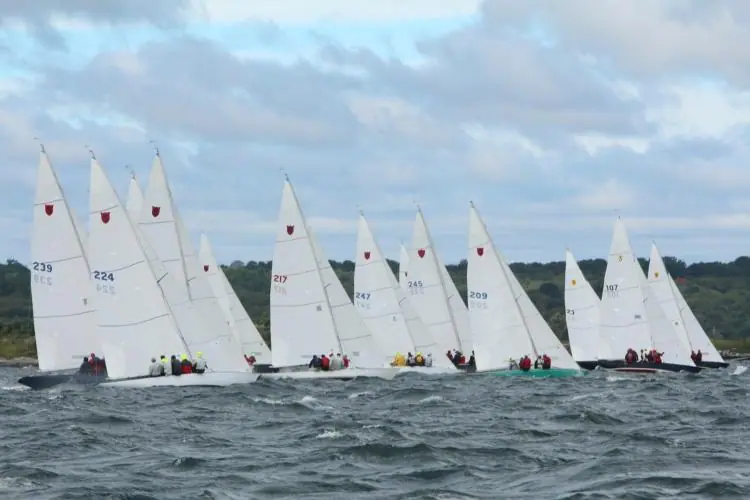
Fleets race in the Northeast, Mid-Atlantic, Midwest, Southeast and California. The National Championship moves between them: Newport in 2022, Larchmont in 2024, Edgartown in 2025 and Oxford, Maryland, in September 2026, where a Nor'easter limited racing to five races over two days. Orange Coast College in Costa Mesa and Oakcliff Sailing on Long Island run training fleets.
Finding a Shields sailboat for sale
The best source is the class itself. Its for-sale page lists boats by sail number with notes on builder, sails and trailer, and Cape Cod Shipbuilding brokers used boats too. Typical recent listings include a 2001 Cape Cod hull with an outboard bracket and electronics, a Chris-Craft boat with a 2023 professionally faired bottom and 2022 North sails, another with a recored deck, and a project hull owned by the Shields Class Foundation offered for lease to whoever funds its rigging.
Our estimated range runs from about $6,000 for a tired 1960s Chris-Craft boat to roughly $70,000 for a recent Cape Cod hull with a race-ready inventory. Ownership is cheap compared with a cruising boat: $4,000 to $12,000 a year covers a mooring or slip, haul and storage, insurance, class dues and teak care, with sails as the main variable.
What goes wrong on a 60-year-old Shields
The structural risk points are predictable. Decks and seats can go soft and need recoring, keel bolts should be checked and tightened (one recent listing noted exactly that work in 2023), and the mast step position must be correct for the class: the association even publishes a mast step location calculator. Flotation tanks that no longer seal are a safety issue as well as a class compliance one.
Teak is the cosmetic budget item. Owners who varnish or oil it every year keep boats looking like the ones in class photos; boats left bare for years need sanding, bunging and sometimes replacement trim.
Shields One-Design specifications
| Length overall | 30.2 ft9.21 m |
|---|---|
| Waterline length | 20 ft6.1 m |
| Beam | 6.4 ft1.96 m |
| Draft | 4.8 ft1.45 m |
| Displacement | 4,6 lbs2,087 kg |
| Ballast | 3,08 lbs1,397 kg |
| Sail area | 36 sq ft33.5 m² |
| Cabins | None (open cockpit boat) |
| Berths | None |
| Heads | None |
| Standard engines | None (outboard bracket is an aftermarket or builder option) |
| Hull type | Narrow, long-overhang displacement keelboat with spoon bow and raised counter |
| Keel | Fixed modified long keel with 3,080 lb external lead and keel-hung rudder, 4 ft 9 in draft |
| Rig | Fractional sloop with tapered aluminum mast; jib and spinnaker, no genoa allowed |
| Hull construction | Fiberglass with teak trim and external lead keel |
| Builder | Cape Cod Shipbuilding (also Chris-Craft and Hinckley in earlier years), United States |
| Naval architect | Sparkman & Stephens (design 1720) |
| Other design credits | Commissioned by Cornelius Shields |
| Production | 1962 to present |
| Status | In production |
Figures come from builder documentation and independent tests where available. Displacement is usually quoted light, so a loaded cruising boat will weigh more. Compare these specs with another model.
How much does a Shields One-Design cost?
Cape Cod Shipbuilding lists the standard white-hull, buff-deck Shields at $85,000, with options such as a colored gelcoat hull ($1,550), Edson bilge pump ($2,050) and spinnaker sheet winches ($1,980) adding up quickly. Used prices are our estimates because class classifieds rarely publish asking prices: 1960s Chris-Craft hulls needing a deck recore sit at the bottom, while 2000s Cape Cod boats with fresh sails and a good trailer sit at the top.
Estimate your yearly cost
A planning estimate using common rules of thumb: insurance near 1.5 percent of value, maintenance near 3 percent, haul out and bottom paint by length. Your marina, region and use will move these numbers. Open the full cost calculator.
Versions and options
- Cape Cod Shipbuilding hulls 1 to 31
- The first boats, donated by Cornelius Shields to East Coast universities.
- Chris-Craft hulls 32 to 189
- The largest group, built in the 1960s; often refit with new decks and spars.
- Hinckley hulls 190 to 200
- A short run from Hinckley Yachts.
- Cape Cod hulls 201 onward
- Current production, $85,000 standard, with modern Harken and Lewmar hardware.
Shields One-Design timeline
- 1962Cornelius Shields commissions S&S design 1720 to replace the International One Design
- 1965Northern Massachusetts Bay fleet begins racing, according to the class history archive
- 1994Richard Sherwood notes the class's one-set-of-sails-per-year rule
- 2001Cape Cod Shipbuilding hull 250 launched
- 2026Karl Anderson's Harrier wins the National Championship in Oxford, Maryland
Strengths and weaknesses
What owners like
- Classic S&S lines and a very stiff, high-ballast hull
- Strict one-design rules keep old boats competitive
- Still built new by Cape Cod Shipbuilding
- Active fleets on both coasts and in the Midwest
- Low running costs for a 30 ft keelboat
What to weigh up
- No cabin, so strictly a day boat
- Narrow and wet in a chop
- Older Chris-Craft hulls often need deck work
- Teak trim demands annual maintenance
- Few used listings carry published prices
Used Shields One-Design buyer checklist
Take this list to a viewing. Your ticks are saved in this browser so you can come back to it.
Always commission an independent marine survey and an engine survey before you buy. How a marine survey works.
Rivals to consider
Sonar
Shorter, lighter, with a sit-in cockpit and a near-identical Portsmouth rating.
Compare side by sidePearson Ensign
Full-keel daysailer with a small cuddy and a larger fleet of older boats.
Compare side by sideAlerion 28
A modern classic daysailer with a cabin, for those who want to cruise as well as race.
Compare side by sideOur verdict on the Shields One-Design
The Shields is one of the purest racing keelboats in America: beautiful S&S lines, enormous stability, no cabin and class rules that make a 1960s hull the equal of a new one. It is not a boat for overnighting or for keeping dry in a chop, but for fleet racing with four friends it is hard to beat, and the fact that Cape Cod Shipbuilding still builds it six decades on says a lot. Buy a sound older hull through the class and spend the difference on sails.
Shields One-Design questions answered
How much does a new Shields cost?
Cape Cod Shipbuilding lists the standard boat at $85,000, before options such as a colored hull or bilge pump.
Who designed the Shields?
Sparkman & Stephens, as design 1720, commissioned by Cornelius Shields in 1962.
Does the Shields have a cabin?
No. It is an open keelboat with a long cockpit, teak seats and flotation compartments.
How many people sail a Shields?
Most race with four or five, and two can daysail it.
Why is it sometimes called the Shields 30?
Because it is just over 30 ft long overall; the class name is simply Shields.
Who builds the Shields today?
Cape Cod Shipbuilding, which built the first hulls in 1962 and resumed with hull 201.