J/99 Review and Buyer's Guide, the Short-Handed J That Rivals a J109
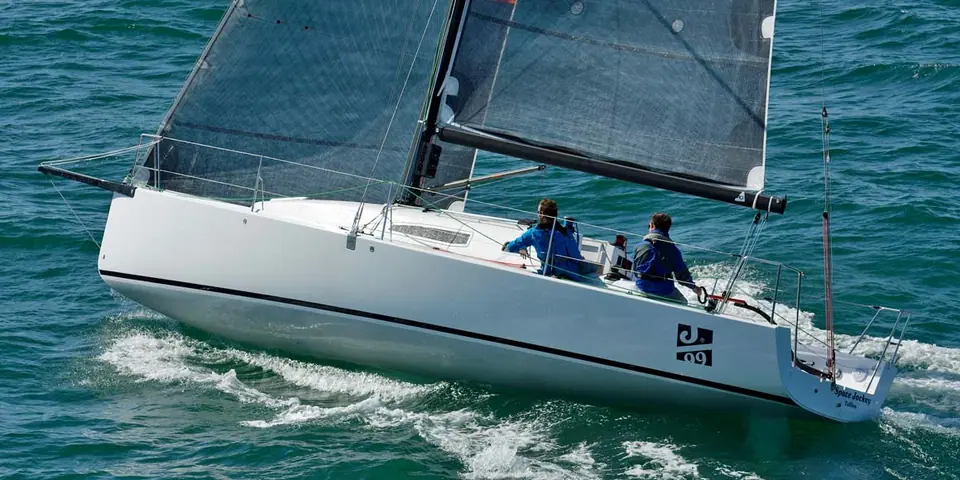
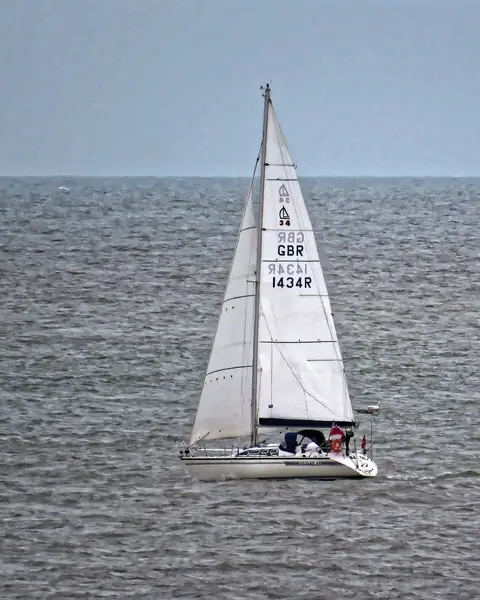
A 32 ft 7 in offshore speedster drawn for two-person racing, with twin aft cabins, a fixed carbon sprit and a Fastnet class win on its record.
- Length
- 32.6 ft9.94 m
- Beam
- 11.2 ft3.4 m
- Draft
- 6.5 ft1.99 m
- Cabins
- 2 double aft cabins with doors; forepeak for head and sail storage
- Used price
- $180K to $275K
On this page
- Overview
- Why so many J109 for sale shoppers end up on a J/99
- A J without a furler or a retractable sprit
- A cockpit laid out for two people at night
- Speeds measured by testers and claimed by the builder
- Fastnet, Chicago-Mac and the double-handed circuit
- Twin aft cabins in a 32 footer
- SCRIMP infusion, an AG+ spar and a 20 hp Volvo
- What a J/99 costs to buy and run
- Specifications
- Price and value
- Strengths and weaknesses
- Used buyer checklist
- Rivals
- Our verdict
- FAQ
The J/99 is Alan Johnstone's 2019 short-handed offshore racer-cruiser, built by J/Composites in France. It weighs 8,415 lb, carries a fixed carbon bowsprit and hank-on jibs, and sold for about $220,000 all-up at launch; new boats now list near $306,000.
- Double-handed offshore racers
- J/105 and J/109 owners wanting a newer, smaller boat
- Weekend cruising couples who also race
- Owners targeting the Fastnet, Chicago-Mac or Bermuda races
J/99 by the numbers
- Sail area to displacement
- 22.1Plenty of sail for the weight, the boat should feel lively in light air.
- Displacement to length
- 161Light displacement for its length, quick but sensitive to added cruising weight.
- Theoretical hull speed
- 7.2 knThe practical top speed of a displacement monohull under normal sailing, based on waterline length.
- Ballast ratio
- 40%A typical ballast ratio for a cruising monohull.
- Capsize screening
- 2.20Above 2.0, so this hull leans toward coastal stability over ultimate offshore resistance.
- Motion comfort ratio
- 17.5A quicker motion in waves, typical of light, beamy hulls.
- Length to beam ratio
- 2.92 : 1A beamy hull with lots of volume for its length.
Why so many J109 for sale shoppers end up on a J/99
Plenty of sailors start out looking at a J109 for sale and finish the search on a J/99. The J/109 is the 35 ft cruiser-racer that defined the J/Boats sprit-boat era in the 2000s, with a retractable sprit, a furling jib and a proper cruising interior; Denison recently listed a 2004 example at $299,000. The J/99 is shorter at 32 ft 7 in, newer, and built for a different job: double-handed and short-handed offshore racing, with weekend cruising as a bonus.
Alan Johnstone designed it and J/Composites in France builds it. Yachting World's test reported 38 confirmed orders before the boat reached the water in numbers, with more than half of those owners planning to race short-handed. The boat won Sailing World's 2020 Boat of the Year award for Best Crossover, a SAIL Best Boats performance award and a British Yachting Award. If you want a J you can sail across the Gulf of Maine with one friend, this is the current answer.
A J without a furler or a retractable sprit
Yachting World pointed out how much the J/99 breaks with two decades of J/Boats habit. Gone are the retractable bowsprit and the furling jib. In their place are a beamier hull carried well aft, a fixed carbon bowsprit (the first on a J, according to the builder) and hank-on jibs. The logic is offshore: a fixed sprit keeps weight out of the bow and eliminates a leaky sprit tube, while a slab-reefed hanked jib holds a better shape than a part-furled one.
Unlike its closest rivals, the JPK 1010 and the Jeanneau Sun Fast 3200, the J/99 has no chines. Yachting World argued the rounder sections give more all-round performance, particularly in light inshore conditions. Beam is 11 ft 2 in and the boat is stiff: Sailing World's judges called it wicked stiff and said three people on the rail were enough upwind.
A cockpit laid out for two people at night
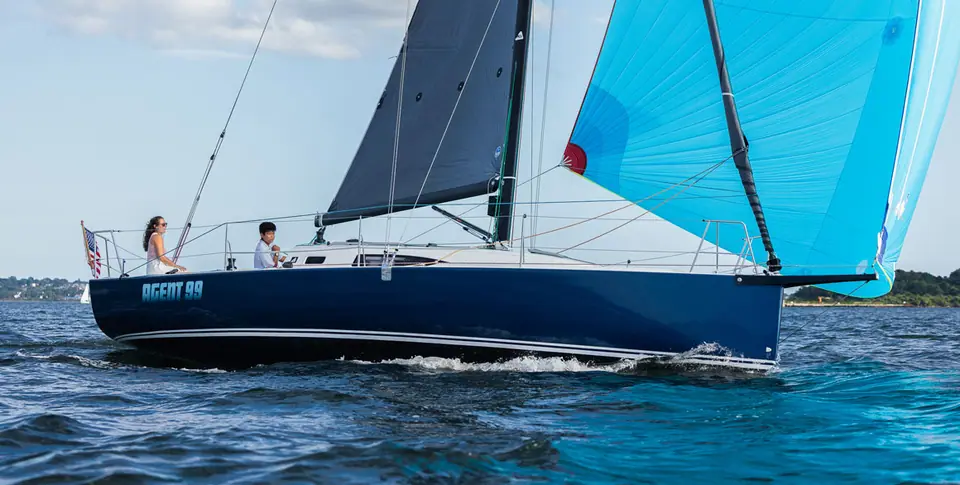
The cockpit takes up roughly a third of the deck. Traveler, mainsheet fine-tune and the 48:1 cascading backstay all lead to the helm, and the two self-tailing primaries are within the driver's reach, so one person can steer and trim. The jib uses a floating lead system with an 8:1 inhauler and a longitudinal track, giving fine control over sheeting angle. A double-ended vang, cockpit-led outhaul and cunningham complete the list.
Steering is by tiller, curved upward so a liferaft can live beneath it. The single balanced spade rudder gives direct, nimble handling; the optional twin-rudder setup still uses a tiller and is the popular choice for short-handed offshore work on autopilot. At the time of the Yachting World test, 12 of 38 orders had twin rudders. A wheel package is available but most owners do not see the point.
Speeds measured by testers and claimed by the builder
Yachting World tested the J/99 double-handed in a cold January breeze on the Solent. Upwind with full main and non-overlapping J2 in 17 knots of wind, it made 6.7 knots at a true wind angle of 38 degrees. Under the 100 square meter A2 spinnaker it sailed at 8.4 knots at 146 degrees true, could reach up to 135 degrees, and still sailed usefully as deep as 170 degrees with the kite rotated. Under a 66 square meter Code 0 it reached at up to 9 knots.
Sailing World's Boat of the Year judges in Annapolis saw 7.5 knots upwind and 10 to 11 knots downwind with ease. The magazine also reported that the Johnstone family's own J/99 hit 18.5 knots in 30 knots of wind at Cowes with six aboard, gybing repeatedly while other boats wiped out. Its provisional PHRF base rating in New England in 2019 was 78.
- 6.7 knots upwind at 38 degrees true in 17 knots (Yachting World)
- 8.4 knots at 146 degrees true under A2 spinnaker (Yachting World)
- Up to 9 knots reaching under Code 0 (Yachting World)
- 18.5 knots peak in 30 knots at Cowes, six aboard (Sailing World)
Fastnet, Chicago-Mac and the double-handed circuit
J/Boats publishes a long list of J/99 offshore results. For 2025 it credits the J/99 Whimjy with first in division and first overall in IRC 3 at the Rolex Fastnet Race, Rambler with a division win in the Chicago-Mackinac Race and second overall in the Trans-Superior, and J/99s with podium finishes in ORC classes, including double-handed, at the Annapolis to Newport Race. The boat also races in Palma, the Netherlands and Hong Kong, so ratings and sails are well understood in both ORC and IRC.
That record matters for resale. A boat that rates well and has proven results in the classes buyers want to sail tends to hold value better than a pure cruiser of similar age.
Twin aft cabins in a 32 footer
Below, the J/99 is functional rather than plush. Two full-length settee berths flank a drop-leaf table, with optional flip-up pilot berths outboard. The L-shaped galley has a two-burner stove, an icebox and a sink with pressure water, and there is a proper forward-facing nav station to starboard. Two matching double aft cabins with doors are unusual at this length and let a double-handed crew sleep on the windward side.
The forepeak is deliberately empty except for the head, so it serves as a sail locker and spinnaker drop zone. Yachting World suggested extra handholds for rough weather, which is a fair note on any open-plan racer-cruiser.
SCRIMP infusion, an AG+ spar and a 20 hp Volvo
The hull and deck are SCRIMP resin-infused with 65 percent glass content in the structural skins and a vinylester outer layer, engineered to exceed ISO 12215 Category A. An infused structural grid takes the keel and mast loads, bulkheads are bonded to hull and deck, and the keel is through-bolted and bonded with substantial backing plates. Sailing World reported a mix of balsa and Corecell core.
The custom AG+ aluminum mast has an integral track that accepts either a bolt-rope main or slides, eliminating more than 40 ft of fasteners and glue. Power is a 20 hp Volvo Penta D1-20 on a saildrive with a 13 gallon tank, 100 amp AGM house battery and 70 amp AGM start battery, charged by a 115 amp alternator. Short-handed racers usually add a second house battery and a stronger autopilot.
What a J/99 costs to buy and run
At launch, Sailing World quoted about $220,000 all-up and called it a bang for your buck. Prices have climbed: a 2026 boat in Buffalo was listed at $306,385, while a 2023 J/99 in Larchmont asked $239,000. Expect used boats from 2019 to 2024 to sit roughly between $180,000 and $275,000, depending on rudders, sails and electronics.
Running costs are moderate for a racing boat: $12,000 to $30,000 a year covers a 33 ft slip, haul-out, insurance and Volvo service. Sails dominate the budget if you campaign seriously, because a short-handed offshore wardrobe of main, J1, J2, A2, A4 and Code 0 is not cheap.
J/99 specifications
| Length overall | 32.6 ft9.94 m |
|---|---|
| Waterline length | 28.6 ft8.72 m |
| Beam | 11.2 ft3.4 m |
| Draft | 6.5 ft1.99 m |
| Displacement | 8,415 lbs3,817 kg |
| Ballast | 3,35 lbs1,52 kg |
| Sail area | 571 sq ft53 m² |
| Fuel capacity | 13 gal5 L |
| Fresh water | 26 gal1 L |
| Cabins | 2 double aft cabins with doors; forepeak for head and sail storage |
| Berths | 6 standard (two aft doubles and two saloon settees), 8 with optional flip-up pilot berths |
| Heads | 1 (forepeak) |
| Standard engines | Volvo Penta D1-20 (20 hp) diesel on saildrive with folding propeller |
| Maximum power | 20 hp |
| Hull type | Light displacement planing-capable monohull without chines, beam carried well aft |
| Keel | Low VCG keel, encapsulated cast iron fin with integral lead wedge bulb, 6 ft 6 in draft; all-lead deep fin optional |
| Rig | Fractional sloop, AG+ tapered aluminum mast with integral mainsail track, fixed carbon bowsprit, hank-on non-overlapping jibs, single or twin rudders with tiller |
| Hull construction | SCRIMP resin-infused fiberglass sandwich (balsa and Corecell) with vinylester outer skin |
| CE design category | A |
| Builder | J/Composites (France) for J/Boats, France |
| Naval architect | Alan Johnstone |
| Production | 2019 to present |
| Status | In production |
Figures come from builder documentation and independent tests where available. Displacement is usually quoted light, so a loaded cruising boat will weigh more. Compare these specs with another model.
How much does a J/99 cost?
At launch Sailing World quoted about $220,000 all-up, but dealer pricing has risen sharply since 2020 and a new 2026 J/99 has been listed at $306,385. A 2023 boat recently asked $239,000. Twin rudders, a racing sail inventory, short-handed electronics and offshore safety gear add real value, and boats with ORC or IRC certificates and a race record sell quickest.
Estimate your yearly cost
A planning estimate using common rules of thumb: insurance near 1.5 percent of value, maintenance near 3 percent, haul out and bottom paint by length. Your marina, region and use will move these numbers. Open the full cost calculator.
Versions and options
- Single rudder
- Standard balanced spade rudder with tiller; direct and nimble inshore.
- Twin rudders
- Optional, still tiller-steered, favored for short-handed offshore racing on autopilot.
- All-lead deep fin
- Optional alternative to the standard iron fin with lead bulb, per sailboatdata.
- Wheel package
- Optional wheel steering in place of the tiller.
J/99 timeline
- 2019J/99 launched; J/Boats campaigns hull one in New England with a provisional PHRF of 78
- 2020Sailing World Boat of the Year Best Crossover and SAIL Best Boats performance award
- 2025J/99 Whimjy credited with first in IRC 3 at the Rolex Fastnet Race
- 2026Still in production at J/Composites, with new boats listed around $306,000
Strengths and weaknesses
What owners like
- Purpose-built for double-handed offshore racing
- Stiff, chineless hull that also works inshore in light air
- Two private aft cabins at 32 ft
- Fixed carbon sprit and hank-on jibs suit offshore sail plans
- Proven results in Fastnet, Chicago-Mac and ORC double-handed racing
What to weigh up
- Prices have risen roughly 40 percent since launch
- Spartan interior and open forepeak
- Single rudder loads up under big spinnakers in gusts
- Only 13 gallons of fuel
- Hank-on jibs mean more foredeck work for cruisers
Used J/99 buyer checklist
Take this list to a viewing. Your ticks are saved in this browser so you can come back to it.
Always commission an independent marine survey and an engine survey before you buy. How a marine survey works.
Rivals to consider
J/109
Bigger, older and more of a cruiser, with a retractable sprit and furling jib.
Compare side by sideJPK 1010
French double-handed specialist with chines; Yachting World named it a closest rival.
Jeanneau Sun Fast 3200
The other main short-handed rival, also chined and widely raced in Europe.
Our verdict on the J/99
The J/99 is the best modern J for sailors who race with one other person, and it is good enough inshore and comfortable enough on a weekend that it never feels like a single-purpose boat. Its price has risen far beyond the bargain Sailing World described in 2020, but results like the 2025 Fastnet class win keep demand strong. If you were shopping for a J/109 and you mostly sail short-handed, test sail a J/99 before you buy.
J/99 questions answered
How much is a J/99?
A new 2026 J/99 has been listed at $306,385. Used boats from 2019 to 2024 typically sit around $180,000 to $275,000.
Is the J/99 better than a J/109?
For short-handed offshore racing, yes. The J/109 is larger, more comfortable and better for family cruising, and costs about the same used.
Does the J/99 have twin rudders?
Twin rudders are optional. The standard boat has a single balanced spade rudder, both with tiller steering.
Where is the J/99 built?
By J/Composites in France, using SCRIMP resin infusion.
How fast is a J/99?
Testers saw 6.7 to 7.5 knots upwind and 10 to 11 knots downwind, and Sailing World reported an 18.5-knot peak in 30 knots of wind.
What engine does the J/99 have?
A 20 hp Volvo Penta D1-20 on a saildrive, with a 13 gallon fuel tank.
J/99 photos
More performance sailboats to explore
J/100
Performance Sailboats, 33 ft
Used $65K to $115K
Beneteau First 31.7
Performance Sailboats, 32 ft
Used $30K to $78K
Dehler 30 One Design
Performance Sailboats, 34 ft
Used $95K to $190K
Beneteau First 310
Performance Sailboats, 31 ft
Used $18K to $42K