Beneteau Performance Sailboats
Beneteau First 305 Used Buyer's Guide, Jean Berret's Mid-1980s 30-Footer
A Jean Berret masthead sloop built in France and South Carolina, with 644 sold and a reputation as a quick, practical club racer.
- Length
- 30.7 ft9.35 m
- Beam
- 10.7 ft3.25 m
- Draft
- 5.7 ft1.75 m
- Cabins
- 2 (V-berth forward, double aft cabin to port)
- Used price
- $14K to $36K
On this page
- Overview
- A Berret 30-footer that sold 644 times
- Built in the Vendée and in Marion, South Carolina
- Masthead power on a moderate hull
- Deep fin, shoal fin or the twin-rudder lifting keel
- Reading the July 1986 equipment list today
- The Volvo 2002 question
- Where a surveyor should spend time
- What a Beneteau 305 for sale costs in 2026
- First 30 E, First 305 or First 310?
- Specifications
- Price and value
- Strengths and weaknesses
- Used buyer checklist
- Rivals
- Our verdict
- FAQ
The Beneteau First 305 is a Jean Berret cruiser-racer built from 1984 (as a 1985 model) to about 1989, with 644 completed in France and Marion, South Carolina. It displaces about 7,900 lb and came with deep, shoal or lifting keels.
- Budget PHRF racing
- Coastal weekend cruising for a family
- First keelboat for sailors moving up from dinghies
- Owners who can handle routine maintenance themselves
Beneteau First 305 by the numbers
- Sail area to displacement
- 21.2Plenty of sail for the weight, the boat should feel lively in light air.
- Displacement to length
- 182Light displacement for its length, quick but sensitive to added cruising weight.
- Theoretical hull speed
- 6.9 knThe practical top speed of a displacement monohull under normal sailing, based on waterline length.
- Ballast ratio
- 37%A typical ballast ratio for a cruising monohull.
- Capsize screening
- 2.14Above 2.0, so this hull leans toward coastal stability over ultimate offshore resistance.
- Motion comfort ratio
- 18.7A quicker motion in waves, typical of light, beamy hulls.
- Length to beam ratio
- 2.88 : 1A beamy hull with lots of volume for its length.
A Berret 30-footer that sold 644 times
The Beneteau 305 First, as US listings often call it, belongs to the mid-1980s generation that turned Beneteau from a French success into an American one. Jean Berret drew it as a cruiser-racer, and Wikipedia records 644 boats built between 1984, as a 1985 model, and 1989. Sailboatdata notes it was first promoted in the US simply as the F305. If you are pricing a 1986 Beneteau First 305 today, you are looking at a boat that was designed to win club races on Saturday and take a family of four away on Sunday.
Berret had already given Beneteau the First 30 E, a detuned version of the half tonner that won the 1981 Half Ton Cup. The 305 took over its place in the range with a similar 30 ft 6 in to 30 ft 8 in hull length, a masthead rig, a fixed chart table and the head moved aft. Beneteau's archive places it in the second generation of Firsts, alongside the 235, 265, 345 and 375.
Built in the Vendée and in Marion, South Carolina
Production ran in France and at Beneteau's plant in Marion, South Carolina. That matters for American buyers, because many boats here were built and commissioned locally, while a French-built hull that crossed the Atlantic later may differ in details such as fittings and electrics. Ask which factory built the boat before ordering parts.
The hull is solid fiberglass and the deck is balsa-cored, according to Wikipedia. The rudder is an internal spade on a tiller, and the mast is deck-stepped. The 1986 Beneteau brochure gives the overall length as 9.80 m and the hull length as 9.35 m (30 ft 8 in), with an 8.20 m waterline, 3.25 m beam and a displacement of about 3,600 kg (7,937 lb). Sailboatdata lists a slightly heavier 8,242 lb, so treat weight as approximate.
Masthead power on a moderate hull
Beneteau quoted 49 square meters of working sail, an 18.5 m2 mainsail and a 30.5 m2 genoa, so the 305 is a genoa-driven boat in the 1980s style. Sailboatdata, working from the 100 percent foretriangle, puts SA/D near 16 and D/L near 192. Ballast is 1,350 kg (2,976 lb) of cast iron, roughly 36 percent of displacement by sailboatdata's figures, which makes the boat stiffer than many lighter fractional designs of the period.
Hull speed works out at just under 7 knots. Wikipedia gives a PHRF handicap of 159, and a symmetrical spinnaker of about 759 square feet. In practice, that makes the 305 a solid mid-fleet PHRF boat that rewards a well cut genoa and good crew work, rather than a boat that will surf away from the fleet. As on any masthead boat with a big overlapping genoa, the key to sailing it well in a building breeze is changing down or furling the headsail early.
Deep fin, shoal fin or the twin-rudder lifting keel
Sailboatdata notes that the 305 was offered with several keel and rig combinations, and the original brochure confirms the main ones. The deep cast iron fin draws 1.75 m (5 ft 9 in); the shoal fin draws 1.35 m (4 ft 5 in). A third version, which the French paperwork calls the version dériveur, has a cast iron lifting keel and twin rudders, draws 0.76 m (2 ft 6 in) with the keel up and 2.05 m (6 ft 9 in) with it down, and is designed to sit upright on a drying mooring without legs.
On the rig side, the brochure describes the masthead version, while sailboatdata lists an alternative short rig with I and P about 1.7 ft and 1.6 ft shorter. Listings rarely state which keel or rig a boat has, so ask, and compare the photos with the drawings. For Chesapeake or Florida cruising the shoal fin is a sensible compromise; the twin-rudder lifting keel is rare in the US and is aimed at drying harbors in Europe.
Reading the July 1986 equipment list today
Beneteau's July 1986 list shows how well specified these boats were. On deck: Lewmar 40 two-speed genoa winches, a Lewmar 8C halyard winch, halyards led aft to the cockpit with a double stopper, teak cockpit seats and foot holds, a main traveler, a tiller with telescopic extension and a Barbarossa backstay adjuster. Sails were a two-reef Dacron main of about 18 m2 with a flattening reef and a 19.6 m2 working jib.
Below, the layout is classic Beneteau of the era. A double V-berth cabin is forward, the saloon has an L-shaped settee and a straight settee around a table, the L-shaped galley to port has a gimbaled two-burner stove, a double sink and an icebox, and the chart table faces it to starboard. Aft, a double cabin sits to port and the head with shower to starboard, with a sail locker and hanging locker beside it. Headroom is about 1.80 m (5 ft 11 in), and the boat sleeps six.
Beneteau's French brochure sells the interior on its varnished joinery and a feeling of space that, it claimed, belonged on a boat of more than 10 meters. Today the wood is the part that ages best; upholstery, headliners and hatches are usually what need money.
The Volvo 2002 question
Sailboatdata and Wikipedia both list a Volvo Penta 2002 diesel as the original engine, and European listings show it at 18 hp. The 1986 brochure simply refers to the price list for engine type, and gives a fuel tank of about 27 liters (7 gallons) and fresh water of about 100 liters (26 gallons); other sources quote slightly different tank sizes.
The 2002 is a simple two-cylinder engine, but a 40-year-old example will need attention to its raw water cooling, exhaust elbow and drive. Many US boats have been repowered with modern Yanmar or Beta units, and a documented repower is one of the best things a used 305 can have. With only about 7 gallons of fuel, plan on carrying a jerry can for longer motoring passages.
Where a surveyor should spend time
Start with the balsa-cored deck. Moisture readings around stanchions, the genoa tracks, the mast step and the deck hardware will show whether core repairs are coming. Then look at the keel. Cast iron rusts where the fairing has failed, the keel bolts deserve inspection, and any history of hard groundings means the floors and the hull around the keel root need a close look.
Rig age is the next question. If there is no record of new standing rigging, budget for it, and check the chainplates and the deck-stepped mast's base for corrosion and compression. Finally, the spade rudder: bearing play, water in the blade and cracks at the stock are common on boats of this age, and a tired rudder on a tiller boat is easy to feel during a sea trial.
What a Beneteau 305 for sale costs in 2026
Expect US asking prices in 2026 to run from about $14,000 for a project boat to around $36,000 for a well maintained, repowered example with recent sails. Model year makes little difference within such a short run. A boat with a newer engine, documented rigging and a dry deck is worth paying more for, because those three items can easily cost more than the price gap.
Annual running costs of roughly $3,500 to $9,000 cover a slip or mooring, insurance, a haul-out with bottom paint and routine maintenance. Racing adds sails; a new genoa for a masthead boat of this size is the single largest regular expense.
First 30 E, First 305 or First 310?
Three Beneteau 30-footers from the 1980s and early 1990s are often confused. The First 30 E (1981 to 1984) is the Berret detuned half tonner with a fold-down chart table and an amidships head. The First 305 (1984 to 1989) is its Berret successor with a masthead rig, a proper chart table and the head aft. The First 310 (1990 to 1995) is a lighter Groupe Finot design with a fractional rig and a large aft double.
If a listing just says Beneteau 30 or Beneteau First, read the hull identification number and look at the rig: a masthead forestay and an aft head on the starboard side point to the 305.
Beneteau First 305 specifications
| Length overall | 30.7 ft9.35 m |
|---|---|
| Waterline length | 26.9 ft8.2 m |
| Beam | 10.7 ft3.25 m |
| Draft | 5.7 ft1.75 m |
| Displacement | 7,937 lbs3,6 kg |
| Ballast | 2,976 lbs1,35 kg |
| Sail area | 527 sq ft49 m² |
| Fuel capacity | 7 gal27 L |
| Fresh water | 26 gal1 L |
| Cabins | 2 (V-berth forward, double aft cabin to port) |
| Berths | 6 |
| Heads | 1 (aft to starboard, with shower) |
| Standard engines | Volvo Penta 2002 diesel (per sailboatdata and Wikipedia) |
| Hull type | Fiberglass fin keel monohull with internal spade rudder |
| Keel | Cast iron fin 5 ft 9 in (1.75 m) or shoal 4 ft 5 in (1.35 m); twin-rudder lifting keel version 2 ft 6 in to 6 ft 9 in (0.76 to 2.05 m) |
| Rig | Masthead sloop, deck-stepped aluminum mast, single spreader set per the 1986 equipment list; I 39.3 ft, J 11.4 ft, P 33.6 ft, E 11.1 ft; a shorter rig was also listed |
| Hull construction | Solid GRP hull with a balsa-sandwich deck and cast iron ballast |
| Builder | Beneteau (Saint-Hilaire-de-Riez, France, and Marion, South Carolina), France |
| Naval architect | Jean Berret |
| Production | 1984 to 1989 |
| Status | Discontinued |
Figures come from builder documentation and independent tests where available. Displacement is usually quoted light, so a loaded cruising boat will weigh more. Compare these specs with another model.
How much does a Beneteau First 305 cost?
Every First 305 is close to 40 years old, so the year on the listing matters far less than sails, engine and deck condition. A boat with a tired original Volvo 2002 and old Dacron sits near the bottom of the range; a repowered boat with a recent rig and modern sails can reach the mid-30s. Because many US boats came from the South Carolina plant, there is a reasonable pool to choose from and no need to pay a premium for an imported French hull.
Estimate your yearly cost
A planning estimate using common rules of thumb: insurance near 1.5 percent of value, maintenance near 3 percent, haul out and bottom paint by length. Your marina, region and use will move these numbers. Open the full cost calculator.
Versions and options
- Deep fin keel
- Cast iron fin drawing 1.75 m (5 ft 9 in), the usual racing choice.
- Shoal fin keel
- Draws 1.35 m (4 ft 5 in) for thin-water cruising grounds.
- Twin-rudder lifting keel
- Cast iron lifting keel with twin rudders, 0.76 to 2.05 m draft, designed to dry out upright.
- Short rig
- Alternative rig listed by sailboatdata with I of 37.65 ft and P of 32.0 ft.
Beneteau First 305 timeline
- 1981Jean Berret's First 30 E enters production
- 1984First 305 begins production as a 1985 model, in France and later at Marion, South Carolina
- 1986Beneteau issues the July 1986 equipment list with masthead and lifting keel versions
- 1989Production ends after 644 boats
- 1990The Finot-designed First 310 takes over the 30 ft slot
Strengths and weaknesses
What owners like
- Large production run means parts knowledge and comparable sales
- Masthead rig with simple, robust controls
- Good ballast ratio for a 1980s cruiser-racer
- Six berths, a separate aft cabin and a head with shower
- Choice of deep, shoal or lifting keel
- Low purchase price for a capable PHRF boat
What to weigh up
- All boats are close to 40 years old
- Balsa-cored deck needs careful moisture checks
- Small fuel tank and an aging original engine on many boats
- Big genoa makes headsail replacement the main sail cost
- Listings rarely state keel or rig version
Used Beneteau First 305 buyer checklist
Take this list to a viewing. Your ticks are saved in this browser so you can come back to it.
Always commission an independent marine survey and an engine survey before you buy. How a marine survey works.
Rivals to consider
J/30
Johnstone's fractional 30-footer with a strong one-design following and a similar used price.
Compare side by sideCatalina 30
More interior volume and a vast US owner base, but it gives away pace upwind and in light air.
Compare side by sideBeneteau First 310
Lighter Finot successor with a fractional rig and a bigger aft cabin.
Compare side by sideBeneteau First 30 E
Berret's earlier half-ton derivative, usually cheaper, with a fold-down chart table.
Our verdict on the Beneteau First 305
The First 305 is a well proportioned Berret design that still makes sense for a sailor who wants a quick, stiff 30-footer for club racing and family weekends at a modest price. It carries a powerful masthead rig, a sensible two-cabin layout with a proper chart table and an aft head, and a choice of keels that suits shoal US waters. Age is the main risk, not the design. Spend your money on the example with low deck moisture readings, healthy keel bolts and a documented engine or repower, and the 305 will reward you far beyond its price.
Beneteau First 305 questions answered
How many Beneteau First 305s were built?
Wikipedia records 644 boats built between 1984 and 1989, in France and at Beneteau's Marion, South Carolina plant.
Who designed the First 305?
Jean Berret, who also designed the First 30 E that it replaced.
What engine does a 1986 Beneteau First 305 have?
The original engine was a Volvo Penta 2002 diesel, but plenty have been repowered since, so confirm what is in the engine bay today.
What is the PHRF rating of a First 305?
Wikipedia gives a PHRF handicap of 159, though local fleets adjust for keel, rig and sails.
How much is a Beneteau 305 worth?
Most US asking prices in 2026 should fall between about $14,000 and $36,000; engine, sails and deck condition decide where.
Does the First 305 come in a shoal draft version?
Yes. The shoal fin draws 1.35 m (4 ft 5 in), and a rare twin-rudder lifting keel version draws only 0.76 m with the keel raised.
Photos from the Beneteau range
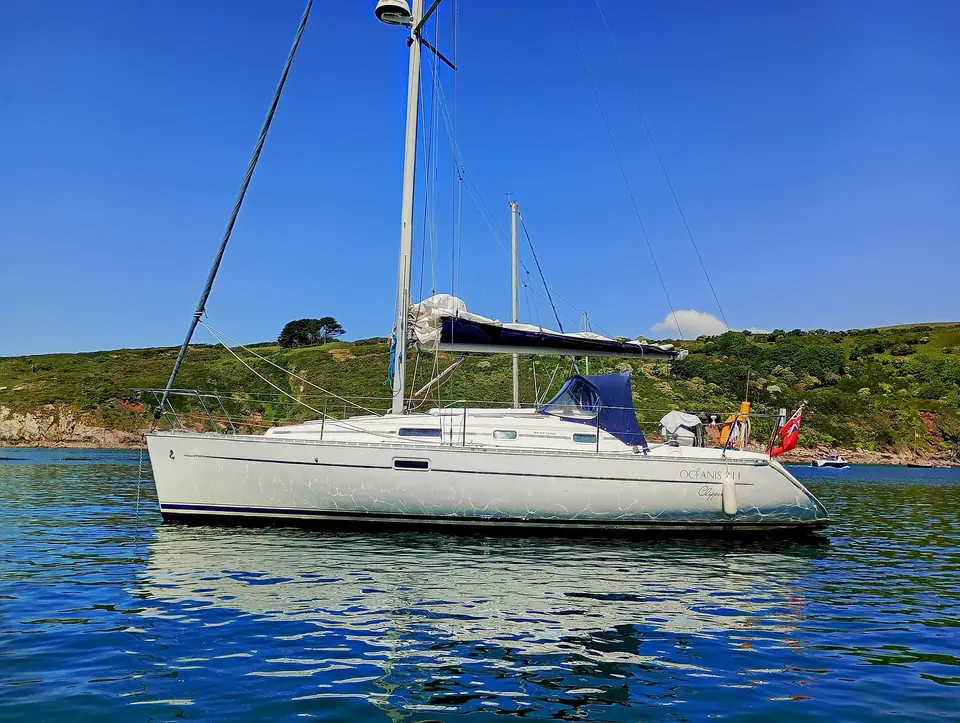
We have not found a freely licensed photo of the Beneteau First 305 yet, so these show other Beneteau boats, each captioned with the boat pictured.
More performance sailboats to explore
Beneteau First 30
Performance Sailboats, 31 ft
Used $150K to $195K
Beneteau First 310
Performance Sailboats, 31 ft
Used $18K to $42K

Shields One-Design
Performance Sailboats, 30 ft
Used $6K to $70K
Beneteau First 31.7
Performance Sailboats, 32 ft
Used $30K to $78K
Other Beneteau models
- Beneteau 49
- Beneteau 50
- Beneteau 57
- Beneteau 343
- Beneteau Antares 5.80
- Beneteau Antares 6
- Beneteau Antares 6.80
- Beneteau Antares 7
- Beneteau Antares 7.30
- Beneteau Antares 7.60
- Beneteau Antares 7.80
- Beneteau Antares 8
- Beneteau Antares 8.00
- Beneteau Antares 8.05
- Beneteau Antares 8.60
- Beneteau Antares 8.80
- Beneteau Antares 9
- Beneteau Antares 9.80
- Beneteau Antares 10.80
- Beneteau Antares 11
- Beneteau Antares 12
- Beneteau Antares 13.80
- Beneteau Antares 30
- Beneteau Antares 32
- Beneteau Antares 36
- Beneteau Antares 42
- Beneteau Antares 620 HB
- Beneteau Antares 650 HB
- Beneteau Antares 750 HB
- Beneteau Cyclades 39.3
- Beneteau Cyclades 43.3 and 43.4
- Beneteau Cyclades 50.5
- Beneteau First 18 SE
- Beneteau First 20
- Beneteau First 21.7
- Beneteau First 24
- Beneteau First 25
- Beneteau First 25.7
- Beneteau First 27
- Beneteau First 27.7
- Beneteau First 30
- Beneteau First 31.7
- Beneteau First 35
- Beneteau First 36
- Beneteau First 36.7
- Beneteau First 38
- Beneteau First 40
- Beneteau First 40.7
- Beneteau First 44
- Beneteau First 45
- Beneteau First 47.7
- Beneteau First 53
- Beneteau First 211
- Beneteau First 235
- Beneteau First 285
- Beneteau First 310
- Beneteau First 345
- Beneteau Flyer 6
- Beneteau Flyer 7
- Beneteau Flyer 8
- Beneteau Flyer 9
- Beneteau Flyer 10
- Beneteau Flyer 12
- Beneteau Flyer 500
- Beneteau Flyer 550
- Beneteau Flyer 650
- Beneteau Flyer 701
- Beneteau Flyer 750
- Beneteau Grand Trawler 62
- Beneteau Gran Turismo 32
- Beneteau Gran Turismo 36
- Beneteau Gran Turismo 40
- Beneteau Gran Turismo 41
- Beneteau Gran Turismo 44
- Beneteau Gran Turismo 45
- Beneteau Monte Carlo 6
- Beneteau Oceanis 30.1
- Beneteau Oceanis 31
- Beneteau Oceanis 34
- Beneteau Oceanis 34.1
- Beneteau Oceanis 35
- Beneteau Oceanis 35.1
- Beneteau Oceanis 36 CC
- Beneteau Oceanis 37
- Beneteau Oceanis 38
- Beneteau Oceanis 38.1
- Beneteau Oceanis 40
- Beneteau Oceanis 40 CC
- Beneteau Oceanis 41
- Beneteau Oceanis 41.1
- Beneteau Oceanis 42
- Beneteau Oceanis 42 CC
- Beneteau Oceanis 43
- Beneteau Oceanis 44 CC
- Beneteau Oceanis 45
- Beneteau Oceanis 46
- Beneteau Oceanis 46.1
- Beneteau Oceanis 48
- Beneteau Oceanis 50
- Beneteau Oceanis 51.1
- Beneteau Oceanis 54
- Beneteau Oceanis 55
- Beneteau Oceanis 58
- Beneteau Oceanis 311
- Beneteau Oceanis 320
- Beneteau Oceanis 321
- Beneteau Oceanis 323
- Beneteau Oceanis 331
- Beneteau Oceanis 350
- Beneteau Oceanis 351
- Beneteau Oceanis 370
- Beneteau Oceanis 390
- Beneteau Oceanis 400
- Beneteau Oceanis 411
- Beneteau Oceanis 423
- Beneteau Oceanis 430
- Beneteau Oceanis 440
- Beneteau Oceanis 461
- Beneteau Oceanis 473
- Beneteau Oceanis 500
- Beneteau Oceanis 510
- Beneteau Oceanis Clipper 361
- Beneteau Oceanis Clipper 373
- Beneteau Oceanis Clipper 381
- Beneteau Oceanis Clipper 393
- Beneteau Oceanis Yacht 54
- Beneteau Oceanis Yacht 60
- Beneteau Oceanis Yacht 62
- Beneteau Sense 43
- Beneteau Sense 46
- Beneteau Sense 50
- Beneteau Sense 55
- Beneteau Swift Trawler 30
- Beneteau Swift Trawler 34
- Beneteau Swift Trawler 35
- Beneteau Swift Trawler 41
- Beneteau Swift Trawler 44
- Beneteau Swift Trawler 48
- All Beneteau models