J/105 Buyer's Guide, the Boat That Introduced the Retractable Sprit
The 34.5-foot owner-driver one-design that made the asymmetric spinnaker mainstream and still runs the deepest big-boat fleets in America.
- Length
- 34.5 ft10.52 m
- Beam
- 11 ft3.35 m
- Draft
- 6.5 ft1.98 m
- Cabins
- 1 plus V-berth
- Used price
- $40K to $135K
On this page
- Overview
- How the J105 changed big-boat sailing in 1991
- The 7,750-pound package, infused hull and Plexus joint
- Downwind is the reason people fall for it
- Owner-driver rules and the J105 culture
- A 35-year-old class that is still adding events
- Accommodation, honest weekending space
- Owning a J105 in 2026, costs and refit priorities
- Specifications
- Price and value
- Strengths and weaknesses
- Used buyer checklist
- Rivals
- Our verdict
- FAQ
Rod Johnstone's 1991 sprit boat. About 685 to 690 built, roughly 500 in North America, raced under owner-driver rules, and sold used from about $40,000 to $135,000 depending on age and sails.
- Owner-driver one-design racing
- Families who race with friends
- Distance racing on bays and lakes
- Sailors stepping up from J24 or J80 fleets
How the J105 changed big-boat sailing in 1991
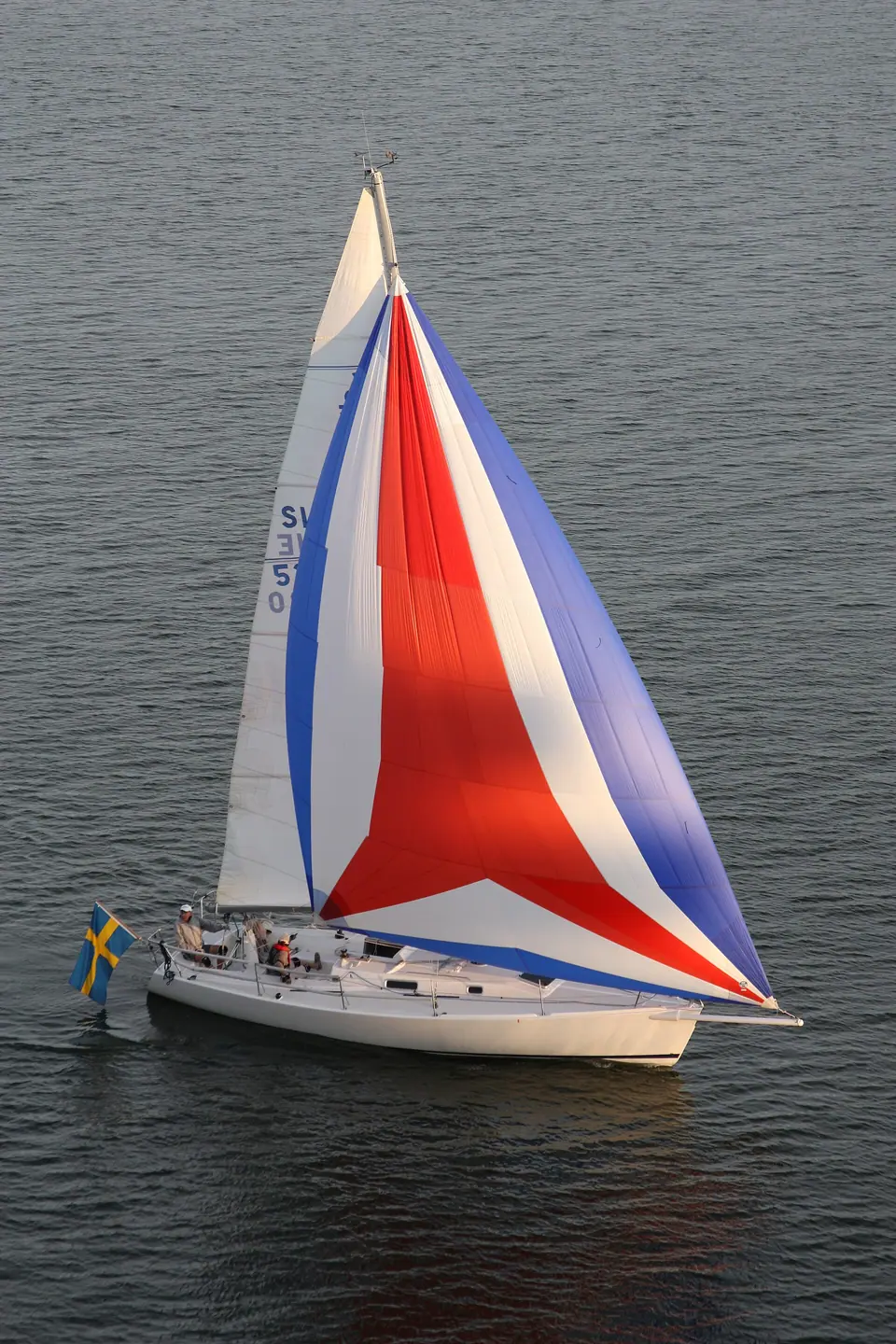
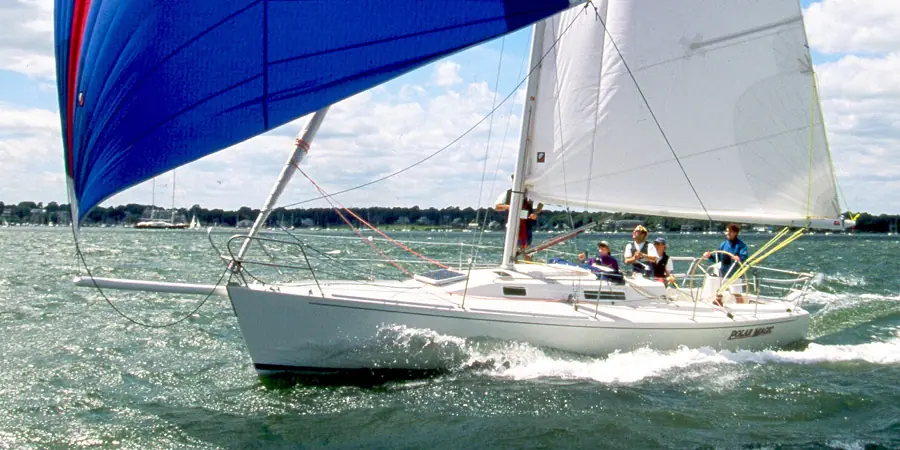
Before the J105, a 35-foot racer meant a symmetric spinnaker, a pole, a foredeck crew wrestling it on every gybe, and a big overlapping genoa. Rod Johnstone's 1991 design swapped all of that for a retractable bowsprit and a large asymmetric spinnaker tacked to its end. It was the first production boat with a retractable sprit, and Sailing World named it the 1992 Boat of the Year in the racer and cruiser category.
The idea spread across the whole industry, but the J105 itself became a phenomenon of its own. Around 685 to 690 boats were built, about 500 of them in North America, and the class describes itself as the most successful one-design keelboat class over 30 feet in the United States. If you want to race a big keelboat in a big fleet with amateur friends, the J105 is still where you go.
J/105 by the numbers
- Sail area to displacement
- 23.6Plenty of sail for the weight, the boat should feel lively in light air.
- Displacement to length
- 135Light displacement for its length, quick but sensitive to added cruising weight.
- Theoretical hull speed
- 7.3 knThe practical top speed of a displacement monohull under normal sailing, based on waterline length.
- Ballast ratio
- 44%A high ballast ratio, so the boat stands up well to a breeze.
- Capsize screening
- 2.22Above 2.0, so this hull leans toward coastal stability over ultimate offshore resistance.
- Motion comfort ratio
- 15.8A quicker motion in waves, typical of light, beamy hulls.
- Length to beam ratio
- 3.14 : 1Moderate proportions.
The 7,750-pound package, infused hull and Plexus joint
TPI built the J105 with the SCRIMP resin infusion process, a structural floor matrix to carry the keel loads, an aluminum I-beam mast step and a balsa-cored deck. The hull and deck are bonded with Plexus adhesive, a joint SAILING Magazine described as stronger than the laminate around it, which is why J105s rarely suffer the hull-deck leaks common on older racers.
The numbers are moderate rather than extreme: 34 feet 6 inches overall, 29.5 feet on the waterline, 11 feet of beam, 7,750 pounds and 3,400 pounds of lead in a 6.5-foot fin. A shoal-draft version was built for shallower harbors, though it is far less common in one-design fleets. The mast stands about 42 feet according to US Sailing, and the 577-square-foot working sail plan uses a non-overlapping jib, which keeps tacking easy for a small crew.
Downwind is the reason people fall for it
SAILING Magazine's test summed it up: the J105 loves wind. In 15 knots of true wind it reaches at better than 10 knots, and with the asymmetric up in 20 knots it touches 15 knots. It sails flat with a light helm and very little tendency to broach, which is exactly what you want when a crew of amateurs is gybing an asymmetric in a breeze on San Francisco Bay.
Upwind it is solid and predictable rather than spectacular. The boat is heavier than modern sportboats, so it keeps its momentum through chop and does not punish small trim errors. That forgiveness is part of why the class has thrived as an owner-driver fleet.
Owner-driver rules and the J105 culture
The class association is owner-managed and the rules reflect that. The owner must drive, the number of World Sailing Category 3 professionals aboard is tightly restricted, and annual sail purchases are limited. Class rules also require a Martec folding propeller, so nobody gains a speed edge by swapping props.
US Sailing lists a crew of five to seven with an ideal combined weight around 1,102 pounds. That makes the J105 one of the few big boats where a group of friends and family can compete at a national level without a payroll.
- Owner must drive in class events
- Strict limits on Category 3 professional crew
- Annual cap on new sail purchases
- Martec folding prop required
- Crew of 5 to 7, ideal combined weight about 1,102 lb
A 35-year-old class that is still adding events
Fleet 3 on the Northern Chesapeake is a good example of how alive the J105 is. In 2025 its Wednesday night racing drew 27 and 29 boats in two series, the largest class in both. Its women's regatta, started in 2022, grew to 18 boats by 2025, and the new Annapolis Invitational paired 16 local owners with 16 visiting crews from Buffalo, Long Island, Chicago, San Francisco, Marblehead, Cleveland, Seattle and Toronto.
San Francisco, Chicago, Long Island Sound, Marblehead, Toronto and the Pacific Northwest all run active fleets, and the last five production hulls went to owners in Chile.
Accommodation, honest weekending space
The interior favors sailing over comfort but is perfectly usable. There is a V-berth with a hanging locker, two settees, two quarter berths, a galley with a cooler, a navigation station and an enclosed head. Headroom is about 5 feet 5 inches except under the companionway.
Tankage is minimal. Sources list a small fuel tank of roughly 10 to 12 gallons, and many boats carry fresh water in jugs. That is plenty for weekend trips and distance races, but anyone planning coastal cruising should think about adding water capacity and a better refrigeration solution.
Owning a J105 in 2026, costs and refit priorities
Production wound down in the early 2010s, after TPI and then US Watercraft in Rhode Island built the boats (J/Boats already counted over 680 hulls in 2012), so the youngest hulls are well over a decade old and the oldest are past 35. That makes the refit history the core of any purchase. Standing rigging, rudder bearings, engine mounts and the shaft seal and cutless bearing, deck hardware bedding, and the sprit tube and its bearings are the common big-ticket items.
Annual costs for a club racer, including a slip, insurance, haul-out, bottom work and a sail or two within class limits, run about $12,000 to $20,000 in most US markets. A national championship program with new sails each year, travel and coaching can reach $35,000. Because the class limits sails and pros, that ceiling is far lower than for comparable big boats racing under IRC or ORC.
J/105 specifications
| Length overall | 34.5 ft10.52 m |
|---|---|
| Waterline length | 29.5 ft8.99 m |
| Beam | 11 ft3.35 m |
| Draft | 6.5 ft1.98 m |
| Displacement | 7,75 lbs3,515 kg |
| Ballast | 3,4 lbs1,542 kg |
| Sail area | 577 sq ft53.6 m² |
| Fuel capacity | 1 gal38 L |
| Cabins | 1 plus V-berth |
| Berths | 6 (V-berth, two settees, two quarter berths) |
| Heads | 1 |
| Standard engines | 18 hp Yanmar diesel with straight shaft on most North American boats; J/Boats late spec lists a 20 hp Yanmar 3YM20 |
| Optional engines | Volvo 2020 diesel on French-built boats |
| Maximum power | 20 hp |
| Hull type | Fiberglass monohull with fin keel and spade rudder |
| Keel | Lead fin keel, 6 ft 6 in standard draft, shoal version offered |
| Rig | Fractional sloop with retractable bowsprit and asymmetric spinnaker |
| Hull construction | SCRIMP-infused fiberglass with balsa-cored deck, Plexus-bonded hull to deck joint |
| Builder | Tillotson Pearson (TPI) for J/Boats, later US Watercraft; also built in France, United States |
| Naval architect | Rod Johnstone |
| Production | 1991 to present |
| Status | Discontinued |
Figures come from builder documentation and independent tests where available. Displacement is usually quoted light, so a loaded cruising boat will weigh more. Compare these specs with another model.
How much does a J/105 cost?
J105 prices follow hull age, sail inventory and fleet location. Early 1990s TPI boats with original engines and tired sails are the entry point, while late US Watercraft hulls with recent class sails, rebuilt rudder bearings and a fresh engine service command the top. Boats in San Francisco, Annapolis, Chicago and Long Island Sound sell faster and closer to asking because there is always a local fleet buyer.
Estimate your yearly cost
A planning estimate using common rules of thumb: insurance near 1.5 percent of value, maintenance near 3 percent, haul out and bottom paint by length. Your marina, region and use will move these numbers. Open the full cost calculator.
J/105 timeline
- 1991J105 introduced as the first production boat with a retractable bowsprit
- 1992Named Sailing World Boat of the Year in the racer and cruiser category
- 2008Production moves to US Watercraft in Portsmouth, Rhode Island
- 2012J/Boats reports over 680 J105s sailing worldwide; the final hulls, numbers 681 to 685, were built in the US and shipped to Chile
- 2022Annapolis Fleet 3 launches its J105 women's regatta
- 2025First J105 Annapolis Invitational with 16 visiting teams
Strengths and weaknesses
What owners like
- Deepest big-boat one-design fleets in the US
- Owner-driver and sail limits keep racing amateur-friendly
- Fast, forgiving asymmetric handling with a small crew
- Plexus hull-deck joint resists leaks
- Usable interior for weekends and distance races
- Strong resale in fleet areas
What to weigh up
- Youngest hulls are about ten years old
- Small fuel and water capacity
- Limited headroom for cruising
- 6.5-foot standard draft
- Upwind performance is good, not outstanding, against modern designs
Used J/105 buyer checklist
Take this list to a viewing. Your ticks are saved in this browser so you can come back to it.
Always commission an independent marine survey and an engine survey before you buy. How a marine survey works.
Rivals to consider
J/109
The cruising-friendlier successor with two cabins and more tankage, heavier and pricier, with smaller one-design fleets.
Compare side by sideJ/88
Newer and lighter at 29 feet, trailerable, but with far fewer boats and a smaller interior.
Compare side by sideJ/111
Much faster and more modern, but a bigger budget boat with smaller fleets.
Compare side by sideTartan 101
A comparable 33-foot racer and cruiser with a nicer interior but nothing like the J105's one-design scene.
Our verdict on the J/105
The J105 remains the best value in American big-boat one-design racing. It is fast enough to be exciting, forgiving enough for amateur crews and governed by a class that has kept professionals and costs under control for more than three decades. The boats are aging, so pay for a thorough survey and favor documented refits over low prices. If there is a fleet near you, buy one and go racing; it is hard to find more sailing per dollar at this size.
J/105 questions answered
How much is a J105 worth?
Used J105s generally sell for about $40,000 to $135,000 in 2026, depending on hull age, sail inventory and refit history.
How many J105s were built?
About 685 to 690, with roughly 500 in North America. J/Boats counted over 680 by 2012, and production has since ended.
What made the J105 special?
It was the first production boat with a retractable bowsprit and asymmetric spinnaker, and Sailing World named it 1992 Boat of the Year.
How many crew race a J105?
Five to seven, with an ideal combined weight of about 1,102 pounds, and the owner must drive in class events.
What engine does a J105 have?
Most North American boats have an 18-horsepower Yanmar diesel on a straight shaft, French-built boats usually have a Volvo 2020, and J/Boats' late spec sheet lists a 20-horsepower Yanmar 3YM20.
How fast is a J105?
SAILING Magazine saw more than 10 knots reaching in 15 knots of wind and about 15 knots under spinnaker in 20 knots.
J/105 photos
More performance sailboats to explore
Bavaria 35 Match
Performance Sailboats, 35 ft
Used $45K to $75K
Dehler 35
Performance Sailboats, 34 ft
Used $70K to $125K
Beneteau First 345
Performance Sailboats, 35 ft
Used $20K to $45K
Elan 350
Performance Sailboats, 35 ft
Used $85K to $135K