J/40 Review, Specs and Buying Guide for the Classic and New J40
One name, two generations: the 1984 J/40 that took families to Bermuda and the 2024 J/40 that won Boat of the Year all over again.
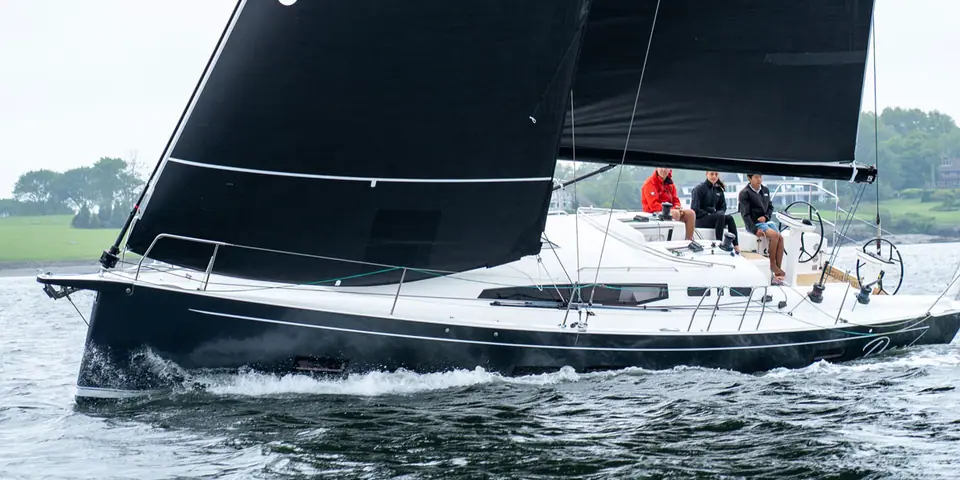
- Length
- 40.9 ft12.47 m
- Beam
- 12.7 ft3.86 m
- Draft
- 7.2 ft2.2 m
- Cabins
- 3 standard (twin aft doubles plus forward V-berth) or 2 with a second head and aft storage garage
- Used price
- $45K to $620K
On this page
- Overview
- Which J40 are you looking at, the 1984 boat or the 2024 boat?
- Al Johnstone's brief, sail at wind speed in 8 knots and still pass the family test
- Twin wheels, six winches and a German mainsheet
- Three cabins and one head, or two cabins and a garage
- What the J/40 actually did on test
- Infusion, Corecell and a yard in the Vendee
- Rod Johnstone's original J/40, 1984 to 1994
- Pricing a J/40 in 2026
- Specifications
- Price and value
- Strengths and weaknesses
- Used buyer checklist
- Rivals
- Our verdict
- FAQ
The J/40 nameplate covers Rod Johnstone's 1984 to 1994 offshore cruiser (86 hulls built by TPI) and Al Johnstone's all-new 2024 J/40, built by J/Composites in France with a carbon mast, twin wheels and a base price near $500,000.
- Families who want to cruise and also race distance events
- Short-handed sailors stepping up from a J/109 or J/111
- Bermuda Race and Chicago-Mac programs
- Budget offshore cruisers buying a classic J/40
J/40 by the numbers
- Sail area to displacement
- 22.3Plenty of sail for the weight, the boat should feel lively in light air.
- Displacement to length
- 149Light displacement for its length, quick but sensitive to added cruising weight.
- Theoretical hull speed
- 8.2 knThe practical top speed of a displacement monohull under normal sailing, based on waterline length.
- Ballast ratio
- 37%A typical ballast ratio for a cruising monohull.
- Capsize screening
- 1.98Below 2.0, the traditional threshold for offshore suitability.
- Motion comfort ratio
- 23.2A quicker motion in waves, typical of light, beamy hulls.
- Length to beam ratio
- 3.22 : 1Moderate proportions.
Which J40 are you looking at, the 1984 boat or the 2024 boat?
Search for a J40 sailboat for sale and the listings will mix two boats that share nothing but a name and a family. The first J/40 was the company's first true offshore cruiser, drawn by founder Rod Johnstone and launched in 1984. J/Boats says it was built through hull number 86, with 1994 as the last model year. The second J/40 arrived 40 years later, designed by Rod's son Alan Johnstone and built in France by J/Composites. It is lighter, longer on the waterline, carbon rigged and aimed at the same family offshore market with modern tools.
This page treats the 2024 boat as the current J/40, but gives the classic its own section because brokerage listings are still dominated by older hulls. A masthead rig, single wheel and 1980s build year means the original; twin wheels, a plumb bow and a fixed sprit mean the new generation.
Al Johnstone's brief, sail at wind speed in 8 knots and still pass the family test
J/Boats describes the new J/40 as a design that does not fit a rule or a category. Al Johnstone's stated goal was a boat with the sail power and stability for both light and windy days, able to excel in coastal and offshore rallies and races while passing what he calls the family cruising test. The builder claims that in under 8 knots of breeze, with mainsail and code sail, the J/40 sails at nearly the wind speed. Cruising World reported that the design target was sailing close to windspeed in 8 knots while letting the crew dial back when it gets sporty.
The team behind it produced the J/112E, J/122 and J/45, and the 40 borrows openly from the 45: twin wheels, a low deckhouse, a plumb bow and a fixed carbon bowsprit that also carries the anchor roller. The hull keeps a smooth, chineless run aft, which SAIL singled out as a difference from many modern performance cruisers. J/Boats names the Rolex Fastnet, Newport Bermuda, Transpac and Chicago-Mac as events the boat can be optimized for.
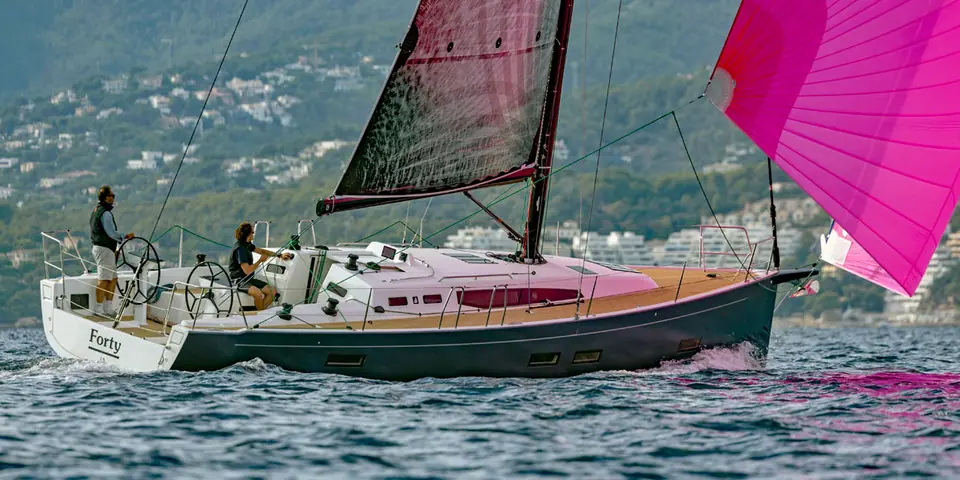
Twin wheels, six winches and a German mainsheet
The cockpit is the part of the new J/40 that racers and cruisers will argue about least. All sail controls lead aft to six Harken Performa winches, optionally electric. The mainsheet is a double-ended German system that runs inside the boom and below deck before emerging near the aft winches, so the helmsman can trim from either wheel. The hydraulic backstay and a cockpit-wide traveler set in the sole are within reach of the driver, and two coaming winches handle the jib and spinnaker while two cabin-top winches, one electric, take halyards and reef lines.
The non-overlapping jib is sheeted through floating inhaulers on the cabin top, giving real shape control without grinding a big genoa. Twin low pedestals with Lewmar chain-and-wire steering free the centerline for a removable table, and J/Boats claims 360-degree visibility from the helm, which both magazines confirmed.
Practical details count offshore. SAIL notes a line-tail locker under the cockpit sole that satisfies offshore racing rules and allows a low companionway threshold, a dedicated liferaft locker, an oversized anchor locker that doubles as fender stowage, and an optional inner forestay for a staysail or storm jib. A drop-down swim platform is optional, and on hull one the autopilot drove a separate tiller arm on the rudder stock for steering redundancy.
Three cabins and one head, or two cabins and a garage
Below, the new J/40 offers two layouts. The standard plan has twin double cabins aft, a V-berth cabin forward and a single head with shower forward of the mast, which suits families and offshore race crews who want to sleep on the high side. The alternative replaces the starboard aft cabin with a large storage garage and adds a second head with shower aft, which Cruising World and SAIL both suggested would suit a cruising couple with gear and occasional guests.
The saloon has an L-shaped galley to port at the foot of the companionway, a forward-facing nav station to starboard, a fold-out table with L-settee to port and a straight settee opposite. Overhead handrails run the length of the saloon, something Adam Cove called a rarity on current production boats, and the galley counter carries a full fiddle and grabrail. Mahogany is standard, with white oak and walnut optional; hull ports throughout, plus an optional comfort package with extra ports, sliding shades and upper cabinets.
This is still a performance boat inside: headroom over the aft berths is limited, aft stowage is modest and some lockers show painted fiberglass. In the U.S., air conditioning and electronics are dealer-installed, so equipment varies boat to boat.
What the J/40 actually did on test
Both major U.S. tests were sailed on Chesapeake Bay in late 2024. SAIL's Adam Cove sailed the first U.S. hull in light to moderate air: 6.6 knots of boatspeed at 28 degrees apparent in 8 knots of wind, and 7.2 knots reaching under a large A2 asymmetric at 110 to 130 degrees apparent in only 8 to 9 knots of breeze. Cruising World's judges saw 8.3 knots closehauled in roughly 15 knots of wind and called the Lewmar steering smooth as butter.
Under power the 50 hp Volvo on a saildrive pushed the boat at 6 knots at 2,000 rpm into a light chop and 7.3 knots at 2,500 rpm. No fuel figures were published, so we have not invented one. J/Boats promises double-digit speeds off the wind in more breeze, which neither test had the conditions to confirm.
Infusion, Corecell and a yard in the Vendee
J/Composites, the French arm led by Didier Le Moal, was the first European builder to adopt resin infusion in the mid 1990s, according to J/Boats. On the J/40 the hull, deck, structural grid and main bulkhead are all vacuum-infused with Corecell foam core, using three core densities in the hull and two in the deck. J/Boats says it is the only 40-footer on the market with all four elements infused, and the infused veneer-and-foam main bulkhead is part of the weight control story.
The rig is a keel-stepped Axxon tapered carbon mast, 63.8 ft per J/Boats, with discontinuous rod rigging, an aluminum boom and slab reefing led inside the boom. Standard electrics are a conventional AGM bank, and the two-blade Gori folding propeller can be upgraded to three blades.
For owners, this is a modern composite boat that rewards routine care of saildrive seals, rod rigging and any hardware penetrations into the cored deck. None of these are known faults, just the maintenance items of the type.
Rod Johnstone's original J/40, 1984 to 1994
The original J/40 was J/Boats' first bluewater cruiser and, as Cruising World recalls, Sailing World named it Best Domestic Cruiser as soon as it appeared. It is 40 ft overall with a 34 ft waterline, 12 ft 2 in beam, 18,000 lb displacement and 6,500 lb of lead ballast, according to sailboatdata, with a 6 ft 6 in standard draft plus wing keel (5 ft 5 in) and shoal fin (5 ft) options. Power was a 43 hp Volvo diesel under the galley sink, with 33 gallons of fuel and 60 gallons of water.
The deck has a small cabin house and a large single-level cockpit with the mainsheet traveler separating helmsman from crew, a wheel on a balanced rudder in Harken roller bearings, and a double-spreader masthead aluminum rig by Kenyon Spars with Navtec rod rigging. Below, a V-berth and head forward, proper settee berths, galley and nav station amidships, a double cabin aft to starboard and a second head aft to port. The boat raced well under PHRF and later ORR, especially in the Newport Bermuda Race, and the J/40 Owners Association remains active.
As a used buy, a classic J/40 is an honest offshore boat at a fraction of new money; age matters more than design, so focus on engines, decades-old rod rigging, chainplates and deck core moisture.
Pricing a J/40 in 2026
New, the 2024 J/40 starts around $500,000 according to Cruising World, and the Annapolis show boat was closer to $650,000 with air conditioning and electronics; SAIL listed $625,000 as sailed. Budget for dealer-installed electronics and climate control on top of the base boat.
Classic J/40s are priced on condition rather than year: newer sails and a repowered engine put a boat at the top of the range, original rod rigging and a wet deck at the bottom. Expect annual costs of $18,000 to $45,000 for a 40 ft slip, haul-out, insurance and, if you race the new boat, sails.
J/40 specifications
| Length overall | 40.9 ft12.47 m |
|---|---|
| Waterline length | 37 ft11.26 m |
| Beam | 12.7 ft3.86 m |
| Draft | 7.2 ft2.2 m |
| Air draft | 63.8 ft19.45 m |
| Displacement | 16,9 lbs7,665 kg |
| Ballast | 6,3 lbs2,858 kg |
| Sail area | 918 sq ft85.3 m² |
| Cabins | 3 standard (twin aft doubles plus forward V-berth) or 2 with a second head and aft storage garage |
| Berths | Three double cabins in the standard layout, plus saloon settees usable as sea berths |
| Heads | 1 forward in the three-cabin layout, 2 in the two-cabin layout |
| Standard engines | Volvo Penta 50 hp diesel on a saildrive with folding Gori propeller |
| Maximum power | 50 hp |
| Cruise speed | 7.3 knots |
| Hull type | Light displacement monohull with plumb bow, chineless run aft and fixed carbon bowsprit |
| Keel | Lead foil keel, 7 ft 3 in standard or roughly 5 ft 11 in shoal option |
| Rig | Fractional sloop with keel-stepped Axxon tapered carbon mast, discontinuous rod rigging, aluminum boom and non-overlapping 103 percent jib |
| Hull construction | Vacuum-infused fiberglass with Corecell foam core in hull, deck, structural grid and main bulkhead |
| CE design category | A |
| Builder | J/Composites (Les Sables d'Olonne, France) for J/Boats, France |
| Naval architect | Alan Johnstone |
| Other design credits | Interior styling by Isabelle Racoupeau with J/Composites; the original 1984 J/40 was designed by Rod Johnstone |
| Production | 2024 to present |
| Status | In production |
Figures come from builder documentation and independent tests where available. Displacement is usually quoted light, so a loaded cruising boat will weigh more. Compare these specs with another model.
How much does a J/40 cost?
The used range spans two very different boats. Classic 1984 to 1994 J/40s trade in the tens of thousands depending on sails, engine hours and deck core condition, while the 2024 and later J/40 starts around $500,000 base according to Cruising World, with sailed-away test boats quoted at $625,000 to about $650,000. Early new-generation hulls that reach brokerage should sit a little below a new boat, because the order book was already 15 deep before hull one launched.
Estimate your yearly cost
A planning estimate using common rules of thumb: insurance near 1.5 percent of value, maintenance near 3 percent, haul out and bottom paint by length. Your marina, region and use will move these numbers. Open the full cost calculator.
Versions and options
- J/40 (1984 to 1994), Rod Johnstone design
- Masthead sloop, 40 ft LOA, 18,000 lb, 43 hp Volvo; standard fin, wing keel and shoal fin versions; 86 hulls per J/Boats and Cruising World.
- New J/40 three-cabin layout
- Twin aft doubles, forward V-berth and one head, as on hull one; a second layout swaps the starboard aft cabin for a garage and second head.
- Shoal keel
- About 5 ft 11 in draft instead of 7 ft 3 in, for thin-water cruising grounds.
J/40 timeline
- 1984Rod Johnstone's J/40 launches as J/Boats' first offshore cruiser and is named Best Domestic Cruiser by Sailing World
- 1994Last model year of the classic J/40 after 86 hulls
- 2024All-new J/40 by Alan Johnstone launches; 15 orders taken before hull one hits the water
- 2025Named Cruising World's Best Full-Size Cruiser 40 to 45 Feet and Best Boat Overall, and a SAIL Top 10 Best Boats winner
Strengths and weaknesses
What owners like
- Sails close to wind speed in light air with a code sail
- Twin-wheel cockpit with six winches works for racing and cruising
- Fully infused Corecell construction keeps weight low
- Standard carbon mast is unusual at this price
- Offshore details like overhead handrails, liferaft locker and inner forestay option
What to weigh up
- Base price near $500,000 climbs fast with electronics and air conditioning
- Limited headroom and stowage in the aft cabins
- No published tankage or fuel figures for the new boat
- Classic J/40s are now 30 to 40 years old and need rig and deck scrutiny
Used J/40 buyer checklist
Take this list to a viewing. Your ticks are saved in this browser so you can come back to it.
Always commission an independent marine survey and an engine survey before you buy. How a marine survey works.
Rivals to consider
J/45
The bigger sister with the same twin-wheel concept, more volume and more boat to handle and maintain.
J/120
The popular 40 ft J/Boats racer-cruiser of the 1990s and 2000s, a cheaper used alternative to the new J/40.
Compare side by sideX-Yachts X4.3
Danish performance cruiser with richer joinery and a more traditional cruising interior.
Compare side by sideJ/109
Smaller, simpler and far cheaper used, still a strong offshore one-design.
Compare side by sideOur verdict on the J/40
The new J/40 is the most convincing argument yet that a 40 ft family boat can also be a serious distance racer, and its back-to-back Boat of the Year awards were earned on the water. It is expensive once equipped and honest about being a performance boat below, but it sails beautifully in the light air where most cruisers motor. On a tenth of the budget, a classic J/40 remains one of the best-value offshore cruisers of the 1980s, provided you buy the rig and deck rather than the varnish.
J/40 questions answered
How much does a J/40 cost?
A new J/40 starts around $500,000 according to Cruising World, with well-equipped boats at $625,000 to $650,000. Classic 1984 to 1994 J/40s sell for a small fraction of that, depending on condition.
What is the difference between the classic J/40 and the new J/40?
The classic is a 1984 Rod Johnstone masthead cruiser of 18,000 lb. The 2024 J/40 by Alan Johnstone is lighter at 16,900 lb, has a 37 ft waterline, a carbon fractional rig, twin wheels and a fixed bowsprit.
How many classic J/40s were built?
J/Boats and Cruising World put the total at 86 hulls between 1984 and the last model year, 1994.
Is the J/40 a Class 40?
No. Class 40 is a box rule for shorthanded offshore racers. The J/40 is a production performance cruiser that races under handicap rules.
What engine does the new J/40 have?
A 50 hp Volvo Penta diesel on a saildrive, good for 7.3 knots at 2,500 rpm in SAIL's test.
J/40 photos
More performance sailboats to explore
J/124
Performance Sailboats, 41 ft
Used $130K to $220K
Beneteau First 40
Performance Sailboats, 41 ft
Used $135K to $235K
Dufour 40 Performance
Performance Sailboats, 40 ft
Used $85K to $145K
Beneteau First 38
Performance Sailboats, 40 ft
Used $28K to $65K