Beneteau 343 Used Boat Review and Buyer's Guide
A Berret-Racoupeau 34-footer built in South Carolina to win back the American buyers the Beneteau 331 lost, with a pivoting wheel that frees the cockpit.
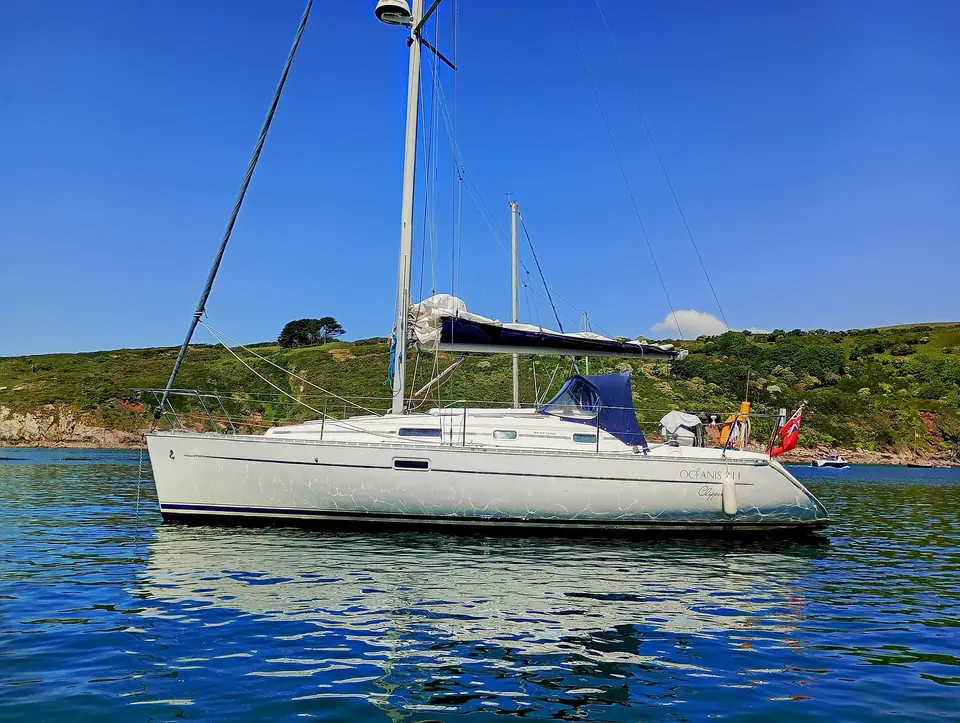
- Length
- 35.5 ft10.82 m
- Beam
- 11.4 ft3.48 m
- Draft
- 6.2 ft1.9 m
- Cabins
- 2 or 3
- Used price
- $55K to $90K
On this page
- Overview
- Why Beneteau built the 343 in South Carolina
- A familiar shape with a nearly masthead 9/10 rig
- The pivoting wheel and the cockpit by the inch
- Below decks, measured rather than marketed
- How the 343 sails
- Deep, shoal or lifting: choosing the right 343
- Telling the 343 apart from its neighbors
- What a 343 costs to buy and keep in 2026
- Specifications
- Price and value
- Strengths and weaknesses
- Used buyer checklist
- Rivals
- Our verdict
- FAQ
The Beneteau 343, called the Oceanis Clipper 343 in Europe, was built from 2004 to 2008. It is a stiff, easily handled 34-foot family cruiser with two or three cabins and a clever cockpit, now a $55,000 to $90,000 used buy.
- Young families moving up from a 27 to 30 foot boat
- Couples daysailing and weekending on bays and sounds
- Budget buyers who want a newer boat than a 1990s Oceanis
- Owners who value cockpit space for entertaining
Why Beneteau built the 343 in South Carolina
The Beneteau 343 exists because its predecessor stumbled. The Beneteau 331, launched in 1999, never caught on with American sailors, and Practical Sailor's verdict was blunt: too small and too slow to be a legitimate 33-footer, yet priced as one. Beneteau answered with the 343, drawn by Berret-Racoupeau (Beneteau dates the design to 2004) and built for the US market at the company's plant in Marion, South Carolina.
In Europe the same boat was sold as the Oceanis Clipper 343, which is why listings and owner forums use three names for one model: Beneteau 343, Oceanis 343 and Clipper 343. They share the hull, rig and layout options, although equipment differs between US and European builds, and the US boats carry American-sourced spars and wiring practices.
Production ended in 2008, when the Finot-Conq designed Oceanis 34 (sold in the US as the Beneteau 34) replaced it. That makes every 343 on the market today somewhere between 18 and 22 years old, which shifts the buying question from design to condition.
Beneteau 343 by the numbers
- Sail area to displacement
- 18.4Balanced power for coastal and offshore cruising.
- Displacement to length
- 205Moderate displacement, a classic cruising balance between load carrying and speed.
- Theoretical hull speed
- 7.4 knThe practical top speed of a displacement monohull under normal sailing, based on waterline length.
- Ballast ratio
- 25%Relatively low ballast, form stability does more of the work.
- Capsize screening
- 1.92Below 2.0, the traditional threshold for offshore suitability.
- Motion comfort ratio
- 25.2Moderate motion comfort, typical of modern cruisers.
- Length to beam ratio
- 3.11 : 1Moderate proportions.
A familiar shape with a nearly masthead 9/10 rig
Practical Sailor noted that the designers spent their effort on boat handling and accommodation rather than radical changes to hull or appendages. The profile is classic mid-2000s Oceanis: a near-plumb bow, a sheer that falls toward a reverse transom, a coachroof that rises toward the stern and a broad, rounded stern with a swim platform and fixed stainless ladder.
The rig is a 9/10 fractional sloop, close enough to masthead that it relies on a generous genoa for drive. US boats had a US Spars mast and boom, a Profurl furler and a split backstay that opens a path to the transom. Cap shrouds and aft lowers land on inboard chainplates for tight sheeting angles, and a rigid vang holds the boom up when reefing. Both a classic and an in-mast furling mainsail were offered.
Sailboatdata's numbers put the 343 firmly in the cruiser camp: a displacement to length ratio around 205, a calculated sail area to displacement ratio near 15.4 for the main and foretriangle, and a ballast ratio of about 25 percent with the deep keel.
The pivoting wheel and the cockpit by the inch
The most talked-about feature is the patented pivoting wheel on a pedestal that also carries the compass, throttle, instrument displays, a grabrail and a cup holder. Swing the wheel to port and a pivoting helm seat opens a straight walkway from the off-center transom opening to the companionway. On a 34-footer, where a fixed wheel usually blocks the stern, that is a real gain.
Practical Sailor measured the space: 85 inches from stern to companionway on the centerline, 22 inches between wheel and helm seat, 50 inches from helm to companionway and two 82-inch seats with angled backrests that seat six. An emergency tiller fits under the helm seat, alongside a manual bilge pump.
The weak point is short-handed sail trim. The mainsheet runs on a coachroof traveler with 4:1 purchase to a Lewmar winch, and the main halyard, furling lines and reef lines also terminate at the cabin top. The genoa sheets reach Lewmar 40 self-tailing primaries just outboard of the binnacle, so the helmsman can trim the headsail but must leave the wheel to touch the main.
Below decks, measured rather than marketed
The interior is traditional Beneteau of its era, with mahogany-family veneers on the hull sides and bulkheads, a white liner with wood battens overhead and about 6 ft 5 in of headroom in the saloon. Grabrails run the length of the saloon on both sides, set far enough off the hull to grab when heeled.
The dining table carries the mast compression post and opens to roughly 43 by 35 inches. The port settee is a 76-inch rectangle that makes a real berth, while the tapered starboard settee suits a child. The L-shaped galley has a two-burner Eno stove and oven, a single sink, a 4.5 cubic foot front-opening fridge and, on many boats, a microwave. The nav station's chart table is about 26 by 20 inches.
In the two-cabin version the aft cabin has a 6 ft 7 in by 7 ft 1 in athwartships double with 6 ft 6 in of headroom, though the engine, batteries and fuel tank all live around it and engine access is through a panel at the foot of the berth. The forward cabin has a triangular double and 6 ft 1 in of headroom. The molded head has 6 ft 7 in headroom and a sink tap that doubles as the shower. A three-cabin version was also offered, which trades cockpit stowage for a second aft cabin.
How the 343 sails
Practical Sailor sailed the first US boat on Chesapeake Bay in 8 to 14 knots. It tacked through about 35 degrees apparent, accelerated quickly out of tacks and held 5 to 7 knots on all points under the standard sails. The testers called it as quick as any similarly sized production boat and noted it was stiff enough that they never considered reefing in 14 knots and an 18 to 24 inch chop.
The helm was balanced and responsive, and because the rig is nearly masthead with a large genoa, the boat should keep moving in 4 to 6 knots of breeze. For context, Practical Sailor compared it with the Beneteau First 36.7: the 343 is heavier, but its waterline is within seven inches and its sail area within a few feet.
Under power the boat backed cleanly out of a tight Annapolis slip and cruised at 5 to 6 knots at 2,500 rpm in flat water, quiet enough to talk at normal volume in the cockpit. With 20 gallons of diesel, plan fuel stops conservatively on longer motoring legs.
Deep, shoal or lifting: choosing the right 343
Three keels were listed. The deep cast iron bulb fin draws 6 ft 2 in with 3,402 lb of ballast and gives the best windward ability. The shoal fin draws about 4 ft 9 in and, per sailboatdata, carried around 4,321 lb of ballast; early in the run Beneteau listed it as the standard keel. A lifting keel version drawing roughly 3 ft 11 in to 5 ft 3 in also appears in the record and is rare in the US.
For the Chesapeake, Florida's Gulf Coast and the Bahamas, a shoal-keel boat is the practical choice. In New England, the Great Lakes and the West Coast, the deep keel makes a better sailboat and tends to sell more easily.
Telling the 343 apart from its neighbors
Listings mix up Beneteau's 33 to 35 foot models, so check the hull identification number and the layout. The 331 that preceded it (1999 to 2004) is smaller and was offered with a twin-rudder lifting keel version. The Oceanis 34, or Beneteau 34 in the US, that followed from 2008 is a Finot-Conq design with a different hull, a bigger cockpit and a 34-gallon fuel tank.
Further back, the Oceanis 350 of 1986 and the Oceanis 351 of the 1990s are older Briand and Berret designs, and the twin-rudder Oceanis 35 and 35.1 of 2014 onward belong to a different era altogether. None of them share the 343's pivoting wheel, which is the fastest visual identifier on a dock.
What a 343 costs to buy and keep in 2026
Expect asking prices from about $55,000 for a tired three-cabin or ex-charter boat to around $90,000 for a well-kept 2008 with recent sails, electronics and canvas. Most good private boats trade in the $65,000 to $80,000 band. Survey costs, a haul-out and any rigging replacement should be in your offer math.
Running costs are modest: a typical US owner spends roughly $6,500 to $13,000 a year on slip, insurance, haul-out, bottom paint and routine engine service. The big-ticket items on a boat of this age are standing rigging, sails, the furler and electronics, each of which can add $5,000 to $15,000 when it comes due.
Beneteau 343 specifications
| Length overall | 35.5 ft10.82 m |
|---|---|
| Waterline length | 30.8 ft9.4 m |
| Beam | 11.4 ft3.48 m |
| Draft | 6.2 ft1.9 m |
| Air draft | 49.4 ft15.06 m |
| Displacement | 13,448 lbs6,1 kg |
| Ballast | 3,402 lbs1,543 kg |
| Sail area | 649 sq ft60.3 m² |
| Fuel capacity | 2 gal75 L |
| Fresh water | 67 gal255 L |
| Cabins | 2 or 3 |
| Berths | 4 to 8 |
| Heads | 1 |
| Standard engines | Yanmar diesel, listed at 21 to 29 hp depending on market and year |
| Maximum power | 29 hp |
| Cruise speed | 5.5 knots |
| Hull type | Moderate displacement monohull with bulb fin keel and single spade rudder |
| Keel | Cast iron bulb fin 6 ft 2 in (deep), shoal fin 4 ft 9 in, or lifting keel 3 ft 11 in to 5 ft 3 in |
| Rig | 9/10 fractional sloop, discontinuous wire rigging, split backstay, rigid vang; classic or in-mast furling main |
| Hull construction | Solid fiberglass hull with bonded structural liner, cored deck, cast iron keel |
| Builder | Beneteau USA, Marion, South Carolina (US boats); Beneteau, France (Oceanis Clipper 343), France |
| Naval architect | Berret-Racoupeau Yacht Design |
| Production | 2004 to 2008 |
| Status | Discontinued |
Figures come from builder documentation and independent tests where available. Displacement is usually quoted light, so a loaded cruising boat will weigh more. Compare these specs with another model.
How much does a Beneteau 343 cost?
These are 2026 US asking-price estimates, not sold prices. US-built two-cabin boats with the deep keel and a slab-reefed main sell fastest. Three-cabin and ex-charter boats, and those still on original sails, canvas and electronics, sit at the bottom of the range, while a repowered or re-rigged boat with new sails can justify the top.
Estimate your yearly cost
A planning estimate using common rules of thumb: insurance near 1.5 percent of value, maintenance near 3 percent, haul out and bottom paint by length. Your marina, region and use will move these numbers. Open the full cost calculator.
Beneteau 343 timeline
- 1999Beneteau 331 launched; it sells poorly in the US
- 2004Berret-Racoupeau designed 343 introduced, built in Marion, South Carolina and sold in Europe as the Oceanis Clipper 343
- 2008Production ends; the Finot-Conq Oceanis 34, sold in the US as the Beneteau 34, takes its place
Strengths and weaknesses
What owners like
- Pivoting wheel and helm seat open the stern on a 34-foot boat
- Stiff and quick for a production cruiser of its size
- Large aft double cabin in the two-cabin version
- Well-organized deck hardware with all lines led aft
- US-built boats have a strong dealer and parts network
- Affordable entry into a 2000s-era family cruiser
What to weigh up
- Mainsheet and halyard winches are out of reach of the helm
- Only 20 gallons of fuel
- Engine access is through the aft cabin berth
- Narrow starboard settee is a child's berth at best
- Every boat on the market is now 18 years old or more
Used Beneteau 343 buyer checklist
Take this list to a viewing. Your ticks are saved in this browser so you can come back to it.
Always commission an independent marine survey and an engine survey before you buy. How a marine survey works.
Rivals to consider
Catalina 34
The American benchmark at this size, with a more traditional interior and a big owner association for parts and advice.
Compare side by sideHunter 33
A contemporary US-built rival with a cockpit arch and open interior, often a little cheaper on the brokerage market.
Compare side by sideJeanneau Sun Odyssey 35
The sister-brand alternative of the same era, slightly larger, with a more traditional European interior.
Beneteau 34 (Oceanis 34)
The Finot-Conq successor from 2008 with a bigger cockpit and more fuel, at a higher used price.
Compare side by sideOur verdict on the Beneteau 343
The Beneteau 343 is a better boat than its modest reputation suggests. Practical Sailor found it as quick as any production 34-footer, stiff in a breeze and easy to maneuver, and the pivoting wheel solves the cockpit congestion that plagues most boats of this size. Its flaws are the usual compromises of a family cruiser: a mainsheet out of the helmsman's reach, small fuel tankage and an aft cabin wrapped around the engine. At $55,000 to $90,000 it is one of the most sensible ways into a 2000s-era Beneteau, provided the survey clears the keel, the liner bonding and an aging rig. Pay for the deep keel and recent sails and you will own a boat that sails better than the brokerage photos imply.
Beneteau 343 questions answered
Are the Beneteau 343 and the Oceanis Clipper 343 the same boat?
Yes. Beneteau sold it as the 343 in the US, where it was built in Marion, South Carolina, and as the Oceanis Clipper 343 in Europe. Hull, rig and layouts are shared.
How much is a used Beneteau 343 worth?
In 2026 most US boats ask roughly $55,000 to $90,000, depending on year, keel, layout and the age of sails, rigging and electronics.
What years was the Beneteau 343 built?
It was introduced in 2004 and built until 2008, when the Oceanis 34, sold in the US as the Beneteau 34, replaced it.
What is the draft of a Beneteau 343?
The deep keel draws about 6 ft 2 in and the shoal keel about 4 ft 9 in. A rarer lifting keel version draws roughly 3 ft 11 in to 5 ft 3 in.
Is the Beneteau 343 a good first cruising boat?
Yes for coastal sailing. It is stiff, easy to maneuver under power and simple to handle, though the mainsheet sits away from the helm and fuel tankage is small for long trips.
Who designed the Beneteau 343?
The French studio Berret-Racoupeau, which drew many of Beneteau's Oceanis Clipper models of the late 1990s and 2000s.
Photos from the Beneteau range
We have not found a freely licensed photo of the Beneteau 343 yet, so these show other Beneteau boats, each captioned with the boat pictured.
More cruising sailboats to explore
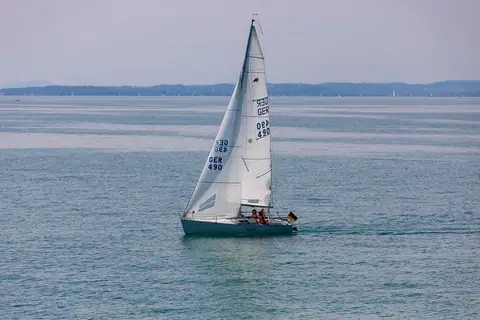
Catalina 355
Cruising Sailboats, 35 ft
Used $145K to $290K
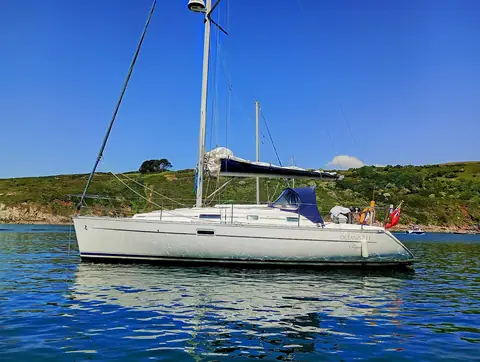
Beneteau Oceanis 34.1
Cruising Sailboats, 35 ft
Used $195K to $300K
Beneteau Oceanis 370
Cruising Sailboats, 36 ft
Used $28K to $50K
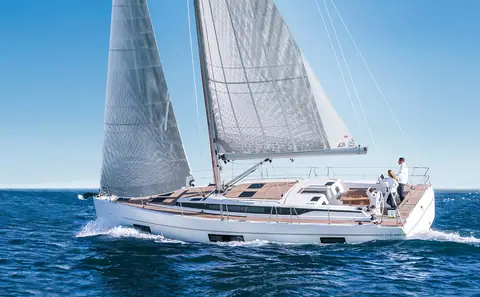
Bavaria 35 Cruiser
Cruising Sailboats, 35 ft
Used $55K to $85K
Other Beneteau models
- Beneteau 49
- Beneteau 50
- Beneteau 57
- Beneteau Antares 5.80
- Beneteau Antares 6
- Beneteau Antares 6.80
- Beneteau Antares 7
- Beneteau Antares 7.30
- Beneteau Antares 7.60
- Beneteau Antares 7.80
- Beneteau Antares 8
- Beneteau Antares 8.00
- Beneteau Antares 8.05
- Beneteau Antares 8.60
- Beneteau Antares 8.80
- Beneteau Antares 9
- Beneteau Antares 9.80
- Beneteau Antares 10.80
- Beneteau Antares 11
- Beneteau Antares 12
- Beneteau Antares 13.80
- Beneteau Antares 30
- Beneteau Antares 32
- Beneteau Antares 36
- Beneteau Antares 42
- Beneteau Antares 620 HB
- Beneteau Antares 650 HB
- Beneteau Antares 750 HB
- Beneteau Cyclades 39.3
- Beneteau Cyclades 43.3 and 43.4
- Beneteau Cyclades 50.5
- Beneteau First 18 SE
- Beneteau First 20
- Beneteau First 21.7
- Beneteau First 24
- Beneteau First 25
- Beneteau First 25.7
- Beneteau First 27
- Beneteau First 27.7
- Beneteau First 30
- Beneteau First 31.7
- Beneteau First 35
- Beneteau First 36
- Beneteau First 36.7
- Beneteau First 38
- Beneteau First 40
- Beneteau First 40.7
- Beneteau First 44
- Beneteau First 45
- Beneteau First 47.7
- Beneteau First 53
- Beneteau First 211
- Beneteau First 235
- Beneteau First 285
- Beneteau First 305
- Beneteau First 310
- Beneteau First 345
- Beneteau Flyer 6
- Beneteau Flyer 7
- Beneteau Flyer 8
- Beneteau Flyer 9
- Beneteau Flyer 10
- Beneteau Flyer 12
- Beneteau Flyer 500
- Beneteau Flyer 550
- Beneteau Flyer 650
- Beneteau Flyer 701
- Beneteau Flyer 750
- Beneteau Grand Trawler 62
- Beneteau Gran Turismo 32
- Beneteau Gran Turismo 36
- Beneteau Gran Turismo 40
- Beneteau Gran Turismo 41
- Beneteau Gran Turismo 44
- Beneteau Gran Turismo 45
- Beneteau Monte Carlo 6
- Beneteau Oceanis 30.1
- Beneteau Oceanis 31
- Beneteau Oceanis 34
- Beneteau Oceanis 34.1
- Beneteau Oceanis 35
- Beneteau Oceanis 35.1
- Beneteau Oceanis 36 CC
- Beneteau Oceanis 37
- Beneteau Oceanis 38
- Beneteau Oceanis 38.1
- Beneteau Oceanis 40
- Beneteau Oceanis 40 CC
- Beneteau Oceanis 41
- Beneteau Oceanis 41.1
- Beneteau Oceanis 42
- Beneteau Oceanis 42 CC
- Beneteau Oceanis 43
- Beneteau Oceanis 44 CC
- Beneteau Oceanis 45
- Beneteau Oceanis 46
- Beneteau Oceanis 46.1
- Beneteau Oceanis 48
- Beneteau Oceanis 50
- Beneteau Oceanis 51.1
- Beneteau Oceanis 54
- Beneteau Oceanis 55
- Beneteau Oceanis 58
- Beneteau Oceanis 311
- Beneteau Oceanis 320
- Beneteau Oceanis 321
- Beneteau Oceanis 323
- Beneteau Oceanis 331
- Beneteau Oceanis 350
- Beneteau Oceanis 351
- Beneteau Oceanis 370
- Beneteau Oceanis 390
- Beneteau Oceanis 400
- Beneteau Oceanis 411
- Beneteau Oceanis 423
- Beneteau Oceanis 430
- Beneteau Oceanis 440
- Beneteau Oceanis 461
- Beneteau Oceanis 473
- Beneteau Oceanis 500
- Beneteau Oceanis 510
- Beneteau Oceanis Clipper 361
- Beneteau Oceanis Clipper 373
- Beneteau Oceanis Clipper 381
- Beneteau Oceanis Clipper 393
- Beneteau Oceanis Yacht 54
- Beneteau Oceanis Yacht 60
- Beneteau Oceanis Yacht 62
- Beneteau Sense 43
- Beneteau Sense 46
- Beneteau Sense 50
- Beneteau Sense 55
- Beneteau Swift Trawler 30
- Beneteau Swift Trawler 34
- Beneteau Swift Trawler 35
- Beneteau Swift Trawler 41
- Beneteau Swift Trawler 44
- Beneteau Swift Trawler 48
- All Beneteau models