Catalina Yachts Cruising Sailboats
Catalina 27 for Sale Guide, Specs and Ownership Advice
More than 6,600 built from 1971 to 1991, the Catalina 27 is the cheapest way into a real inboard cruising sailboat with standing headroom aft.
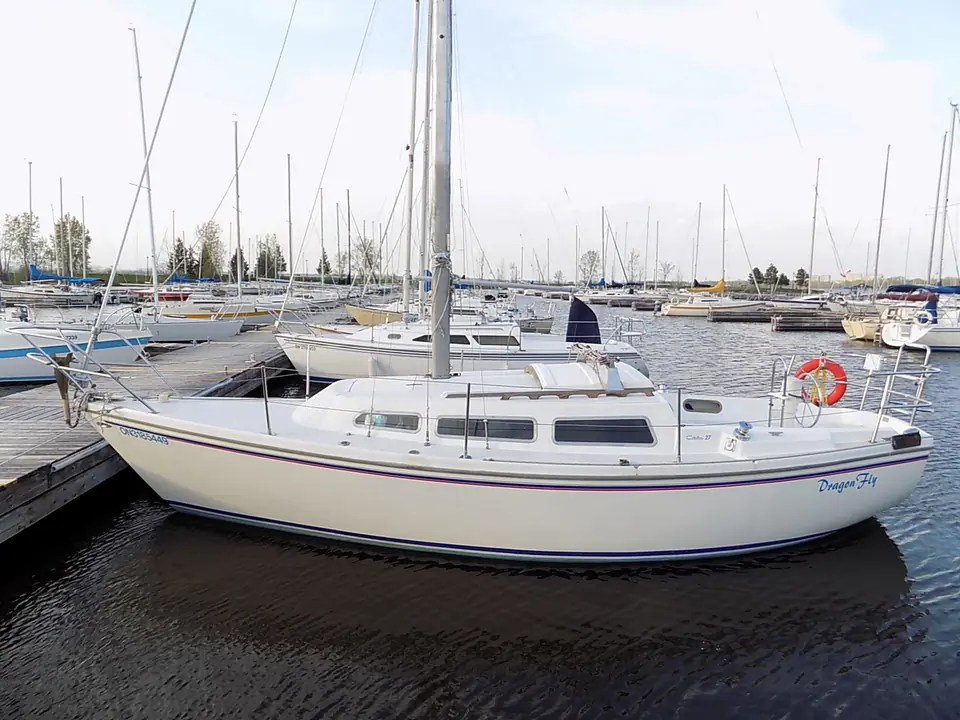
- Length
- 26.8 ft8.18 m
- Beam
- 8.8 ft2.69 m
- Draft
- 4 ft1.22 m
- Cabins
- 1 plus quarter berths
- Used price
- $3K to $20K
On this page
- Overview
- The Catalina 27, Volkswagen of the marina
- Deep or shoal, standard or tall mast: four boats in one
- Atomic 4, Petter or Universal: the engine defines the boat
- Catalina 27 interior: traditional aft galley or midship dinette
- From 5,650 to 6,850 pounds: how the 27 got heavier
- Chainplates, spreader sockets and other known weak spots
- Catalina 27, 270 or 275 Sport: three boats behind one search
- Catalina 27 sailboat for sale prices and yearly costs
- Specifications
- Price and value
- Strengths and weaknesses
- Used buyer checklist
- Rivals
- Our verdict
- FAQ
A 27-foot Frank Butler masthead sloop built 1971 to 1991 with deep or shoal keels, standard or tall rigs, and outboard, gasoline or diesel power. Followed by the Catalina 270 and the 275 Sport.
- First inboard cruising boat
- Budget PHRF club racing
- Weekend cruising couples
- Owners who like to tinker
The Catalina 27, Volkswagen of the marina
Practical Sailor once called the Catalina 27 the Volkswagen of the boat market, and the comparison is affectionate. It is basic, built to a price, and everywhere. Catalina launched it in 1971 and built 6,662 by 1991, which Practical Sailor called undoubtedly the largest production run of any 27-foot sailboat in US history. If you are browsing listings for a Catalina 27 for sale, that volume works in your favor: plenty of choice, honest pricing, and an owner base that has already solved every problem you will meet.
Frank Butler and Robert Finch drew a moderate masthead sloop with a lead fin keel and a cabin that gave about 6 feet 1 inch of headroom aft. It was small enough for a single slip and a modest budget, yet capable enough that owners have sailed Catalina 27s to Bermuda, through the Caribbean and, in a few cases, around the world. Most, of course, spend their lives as weekend boats on lakes, bays and sounds, and that is where the design shines.
Catalina 27 by the numbers
- Sail area to displacement
- 15.2A cruising rig sized for comfort, so expect to motor in very light air.
- Displacement to length
- 297Moderate displacement, a classic cruising balance between load carrying and speed.
- Theoretical hull speed
- 6.2 knThe practical top speed of a displacement monohull under normal sailing, based on waterline length.
- Ballast ratio
- 39%A typical ballast ratio for a cruising monohull.
- Capsize screening
- 1.86Below 2.0, the traditional threshold for offshore suitability.
- Motion comfort ratio
- 25.0A quicker motion in waves, typical of light, beamy hulls.
- Length to beam ratio
- 3.04 : 1Moderate proportions.
Deep or shoal, standard or tall mast: four boats in one
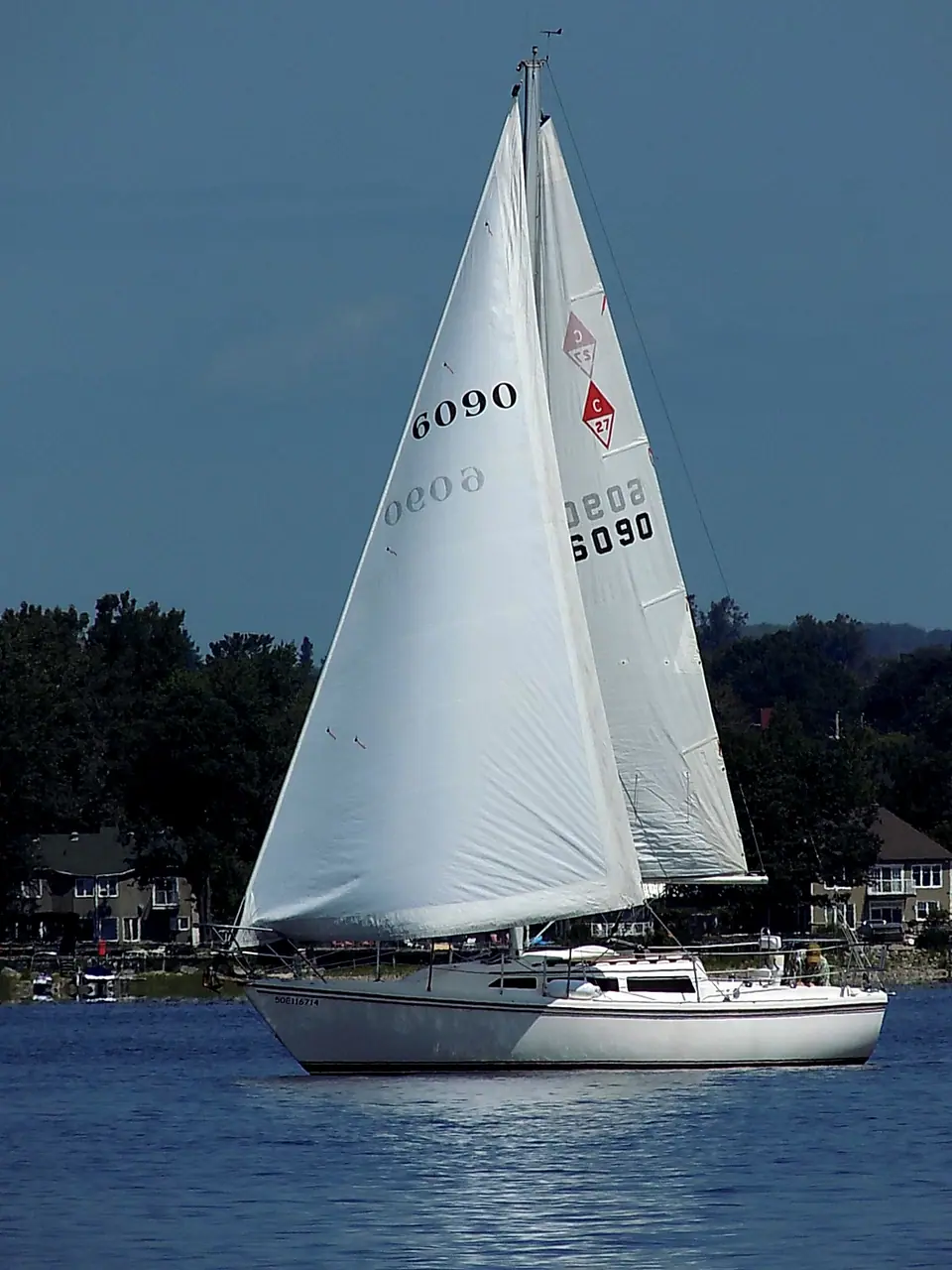
Catalina sold the 27 with a 4-foot standard keel or a roughly 3-foot shoal keel, and with a standard or tall mast. The combinations behave very differently. Practical Sailor puts the standard boat at around PHRF 208, at the fast end of comparable 27-footers like the Hunter 27, Ericson 27 and O'Day 27, and Wikipedia gives an average of 204.
The fastest version is a tall rig, deep keel boat with an outboard, because it carries the most sail and the least weight. The slowest is a shoal keel, standard rig boat with an inboard. If you race in a club PHRF fleet, hunt for the tall rig deep keel combination. If you cruise the Chesapeake, Florida Bay or a shallow reservoir, the shoal keel is a fair trade, though it gives away pointing ability.
Atomic 4, Petter or Universal: the engine defines the boat
Over twenty years Catalina used several power options, and the engine in the boat you are looking at matters more than the hull number. Early boats often had an outboard in a cockpit well. A 10 hp outboard can drive the hull to its roughly 6.25 knot hull speed, but the well installation is awkward and noisy.
Many boats carry the Universal Atomic 4, a four-cylinder gasoline inboard with about twice the power the boat needs. It is smooth, compact and well supported by specialist parts suppliers, but it is gasoline, so bilge blower discipline and fuel system condition are critical. Late 1970s boats sometimes have a 6 hp Petter diesel that Practical Sailor bluntly says should be avoided because it is underpowered and parts are scarce. The most desirable option is the later Universal diesel of 11 to 14 hp.
Engine access on all inboard versions is poor. Practical Sailor rated serviceability one or less on a five-point scale, and oil changes involve contortions behind the companionway steps. Factor that into your plans if you do your own maintenance.
- Outboard: lightest and fastest under sail, clumsy well installation
- Atomic 4 gasoline: plenty of power, good parts support, needs strict fuel safety
- Petter 6 hp diesel: underpowered and hard to source parts for
- Universal 11 to 14 hp diesel: the version most buyers want
Catalina 27 interior: traditional aft galley or midship dinette
Two layouts were built. The traditional plan places the galley aft by the companionway, which gives better storage and a starboard settee that converts to a double. The dinette plan moves the galley amidships and turns the table area into a double berth, raising the berth count to six, more than the boat can comfortably carry. Couples tend to prefer the traditional layout, while families with young kids like the dinette.
Practical Sailor judged the forward V-berth too short and narrow for two adults, with the quarter berths the only truly full-size sleeping spots. Later boats gained a seahood over the companionway to stop leaks, a molded anchor well, aft-facing hatches over the head and passage, and a relocated electrical panel with breakers on the starboard side instead of the vulnerable port quarter berth.
From 5,650 to 6,850 pounds: how the 27 got heavier
A detail many buyers miss is that the Catalina 27 grew heavier over its life. Practical Sailor reports the original 1971 deep keel outboard boat at about 5,650 pounds, while later versions are around 6,850 pounds, and shoal keel boats rose from about 6,150 to about 7,300. Add an inboard engine, a full cruising inventory and a dinghy on deck and many boats float below their painted waterline.
The practical result is that early, lighter boats are livelier in light air, while later boats are stiffer and more comfortable in a chop. Neither is wrong, but if you plan to race, an early outboard boat with a tall rig is the giant killer, and if you plan to cruise with gear, a later diesel boat is the calmer choice.
Chainplates, spreader sockets and other known weak spots
The Catalina 27's issues are well documented and mostly fixable. Original stanchions and deck hardware were installed without backing plates, causing gelcoat cracks and leaks into the plywood-cored deck, which then delaminates. Lower shroud U-bolt chainplates have failed on some boats, with rig failures as a result. Owners also report cracked original cast aluminum spreader sockets, and many boats now have stainless replacements.
Early through-hulls used gate valves threaded onto pipe nipples, which are not true seacocks and should be replaced. The icebox drain on some boats allows water to back up when heeled. None of these are deal breakers, but a boat that still has all of them unaddressed should be priced accordingly.
Catalina 27, 270 or 275 Sport: three boats behind one search
Shoppers searching for a Catalina 27 often land on the Catalina 270 and the Catalina 275 Sport, and they are very different boats. The Catalina 270, designed by Gerry Douglas and first built in 1992, replaced the 27. It is 27 feet overall with a 23-foot waterline and a much wider 9.83-foot beam, displaces about 6,400 pounds, and was powered by an 18 hp Perkins diesel. A 5-foot fin and a 3.5-foot wing keel were offered, along with an LE trim. It stayed in the range for many years and typically sells in the $15,000 to $40,000 range today.
The Catalina 275 Sport, launched in 2013, is a modern fractional rig daysailer and weekender, also by Gerry Douglas. It is 27.5 feet overall with an unusually long 26.6-foot waterline, an open reverse transom, a 14.6 hp Yanmar saildrive and a 5.22-foot fin or 3.66-foot wing keel. It is lighter at 5,000 pounds and much quicker, with a hull speed near 6.9 knots. Expect to pay several times the price of a classic 27 for one.
Catalina 27 sailboat for sale prices and yearly costs
Classic Catalina 27s list from about $3,000 for a boat needing an engine or deck work to around $20,000 for a late, well-equipped diesel boat with wheel steering and newer sails. Most clean, sailable boats sell between $8,000 and $15,000. Practical Sailor observed that Catalinas hold their value better than you would expect, and that remains true because demand from first-time cruisers is constant.
Annual costs of $4,000 to $10,000 cover a slip or mooring, insurance, haul-out and bottom paint, engine service and routine parts. The active Catalina 27/270 association and suppliers such as Catalina Direct make parts easy to find, and most work can be done by an owner with basic tools. Do not expect help from the builder, though. Catalina Yachts shut down in 2025 and its remaining assets were auctioned on June 9, 2026, leaving the association archives and aftermarket suppliers as the only source of model-specific knowledge for a boat that left production in 1991.
Catalina 27 specifications
| Length overall | 26.8 ft8.18 m |
|---|---|
| Waterline length | 21.8 ft6.63 m |
| Beam | 8.8 ft2.69 m |
| Draft | 4 ft1.22 m |
| Displacement | 6,85 lbs3,107 kg |
| Ballast | 2,7 lbs1,225 kg |
| Sail area | 342 sq ft31.8 m² |
| Cabins | 1 plus quarter berths |
| Berths | 5 to 6 |
| Heads | 1 |
| Standard engines | Outboard in a cockpit well on early boats; Atomic 4 gasoline inboard optional from 1972 |
| Optional engines | Petter 6 hp diesel (late 1970s), Universal 11 to 14 hp diesel (later boats) |
| Hull type | Fiberglass monohull with fin keel |
| Keel | Lead fin keel, 4 ft standard or 3 ft shoal draft |
| Rig | Masthead sloop, standard or tall mast |
| Hull construction | Solid fiberglass hull, plywood-cored fiberglass deck |
| Builder | Catalina Yachts, United States |
| Naval architect | Frank V. Butler |
| Other design credits | Robert Finch (co-designer) |
| Production | 1971 to 1991 |
| Status | Discontinued |
Figures come from builder documentation and independent tests where available. Displacement is usually quoted light, so a loaded cruising boat will weigh more. Compare these specs with another model.
How much does a Catalina 27 cost?
The engine is the biggest price driver. A Catalina 27 with a rebuilt Atomic 4 or a healthy Universal diesel, wheel steering and a newer headsail sells two to three times higher than a similar hull with a seized or missing engine. Deck core moisture is the second, because a soggy deck can cost more to fix than the boat is worth.
Estimate your yearly cost
A planning estimate using common rules of thumb: insurance near 1.5 percent of value, maintenance near 3 percent, haul out and bottom paint by length. Your marina, region and use will move these numbers. Open the full cost calculator.
Versions and options
- Catalina 27 standard keel
- 4-foot lead fin, the most common and best pointing version.
- Catalina 27 shoal draft (SD)
- About 3-foot draft for thin water, heavier and slower upwind.
- Tall mast (TM)
- Taller rig for light air, available with either keel.
- Catalina 270 (1992 onward)
- Gerry Douglas replacement with a wider hull, diesel inboard and fin or wing keel.
- Catalina 275 Sport (2013 onward)
- Modern fractional rig weekender with an open transom and Yanmar saildrive.
Catalina 27 timeline
- 1971Catalina 27 introduced with an outboard well; the Atomic 4 inboard option follows in 1972
- Late 1970sPetter diesel offered briefly before Universal diesels take over
- 1991Production ends after 6,662 boats
- 1992Catalina 270 replaces the 27
- 2013Catalina 275 Sport introduced as a new-generation 27-footer
Strengths and weaknesses
What owners like
- Enormous used supply keeps prices low
- Inboard power and a real cabin for a modest budget
- Competitive PHRF rating for its size and era
- Balanced, easy handling for new sailors
- Strong owner association and parts support
- Proven on long coastal and some offshore passages
What to weigh up
- Plywood-cored deck prone to rot around unbacked hardware
- Engine access is notoriously poor
- V-berth is short and narrow
- Early chainplates and spreader sockets need upgrading
- Many boats are overloaded and sit low on their lines
Used Catalina 27 buyer checklist
Take this list to a viewing. Your ticks are saved in this browser so you can come back to it.
Always commission an independent marine survey and an engine survey before you buy. How a marine survey works.
Rivals to consider
Catalina 25
Smaller and trailerable, cheaper to keep, but outboard power only on most boats.
Compare side by sideCatalina 30
The obvious step up, with a full galley, enclosed head and far more room for a modest price increase.
Compare side by sideBeneteau First 27
A modern performance 27-footer that is far faster and far more expensive.
Compare side by sideEricson 27
Similar era and size with a slightly more refined finish and fewer boats on the market.
Our verdict on the Catalina 27
The Catalina 27 is the most practical way to own an inboard cruising sailboat for the price of a used car. Its construction is basic and its problems are well known, but every one of them has a published fix and a supplier selling the part. Buy the best engine and the driest deck you can find, preferably a Universal diesel boat, and you will have a capable coastal cruiser that is easy to sell later. If your budget stretches, look at a Catalina 270 for more space, or a 275 Sport if you want a modern boat that sails fast.
Catalina 27 questions answered
How much is a Catalina 27 worth today?
Most used Catalina 27s sell for $8,000 to $15,000, with project boats from about $3,000 and the best diesel boats near $20,000.
What engine does a Catalina 27 have?
Depending on year, an outboard, an Atomic 4 gasoline inboard, a Petter 6 hp diesel or a Universal 11 to 14 hp diesel. The Universal diesel is the most desirable.
What is the difference between the Catalina 27 and the Catalina 270?
The 270 is a 1992 Gerry Douglas design with a much wider beam, more interior volume and a diesel engine. It replaced the original 27.
Is the Catalina 275 Sport a good boat?
It is a modern, quick fractional rig weekender with a long waterline and Yanmar saildrive, aimed at sailors who want performance and simplicity rather than cruising volume.
Can a Catalina 27 sail offshore?
Catalina 27s have reached Bermuda and the Caribbean, but it is a coastal design at heart, and any offshore attempt needs rig, chainplate and hatch upgrades.
Catalina 27 photos
More cruising sailboats to explore
Bavaria 820
Cruising Sailboats, 27 ft
Used $7K to $18K
Hunter 27
Cruising Sailboats, 27 ft
Used $5K to $50K
MacGregor 26X
Cruising Sailboats, 26 ft
Used $9K to $25K
Catalina 28
Cruising Sailboats, 29 ft
Used $18K to $62K