Catalina Yachts Cruising Sailboats
Catalina 36 Buyer's Guide, From Hull No. 1 to the Mk II
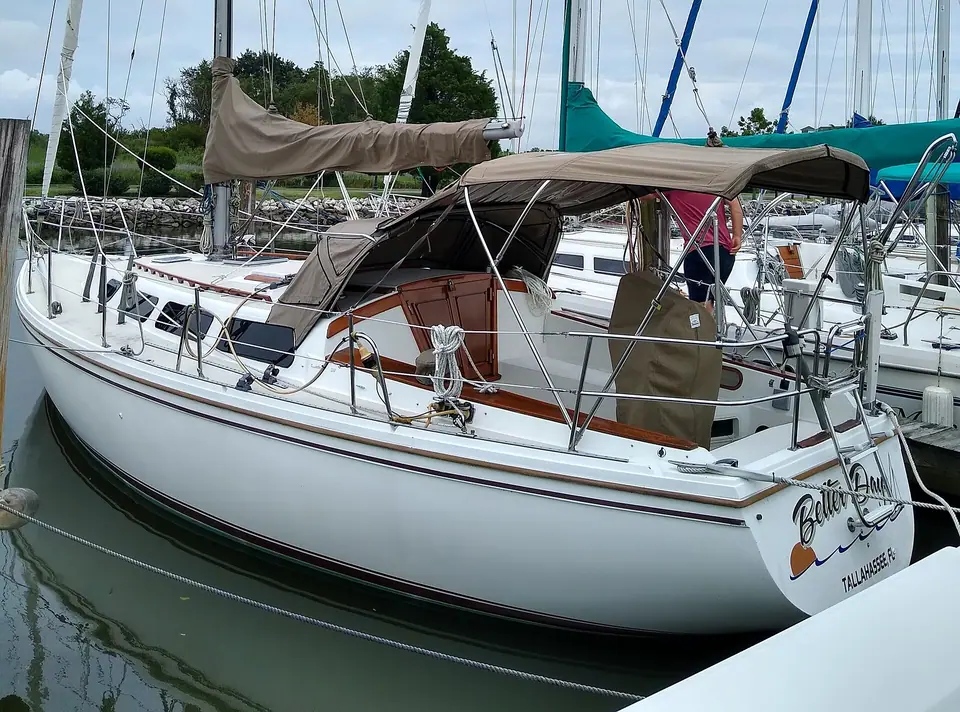
Gerry Douglas's first design became one of America's most popular 36 ft sailboats, with 2,305 built and an owners' association that knows every bolt.
- Length
- 36.3 ft11.07 m
- Beam
- 11.9 ft3.63 m
- Draft
- 5.8 ft1.78 m
- Cabins
- 2 (V-berth forward, aft cabin under the cockpit)
- Used price
- $25K to $95K
On this page
- Overview
- Gerry Douglas's first boat, and 2,305 more
- What changed with the 1994 Mk II
- Practical Sailor's blustery Puget Sound test
- Deck details that owners change
- The famous game table and a 78 inch aft berth
- Universal diesel, 25 gallons and a hard-to-reach port side
- Buying a 36 ft sailboat with this much history
- Specifications
- Price and value
- Strengths and weaknesses
- Used buyer checklist
- Rivals
- Our verdict
- FAQ
The Catalina 36 is a masthead sloop built in California from 1982, with the Mk II arriving in 1994 at hull No. 1368. Cruising World puts total production at 2,305 boats, and the 36 was replaced by the Catalina 375 after the Mk II ended in the mid-2000s.
- Couples and families cruising coastally
- One-design and PHRF club racing
- First big cruising boat buyers
- Southern California, Great Lakes and Chesapeake sailing
Catalina 36 by the numbers
- Sail area to displacement
- 15.4A cruising rig sized for comfort, so expect to motor in very light air.
- Displacement to length
- 218Moderate displacement, a classic cruising balance between load carrying and speed.
- Theoretical hull speed
- 7.4 knThe practical top speed of a displacement monohull under normal sailing, based on waterline length.
- Ballast ratio
- 44%A high ballast ratio, so the boat stands up well to a breeze.
- Capsize screening
- 2.00Above 2.0, so this hull leans toward coastal stability over ultimate offshore resistance.
- Motion comfort ratio
- 24.0A quicker motion in waves, typical of light, beamy hulls.
- Length to beam ratio
- 3.05 : 1Moderate proportions.
Gerry Douglas's first boat, and 2,305 more
The Catalina 36 began a long career for its designer. Gerry Douglas, who later became Catalina's chief designer and co-owner, has said the 36 was his first design, drawn in 1982. Catalina's history records that the first Catalina 36 was completed in July 1982 at the Woodland Hills, California, plant. When Douglas announced his retirement, Cruising World put total Catalina 36 production at 2,305 boats.
Practical Sailor described the 36 as an extraordinarily popular design. Catalina built hull No. 2000 in December 2000, and the boat stayed in production into the mid-2000s before the Catalina 375 took over the slot in 2008. Few 36 ft sailboats in the US come close to those numbers, and that is the single best reason to buy one: parts, knowledge and fellow owners are everywhere, backed by the Catalina 36 International Association.
Douglas told Practical Sailor that the target buyer was a couple or family who mostly weekends and takes vacation cruises, may plan some extended cruising and wants a comfortable, stable and predictable boat that fits the budget.
What changed with the 1994 Mk II
The Catalina 36 Mk II was introduced in August 1994, starting at hull No. 1368, and won a Cruising World Boat of the Year award in March 1995. The hull did not change, because Catalina wanted the boat to keep sailing as a one-design fleet, but the Mk II got a larger cockpit and a modified deck and interior. Douglas told Practical Sailor that three different decks were built over the years, with most changes cosmetic or ergonomic.
Construction also evolved. Later decks were cored with end-grain balsa, while earlier versions used plywood, and Catalina used vinylester resin in the outer hull plies under the gelcoat to resist osmotic blistering. The standard rudder was later reshaped to a semi-elliptical blade, and an optional Scheel keel that had limited success was replaced by a shoal draft wing keel.
For buyers, the Mk II's bigger cockpit and updated deck make it the more comfortable boat for entertaining at the dock and for cruising couples. The Mk I sails the same way and costs much less.
Practical Sailor's blustery Puget Sound test
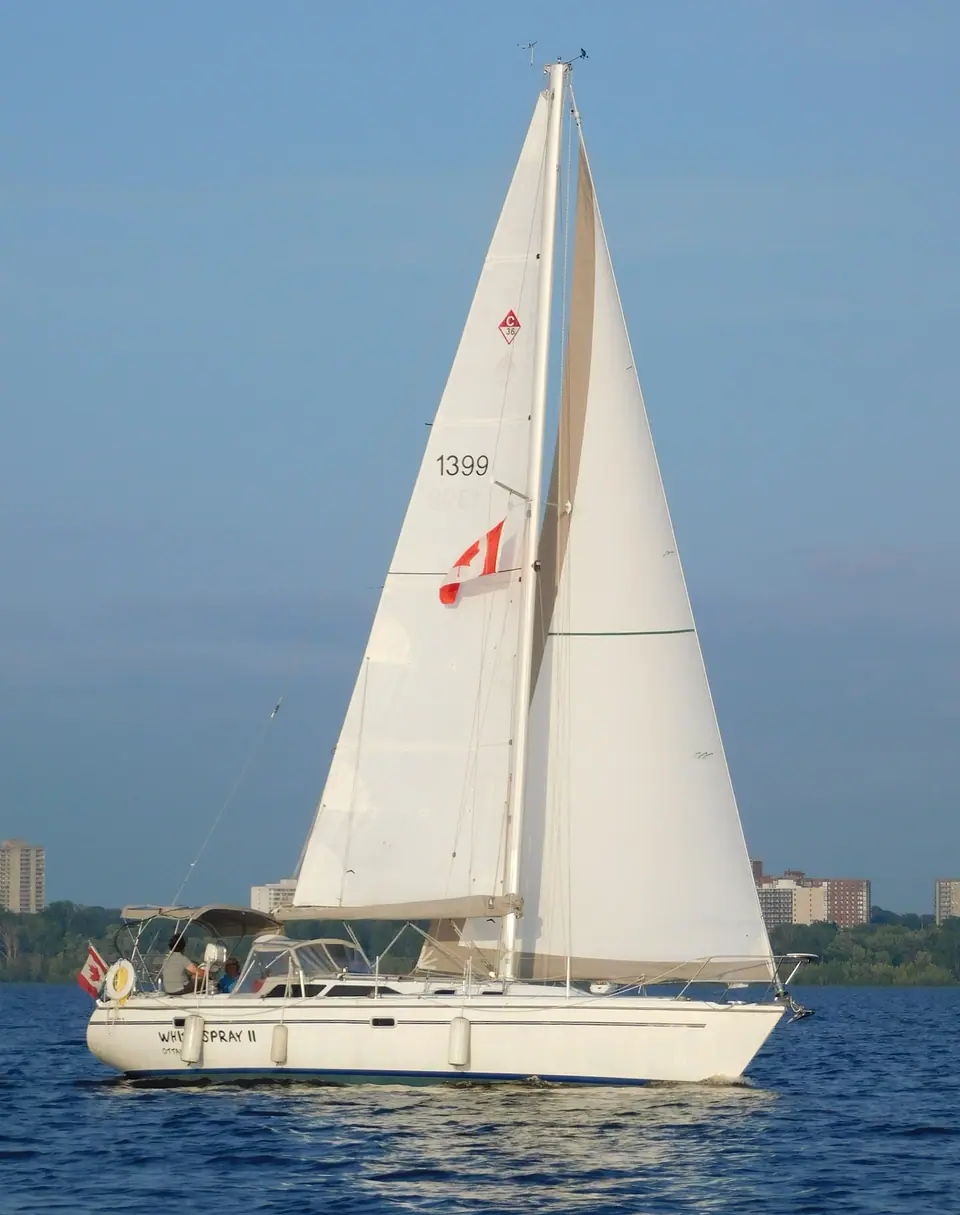
Practical Sailor tested a three year old Mk II with the tall rig on Puget Sound in 15 to 30 knots of wind, loaded for cruising with kayaks on deck and a dinghy in tow. Under full main alone in 16 knots true it made 5.7 knots. Upwind with full main and a 135 percent genoa it made 5.5 to 6 knots, and reefing the main flattened it to about 15 degrees of heel and lifted speed to 6.2 knots.
With a second reef and the headsail rolled to 105 percent, the boat made 7.1 knots upwind with water coming over the bow and touched 7.6 knots. Off the wind on a broad reach it reached 8 to 8.5 knots, a knot above theoretical hull speed. Tacking angles were about 100 to 110 degrees, which the magazine called not stellar but normal. The testers recommended a backstay adjuster to control headstay sag and better-cut sails than the standard inventory.
The numbers back that up. Sailboatdata lists a sail area to displacement ratio of about 15.4 on the standard rig and a ballast ratio of about 44 percent, which explains why the 36 likes to be reefed early and then stands up well in a breeze. PHRF ratings run about 140 to 150 depending on the fleet.
Deck details that owners change
Practical Sailor measured the Mk II cockpit at 8 ft 8 in with 17 inch seats and comfortable backrests, steered by a 42 inch wheel that eases heavy-weather steering but blocks movement forward when singlehanding. Side decks are 17 inches wide with a 1.5 inch toerail and a cabintop handrail running the full length.
The magazine also pointed out weaknesses that many owners fix: stanchions only 24 inches high, wet cockpit seats that get slippery when heeled, an inboard genoa track about a foot too short for reefed upwind sailing, and standard Dacron running rigging. Primary winches were self-tailing Lewmar 48s, the furler a Schaeffer 2100, and most deck hardware came from Garhauer.
The famous game table and a 78 inch aft berth
Below, the layout stayed essentially unchanged for almost 20 years. The saloon runs 13 ft 4 in from the companionway to the forward cabin with up to 6 ft 5 in of headroom. The galley is L-shaped to port at the foot of the companionway with a two-burner propane stove and double sinks, opposite a U-shaped dinette, with an L-shaped dinette also offered.
The quirk everyone remembers is the game table, flanked by two heavily cushioned chairs, which can be lowered to make a 6 ft 2 in berth. Douglas said it had been part of the design since hull No. 1 and was the first of its type in the industry. The head is forward to port with access from both the saloon and the forward cabin, and the V-berth measures 90 inches wide at the head.
The aft cabin under the cockpit holds a 78 by 80 inch double, though with only 16 inches between the cushion and the cockpit sole above. Practical Sailor's owner survey found the main complaint was average joinery, from cabinet corners that do not fit squarely to drawers that need planing, which owners accept on a production boat.
Universal diesel, 25 gallons and a hard-to-reach port side
The Mk II's standard engine was a four-cylinder Universal 35B, rated at 35 hp by sailboatdata, with Catalina estimating fuel use at about 0.8 gph at 2,200 rpm. Practical Sailor found it held the boat head to wind easily in 25 knot gusts and gave quick response under power. Access is through the companionway steps and panels in the aft cabin, and reaching the port side of the engine is awkward.
Tankage is coastal: 25 gallons of fuel under the aft berth and 72 gallons of water. That is enough for weekends and Bahamas hops, but long-distance cruisers usually add jerry cans or a watermaker.
Buying a 36 ft sailboat with this much history
Whether you are browsing 36 foot sailboats for sale in Marina del Rey or on the Chesapeake, the Catalina 36 will be on the list, often several at once. That supply keeps prices sensible and lets you be picky. We estimate $8,000 to $20,000 a year to keep one, depending mostly on slip fees, plus a reserve for sails, rigging and eventual repower.
Focus the survey on a few known issues. Practical Sailor's owners reported leaking chainplates that need annual inspection or rebedding, and the lower shrouds load the hull through tie rods that should be checked. Keel bolts and the keel joint deserve attention on any boat of this age, and the Catalina 36 International Association is the best place to learn what other owners have found.
Catalina 36 specifications
| Length overall | 36.3 ft11.07 m |
|---|---|
| Waterline length | 30.3 ft9.22 m |
| Beam | 11.9 ft3.63 m |
| Draft | 5.8 ft1.78 m |
| Air draft | 50.2 ft15.29 m |
| Displacement | 13,5 lbs6,123 kg |
| Ballast | 6, lbs2,722 kg |
| Sail area | 545 sq ft50.6 m² |
| Fuel capacity | 25 gal95 L |
| Fresh water | 72 gal273 L |
| Cabins | 2 (V-berth forward, aft cabin under the cockpit) |
| Berths | 5 to 7 including the convertible dinette and game table berth |
| Heads | 1 with shower |
| Standard engines | Universal 35B diesel, 35 hp, on the Mk II; Mk I engines vary by year |
| Maximum power | 35 hp |
| Hull type | Moderate displacement fin keel monohull with spade rudder |
| Keel | Lead fin, 5 ft 10 in, or wing keel 4 ft 5 in (14,100 lb displacement, 6,600 lb ballast); early Scheel keel option |
| Rig | Masthead sloop, standard or tall rig (2 ft taller, 601 sq ft) |
| Hull construction | Hand-laid solid fiberglass with vinylester outer plies, bonded liner, balsa-cored deck on later boats |
| Builder | Catalina Yachts, United States |
| Naval architect | Gerry Douglas |
| Other design credits | Frank Butler (Catalina founder, credited by sailboatdata) |
| Production | 1982 to 2005 |
| Status | Discontinued |
Figures come from builder documentation and independent tests where available. Displacement is usually quoted light, so a loaded cruising boat will weigh more. Compare these specs with another model.
How much does a Catalina 36 cost?
Mk II boats from 1994 on, with their bigger cockpit, updated deck and balsa-cored rather than plywood-cored deck, sell for clearly more than Mk Is. Within each version the engine, deck moisture, chainplate condition and sail inventory drive price far more than model year. Tall rig and wing keel boats each have their own regional fans, and Southern California, the Chesapeake and the Great Lakes all have deep markets. These are our 2026 US brokerage estimates.
Estimate your yearly cost
A planning estimate using common rules of thumb: insurance near 1.5 percent of value, maintenance near 3 percent, haul out and bottom paint by length. Your marina, region and use will move these numbers. Open the full cost calculator.
Versions and options
- Catalina 36 Mk I (1982 to 1994)
- Original deck and smaller cockpit; plywood-cored decks on earlier boats.
- Catalina 36 Mk II (1994 onward)
- Same hull and rig with a larger cockpit and updated deck and interior; Universal 35B diesel.
- Wing keel
- 4 ft 5 in draft, 14,100 lb displacement and 6,600 lb ballast.
- Tall rig
- About 2 ft taller with roughly 601 sq ft of sail for light-air areas.
Catalina 36 timeline
- 1982First Catalina 36 completed at Woodland Hills, California, in July
- 1994Mk II introduced in August at hull No. 1368
- 1995Catalina 36 Mk II wins a Cruising World Boat of the Year award
- 2000Hull No. 2000 built in December
- 2008Catalina 375 introduced as the replacement
Strengths and weaknesses
What owners like
- Huge owner base and parts availability
- Stiff, with about 44 percent ballast ratio
- Comfortable 8 ft 8 in Mk II cockpit
- Versatile game table that converts to a berth
- Wing keel and tall rig options
- Affordable to buy and keep
What to weigh up
- Low 24 inch stanchions for offshore use
- Chainplate leaks are a common owner complaint
- Only 25 gallons of fuel
- Average interior joinery
- Tight clearance above the aft berth
Used Catalina 36 buyer checklist
Take this list to a viewing. Your ticks are saved in this browser so you can come back to it.
Always commission an independent marine survey and an engine survey before you buy. How a marine survey works.
Rivals to consider
Catalina 375
The 2008 replacement, roomier and more expensive.
Our verdict on the Catalina 36
The Catalina 36 is the definition of a safe buy. It sails better than its production-boat image suggests, especially reefed in a breeze, it has a comfortable cockpit and a clever interior, and with more than 2,300 built you will never be alone with a problem. Check the chainplates, keel bolts and engine with care, favor a Mk II if the budget allows, and you will have a coastal cruiser and club racer that holds its value better than most boats of its age.
Catalina 36 questions answered
How many Catalina 36s were built?
Cruising World reported 2,305 Catalina 36s, making it one of the most popular 36 ft sailboats ever built in the US.
What is the difference between the Catalina 36 Mk I and Mk II?
The Mk II, introduced in August 1994 at hull No. 1368, kept the same hull and rig but added a larger cockpit and updated deck and interior.
Who designed the Catalina 36?
It was Gerry Douglas's first design for Catalina in 1982; sailboatdata also credits founder Frank Butler.
What is the draft of the Catalina 36?
About 5 ft 10 in with the standard fin keel and 4 ft 5 in with the wing keel.
How fast is a Catalina 36?
Practical Sailor saw 7.1 to 7.6 knots upwind reefed in a strong breeze and 8 to 8.5 knots on a broad reach; hull speed is about 7.4 knots.
How much is a Catalina 36 sailboat for sale?
We expect roughly $25,000 to $95,000 in 2026, with Mk II boats from the late 1990s and 2000s at the top.
Catalina 36 photos
More cruising sailboats to explore
Beneteau Oceanis 36 CC
Cruising Sailboats, 36 ft
Used $45K to $80K
Beneteau Oceanis Clipper 361
Cruising Sailboats, 36 ft
Used $55K to $88K
Dufour 36 Classic
Cruising Sailboats, 36 ft
Used $50K to $85K
Hanse 371
Cruising Sailboats, 37 ft
Used $55K to $90K