Contessa (Jeremy Rogers) Bluewater Sailboats
Contessa 26 Pocket Ocean Cruiser, Specs and Buying Advice
A 25 foot 6 inch long-keel sloop born from the Nordic Folkboat that carried two teenagers around the world and still costs less than a used car.
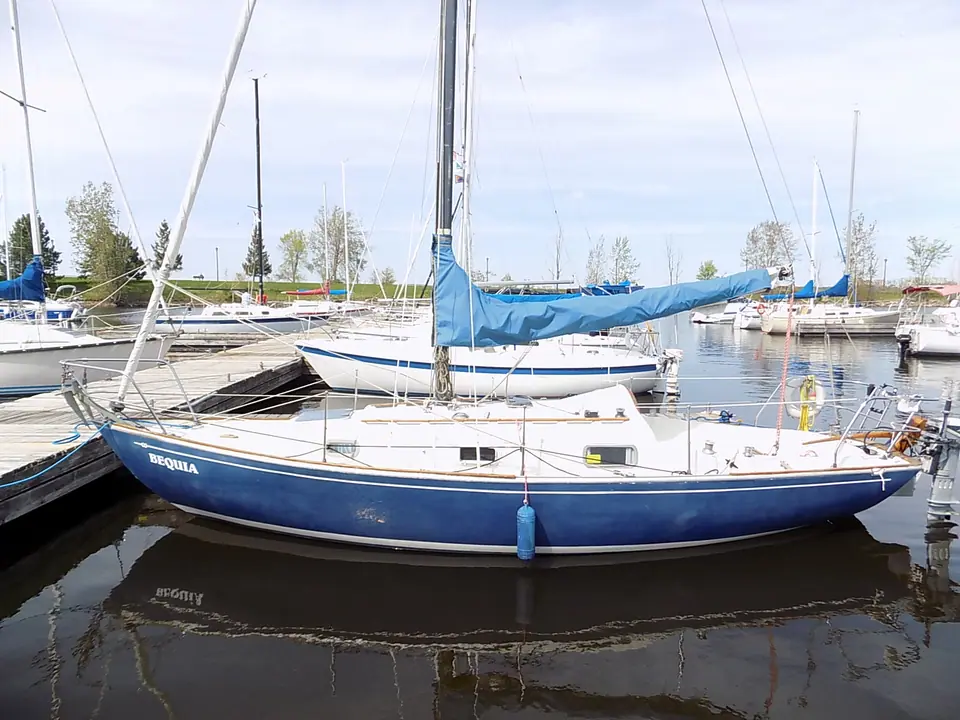
- Length
- 25.5 ft7.77 m
- Beam
- 7.5 ft2.29 m
- Draft
- 4 ft1.22 m
- Cabins
- 1 (open plan)
- Used price
- $8K to $40K
On this page
- Overview
- Folkboat bones, offshore ambitions
- Two builders and two versions, Lymington and Ontario
- The small boat that took teenagers around the world
- Sitting headroom and a companionway with no sliding hatch
- Stiff, wet and dependable under sail
- Tired original engines and the repower decision
- Iron in the keel, teak on the deck
- What a Contessa 26 needs before a long passage
- What Contessa 26s sell for in North America
- Specifications
- Price and value
- Strengths and weaknesses
- Used buyer checklist
- Rivals
- Our verdict
- FAQ
David Sadler's 1966 Folkboat-derived pocket cruiser, about 750 built by Jeremy Rogers in England and J.J. Taylor in Canada. Tiny inside, wet and slow to windward, yet one of the most proven small ocean boats ever.
- Solo ocean sailors on a budget
- First offshore boat for a young sailor
- Weekend cruising on lakes and coastal waters
Folkboat bones, offshore ambitions
The Contessa 26 starts with the Nordic Folkboat, conceived by Sweden's Royal Gothenburg Sailing Club in 1939 as an affordable family boat, sometimes called the VW of the seas. In 1965 David Sadler and Jeremy Rogers took the Folkboat's narrow, long-keeled hull and turned it into a fiberglass offshore cruiser, with a masthead rig, more freeboard and a cabin. The first boats were launched in 1966.
The result measures 25 feet 6 inches overall, 20 feet on the waterline and only 7 feet 6 inches wide, and displaces 5,400 pounds with 2,300 pounds of ballast. The ballast ratio is about 43 percent, the displacement to length ratio about 300 and the sail area to displacement ratio near 15.8. Those are serious offshore numbers for a boat you can almost fit in a two-car garage.
Contessa 26 by the numbers
- Sail area to displacement
- 15.8A cruising rig sized for comfort, so expect to motor in very light air.
- Displacement to length
- 301Heavy displacement. Slow to accelerate but steady and sea kindly with a full load.
- Theoretical hull speed
- 6.0 knThe practical top speed of a displacement monohull under normal sailing, based on waterline length.
- Ballast ratio
- 43%A high ballast ratio, so the boat stands up well to a breeze.
- Capsize screening
- 1.71Below 2.0, the traditional threshold for offshore suitability.
- Motion comfort ratio
- 26.3Moderate motion comfort, typical of modern cruisers.
- Length to beam ratio
- 3.40 : 1Moderate proportions.
Two builders and two versions, Lymington and Ontario
Jeremy Rogers built about 350 Contessa 26s in Lymington, England, between 1966 and 1977. Maclan Marine built a few around 1977 to 1978. Across the Atlantic, J.J. Taylor and Sons of Toronto built about 400 under license from 1970 to 1990, marketing them as the J.J. Taylor 26 after 1984. Some of those later boats got a deck molding with an enlarged hump by the companionway for a little more headroom.
Owner sources report that Taylor's later boats, from about 1983, switched from encapsulated iron to cast lead ballast, which removes the risk of iron corroding and swelling inside the keel. Confirm it on the specific boat rather than trusting the build year. For a US buyer, a late Taylor boat with lead ballast and the revised deck is the one to look for.
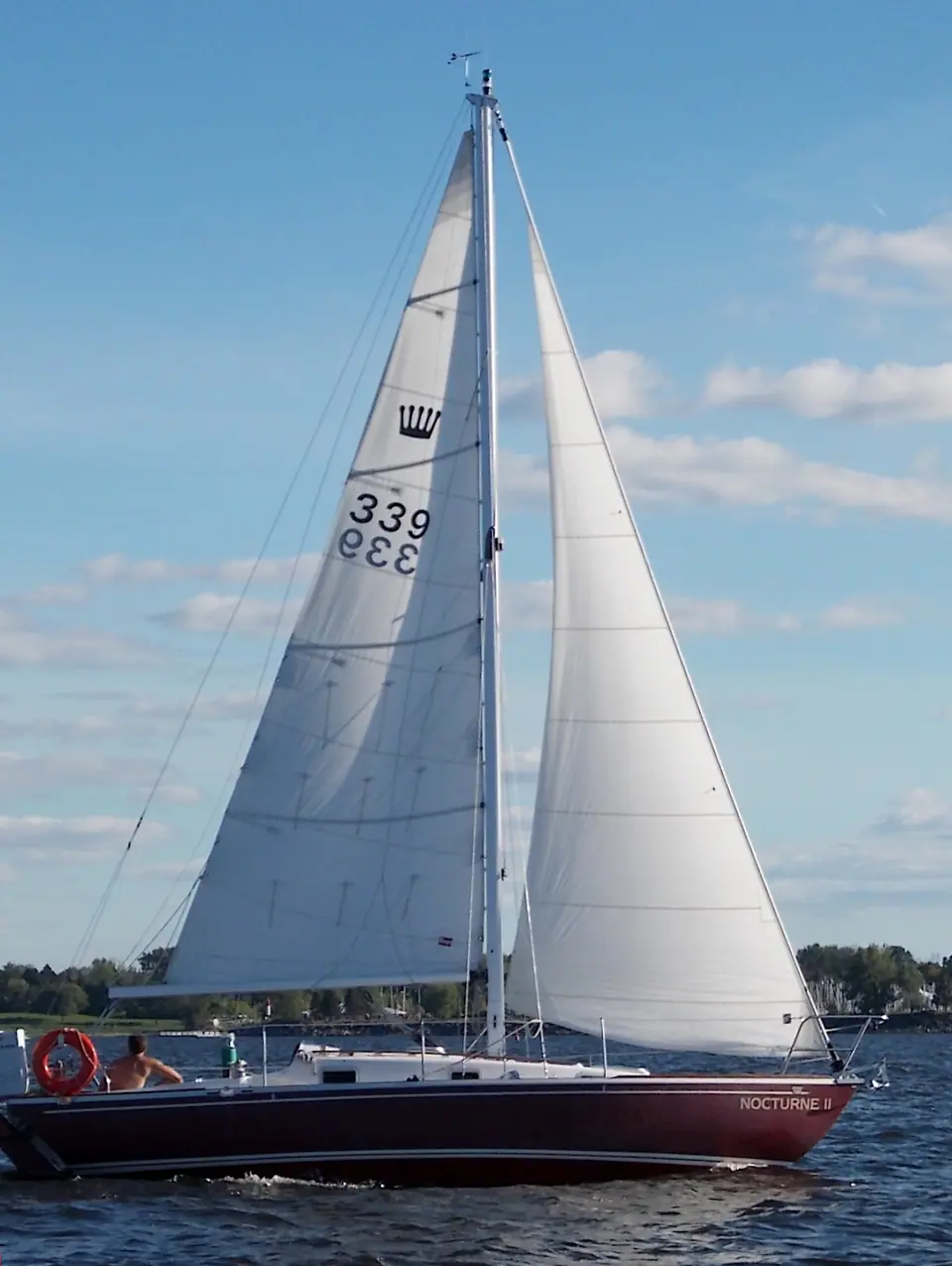
The small boat that took teenagers around the world
The Contessa 26 owes its fame to the people who sailed it far beyond what a 25 footer should. Tania Aebi sailed Varuna, a Contessa 26, around the world singlehanded in the 1980s and wrote about it in Maiden Voyage. In 1995 and 1996 Brian Caldwell sailed a 27,000 mile solo circumnavigation, starting at 19, in Mai Miti Vavau, a J.J. Taylor boat, becoming at the time the youngest to do so.
Others followed. Nick Jaffe sailed Constellation from the Netherlands to Sydney between 2007 and 2010, Peter Hancock wrote three books about his ocean voyages, and in 2008 Stephane Tremblay crossed from New Jersey to Spain alone and without an engine in Joshua III. In its early years the boat also raced in the OSTAR and Round Britain races between 1970 and 1976.
Sitting headroom and a companionway with no sliding hatch
There is no standing headroom below. The layout is a V-berth forward, a hanging locker to port and toilet to starboard, then the main bulkhead, with the galley to port and chart table to starboard and two berths running aft under the cockpit seats. All berths exceed 6 feet. Owners describe the cabin as warm, efficient and secure at sea, though ventilation is poor.
The companionway is unusual: there is no sliding main hatch, which keeps the cabin roof strong, and the coach roof rises sharply aft. Combined with the solid fiberglass deck, the design is built to take boarding seas. The foredeck can flex, though, since solid laminate without a core is less stiff than a cored panel, and the side decks and foredeck are narrow.
Stiff, wet and dependable under sail
The boat heels early and then locks in. Cruising World reported that it can carry full sail in up to about 20 knots of wind and comfortably make 120 mile days on passage. It tracks exceptionally well for its length and hobbyhorses very little despite the short waterline.
Opinions on windward ability vary. Some reviewers praise how close it sails; others call upwind performance modest. In practice, a well-sailed boat points respectably in smooth water but slows in a short chop. It is wet in rough conditions because of low freeboard and narrow beam, and the bridgedeck is low with a cockpit sole close to the waterline, so the cockpit drains slowly. Keep washboards in and lockers secured offshore.
Tired original engines and the repower decision
Original engines were tiny: a Vire gasoline engine on many boats, or a 7 hp Petter diesel, later replaced by a variety of small single-cylinder diesels. Parts for most of these are hard to find, and even the healthy ones are marginal against wind and tide.
A modern single or twin-cylinder diesel of about 10 to 14 hp is the usual repower. Installed by a yard it can approach the value of the boat, which is why buyers should pay noticeably more for a boat that has already been done. Built-in fuel and water tankage is tiny, so offshore crews carry extra jerry cans.
Iron in the keel, teak on the deck
Age brings predictable problems. Teak deck overlays on older boats deteriorate and leak. Osmotic blisters are common on hulls built before the mid 1980s. On the many boats with encapsulated iron ballast, water that reaches the iron causes it to rust and swell, which can delaminate the surrounding glass, so look for cracks or weeping along the keel.
Standing rigging and deck-stepped mast hardware need a close look, including the deck beam and bulkhead that carry the mast load. Annual running costs are low, about $2,500 to $6,000 a year in most US regions for a slip, insurance and maintenance, and the boat is small enough to store ashore on a cradle for very little.
What a Contessa 26 needs before a long passage
The boats that crossed oceans were not stock. Owners added storage for water in jugs, a wind vane, a storm jib on a removable inner stay with running backstays, and solid companionway boards that lock in place. With a low bridgedeck, many also fit a higher companionway sill or keep the lower board in at all times offshore.
Spend the budget in this order: rig and chainplates, steering, bilge pumps, then electronics. On a boat this small every pound counts, so resist the urge to carry the equipment list of a 40 footer; the Contessa 26 rewards a light, simple fit-out.
What Contessa 26s sell for in North America
Asking prices typically run $8,000 to $40,000. The market is concentrated around the Great Lakes, the Northeast and the Pacific Northwest, where Taylor boats are common. Expect a fair price between $12,000 and $25,000 for a sound boat with an older engine, and more for a recent repower and new rigging.
If you want a proven small ocean boat on the smallest possible budget, the Contessa 26 is among the best choices. If you want to live aboard or carry guests, it is simply too small.
Contessa 26 specifications
| Length overall | 25.5 ft7.77 m |
|---|---|
| Waterline length | 20 ft6.1 m |
| Beam | 7.5 ft2.29 m |
| Draft | 4 ft1.22 m |
| Displacement | 5,4 lbs2,449 kg |
| Ballast | 2,3 lbs1,043 kg |
| Sail area | 304 sq ft28.2 m² |
| Cabins | 1 (open plan) |
| Berths | 4 to 5 |
| Heads | 1 |
| Standard engines | Small inboard, originally a Vire gasoline engine or a 7 hp Petter diesel |
| Optional engines | Most boats now repowered with modern small diesels |
| Hull type | Narrow long-keel displacement monohull |
| Keel | Long keel with encapsulated iron ballast (2,300 lb) and transom-hung rudder; owner sources report lead ballast on some later J.J. Taylor boats |
| Rig | Masthead sloop, deck-stepped, convertible to cutter with running backstays |
| Hull construction | Solid fiberglass hull and deck with no balsa core; encapsulated ballast |
| Builder | Jeremy Rogers (UK) and J.J. Taylor and Sons (Canada), United Kingdom |
| Naval architect | David Sadler |
| Other design credits | Jeremy Rogers (development); Nordic Folkboat lineage |
| Production | 1966 to 1990 |
| Status | Discontinued |
Figures come from builder documentation and independent tests where available. Displacement is usually quoted light, so a loaded cruising boat will weigh more. Compare these specs with another model.
How much does a Contessa 26 cost?
Most Contessa 26s in North America are J.J. Taylor boats from Ontario, and asking prices are set mainly by engine condition and rig age. A boat with an original 1970s engine, an old deck-stepped rig and soft decks belongs at the bottom; a late lead-keel Taylor boat with a modern diesel and new sails sits near the top.
Estimate your yearly cost
A planning estimate using common rules of thumb: insurance near 1.5 percent of value, maintenance near 3 percent, haul out and bottom paint by length. Your marina, region and use will move these numbers. Open the full cost calculator.
Contessa 26 timeline
- 1939Nordic Folkboat conceived in Sweden, the Contessa 26's ancestor
- 1966First Contessa 26s launched by Jeremy Rogers in Lymington
- 1970J.J. Taylor begins licensed production in Toronto
- 1983Owner sources date Taylor's switch to cast lead ballast to about this year
- 1990Production ends at about 750 boats
- 1996Brian Caldwell completes a solo circumnavigation begun at 19
Strengths and weaknesses
What owners like
- Proven by multiple solo circumnavigations
- High ballast ratio and strong self-righting ability
- Solid fiberglass construction with no balsa core
- Very cheap to buy, berth and maintain
- Tracks well and handles strong winds
What to weigh up
- No standing headroom and limited ventilation
- Wet in rough water, with a low bridgedeck
- Tiny water and fuel tankage
- Original engines are underpowered and hard to repair
Used Contessa 26 buyer checklist
Take this list to a viewing. Your ticks are saved in this browser so you can come back to it.
Always commission an independent marine survey and an engine survey before you buy. How a marine survey works.
Rivals to consider
Contessa 32
The bigger sister with a fin keel, more space and better windward speed, at two to three times the price.
Compare side by sidePacific Seacraft Dana 24
A beamier American pocket cruiser with far more interior and a better finish, and higher prices.
Compare side by sidePacific Seacraft Flicka 20
Smaller but with standing headroom on later boats, aimed at couples cruising coastal waters.
Compare side by sideAlbin Vega 27
A Swedish fin-keel contemporary with more room inside and its own ocean record.
Our verdict on the Contessa 26
The Contessa 26 is the cheapest proven ocean boat you can realistically buy, and its record is not a marketing story. It is small, wet and cramped, and you will crouch below. But it is strong, stiff, honest and simple. Buy a late Taylor boat, ideally one confirmed to have lead ballast, with a recent repower, spend money on rigging rather than cosmetics, and you have a boat that has already shown it can sail around the world.
Contessa 26 questions answered
How much is a Contessa 26 for sale?
Most ask between $8,000 and $40,000, with good boats with recent repowers commonly between $20,000 and $35,000.
Has a Contessa 26 sailed around the world?
Yes. Tania Aebi and Brian Caldwell both completed solo circumnavigations in Contessa 26s.
What is the difference between a Contessa 26 and a J.J. Taylor 26?
They are the same design. Taylor built about 400 under license in Canada and later sold them as the J.J. Taylor 26.
Does the Contessa 26 have standing headroom?
No. It has sitting headroom only, though all berths are over 6 feet long.
Is the Contessa 26 a good first bluewater boat?
Yes, for a solo sailor or a hardy couple, if you accept the tight interior and prepare the rig and engine properly.
How fast is a Contessa 26?
Hull speed is roughly 6 knots on its 20 foot waterline, and Cruising World reported that the boat can comfortably make 120 mile days on passage.
Who designed the Contessa 26?
David Sadler designed it with builder Jeremy Rogers in 1965, adapting the hull of the Nordic Folkboat.
Contessa 26 photos
More bluewater sailboats to explore

Nor'Sea 27
Bluewater Sailboats, 27 ft
Used $35K to $85K
Pacific Seacraft Flicka 20
Bluewater Sailboats, 24 ft
Used $18K to $70K
Pacific Seacraft Dana 24
Bluewater Sailboats, 27 ft
Used $35K to $120K
Bristol Channel Cutter 28
Bluewater Sailboats, 28 ft
Used $60K to $175K