Oyster Yachts Bluewater Sailboats
Oyster 495 Review, Price and Ownership Guide
The 50-foot Oyster that rebooted the brand after 2018, with twin rudders, push-button sail handling and a price tag to match.
- Length
- 52.8 ft16.1 m
- Beam
- 15.7 ft4.77 m
- Draft
- 7.5 ft2.28 m
- Cabins
- 3
- Used price
- $1.5M to $2.25M
On this page
- Overview
- The Oyster 495 and the Hadida reboot
- Rob Humphreys' hull under the Seascape windows
- How fast is an Oyster 495 under sail
- Push-button sailing and the hydraulics question
- Three cabins, a semi-raised saloon and twelve steps
- Yanmar 110, generator and motoring range
- Buying a used Oyster 495 now the 515 has arrived
- Specifications
- Price and value
- Strengths and weaknesses
- Used buyer checklist
- Rivals
- Our verdict
- FAQ
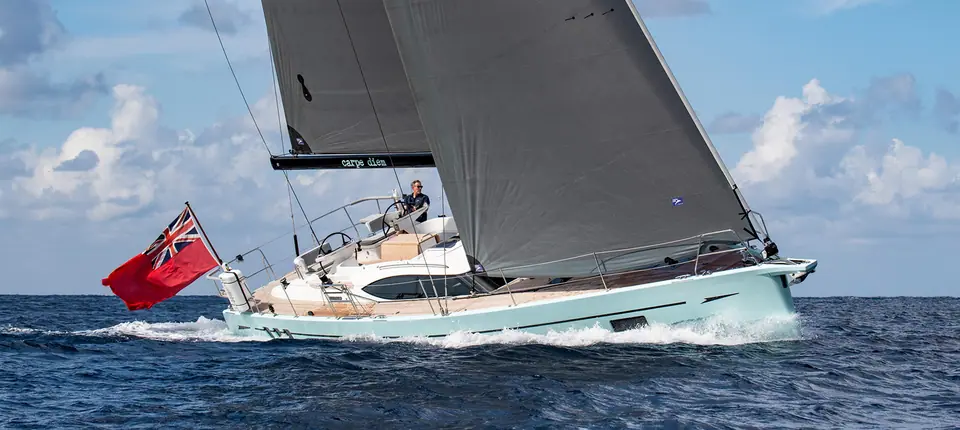
The Oyster 495 is a Humphreys designed 50-foot deck saloon cruiser built in Hythe, near Southampton, from 2021. Oyster's entry-level model and an award winner, it was succeeded by the Oyster 515 in 2026.
- Couples planning a circumnavigation
- First-time Oyster owners
- World rally participants
- Owners who want luxury without crew
Oyster 495 by the numbers
- Sail area to displacement
- 16.6Balanced power for coastal and offshore cruising.
- Displacement to length
- 202Moderate displacement, a classic cruising balance between load carrying and speed.
- Theoretical hull speed
- 9.2 knThe practical top speed of a displacement monohull under normal sailing, based on waterline length.
- Ballast ratio
- 32%A typical ballast ratio for a cruising monohull.
- Capsize screening
- 1.74Below 2.0, the traditional threshold for offshore suitability.
- Motion comfort ratio
- 37.8A slow, easy motion in a seaway, kind to crews on long passages.
- Length to beam ratio
- 3.37 : 1Moderate proportions.
The Oyster 495 and the Hadida reboot
Oyster Yachts spent the years before 2018 moving steadily upmarket, toward the 82 and 88 footers that defined the brand in superyacht circles. When software entrepreneur Richard Hadida bought the company in 2018, the first boat fully conceived under his ownership went in the other direction. The Oyster 495 was the smallest yacht the Southampton firm had developed from scratch since 2005, aimed at a younger, often first-time Oyster owner who wanted the brand's ocean pedigree in a boat a couple could run alone.
The bet paid off quickly. Yachting Monthly reported 16 boats sold off plan, and Yachting World noted that only two of the first 15 buyers were existing Oyster owners. Oyster built a dedicated production facility for the 495 at Hythe, aiming for 12 boats a year, and SAIL magazine shortlisted it among its Top 10 Best Boats nominees for 2024. In July 2026 Oyster announced the Oyster 515 as its successor, so the 495 is now a used-market boat.
Rob Humphreys' hull under the Seascape windows
Humphreys Yacht Design drew a long-waterline hull, 46 ft 10 in on a 52 ft 10 in overall length, with a wide aft section carried on twin rudders and an L-shaped bulb keel drawing 7 ft 6 in, or 6 ft 0 in in shoal form. Lightship displacement is 21,000 kg (46,297 lbs) with 6,645 kg of ballast, heavy for a modern 50 footer, which is exactly what Oyster buyers want when they are hove-to off Cape Hatteras.
Construction is resin-infused fiberglass with a vinylester outer skin below the waterline to resist osmosis, plus carbon-reinforced stringers and frames. Cruising World described the laminate as over-specified. Topsides, the 495 keeps Oyster's signature deck saloon with its dark Seascape windows and adds vertical hull portlights, a flush foredeck with removable dorades and an electrically deployed cassette bathing platform aft.
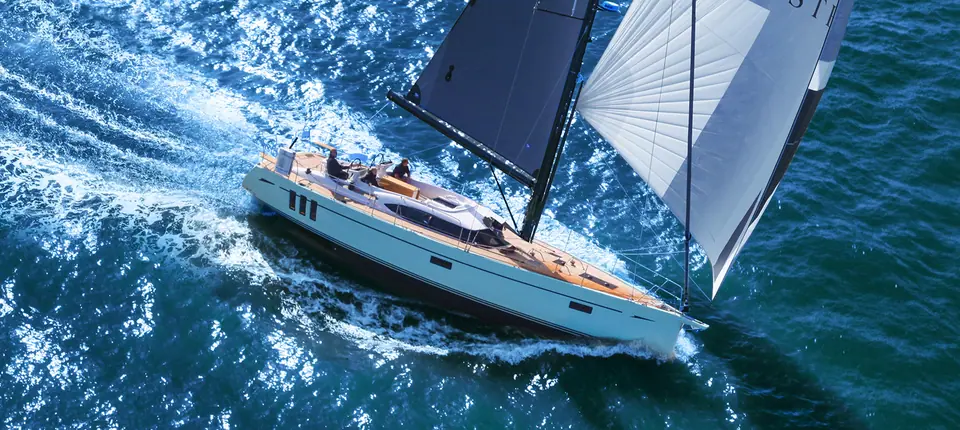
How fast is an Oyster 495 under sail
Yachting World sailed the 495 in conditions from a 10 knot sea breeze to 15 to 20 knots true with gusts in the mid-20s. In the light stuff it made 7 knots close-hauled on flat water. Once the breeze filled in it settled into the high 8s upwind, the 9s when freed, and double figures broad reaching. The tester's conclusion was that you can reliably plan passages at 8 knots, and Yachting Monthly adds that broad reaching with the 197 m2 asymmetric the boat will manage 11 knots in a blow.
Yachting Monthly had a much lighter day, recording 5.1 knots fetching in 8 knots apparent, and found the boat light and responsive. Yachting World's tester, by contrast, found the helm initially heavy until Oyster's crew adjusted the gear, and warned that the long geared linkage from the twin wheels of a raised center cockpit to the twin rudders will always limit feedback in light air. This is a powerful, stable boat that wants 12 knots of wind and up to feel alive. In under 8 knots, expect to motor or fly a code zero.
Push-button sailing and the hydraulics question
Every halyard, sheet and furler can be driven from buttons at the helm pedestal. Electric in-mast furling is standard on an aluminum mast, with a Seldén carbon rig as the main upgrade, and the optional hydraulics package adds powered mainsheet, vang, outhaul, backstay and in-boom furling ram. Primary winches sit on a raised step outboard of the coamings within reach of the helmsman, and boarding ladders fold out of the guardrails.
The system works, and it is the reason a couple in their sixties can handle 1,300 sq ft of sail. But Yachting Monthly questioned how much a bluewater cruiser should rely on hydraulics far from a service agent, and criticized the captive halyard arrangement that needs a mousing line to lower. Our view: if you are buying for ocean passages, ask for a full hydraulic service history, carry seal kits and know how every powered system is overridden by hand.
- Standard in-mast furling sail area about 115 m2; full sail plan about 124.6 m2
- Carbon mast saves about 200 kg aloft
- Pre-rigged preventers and deep, angled cockpit footwells for sailing at heel
- Sail locker hatch is small for handling a bagged gennaker
Three cabins, a semi-raised saloon and twelve steps
The interior is a three cabin, two head arrangement for six. The owner's stateroom is aft with 6 ft 4 in headroom, vertical hull ports, a sofa, cedar-lined lockers and an en suite with separate shower. Forward are a double guest cabin and a compact Pullman or bunk cabin, sharing a second head with separate shower. The U-shaped galley is to port, two steps down, with a starboard passageway linking saloon and owner's cabin.
Testers loved the light and the stowage world cruisers will need, but there are trade-offs. Yachting Monthly counted 12 interior steps besides the companionway, which matters at sea at night. Clothes storage is limited for a long-term liveaboard couple, there is no dedicated wet locker for foul weather gear and the navigation station is set low and dark, with no view out. The large cockpit table seats eight and folds into a lounge, and the saloon table drops to berth height.
Yanmar 110, generator and motoring range
A 110 hp Yanmar 4JH110 drives through a saildrive, in a heavily insulated engine room that testers described as unusually quiet. An 8 kW Panda generator sits in its own sound-shielded compartment, an 800 Ah gel battery bank and CZone digital switching are standard, and a 110 liter per hour watermaker was a popular option.
Under power the 495 is fast and frugal for its weight. Yachting World logged 8.5 knots at 2,100 rpm burning about 6 liters per hour, and Yachting Monthly saw 8 knots at 2,300 rpm on 8.7 liters per hour. With 800 liters (211 gallons) of diesel, that is roughly 650 to 1,000 miles of motoring with a 10 percent reserve, depending on how hard you push.
Buying a used Oyster 495 now the 515 has arrived
Because almost every 495 was ordered with a long options list, two boats of the same year can differ by several hundred thousand dollars in specification. Compare like for like: carbon rig or aluminum, hydraulics package, thrusters, generator, watermaker, lithium or gel batteries, and sail inventory. Hull number one spent much of 2023 on a promotional world tour, and prototype issues reported by testers, such as a cracked skin fitting in the lazarette, were fixed by the yard, but ask for warranty records on early hulls.
Oyster runs its own brokerage and an owner support program, and its annual regattas and world rallies keep a strong community around the boats. That support is part of what you buy. Budget $75,000 to $145,000 a year in the US for insurance, a 55 ft slip, haul-outs, generator and engine service, hydraulic and electronics maintenance, and a sail and rigging reserve.
Oyster 495 specifications
| Length overall | 52.8 ft16.1 m |
|---|---|
| Waterline length | 46.8 ft14.27 m |
| Beam | 15.7 ft4.77 m |
| Draft | 7.5 ft2.28 m |
| Air draft | 75.9 ft23.13 m |
| Displacement | 46,297 lbs21, kg |
| Ballast | 14,65 lbs6,645 kg |
| Sail area | 1,341 sq ft124.6 m² |
| Fuel capacity | 211 gal8 L |
| Fresh water | 159 gal6 L |
| Cabins | 3 |
| Berths | 6 |
| Heads | 2, each with separate shower |
| Standard engines | Yanmar 4JH110 (110 hp) with saildrive |
| Maximum power | 110 hp |
| Cruise speed | 8.5 knots |
| Range | 1,000 nm |
| Hull type | Moderate displacement monohull with twin rudders |
| Keel | L-shaped fin with bulb, 7 ft 6 in standard or 6 ft 0 in shoal |
| Rig | Fractional sloop, keel-stepped aluminum mast with electric in-mast furling (carbon option), hydraulic sail controls optional |
| Hull construction | Resin-infused fiberglass with vinylester outer skin below the waterline, carbon-reinforced stringers |
| CE design category | A |
| Builder | Oyster Yachts, United Kingdom |
| Naval architect | Humphreys Yacht Design (Rob Humphreys) |
| Other design credits | Oyster Yachts in-house design studio |
| Production | 2021 to 2026 |
| Status | Discontinued |
Figures come from builder documentation and independent tests where available. Displacement is usually quoted light, so a loaded cruising boat will weigh more. Compare these specs with another model.
Performance data
| RPM | Speed (kn) | Fuel (gph) | Range (nm) |
|---|---|---|---|
| 2100 | 8.5 | 1.6 | 1010 |
| 2300 | 8 | 2.3 | 660 |
2,100 rpm row from Yachting World's test (6 liters per hour), 2,300 rpm row from Yachting Monthly's test (8.7 liters per hour), different boats and conditions. Range calculated by yatch-us from the 800 liter tank with a 10 percent reserve.
How much does a Oyster 495 cost?
Yachting World quoted a base price of 1.25 million GBP ex VAT in 2022 and Yachting Monthly 1.35 million GBP a few months later, with as-tested boats at 1.535 and 1.6 million GBP, around $1.6 million and up in the US. Options decide everything here: a carbon rig added roughly 100,000 to 140,000 GBP, retractable bow and stern thrusters around 40,000 GBP. Used 2022 and 2023 boats have been listed between about 1.32 and 1.5 million GBP, and the arrival of the Oyster 515 in 2026 is likely to put modest pressure on early 495 prices.
Estimate your yearly cost
A planning estimate using common rules of thumb: insurance near 1.5 percent of value, maintenance near 3 percent, haul out and bottom paint by length. Your marina, region and use will move these numbers. Open the full cost calculator.
Versions and options
- Standard deep keel
- 7 ft 6 in draft, better pointing and the choice for ocean passages.
- Shoal keel
- 6 ft 0 in draft for the Bahamas, Chesapeake and US East Coast.
- Carbon rig and hydraulics
- Seldén carbon mast with in-mast furling plus hydraulic mainsheet, vang, outhaul and backstay. The most desirable used spec.
- Oyster 515 (successor)
- Announced July 2026 with more sail area, more volume, a beach-club style aft deck and new wing seats beside the helm stations.
Oyster 495 timeline
- 2018Richard Hadida acquires Oyster Yachts
- 2021Oyster 495 launched, the first all-new Oyster of the Hadida era, built at a new facility in Hythe
- 2022Hull one starts a promotional world tour of Europe; Yachting World tests it in September
- 2023Hull one, Genevieve, is delivered to its owner in Santa Barbara, California after the European tour
- 2026Oyster 515 announced in July as the successor to the 495
Strengths and weaknesses
What owners like
- Plans passages at 8 knots and reaches double figures in breeze
- Push-button sail handling for a couple
- Over-built infused hull with vinylester skin
- Bright deck saloon with excellent stowage
- Strong factory support, brokerage and owner community
- Quiet, efficient 110 hp installation
What to weigh up
- Very expensive to buy and to option
- Heavy, remote helm feel in light air
- Reliance on hydraulics and electrics offshore
- Many interior steps and a dark nav station
- No wet locker
Used Oyster 495 buyer checklist
Take this list to a viewing. Your ticks are saved in this browser so you can come back to it.
Always commission an independent marine survey and an engine survey before you buy. How a marine survey works.
Rivals to consider
Hallberg-Rassy 44
Smaller and much cheaper, with a fixed windscreen and twin rudders, and very similar windward ability.
Compare side by sideAmel 50
Enclosed doghouse steering and simpler, more self-sufficient systems, at a lower price.
Compare side by sideSwan 48
Lighter, faster and more of a sailor's boat, with less interior volume and an aft cockpit.
Compare side by sideContest 50CS
Dutch center cockpit rival with a similar quality ethos and more conservative styling.
Our verdict on the Oyster 495
The Oyster 495 is the boat that brought Oyster back to the size most cruising couples can actually use. It is fast in a breeze, extremely well built and set up so two people can handle it without crew, and it carries the support network that makes an Oyster easier to own far from home. It is also expensive, dependent on powered systems and less engaging to steer than its looks suggest in light air. As a used buy in the shadow of the new 515, a carefully specified 495 is a strong choice for a couple heading over the horizon who value comfort and safety above helm feel.
Oyster 495 questions answered
How much does an Oyster 495 cost?
New, the 495 was quoted from 1.25 to 1.35 million GBP ex VAT in 2022 and 2023, and optioned test boats came to 1.5 to 1.6 million GBP, or about $1.6 million and up. Used boats have been listed from roughly $1.5 million to over $2 million.
Is the Oyster 495 still in production?
No. Oyster announced the Oyster 515 as its successor in July 2026, so the 495 is now sold through brokerage.
How fast is the Oyster 495?
Testers recorded high 8s upwind and double figures broad reaching in 15 to 20 knots of wind, and 8.5 knots under power at 2,100 rpm.
How many cabins does the Oyster 495 have?
Three: an aft owner's stateroom with en suite, a forward double and a Pullman or bunk cabin, with two heads in total.
Who designed the Oyster 495?
Humphreys Yacht Design drew the hull with Oyster's in-house design team, and the boat was built at Oyster's Hythe facility near Southampton.
Did the Oyster 495 win any awards?
Oyster markets the 495 as award-winning, and SAIL magazine named it one of its Top 10 Best Boats nominees for 2024.