Hallberg-Rassy Bluewater Sailboats
Hallberg-Rassy 44 Review, Used Prices and HR44 Buying Notes
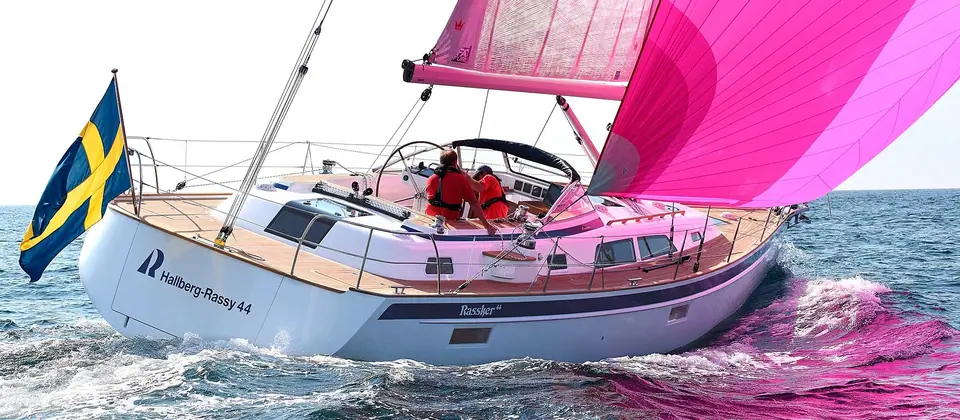
The boat where Hallberg-Rassy's center cockpit tradition met a modern Frers hull with twin rudders, and sailed better than anyone expected.
- Length
- 47.4 ft14.45 m
- Beam
- 13.8 ft4.2 m
- Draft
- 6.9 ft2.1 m
- Cabins
- 2 or 3 (one or two cabins forward of the mast plus the aft cabin)
- Used price
- $750K to $1.15M
On this page
- Overview
- Why the Hallberg Rassy 44 broke with Ellös tradition
- Twin rudders, in-mast furling and surprising pace
- The fixed windscreen and a cockpit built for watchkeeping
- Two or three cabins and the galley decision
- Volvo D2-75, tankage and range
- What the 2026 Mk II changes, and why it matters to used buyers
- Buying a used HR44 in the US
- Does the Hallberg-Rassy premium hold up?
- Specifications
- Price and value
- Strengths and weaknesses
- Used buyer checklist
- Rivals
- Our verdict
- FAQ
The Hallberg-Rassy 44 is a Germán Frers designed center cockpit cruiser built in Ellös, Sweden, from 2016 to 2026. About 85 were built before the 44 Mk II replaced it for model year 2027.
- Couples planning ocean passages
- Owners stepping up from an older Hallberg-Rassy
- High-latitude and cold-water cruisers
- Buyers who value finish and resale
Hallberg-Rassy 44 by the numbers
- Sail area to displacement
- 19.4Balanced power for coastal and offshore cruising.
- Displacement to length
- 173Light displacement for its length, quick but sensitive to added cruising weight.
- Theoretical hull speed
- 8.7 knThe practical top speed of a displacement monohull under normal sailing, based on waterline length.
- Ballast ratio
- 40%A high ballast ratio, so the boat stands up well to a breeze.
- Capsize screening
- 1.79Below 2.0, the traditional threshold for offshore suitability.
- Motion comfort ratio
- 31.4Moderate motion comfort, typical of modern cruisers.
- Length to beam ratio
- 3.45 : 1Moderate proportions.
Why the Hallberg Rassy 44 broke with Ellös tradition
For decades a Hallberg-Rassy was easy to describe: blue cove stripe, center cockpit, a fixed windscreen, a single deep rudder, superb joinery and a hull that put seakindliness ahead of speed. The Hallberg Rassy 44, launched in April 2016, kept most of that list and quietly rewrote the hull. Germán Frers, who has designed every HR since 1989, gave the 44 a wide, powerful stern, a long waterline of 42 ft 3 in on a 44 ft 11 in hull, an integral bowsprit and, for the first time on a Hallberg-Rassy of this size, twin rudders.
It replaced the HR 43, which ran through three versions from 2001 to 2016 and 199 hulls, and it gained 1.13 m of waterline and 19 cm of cockpit length over the 43 Mk III. The yard needed a boat that would appeal to younger buyers comparing it with modern Scandinavian and French cruisers without alienating its loyal base. The HR44, often shortened to HR44 in owner forums and listings, did that well enough to build about 85 hulls before the 44 Mk II took over for model year 2027.
Twin rudders, in-mast furling and surprising pace
Sceptics expected a wide-sterned, twin-rudder Hallberg to lose the gentle motion the brand is known for. Testers found the opposite problem: the boat was simply quicker than anyone expected. In Yachting World's June 2017 test, sailed by Pip Hare in a Swedish winter with 4 degree water, the 44 made 7.5 knots upwind in 12 knots of true wind, held over 7 knots on a beam reach in 18 knots and tacked through close to 90 degrees. Five knots in under 10 knots of true breeze is realistic.
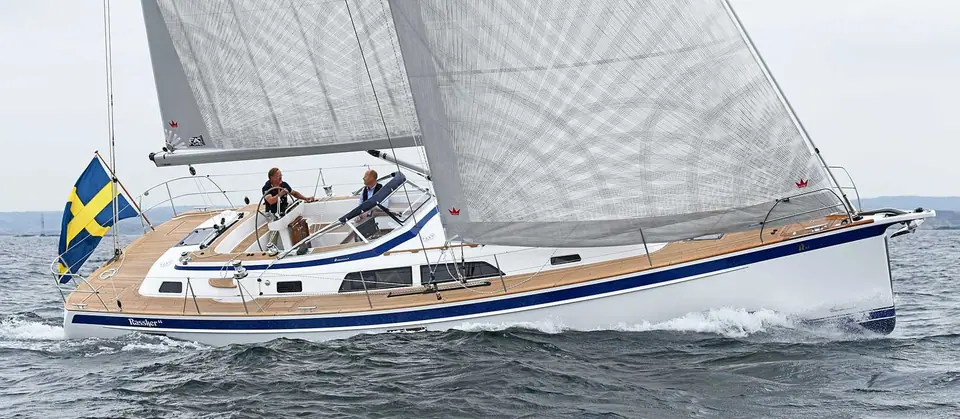
Part of that is the mainsail. Hallberg-Rassy specified in-mast furling as standard but paired it with a membrane sail using full-length vertical battens (an Elvström system), giving roach and a headboard that a conventional furling main cannot carry. Yachting World's tester said she had never seen windward performance like it on an in-mast furling boat. Standard sail area is 106.5 m2 (1,152 sq ft), or 113.1 m2 (1,216 sq ft) with the optimized sail plan.
Where the 44 is weaker is light-air sailing deep downwind. Without a gennaker or code zero on the integral bowsprit, the test boat could not usefully steer below 150 degrees true in light conditions. Budget for a furling asymmetric if you plan trade wind passages.
The fixed windscreen and a cockpit built for watchkeeping
The center cockpit sits behind Hallberg-Rassy's signature fixed glass windscreen, which Cruising World judge Dan Spurr singled out as superior to any canvas dodger. With a bimini or the optional hard top above, a watch on a wet night is spent dry and warm. Cruising World named the HR44 its Best Midsize Cruiser Under 45 Feet for 2020, with Ralph Naranjo praising the integrity of the systems installation, from the autopilot bracket tied into transverse and longitudinal members to the bow thruster and windlass mountings.
The cockpit itself is on the compact side, which some owners like at sea and others find tight with guests. Tester complaints were minor: a backstay adjuster with a low purchase ratio that is hard to trim, and a helm position that lacks foot support when sitting to windward. Neither is hard to fix aftermarket. Lines are led aft, primary winches are within reach of the wheel and most boats carry electric primaries.
Two or three cabins and the galley decision
Below, the HR44 follows the brand's center cockpit template. The owner's cabin is aft, under the cockpit, with a large double, generous hanging lockers and an en suite head with separate shower. The aft cabin itself came with either an extra wide centerline double or twin berths with a sofa between. Forward of the mast the yard offered four arrangements, two with one cabin and two with two cabins: the standard large V cabin, a supercabin moved further aft around a wider bed, or the forward cabin plus a twin bunk cabin to starboard. The forward head is very large, with a separate shower behind acrylic doors and space for a washing machine.
The galley came as a U-shape to starboard (standard) or as an optional linear galley along the port side, which opens up the saloon at the expense of bracing for the cook at sea. For ocean passages the U-shape is the better choice and the more liquid option at resale. Natural light comes through six flush deck hatches, eight opening portlights and four large hull portlights, and the joinery came in mahogany, European oak or teak with the precise, tight finish the yard is known for. Headroom is about 6 ft 5 in.
Volvo D2-75, tankage and range
Standard power is a Volvo Penta D2-75 rated at 75 hp, fed from a 420 liter (110 gallon) diesel tank. Fresh water capacity is 745 liters (196 gallons), generous for a 44 footer and a good argument for delaying a watermaker on coastal cruising. A bow thruster is common and Cruising World's judges noted the quality of its installation.
Hallberg-Rassy published its own propeller measurements for the 44 with a three blade Gori. In normal gear the boat made 6.2 knots at 2,000 rpm on 4.3 liters (about 1.1 gallons) an hour and 7.0 knots at 2,300 rpm on 6.2 liters (about 1.6 gallons), for a theoretical range of roughly 400 to 510 miles. Top speed was 8.4 knots at 3,100 rpm. In the Gori's overdrive setting the same 2,000 rpm gave 7.6 knots on 6.4 liters an hour. The yard stresses these came from a new, clean and empty boat in ideal conditions, so a loaded cruising boat will do worse.
What the 2026 Mk II changes, and why it matters to used buyers
In 2026 Hallberg-Rassy announced the 44 Mk II, shown at the yard's Open Yard event in Ellös in August 2026 as a 2027 model year boat. The yard lists 29 refinements, including larger saloon and hull windows with tempered glass, a revised steering system, a wider swim platform, a redesigned windscreen with better instrument visibility, an optional carbon in-mast furling rig, an under-deck electric furler for light-wind sails and dedicated lockers to stow them.
None of these changes undermines the original boat. The hull, keel and twin rudders are the same concept, so a good 2016 to 2025 HR44 remains the value play: you get the performance and build quality at a price below a new Mk II, and late original boats with the optimized sail plan and a code zero already carry many of the Mk II's practical gains.
Buying a used HR44 in the US
Most HR44s live in Northern Europe and the Mediterranean, so a US buyer is usually looking at importing, either through Hallberg-Rassy's US dealer network or by sailing the boat across. Factor in transatlantic delivery or shipping, survey travel and import duty (US duty on imported pleasure sailboats is modest, but check current rates and whether the boat was built in the EU). A boat already lying in the US or Caribbean commands a premium.
Budget roughly $38,000 to $75,000 a year to run an HR44 in the US, depending heavily on where you keep it. The big items are insurance (higher for ocean cruising), a 50 ft slip in a Northeast or Florida marina, annual haul-out and antifouling, Volvo service, and a reserve for standing rigging and sails, which on a boat of this quality and size run well into five figures each time they come due.
Hallberg-Rassy 44 specifications
| Length overall | 47.4 ft14.45 m |
|---|---|
| Waterline length | 42.3 ft12.88 m |
| Beam | 13.8 ft4.2 m |
| Draft | 6.9 ft2.1 m |
| Air draft | 70.9 ft21.61 m |
| Displacement | 29,2 lbs13,3 kg |
| Ballast | 11,7 lbs5,307 kg |
| Sail area | 1,152 sq ft106.5 m² |
| Fuel capacity | 11 gal42 L |
| Fresh water | 196 gal745 L |
| Cabins | 2 or 3 (one or two cabins forward of the mast plus the aft cabin) |
| Berths | 4 to 6 in cabins plus saloon settees |
| Heads | 2, each with separate shower |
| Standard engines | Volvo Penta D2-75 (75 hp) diesel |
| Maximum power | 75 hp |
| Cruise speed | 7 knots |
| Top speed | 8.4 knots |
| Range | 400 nm |
| Hull type | Moderate displacement monohull with twin rudders |
| Keel | Lead keel on a deep bilge, 6 ft 11 in standard or 5 ft 9 in shoal (shoal version 610 kg heavier) |
| Rig | Sloop without running backstays, in-mast furling main with vertical battens, integral bowsprit |
| Hull construction | Fiberglass (GRP) with bolted lead keel |
| CE design category | A |
| Builder | Hallberg-Rassy Varvs AB, Sweden |
| Naval architect | Germán Frers |
| Production | 2016 to 2026 |
| Status | Discontinued |
Figures come from builder documentation and independent tests where available. Displacement is usually quoted light, so a loaded cruising boat will weigh more. Compare these specs with another model.
Performance data
| RPM | Speed (kn) | Fuel (gph) | Range (nm) |
|---|---|---|---|
| 1500 | 4.6 | 0.7 | 653 |
| 1800 | 5.6 | 0.9 | 568 |
| 2000 | 6.2 | 1.1 | 512 |
| 2300 | 7 | 1.6 | 401 |
| 2500 | 7.6 | 2 | 350 |
| 2800 | 8.2 | 3 | 260 |
| 3100 | 8.4 | 4.5 | 174 |
Hallberg-Rassy factory measurements with a three blade Gori propeller in normal gear, new clean and empty boat in ideal conditions. Liters per hour converted to US gallons; theoretical range assumes 355 liters usable.
How much does a Hallberg-Rassy 44 cost?
Hallberg-Rassy prices only make sense once you know the yard's base price was always a starting point. In 2017 Yachting World quoted a base of about 401,000 GBP and a fully equipped test boat at 488,000 GBP, and later boats rose sharply with inflation and euro pricing. Used HR44s in Europe have recently asked roughly $800,000 to $990,000, and the arrival of the Mk II in 2026 may soften prices for the earliest hulls slightly while increasing interest in late, well-optioned boats.
Estimate your yearly cost
A planning estimate using common rules of thumb: insurance near 1.5 percent of value, maintenance near 3 percent, haul out and bottom paint by length. Your marina, region and use will move these numbers. Open the full cost calculator.
Versions and options
- Standard keel
- 6 ft 11 in draft, the better choice for windward work and ocean passages.
- Shoal keel
- 5 ft 9 in draft for the Bahamas, the Baltic archipelagos and the US East Coast.
- Optimized sail plan
- 113.1 m2 instead of 106.5 m2, worth having in light-air cruising grounds.
- Hallberg-Rassy 44 Mk II (2027 model year)
- 29 refinements including larger windows, a new windscreen, a carbon furling option and under-deck furler for light-wind sails.
Hallberg-Rassy 44 timeline
- 1989Germán Frers becomes the designer of every new Hallberg-Rassy
- 2016Hallberg-Rassy 44 launched in April with twin rudders and an integral bowsprit
- 2017Yachting World test records 7.5 knots upwind in 12 knots of breeze
- 2020Named Cruising World's Best Midsize Cruiser Under 45 Feet
- 2026Production of the original 44 ends at about 85 hulls; the 44 Mk II debuts at Open Yard in August
Strengths and weaknesses
What owners like
- Unusually quick upwind for an in-mast furling cruiser
- Twin rudders give grip and a light, responsive helm
- Fixed windscreen and protected center cockpit
- Exceptional joinery and systems installation
- Large 196 gallon water tank and an economical 1.6 gph at 7 knots
- Strong resale and factory support
What to weigh up
- Expensive to buy, even used
- Weak deep downwind in light air without a gennaker
- Cockpit is compact for entertaining
- Few boats on the US market, so most purchases involve import
Used Hallberg-Rassy 44 buyer checklist
Take this list to a viewing. Your ticks are saved in this browser so you can come back to it.
Always commission an independent marine survey and an engine survey before you buy. How a marine survey works.
Rivals to consider
Oyster 495
Bigger, more luxurious and far more expensive, with a deck saloon and hydraulic sail handling.
Compare side by sideAmel 50
A fully enclosed doghouse and Amel's systems philosophy, at a similar price but with a very different sailing experience.
Compare side by sideSwan 48
A faster, aft cockpit performance cruiser for owners who value speed above the center cockpit lifestyle.
Compare side by sideContest 45CS
Dutch center cockpit rival with similar build quality and a slightly more modern interior style.
Our verdict on the Hallberg-Rassy 44
The Hallberg-Rassy 44 is the boat that proved a traditional Swedish yard could build a genuinely quick, twin-rudder cruiser without losing the qualities its owners pay for. It sails to windward better than almost any in-mast furling cruiser, it is beautifully built and it will hold its value. If you can live with the price and the compact cockpit, a used HR44 is one of the most complete short-handed ocean cruisers under 50 feet, and the arrival of the Mk II makes the original a slightly better value than it was a year ago.
Hallberg-Rassy 44 questions answered
How much does a Hallberg-Rassy 44 cost?
Used HR44s have recently been listed at roughly $800,000 to $990,000, with the best late boats above $1 million. New prices now apply to the 44 Mk II and are quoted by the yard and its dealers.
What does HR44 mean?
HR44 is the common shorthand for the Hallberg-Rassy 44, the 44 ft 11 in hull length center cockpit cruiser designed by Germán Frers and built from 2016 to 2026.
How many Hallberg-Rassy 44s were built?
About 85 were built from 2016 until 2026, when the 44 Mk II replaced the original version.
Does the Hallberg-Rassy 44 have twin rudders?
Yes. It was one of the first Hallberg-Rassys with twin rudders, which testers found made the boat nimble rather than heavy on the helm.
Is the HR44 good for ocean crossings?
Yes. It is CE Category A, carries 196 gallons of water and 110 gallons of fuel, and has a fixed windscreen and center cockpit designed for long watches offshore.
Where can I find a Hallberg-Rassy 44 for sale?
Most listings are in Northern Europe and the Mediterranean through Hallberg-Rassy's own brokerage and major portals. US buyers should budget for import or a transatlantic delivery.
Hallberg-Rassy 44 photos
More bluewater sailboats to explore
Garcia Exploration 45
Bluewater Sailboats, 46 ft
Used $650K to $1M

Island Packet 45
Bluewater Sailboats, 45 ft
Used $150K to $235K
Kraken 50
Bluewater Sailboats, 50 ft
Used $700K to $1.05M
Island Packet 420
Bluewater Sailboats, 45 ft
Used $185K to $295K