Tartan Yachts Bluewater Sailboats
Tartan 37 Review and Used Buying Guide
Sparkman and Stephens drew it, Ohio built nearly 500 of them, and the keel-centerboard version still opens up thin water that deep fins cannot reach.
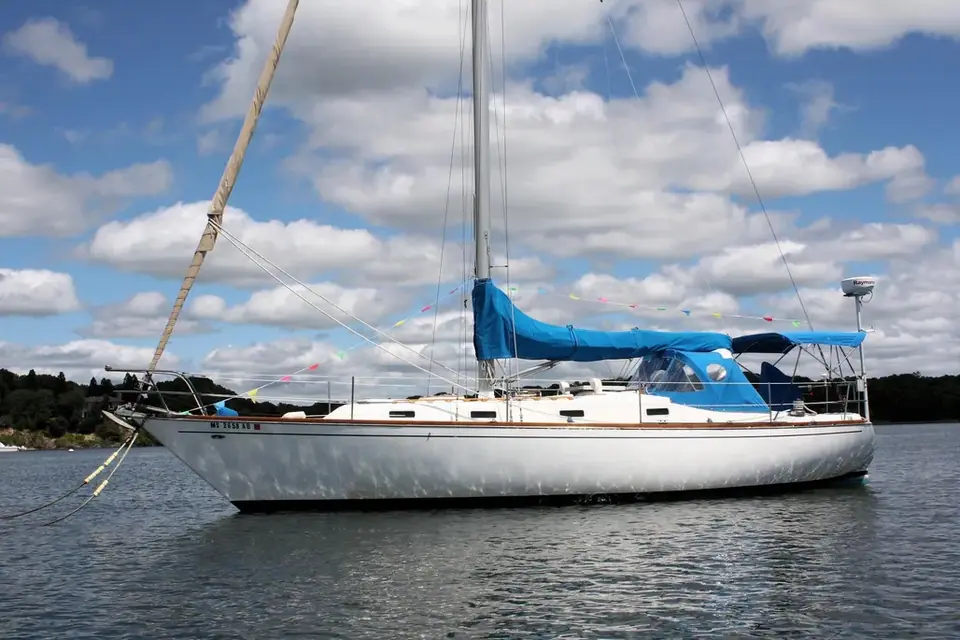
- Length
- 37.3 ft11.37 m
- Beam
- 11.8 ft3.58 m
- Draft
- 4.2 ft1.27 m
- Cabins
- 2
- Used price
- $25K to $85K
On this page
- Overview
- The Tartan 37 and the Ohio yard that built it
- Keel-centerboard, deep fin or Scheel keel
- Stiff, weatherly and happiest on a reach
- How Tartan built it, and where it can go wrong
- Teak interior, pilot berth and a real nav station
- The original 40 hp diesel and the repower question
- Tartan 37 versus Tartan 3700, the boat that shares the name
- What a Tartan 37 costs to keep, and how it holds value
- Specifications
- Price and value
- Strengths and weaknesses
- Used buyer checklist
- Rivals
- Our verdict
- FAQ
A 37-foot S&S cruiser-racer built by Tartan Marine from 1976 to 1989, mostly as a keel-centerboarder. Roughly 486 hulls, strong secondary bonding, and used prices that remain accessible.
- Chesapeake and Florida coastal cruisers
- Budget-minded couples moving up from a 30-footer
- PHRF club racing in the fin-keel version
- Bahamas island hoppers who need shoal draft
Tartan 37 by the numbers
- Sail area to displacement
- 16.1Balanced power for coastal and offshore cruising.
- Displacement to length
- 203Moderate displacement, a classic cruising balance between load carrying and speed.
- Theoretical hull speed
- 7.6 knThe practical top speed of a displacement monohull under normal sailing, based on waterline length.
- Ballast ratio
- 48%A high ballast ratio, so the boat stands up well to a breeze.
- Capsize screening
- 1.89Below 2.0, the traditional threshold for offshore suitability.
- Motion comfort ratio
- 26.6Moderate motion comfort, typical of modern cruisers.
- Length to beam ratio
- 3.17 : 1Moderate proportions.
The Tartan 37 and the Ohio yard that built it
The Tartan 37 is the boat most people picture when they hear the Tartan name. It debuted in 1976, stayed in the catalog until 1989, and Tartan Marine delivered about 486 hulls, a remarkable run for a 37-foot yacht that was never cheap. For a broker that number matters: there are always a few Tartan 37s on the market, so a buyer can afford to be choosy.
Tartan and the design office of Sparkman and Stephens had worked together since the Tartan 27 of the early 1960s, and the 37 is the mature expression of that partnership. It is a moderate, slightly lean cruiser-racer with a long coachroof, a sweet sheer and the keel-centerboard underbody that S&S used to let East Coast sailors race offshore and still poke into shallow anchorages.
One clarification before you shop. The Tartan 3700 of the early 2000s is a different boat entirely, a Tim Jackett design with a modern underbody. Listings and search results mix the two constantly, and the price gap is large, so we cover the 3700 separately below.
Keel-centerboard, deep fin or Scheel keel
Until the early 1980s most Tartan 37s left the factory as keel-centerboarders. With the board up the boat draws about 4 feet 2 inches, and with the board down published figures reach roughly 7 feet 9 inches. That range is the entire appeal. You can cross the bar into a Bahamas anchorage or a Chesapeake creek, then drop the board and point respectably on a beat.
Racers ordered the deep fin keel, which draws a little over 6 feet and gives better pointing without a board to maintain. In the 1980s Tartan also offered a Henry Scheel keel, a shoal fin with an enlarged lower section intended to recover some of the lift a short keel loses, and by 1985 all three keels were available. The tall rig was usually paired with the fin by racers, so check the documentation: a tall-rig deep-fin boat is a very different animal on the racecourse from a standard-rig centerboarder.
Which should you buy? For Gulf Coast, Florida Keys, Bahamas and Chesapeake sailing the centerboarder is the right tool, and it is the most common version anyway. If you sail the Great Lakes or New England and want to race PHRF, the fin keel removes a maintenance item and points higher.
- Keel-centerboard: about 4 ft 2 in board up, about 7 ft 9 in board down
- Deep fin: a little over 6 ft, favored by racers
- Scheel keel: shoal fin option introduced in the 1980s
- Tall masthead rig option, most often ordered with the deep fin
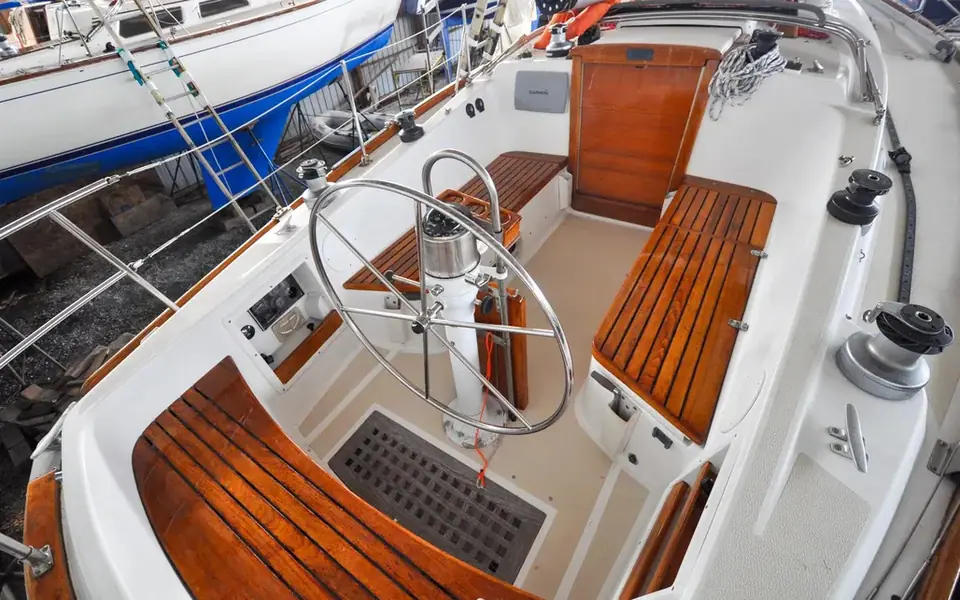
Stiff, weatherly and happiest on a reach
With 7,500 pounds of lead against a design displacement of about 15,500 pounds, the Tartan 37 carries a ballast ratio near 48 percent, which is high by any standard. The result is a boat that stands up to its sail plan in a breeze and does not need an early reef. SpinSheet calculated a sail area to displacement ratio of about 16.1 and a displacement to length ratio of about 220, which is moderate, so in light air you will want a big genoa or an asymmetric.
Reviewers and owners describe the boat as well mannered rather than thrilling. It is not a tender, rolly cruiser and it is not a light-air rocket. Close reaching in 12 to 18 knots is where it shines, and theoretical hull speed works out to roughly 7.5 knots. Steve Pettingill set a record in the singlehanded Port Huron to Mackinac Island race in a fin-keel Tartan 37, and several have sailed the Marion and Newport to Bermuda races respectably.
Some spec databases, including sailboatdata.com, list a heavier displacement of around 17,800 pounds. Treat that as a loaded or later-boat figure. The 15,500-pound number is the one most widely published for the design.
How Tartan built it, and where it can go wrong
Tartan laid up the hull and deck by hand with woven roving and end-grain balsa core, adding unidirectional roving in high-load areas. SpinSheet's reviewer called the secondary bonding and filleting of bulkheads to the hull some of the best in any production boat of the era, and that matches what surveyors see: the structure inside a Tartan 37 rarely gives trouble.
The weak point is moisture. Every deck fitting, stanchion base, chainplate and toerail fastener is a potential path for water into the balsa. Wet core is the number one reason Tartan 37s fail survey or get discounted. Practical Sailor also flagged the unusual hull-to-deck joint, which uses an aluminum plate with stainless fasteners, as a spot to watch for galvanic corrosion and poor toerail bedding.
None of this is unique to Tartan. It is the standard tax on a cored 1970s yacht. The good news is that a dry Tartan 37 deck, properly rebedded, can stay dry for decades.
Teak interior, pilot berth and a real nav station
Below, the Tartan 37 is a traditional two-cabin layout finished in dark, high-quality teak. The forward cabin has a V-berth, drawers, hanging lockers and separate access to the head. The saloon has a dinette to port and a settee to starboard, and early boats added a pilot berth above that settee, which Tartan replaced with shelves by 1986. Aft are the galley and a chart table near the companionway; Practical Sailor noted that you reach across the stove to get at many galley lockers.
The joinery is first rate, but some owners find the all-teak look heavy, and the boat is darker below than a modern 37-footer. Practical Sailor's main practical complaint is the companionway: the bridgedeck is low and the dropboards thin for serious offshore work, so many owners fit a stronger, taller washboard arrangement.
The original 40 hp diesel and the repower question
Most Tartan 37s left the factory with a 40 hp four-cylinder diesel, listed as a Westerbeke 4-107 in spec databases and as a Universal 40 by Practical Sailor, which called it more than adequate power for the boat. The engine box was only partly insulated from the factory. With 50 gallons of fuel and 90 gallons of water, tankage is generous for coastal cruising and acceptable for island passages.
Many original engines have now been replaced, usually with a Yanmar or Beta in the 30 to 40 hp range. A documented repower adds real value, often $10,000 or more in asking price, because it removes the single largest unknown in an older boat. If the original engine is still aboard, ask for oil analysis and compression numbers and price the boat as if a repower is coming within a few years.
Look closely at the centerboard pennant, which runs up through the middle of the mast to the deck, the board itself and the trunk. A seized or corroded board is not a deal breaker, but dropping it requires a haul-out and some careful work.
Tartan 37 versus Tartan 3700, the boat that shares the name
If you searched for a Tartan 3700 for sale, you are looking at a different generation. The 3700 is a Tim Jackett design built from about 2000 to 2005, roughly 60 hulls by most accounts. It has 12 feet 8 inches of beam, a longer effective waterline, a balsa-cored hull above the waterline only, vinylester resins in the skin coat, and a choice of deep fin, moderate beavertail and shoal centerboard keels.
Good Old Boat's data lists the 3700 at about 15,500 pounds, and Practical Sailor quotes a range of positive stability of 125 degrees. Used 3700s typically ask $115,000 to $205,000, roughly two to three times a good S&S Tartan 37. They are faster, roomier and newer, but they are not the classic.
The rule of thumb for buyers: the Tartan 37 is the value play for someone who will maintain an older yacht, and the 3700 is the choice if you want a modern performance cruiser with a known American builder behind it.
What a Tartan 37 costs to keep, and how it holds value
A sound Tartan 37 is affordable to own. Expect roughly $6,500 to $15,000 per year for insurance, a seasonal slip outside the priciest harbors, haul-out, bottom paint and routine engine work. Big-ticket items arrive on their own schedule: standing rigging every 10 to 15 years, sails every 8 to 12, and a repower if the original diesel is still running.
Resale is steady rather than spectacular. The best boats hold in the $60,000 to $85,000 band and sell quickly because there is a loyal owner base and an active Tartan class association. Neglected boats linger in the $20,000s and $30,000s. The spread between them is almost entirely deck condition, engine and rig, which is why a careful buyer can do very well by paying for the right boat rather than haggling on the wrong one.
Tartan 37 specifications
| Length overall | 37.3 ft11.37 m |
|---|---|
| Beam | 11.8 ft3.58 m |
| Draft | 4.2 ft1.27 m |
| Displacement | 15,5 lbs7,031 kg |
| Ballast | 7,5 lbs3,402 kg |
| Sail area | 625 sq ft58.1 m² |
| Fuel capacity | 5 gal189 L |
| Fresh water | 9 gal341 L |
| Cabins | 2 |
| Berths | 6 |
| Heads | 1 |
| Standard engines | 40 hp diesel (Westerbeke 4-107 per spec databases; Practical Sailor lists a Universal 40) |
| Maximum power | 40 hp |
| Hull type | Moderate-displacement fiberglass monohull with balsa-cored topsides |
| Keel | Keel-centerboard (most common through the early 1980s), deep fin keel, or Scheel shoal keel from the 1980s; skeg-hung rudder |
| Rig | Masthead sloop, standard or tall rig |
| Hull construction | Hand-laid fiberglass with end-grain balsa core in hull and deck |
| Builder | Tartan Marine, United States |
| Naval architect | Sparkman and Stephens |
| Production | 1976 to 1989 |
| Status | Discontinued |
Figures come from builder documentation and independent tests where available. Displacement is usually quoted light, so a loaded cruising boat will weigh more. Compare these specs with another model.
How much does a Tartan 37 cost?
Condition of the balsa-cored deck sets the price more than model year does. A boat with a dry deck, a repowered diesel and recent standing rigging can ask double what a tired, wet-cored example brings. Centerboard boats sell well on the Chesapeake and in Florida, while deep-fin boats find buyers among Great Lakes racers. Treat anything under about $30,000 as a project until a moisture meter proves otherwise. New, the base price nearly doubled over the production run to about $100,000, and a fully equipped boat topped $120,000 by 1987.
Estimate your yearly cost
A planning estimate using common rules of thumb: insurance near 1.5 percent of value, maintenance near 3 percent, haul out and bottom paint by length. Your marina, region and use will move these numbers. Open the full cost calculator.
Versions and options
- Keel-centerboard, standard rig
- The most common configuration, drawing about 4 ft 2 in with the board up. Ideal for shoal cruising grounds.
- Deep fin keel
- Draws a little over 6 ft, points higher and removes the centerboard maintenance. Preferred by racers.
- Scheel keel
- A Henry Scheel shoal keel with an enlarged lower section, offered from the 1980s as an alternative to the centerboard.
- Tall rig
- A taller masthead rig was available for better light-air performance, usually paired with the deep fin.
Tartan 37 timeline
- 1961Tartan's long partnership with Sparkman and Stephens begins with the Tartan 27
- 1976Tartan 37 debuts as an S&S keel-centerboard cruiser-racer
- 1980sScheel keel option added, all three keels offered by 1985, and the pilot berth dropped by 1986
- 1989Production ends after roughly 486 hulls
- 2000Tim Jackett's Tartan 3700 revives the 37-foot size with a completely new design, about 60 built through 2005
Strengths and weaknesses
What owners like
- Keel-centerboard version reaches shoal anchorages and still sails to windward
- Very high ballast ratio makes it stiff in a breeze
- Excellent secondary bonding and teak joinery
- Large fleet means good choice on the used market
- Loyal owner community and class association
- Classic S&S looks that age well
What to weigh up
- Balsa-cored deck and hull demand careful moisture survey
- Dark interior and low companionway sill by modern standards
- Original 40 hp diesels are now well past middle age
- Centerboard and its pennant add a maintenance item
- Light-air performance needs a large genoa or asymmetric
Used Tartan 37 buyer checklist
Take this list to a viewing. Your ticks are saved in this browser so you can come back to it.
Always commission an independent marine survey and an engine survey before you buy. How a marine survey works.
Rivals to consider
Cape Dory 36
Full keel, heavier and slower, but simpler to maintain with no centerboard.
Compare side by sidePacific Seacraft 37
More of a true offshore boat with a canoe stern, and far more expensive on the used market.
Compare side by sideTayana 37
Heavy Taiwan-built cutter with more interior volume and far more teak to maintain.
Compare side by sideHinckley Bermuda 40
The premium keel-centerboard yawl, with higher finish quality and much higher prices.
Compare side by sideOur verdict on the Tartan 37
The Tartan 37 is one of the smartest used buys in the 35 to 40 foot range for sailors who want a real sailing boat rather than a floating condo. It is stiff, pretty, well built inside and, in centerboard form, uniquely useful in shallow cruising grounds. Its weakness is the one every cored 1970s yacht shares, so buy on deck condition and engine history above everything else. Get those right and you will own a boat that sails better than most of its contemporaries for the price of a midsize pickup truck.
Tartan 37 questions answered
How much is a Tartan 37 worth?
Most Tartan 37s list between about $25,000 and $85,000. Dry decks, a repowered diesel and recent rigging push a boat to the top of that range.
What is the draft of a Tartan 37 centerboard?
About 4 feet 2 inches with the board up and roughly 7 feet 9 inches with it down. Fin-keel boats draw a little over 6 feet.
Is the Tartan 37 a bluewater boat?
It has crossed oceans and raced to Bermuda, and its high ballast ratio helps. For serious offshore work most owners raise the companionway sill, upgrade the rig and add a storm sail setup.
Is the Tartan 3700 the same as the Tartan 37?
No. The Tartan 3700 is a Tim Jackett design built from about 2000 to 2005, wider and more modern, and it usually costs two to three times as much.
How many Tartan 37s were built?
Tartan Marine built about 486 between 1976 and 1989.
What engine does a Tartan 37 have?
Most were delivered with a 40 hp diesel, listed as a Westerbeke 4-107 in spec databases and as a Universal 40 by Practical Sailor, and many have since been repowered.