Garcia Yachts Bluewater Sailboats
Garcia Exploration 45 Review, the Aluminum Go-Anywhere Cruiser
An aluminum centerboard cruiser born from Jimmy Cornell's brief for a boat that could transit the Northwest Passage and then cruise the tropics.
- Length
- 45.8 ft13.97 m
- Beam
- 14.6 ft4.44 m
- Draft
- 9.5 ft2.9 m
- Cabins
- 2 or 3 (plus a technical room on some layouts)
- Used price
- $650K to $1M
On this page
- Overview
- Garcia Yachts, Jimmy Cornell and a very specific brief
- Why aluminum and a centerboard
- How it sails, upwind and with the board up
- Two watch stations, one inside
- Layouts, insulation and a workshop on board
- Engine, tanks and the energy question
- Buying new or used, and what it costs to run
- Specifications
- Price and value
- Strengths and weaknesses
- Used buyer checklist
- Rivals
- Our verdict
- FAQ
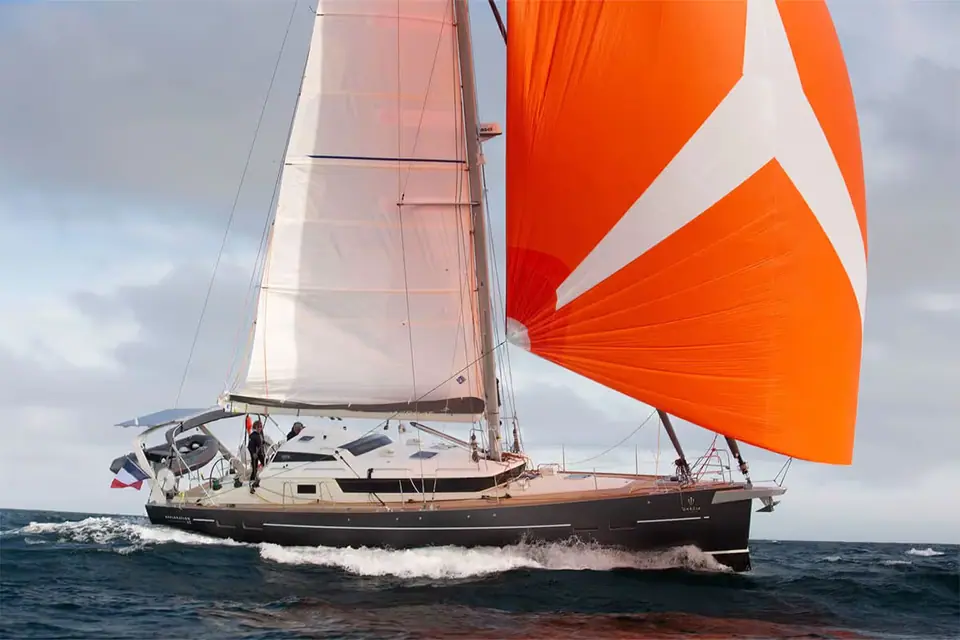
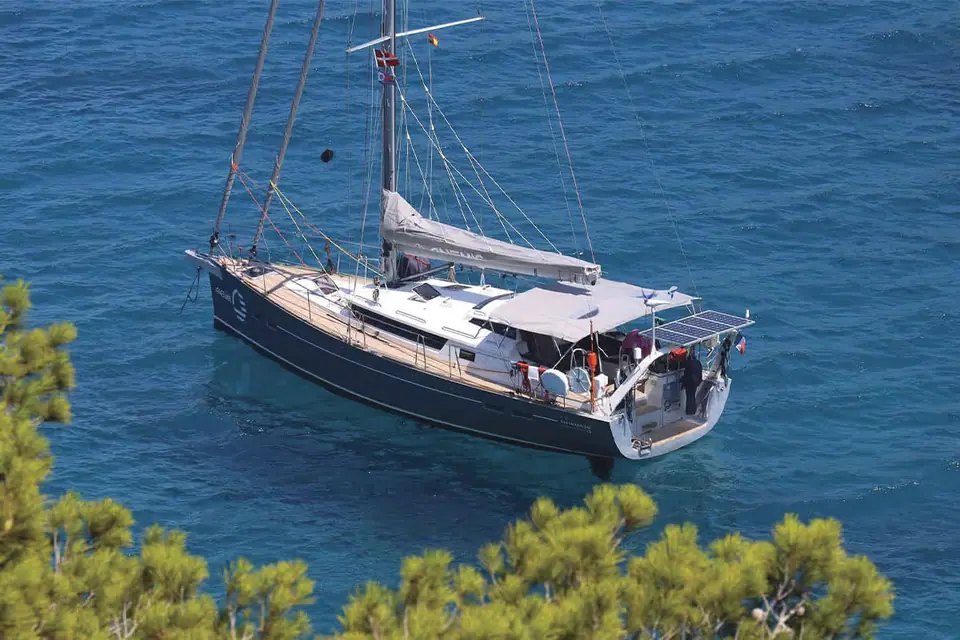
The Garcia Exploration 45 is an aluminum centerboard cruiser drawn by Berret-Racoupeau with Jimmy Cornell and built in Normandy since 2014. It won Cruising World's 2015 Best Full-Size Cruiser Under 50 Feet and listed at $850,000 then.
- High-latitude and expedition cruising
- Couples planning multi-year circumnavigations
- Sailors who want shoal-draft access
- Buyers who value safety over speed
Garcia Exploration 45 by the numbers
- Sail area to displacement
- 15.5A cruising rig sized for comfort, so expect to motor in very light air.
- Displacement to length
- 216Moderate displacement, a classic cruising balance between load carrying and speed.
- Theoretical hull speed
- 8.5 knThe practical top speed of a displacement monohull under normal sailing, based on waterline length.
- Ballast ratio
- 31%A typical ballast ratio for a cruising monohull.
- Capsize screening
- 1.83Below 2.0, the traditional threshold for offshore suitability.
- Motion comfort ratio
- 33.4Moderate motion comfort, typical of modern cruisers.
- Length to beam ratio
- 3.15 : 1Moderate proportions.
Garcia Yachts, Jimmy Cornell and a very specific brief
Garcia Yachts, a French yard founded in 1974, builds aluminum cruising and exploration yachts from 45 to 60 feet, and the Exploration 45 is the boat that defined its modern range. It began with Jimmy Cornell, the founder of the ARC, who by then had owned three cruising boats and covered more than 200,000 miles. His fourth Aventura had to be the ideal bluewater cruiser and also capable of negotiating the Northwest Passage.
Garcia and the naval architects Berret-Racoupeau took on that brief in 2013. Hull 1, Aventura IV, launched in 2014 and immediately proved the point: within its first year it sailed past the Arctic Circle in an attempt on the Northwest Passage, crossed the Atlantic, appeared at two boat shows and headed for Panama and the Pacific. Cornell completed the Northwest Passage in 2015 on his second attempt. Yachting World reported five boats sold and in build before the first was even launched.
Why aluminum and a centerboard
Cornell's third boat was an Ovni 435, and by then he had settled on aluminum. Garcia describes the 5 to 12 mm aluminum hull as one that deforms rather than breaks on impact, and adds watertight collision bulkheads at the bow and stern. The propeller shaft runs inside a skeg, and the twin rudders have a short protective skeg ahead of them and a sacrificial composite zone at the top, so that a bent stock pushes into a crushable section rather than the hull.
The ballast is internal and the foil-shaped centerboard lifts fully into the hull and skeg. Current Garcia figures give 9 ft 6 in (2.90 m) of draft with the board down and 3 ft 9 in (1.14 m) with it up, enough to reach lagoons and poorly charted anchorages, and the boat can dry out supported by the twin rudders. Yachting World measured 2.80 m and 1.05 m on hull 1, an example of how specifications have evolved.
How it sails, upwind and with the board up
Charles Doane sailed Aventura IV for SAIL, first on Chesapeake Bay and then on a passage from Florida toward Panama. On the Bay it felt fully powered at about 40 degrees apparent and made better than 6 knots in a 20 knot breeze in a chop. On passage it held an honest 5 to 7 knots in 7 to 11 knots of true wind on a close reach under full main, staysail and a furling Code 0. He judged the wheel light with a touch of weather helm and the motion in a seaway remarkably smooth for a monohull.
Yachting Monthly's tester was cooler, calling the boat big, heavy and not the most exciting to sail, but responsive on the helm and very comfortable in a confused sea. Like most centerboarders, it gives up some windward ability for lack of deep ballast. The payoff is downwind: raise the board as the wind goes aft of the beam and the helm lightens and speed improves. Garcia claims daily averages of more than 160 miles.
Two watch stations, one inside
The Exploration 45 is built around keeping the person on watch protected. Outside, an overhanging coachroof inspired by IMOCA racers shelters the forward end of the cockpit like a hard dodger, and every control line runs under deck to the coamings. Yachting World admired the twin wheels, the deep cockpit and companionway doors so solid they seal with a bolt top and bottom. SAIL's only criticisms were some friction in the main halyard and mainsheet runs and the coachroof blocking sightlines on the centerline.
Inside, the nav station sits right forward in the raised saloon behind what is effectively a windshield, with secondary autopilot and engine controls and about a 270 degree view. In bad weather you can stand a proper watch from the warm, dry interior.
Layouts, insulation and a workshop on board
Garcia offers two or three cabins with five, six or eight berths. Cornell's own boat was the extreme case, with an owner's cabin forward with an island double and en suite head, two bunks off the passage, a twin cabin aft to starboard and a double aft to port. SAIL found that version cramped and recommended layouts with fewer berths and more storage beside the inline port galley. Current plans include a technical room, a workshop for tools and spares and Garcia claims a carrying capacity of almost two tonnes.
For high latitudes, the hull has 74 mm of insulation, the saloon windows are double-glazed and heating comes from radiators fed by a diesel boiler. Yachting Monthly noted that on the test boat only the saloon windows were double-glazed, not the hull lights and hatches, so check what any used boat actually has.
- Tankage 700 liters (185 gallons) of diesel and 500 liters (132 gallons) of water in current specs
- Transfer pumps shift fuel and water between tanks to trim the boat
- Chain locker near the mast foot keeps weight central
- Room for solar, wind or hydro generator and a watermaker
Engine, tanks and the energy question
Aventura IV was fitted with a 55 hp Volvo Penta diesel and, per SAIL, 87 gallons of fuel. Garcia's current specification lists an 80 hp (59.5 kW) engine with 700 liters of diesel, a sign of how owners have pushed the boat toward motoring range for ice and calms. Yachting Monthly described the design goal as being able to motor 1,000 miles through inhospitable water and come out the other side.
Energy is the other half of autonomy. Cornell's boat carried a full solar array, a wind generator and a water generator, and SAIL found it easy to keep the batteries healthy on passage. Budget for a modern lithium bank and charging system if a used boat still has its original setup.
Buying new or used, and what it costs to run
Cruising World quoted $850,000 in 2014, and a new, well-equipped Exploration 45 in 2026 is likely to cost well over $1 million once heating, energy, electronics and sails are added. Used boats appear through Garcia's own brokerage and European agents more often than on US portals, and many are lying in Europe, the Caribbean or remote cruising grounds.
Running costs are those of a complex 45 ft offshore boat. Allow roughly $35,000 to $70,000 a year in the US for slip, insurance (some insurers ask questions about high-latitude plans), haul-out, aluminum-appropriate antifouling, engine, boiler and generator service, and a reserve for sails and rigging. Aluminum is forgiving of knocks but requires careful attention to galvanic corrosion and the electrical system.
Garcia Exploration 45 specifications
| Length overall | 45.8 ft13.97 m |
|---|---|
| Waterline length | 40.5 ft12.34 m |
| Beam | 14.6 ft4.44 m |
| Draft | 9.5 ft2.9 m |
| Air draft | 65 ft19.8 m |
| Displacement | 32,21 lbs14,61 kg |
| Ballast | 10,01 lbs4,541 kg |
| Sail area | 98 sq ft91 m² |
| Fuel capacity | 185 gal7 L |
| Fresh water | 132 gal5 L |
| Cabins | 2 or 3 (plus a technical room on some layouts) |
| Berths | 5, 6 or 8 depending on layout |
| Heads | 2 |
| Standard engines | 80 hp (59.5 kW) diesel in current Garcia specifications |
| Hull type | Aluminum centerboard monohull with twin rudders and a deck saloon |
| Keel | Internal ballast with a foil-shaped centerboard, 9 ft 6 in down and 3 ft 9 in up; propeller shaft enclosed in a skeg |
| Rig | Cutter rig with furling genoa and staysail, Code 0 or gennaker on the bowsprit, slab-reefed main |
| Hull construction | Aluminum hull 5 to 12 mm thick with integral centerboard trunk; cored fiberglass coachroof on the first boats |
| Builder | Garcia Yachts (formerly Garcia Yachting), France |
| Naval architect | Berret-Racoupeau (Olivier Racoupeau) |
| Other design credits | Concept by Jimmy Cornell with Garcia's design office; interior by Isabelle Racoupeau |
| Production | 2014 to present |
| Status | In production |
Figures come from builder documentation and independent tests where available. Displacement is usually quoted light, so a loaded cruising boat will weigh more. Compare these specs with another model.
How much does a Garcia Exploration 45 cost?
Cruising World quoted the Exploration 45 at $850,000 when it judged the 2015 Boat of the Year fleet, roughly $25 per pound of boat. Euro pricing, inflation and the trend toward heavily equipped high-latitude boats push a comparably specified new boat well above $1 million in 2026; our new and used ranges are estimates rather than published list prices. Used values depend on heating, energy systems, sail inventory and whether the boat has already been proven in high latitudes.
Estimate your yearly cost
A planning estimate using common rules of thumb: insurance near 1.5 percent of value, maintenance near 3 percent, haul out and bottom paint by length. Your marina, region and use will move these numbers. Open the full cost calculator.
Versions and options
- Cornell layout
- Eight berths in four sleeping areas, as on Aventura IV; maximum crew, minimum storage.
- Two or three cabin layouts
- Fewer berths with more storage, a larger aft head and a technical room or workshop.
- Larger siblings
- The Exploration 52 and 60 extend the concept; the Explocat 52 brings it to an aluminum catamaran.
Garcia Exploration 45 timeline
- 1974Garcia founded in France
- 2013Garcia and Jimmy Cornell begin the Exploration 45 project
- 2014Hull 1, Aventura IV, launches and attempts the Northwest Passage
- 2014Wins Cruising World's 2015 Best Full-Size Cruiser Under 50 Feet; also a SAIL 2015 Best Boats winner
- 2015Cornell completes the Northwest Passage on his second attempt
Strengths and weaknesses
What owners like
- Rugged aluminum hull with collision bulkheads
- Centerboard gives 3 ft 9 in draft for shallow anchorages
- Protected inside and outside watch stations
- Serious insulation and heating for cold climates
- Large tankage and carrying capacity
- Excellent systems access
What to weigh up
- Expensive, new and used
- Windward ability limited compared with a deep fin keel
- Heavy to handle in tight marinas without a thruster
- Coachroof restricts centerline visibility from the helm
- Few boats on the US market
Used Garcia Exploration 45 buyer checklist
Take this list to a viewing. Your ticks are saved in this browser so you can come back to it.
Always commission an independent marine survey and an engine survey before you buy. How a marine survey works.
Rivals to consider
Kraken 50
A heavier fiberglass bluewater boat with an integral skeg keel, aimed at the same safety-first buyer.
Compare side by sideAmel 50
A protected-cockpit French cruiser in fiberglass with a fixed keel and more luxury.
Compare side by sideAllures 45.9
Aluminum hull with composite deck and a centerboard from a sister French yard, lighter and less expedition-focused.
Boreal 47
Another French aluminum centerboarder built for high latitudes with a distinctive doghouse.
Our verdict on the Garcia Exploration 45
The Garcia Exploration 45 is a rare production boat that was designed backward from a real voyage, and it has since done that voyage. Aluminum, a lifting centerboard, twin protected rudders, an inside watch station and serious insulation make it one of the most capable 45 footers you can buy for high latitudes and remote cruising. It is not cheap, not a light-air rocket and not ideal for marina life, but for sailors who want to go where charts run out, few boats in this size offer the same margin.
Garcia Exploration 45 questions answered
How much does a Garcia Exploration 45 cost?
It was quoted at $850,000 in 2014. We estimate a comparable new boat in 2026 at $1.1 to $1.4 million and used boats at roughly $650,000 to $1 million.
Who designed the Garcia Exploration 45?
Berret-Racoupeau (Olivier Racoupeau) with Jimmy Cornell and Garcia's design office.
Is the Garcia Exploration 45 still built?
Yes. Garcia Yachts still lists it alongside the Exploration 52, Exploration 60 and Explocat 52.
What is the draft of the Garcia Exploration 45?
About 9 ft 6 in with the centerboard down and 3 ft 9 in with it up, per Garcia's current specifications.
Did the Exploration 45 sail the Northwest Passage?
Yes. Jimmy Cornell's Aventura IV, hull 1, completed it in 2015 on his second attempt.
What awards did it win?
Cruising World's 2015 Best Full-Size Cruiser Under 50 Feet and a SAIL 2015 Best Boats award.