Tayana 37 Sailboat, an Owner's and Buyer's Review
Bob Perry's Taiwan-built double-ender, with close to 600 hulls launched and more of them wandering the oceans than almost any other cruising boat.
- Length
- 36.7 ft11.18 m
- Beam
- 11.5 ft3.51 m
- Draft
- 5.7 ft1.73 m
- Cabins
- 2
- Used price
- $30K to $110K
On this page
- Overview
- Bob Perry's answer to the Westsail craze
- A long keel with the forefoot cut away
- Spruce spars, weather helm and the fixes owners settled on
- Teak everywhere, the interior that sells the boat
- Sea manners, light-air sluggishness and handling under power
- The 650 pound fuel problem in the bow
- The survey items that decide a Tayana 37's price
- Buying in a market with hundreds of choices
- Specifications
- Price and value
- Strengths and weaknesses
- Used buyer checklist
- Rivals
- Our verdict
- FAQ
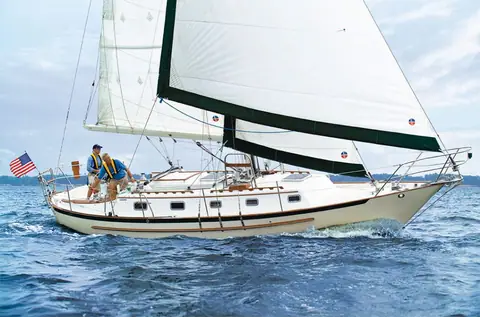
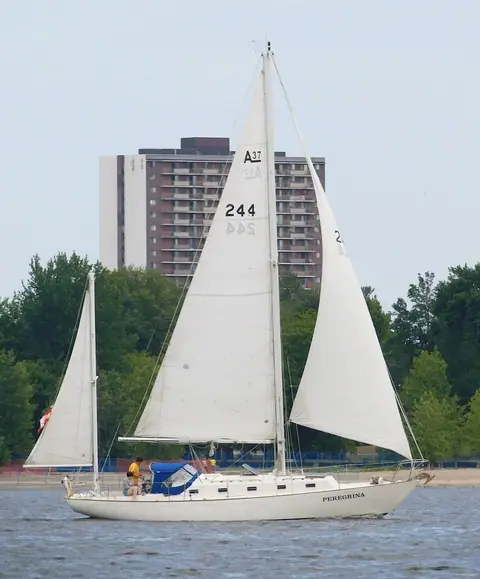
A 37-foot cutter-rigged double-ender designed by Robert Perry and built by Ta Yang in Taiwan from 1976. Heavy, handsome and plentiful on the used market, with teak decks and steel tanks as the big survey items.
- Couples planning long-term ocean cruising
- Buyers who love traditional joinery
- Sailors on a mid-range budget
- Liveaboards wanting tankage and storage
Tayana 37 by the numbers
- Sail area to displacement
- 17.0Balanced power for coastal and offshore cruising.
- Displacement to length
- 337Heavy displacement. Slow to accelerate but steady and sea kindly with a full load.
- Theoretical hull speed
- 7.5 knThe practical top speed of a displacement monohull under normal sailing, based on waterline length.
- Ballast ratio
- 36%A typical ballast ratio for a cruising monohull.
- Capsize screening
- 1.63Below 2.0, the traditional threshold for offshore suitability.
- Motion comfort ratio
- 41.1A slow, easy motion in a seaway, kind to crews on long passages.
- Length to beam ratio
- 3.19 : 1Moderate proportions.
Bob Perry's answer to the Westsail craze
In the mid 1970s the Westsail 32 had convinced thousands of Americans that a heavy double-ender was the only proper way to cross an ocean. The Tayana 37 was the Taiwanese yards' most successful reply. Robert Perry drew a boat that looked traditional above the waterline, with a Baltic canoe stern that borrows from Aage Nielsen's ketch Holger Danske, but with a longer waterline and a far more efficient cutter rig than the Westsail.
The design was commissioned by Will Eckert of Flying Dutchman Yachts together with C.T. Chen of Ta Yang Yacht Building, which took over the rights. Ta Yang first sold the boat as the CT 37, also built it as the Ta Chiao 37 and Ta Yang 37, and from 1979 marketed it as the Tayana 37. The builder's own count stood at 588 around 2012, with the boat still available to order, while Practical Sailor and Charles Doane put the total at about 600 or more. Doane called it the most successful of the Taiwan-built double-ended full-keel cruisers, and reported that at any given time there are more Tayana 37s wandering the globe than any other single type of sailboat.
A long keel with the forefoot cut away
The key number is waterline: 31 feet on a 36 foot 8 inch hull, against 27 feet 6 inches on a Westsail 32. That gives a hull speed of roughly 7.5 knots. Perry trimmed the forefoot and hung the rudder on the back of a modified long keel, which reduces wetted surface and makes the boat noticeably livelier than the full-keel boats it competed with.
Displacement is 22,500 pounds with 8,000 pounds of ballast, a displacement to length ratio of about 337 and a ballast ratio around 36 percent. The comfort ratio is about 41 and the capsize screening number about 1.63. The hull carries molded-in plank seams, a cosmetic nod to wooden boats that you either love or ignore.
Spruce spars, weather helm and the fixes owners settled on
The Tayana 37 carries about 846 square feet as a cutter, the ketch a little over 750. The rig is large for a cruising boat and is why a well-sailed Tayana surprises owners of lighter boats on a reach. But early rigs had real problems. Practical Sailor found wooden masts with massive sections and very thick walls, one with a large knot just at spreader height, and a spruce boom so small it would bend like a rubber band.
Owners also reported heavy weather helm. Part of it came from excessive mast rake, part from stretchy, poorly cut sails from the original loft, and part from the boat's tenderness at small angles of heel. Reducing rake, buying modern sails and reefing early solve most of it. An aluminum rig is the single best upgrade, and on the used market it is worth paying extra for.
Smaller annoyances included an outhaul slide that tended to distort or break, a traveler that sometimes needed a kick after each tack, and a staysail boom that makes moving forward awkward. Many boats now have a staysail on a furler with no boom at all.
Teak everywhere, the interior that sells the boat
Step below and the reason for the Tayana's popularity is obvious. Practical Sailor called the joinery on later boats some of the best it had seen, with near-flawless joints, paneled doors and drawers dovetailed from solid stock. The finish is teak throughout, lit by eleven bronze ports, a teak-framed skylight and a forward hatch.
The common layout has a double V-berth forward, a U-shaped settee and drop-leaf dinette in the saloon with a pilot berth above, a U-shaped galley to port with a three-burner propane stove and oven, a nav station opposite, and a double berth aft to starboard. The head is to port with a shower and teak grating. Later Mark II boats often have a more open arrangement.
Two cautions. The all-teak cabin feels dark to many people, and all that wood needs oiling or varnishing. Second, layouts varied because Ta Yang built many boats to order, so view the actual boat rather than trusting a brochure plan.
Sea manners, light-air sluggishness and handling under power
The Tayana 37 heels early, then firms up, and that initial tenderness is part of what makes it comfortable in a seaway. Directional stability is excellent, and the cutter is easy to sail short-handed. Below about 10 knots of true wind the boat is sluggish, and a drifter or code zero earns its keep.
Under power, performance is sedate rather than sprightly, given the wetted surface and displacement. Owners rate low-speed handling fair to good going ahead, but in reverse the long keel and keel-hung rudder make it unpredictable. One owner described it backing up like a drunken elephant. Plan dockings with springs and use prop walk rather than fighting it.
The 650 pound fuel problem in the bow
Tankage is generous: about 90 gallons of fuel and 100 of water. On many boats the main fuel tank sits under the V-berth, so a full tank puts roughly 650 pounds in the bow and trims the boat down by the head. After owner feedback Ta Yang offered an amidships location, including a tank in the keel area. Ask which arrangement a boat has; amidships fuel makes for a better boat at sea.
Tanks were black iron and eventually rust. Fuel tanks are relatively accessible, so replacement is a job rather than a catastrophe, but water tanks were the bigger casualty and many boats have already had theirs replaced with stainless or plastic. Engines over the years included the Yanmar 3QM30, the Perkins 4-108 and the Volvo MD17C. Most surviving boats have been repowered.
The survey items that decide a Tayana 37's price
Almost every Tayana 37 has had at least some of these problems by now. The question is whether a previous owner fixed them properly. Join the Tayana owners association before you buy, since documented fixes for nearly every known issue already exist.
- Teak decks screwed down over a cored deck, leaking into the core as the bungs and caulking fail
- Early hull-to-deck joints forming a hollow bulwark pierced by hawsepipes and scuppers
- Black iron fuel and water tanks rusting from the outside
- Bronze rudder heel fitting fastened with stainless bolts, prone to galvanic corrosion
- Laminated wooden bowsprit rotting underneath
- Weaker wiring and lower-grade stainless fittings on boats built before 1981
Buying in a market with hundreds of choices
Asking prices run from about $30,000 for a project to around $110,000 for a late, well-refit boat. Most decent examples trade between $45,000 and $80,000. Because supply is deep, you can afford to walk away from a boat with an original teak deck, wooden spars and iron tanks.
Annual costs of $7,000 to $16,000 cover insurance, a 37 to 40 foot slip and routine maintenance, but teak deck work and varnish add to that. Remember that the bowsprit stretches overall length to about 42 feet, which some marinas will bill.
Tayana 37 specifications
| Length overall | 36.7 ft11.18 m |
|---|---|
| Waterline length | 31 ft9.45 m |
| Beam | 11.5 ft3.51 m |
| Draft | 5.7 ft1.73 m |
| Displacement | 22,5 lbs10,206 kg |
| Ballast | 8, lbs3,629 kg |
| Sail area | 846 sq ft78.6 m² |
| Fuel capacity | 9 gal34 L |
| Fresh water | 1 gal38 L |
| Cabins | 2 |
| Berths | Up to 7 |
| Heads | 1 |
| Standard engines | Yanmar diesel; Practical Sailor names the Yanmar 3QM30 as the later standard, and later spec sheets list 33 to 40 hp |
| Optional engines | Perkins 4-108 or Volvo MD17C on some earlier boats |
| Hull type | Heavy displacement double-ender with Baltic-style canoe stern |
| Keel | Modified long keel with cutaway forefoot and keel-hung rudder |
| Rig | Cutter (most boats) or ketch, spruce or aluminum spars, bowsprit taking sparred length to about 42 ft |
| Hull construction | Solid hand-laid fiberglass with molded plank seams; teak-over-fiberglass decks on most boats |
| Builder | Ta Yang Yacht Building Co., Taiwan |
| Naval architect | Robert H. Perry |
| Production | 1976 to present |
| Status | Limited production |
Figures come from builder documentation and independent tests where available. Displacement is usually quoted light, so a loaded cruising boat will weigh more. Compare these specs with another model.
How much does a Tayana 37 cost?
With hundreds of boats built, Tayana 37 prices are set by condition, not scarcity. Charles Doane noted that older boats needing work could be had for under $50,000 and well-equipped younger boats often for under $100,000, and the market still sorts along those lines. Replaced tanks, a re-laid or removed teak deck and an aluminum rig each move a boat toward the top, while original wooden spars and leaking teak decks keep a boat at the bottom.
Estimate your yearly cost
A planning estimate using common rules of thumb: insurance near 1.5 percent of value, maintenance near 3 percent, haul out and bottom paint by length. Your marina, region and use will move these numbers. Open the full cost calculator.
Versions and options
- Cutter
- The standard and most popular rig, about 846 square feet with two headsails.
- Ketch
- Fewer built, a little over 750 square feet, with smaller individual sails.
- Pilothouse
- A protected steering station was available on some boats and is rare on the used market.
- Mark II
- Later boats, often with a more open interior arrangement. On later hulls the hollow bulwark was also glassed over from inside, making the deck joint far more watertight.
Tayana 37 timeline
- 1976Introduced as the CT 37, built by Ta Yang to Robert Perry's design
- 1979Renamed Tayana 37 after the builder, Ta Yang Yacht Building
- 2010Charles Doane reports more than 600 built and Ta Yang still filling orders on a spot basis
- 2012The builder's website puts the boat count at 588 and lists the model as still in production
Strengths and weaknesses
What owners like
- Long 31 foot waterline gives real passage speed for a heavy double-ender
- Excellent tracking and an easy motion offshore
- High-quality teak joinery on later boats
- 90 gallons of fuel and 100 gallons of water
- Deep used market with plenty of choice
- Strong owner association with documented fixes
What to weigh up
- Teak decks leak with age and are expensive to replace
- Black iron tanks rust and need replacement
- Original wooden spars and rigging details were weak
- Sluggish in light air and awkward in reverse
- Dark, maintenance-heavy interior
Used Tayana 37 buyer checklist
Take this list to a viewing. Your ticks are saved in this browser so you can come back to it.
Always commission an independent marine survey and an engine survey before you buy. How a marine survey works.
Rivals to consider
Westsail 32
Cheaper, smaller and slower, with a shorter waterline and a strong heavy-weather record.
Compare side by sideValiant 40
Perry's fin keel performance cruiser, faster and more modern underwater, but watch the blister-era hulls.
Compare side by sidePacific Seacraft 37
Better construction and resale, lighter and smaller inside, at a higher price.
Compare side by sideHans Christian 38
A similar Taiwanese double-ender with heavier displacement and an equally heavy teak maintenance load.
Our verdict on the Tayana 37
The Tayana 37 is the best balance of traditional looks, real sailing ability and affordability among the Taiwan double-enders. It is not a boat to buy on joinery alone. Spend your survey money on the deck, tanks, rig and rudder fitting, and buy one where the big jobs have been done. Get that right and you have a capable ocean boat for the price of a tired coastal cruiser.
Tayana 37 questions answered
How much is a Tayana 37 for sale?
Most Tayana 37s ask between $30,000 and $110,000, with decent cruising-ready boats usually between $45,000 and $80,000.
Who designed the Tayana 37?
Robert Perry designed it, and Ta Yang built it in Taiwan starting in 1976.
How many Tayana 37s were built?
About 600. The builder's own count was 588 around 2012, while Practical Sailor and Charles Doane put the total at about 600 or more, making it one of the most common bluewater cruisers in the world.
Is the Tayana 37 a good bluewater sailboat?
Yes. It has a long sailing record offshore, a comfortable motion and large tanks, but needs a careful survey of decks, tanks and rigging.
What are the common problems on a Tayana 37?
Leaking teak decks, rusting black iron tanks, a corrosion-prone rudder heel fitting, bowsprit rot and weak original wooden spars.