Cape Dory Yachts Bluewater Sailboats
Cape Dory 28 Review and Used Buyer's Guide
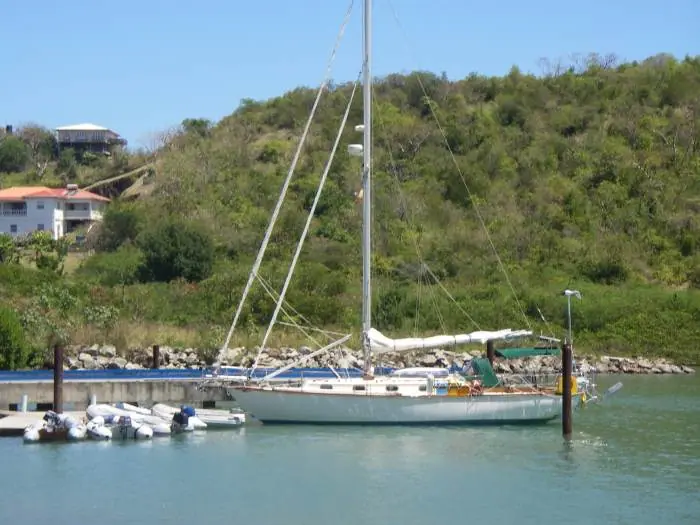
Carl Alberg's sweet-sheered 28 with a teak bowsprit and a full keel, built 388 times in Massachusetts and sailed around the world singlehanded.
- Length
- 28.1 ft8.56 m
- Beam
- 8.9 ft2.7 m
- Draft
- 4 ft1.22 m
- Cabins
- 1 (V-berth forward) plus saloon
- Used price
- $12K to $40K
On this page
- Overview
- The Cape Dory 28 and the art of accidental ownership
- Alberg's lines, and what the ratios say
- Under sail, quicker than the numbers suggest
- Small boat, big passages
- Inside: teak, bronze and a galley split by the companionway
- Engines and the squeeze behind the steps
- Owning one: costs, community and the powerboat confusion
- Used values and what moves them
- Specifications
- Price and value
- Strengths and weaknesses
- Used buyer checklist
- Rivals
- Our verdict
- FAQ
The Cape Dory 28 is a Carl Alberg designed full-keel masthead sloop built by Cape Dory Yachts in East Taunton, Massachusetts, from 1974 to 1987. About 388 were built; used boats typically ask $12,000 to $40,000.
- Cruising couples on a budget
- Singlehanders who value balance
- Classic boat lovers
- Coastal and island cruising with offshore margin
Cape Dory 28 by the numbers
- Sail area to displacement
- 14.9A cruising rig sized for comfort, so expect to motor in very light air.
- Displacement to length
- 367Heavy displacement. Slow to accelerate but steady and sea kindly with a full load.
- Theoretical hull speed
- 6.3 knThe practical top speed of a displacement monohull under normal sailing, based on waterline length.
- Ballast ratio
- 39%A typical ballast ratio for a cruising monohull.
- Capsize screening
- 1.71Below 2.0, the traditional threshold for offshore suitability.
- Motion comfort ratio
- 31.7Moderate motion comfort, typical of modern cruisers.
- Length to beam ratio
- 3.17 : 1Moderate proportions.
The Cape Dory 28 and the art of accidental ownership
Cruising World's Classic Plastic profile of the Cape Dory 28 begins with a confession familiar to many owners: the writer went to a Chesapeake boatyard just to look, found an Alberg-designed Cape Dory 28, and owned it three weeks later. That is how this boat sells. The graceful sheer sweeping forward from a counter stern to a teak bowsprit, the teak eyebrows and grabrails on a long trunk cabin and the bronze opening ports do most of the work.
Cape Dory Yachts built about 388 of them in East Taunton, Massachusetts, between 1974 and 1987 (Wikipedia's model table lists 389, and sailboatdata gives 1988 as the last year). That long run makes the 28 one of the most common Cape Dorys on the market, and one of the most frequently recommended small cruisers for couples on a budget.
Alberg's lines, and what the ratios say
Like most Cape Dorys the 28 follows Carl Alberg's recipe: a full keel with the rudder hung on its trailing edge, relatively narrow beam of about 8 ft 10 in, moderate freeboard and generous overhangs. The waterline is 22 ft 2 in on a 28 ft 1 in hull, displacement is 9,000 lb, and 3,500 lb of it is lead ballast.
Those numbers describe a heavy, stiff boat that will not set speed records but will keep going when lighter boats are reefing hard. The comfort ratio of about 31.7 sits in the moderate bluewater range, and the capsize screening value of 1.71 is well under the usual 2.0 offshore threshold.
Under sail, quicker than the numbers suggest
The Cruising World owner sailed her 28 for six years and described it as sound, safe and comfortable: stiff, surprisingly quick in light wind, extremely capable in heavy air and a joy off the wind. It balanced well, tracked perfectly and used its momentum to plow through Chesapeake chop.
Her one complaint was the club-footed jib. It made tacking easy when singlehanding but was hard to trim well, so she replaced it with a roller furling system. That is a common upgrade, and a boat with a good furler and a newer headsail is worth more than one still carrying the original club.
Small boat, big passages
Wikipedia notes that a Cape Dory 28 has completed a solo circumnavigation, and the boat appears regularly on lists of small offshore-capable cruisers. Treat that as proof of the hull's capability rather than a promise about any individual boat. A 40-year-old 28 needs new standing rigging, a sound rudder, rebedded hardware and a reliable engine before it goes offshore, and tankage is modest for long passages.
For most owners the 28 is a coastal and island-hopping boat that can handle an unexpected gale, which is exactly the margin a cruising couple wants on the way to the Bahamas or along the Maine coast.
Inside: teak, bronze and a galley split by the companionway
Below, solid teak and teak veneer dominate, and bronze appears in the through-hulls and the eight opening ports. The saloon has about 6 ft of headroom and two opening hatches. Each settee hides a 30 gallon water tank, with more storage behind the backrests and narrow bookshelves above. The starboard settee is a single berth; the port settee slides out to make a slender double, and a teak table swings down from the bulkhead between them.
Forward of the saloon is the head, with a hanging wet locker and a small sink. Cruising World noted that the sink drains into a fiberglass trough and then to the bilge, and the toilet sits below the waterline, so valves must be closed when it is not in use. A folding door leads to the V-berth, where a cushioned insert creates a double, with the anchor locker beyond.
The galley straddles the companionway: the top step sits on the counter beside a single stainless sink, with an icebox to starboard and an alcohol stove to port. Many owners have converted to propane.
Engines and the squeeze behind the steps
Sailboatdata lists the 13 hp Volvo MD7A as original equipment, with some boats fitted with Farymann or Universal diesels. Engine access is the 28's least loved feature. Cruising World described removing the companionway stairs to gain just enough room for a small person to lean over the engine to service the raw-water pump or top up the transmission.
Fuel capacity is reported inconsistently, 13 gallons by sailboatdata and 32 gallons by Cruising World, which may reflect different tank installations over the years. Check the actual tank before planning range. A boat that has been repowered with a modern small diesel is worth a meaningful premium, both for reliability and for parts availability.
Owning one: costs, community and the powerboat confusion
Running a 28 footer is affordable. Budget roughly $4,000 to $9,000 a year in most US regions for slip or mooring, insurance, haul-out and bottom paint, engine service and teak care. The Cape Dory Sailboat Owners Association (capedory.org) is one of several groups that support owners, and much of the original bronze hardware came from Cape Dory's own Spartan Marine division, so keep original castings rather than replacing them with generic parts.
Do not confuse the sailboat with the Cape Dory 28 powerboat. Wikipedia's model table lists a separate 28 powerboat line in open, sport and cruiser versions, built from 1984 to 1990 with 223 produced. Listings sometimes mix them, so check that the boat in front of you has a mast.
- Cape Dory Yachts folded in 1992 and sold several designs to Newport Shipyards
- Robinhood Marine, headed by founder Andrew Vavolotis, later acquired molds for several models
- Owner associations remain the best source of drawings and fixes
Used values and what moves them
Cruising World put asking prices at $14,500 to $35,000 when it profiled the boat in 2007. Today we see the realistic range as roughly $12,000 for a tired boat with an original engine to around $40,000 for a repowered, well-kept example with good sails and electronics. Year matters less than refit history, so judge each boat on survey rather than age.
Cape Dory 28 specifications
| Length overall | 28.1 ft8.56 m |
|---|---|
| Waterline length | 22.2 ft6.77 m |
| Beam | 8.9 ft2.7 m |
| Draft | 4 ft1.22 m |
| Air draft | 40.5 ft12.34 m |
| Displacement | 9, lbs4,082 kg |
| Ballast | 3,5 lbs1,588 kg |
| Sail area | 404 sq ft37.5 m² |
| Fresh water | 6 gal227 L |
| Cabins | 1 (V-berth forward) plus saloon |
| Berths | 4 (V-berth double with filler, starboard settee berth and pull-out port settee) |
| Heads | 1 |
| Standard engines | Volvo MD7A (13 hp) diesel |
| Optional engines | Some boats fitted with Farymann or Universal diesels |
| Hull type | Full-keel displacement monohull with counter stern |
| Keel | Full keel with lead ballast and keel-hung rudder |
| Rig | Masthead sloop with teak bowsprit; club-footed jib on many boats |
| Hull construction | Solid fiberglass hull, cored deck, internal lead ballast |
| Builder | Cape Dory Yachts, East Taunton, Massachusetts, USA |
| Naval architect | Carl Alberg |
| Production | 1974 to 1987 |
| Status | Discontinued |
Figures come from builder documentation and independent tests where available. Displacement is usually quoted light, so a loaded cruising boat will weigh more. Compare these specs with another model.
How much does a Cape Dory 28 cost?
Cruising World put Cape Dory 28 asking prices at $14,500 to $35,000 in its 2007 Classic Plastic profile, and values have moved only modestly since because the youngest boats are now nearly 40 years old. The spread today depends on engine (many original Volvo MD7As have been replaced), sails, deck core condition and how well the teak has been kept. Our 2026 estimate is $12,000 to $40,000, with the best repowered boats at the top.
Estimate your yearly cost
A planning estimate using common rules of thumb: insurance near 1.5 percent of value, maintenance near 3 percent, haul out and bottom paint by length. Your marina, region and use will move these numbers. Open the full cost calculator.
Versions and options
- Cape Dory 28 sloop (1974 to 1987)
- Single production version; differences are mostly engines (Volvo, Farymann, Universal) and owner upgrades.
- Cape Dory 28 powerboat (1984 to 1990)
- An unrelated motorboat line in open, sport and cruiser versions, 223 built.
Cape Dory 28 timeline
- 1974Cape Dory 28 enters production in East Taunton
- 1984Cape Dory launches a separate 28 powerboat line
- 1987Sailboat production ends after about 388 boats
- 1992Cape Dory Yachts closes
- 2007Cruising World profiles the 28 in its Classic Plastic series
Strengths and weaknesses
What owners like
- Beautiful Alberg sheer and teak bowsprit
- Stiff, well-balanced and seakindly
- Solid construction with bronze ports and through-hulls
- Proven offshore, including a solo circumnavigation
- Affordable to buy and run
What to weigh up
- Very tight engine access
- Modest fuel capacity and uncertain tank figures
- Club-footed jib is hard to trim
- Narrow interior with a slender double
- Toilet below the waterline needs careful valve discipline
Used Cape Dory 28 buyer checklist
Take this list to a viewing. Your ticks are saved in this browser so you can come back to it.
Always commission an independent marine survey and an engine survey before you buy. How a marine survey works.
Rivals to consider
Cape Dory 25
A smaller, cheaper Cape Dory; the 25D version is a credible pocket cruiser.
Compare side by sideCatalina 28
A roomier, more modern fin-keel cruiser with less offshore pedigree.
Compare side by sideBaba 30
A heavier Perry cutter with more interior and tankage for serious passages.
Compare side by sideNor'Sea 27
A trailerable double-ender with similar bluewater ambitions in a smaller package.
Compare side by sideOur verdict on the Cape Dory 28
The Cape Dory 28 is the Alberg formula at its most approachable: pretty enough to make you buy on impulse, solid enough to justify the decision, and small enough to run on a modest budget. It is not roomy, the engine access will test your patience and the fuel figures need checking, but a well-kept 28 sails beautifully, handles a blow with composure and holds its value better than most boats of its age.
Cape Dory 28 questions answered
How much is a Cape Dory 28 worth?
We estimate $12,000 to $40,000 in 2026. Cruising World listed asking prices of $14,500 to $35,000 in 2007.
How many Cape Dory 28s were built?
About 388 were built in East Taunton, Massachusetts, from 1974 to 1987.
Is the Cape Dory 28 a bluewater boat?
It is capable offshore, and a Cape Dory 28 has completed a solo circumnavigation, but most are used for coastal and island cruising.
What engine is in a Cape Dory 28?
Originally a 13 hp Volvo MD7A; some were fitted with Farymann or Universal diesels, and many have been repowered.
Is there a Cape Dory 28 powerboat?
Yes. Cape Dory built a separate 28 powerboat line in open, sport and cruiser versions from 1984 to 1990, with 223 produced.
Is there a Cape Dory owners association?
Yes. The Cape Dory Sailboat Owners Association at capedory.org is one of several groups that support Cape Dory owners.
More bluewater sailboats to explore
Bristol Channel Cutter 28
Bluewater Sailboats, 28 ft
Used $60K to $175K
Pacific Seacraft Dana 24
Bluewater Sailboats, 27 ft
Used $35K to $120K

Nor'Sea 27
Bluewater Sailboats, 27 ft
Used $35K to $85K
Baba 30
Bluewater Sailboats, 30 ft
Used $30K to $75K