Alberg 37 for Sale, a Used Buyer's Guide to Carl Alberg's Ocean Classic
Carl Alberg's long-keeled 37 from Whitby Boat Works, a heavily built ocean boat that rode out the 1979 Fastnet storm and now sells for less than a new car.
- Length
- 37.2 ft11.33 m
- Beam
- 10.2 ft3.1 m
- Draft
- 5.5 ft1.68 m
- Cabins
- 1 (V-berth cabin forward) plus open saloon
- Used price
- $20K to $65K
On this page
- Overview
- Alberg 37 for sale, and what that money really buys
- Proven the hard way, from the Fastnet storm to a Pacific reef
- Long overhangs, short waterline, kindly motion
- Mk I or Mk II, and does it matter?
- A spartan interior built for sea berths, not parties
- Repower first, then decks and rigging
- What it costs to keep one sailing
- Who should buy one, and who should not
- Specifications
- Price and value
- Strengths and weaknesses
- Used buyer checklist
- Rivals
- Our verdict
- FAQ
The Alberg 37 is a Carl Alberg designed long-keel sloop or yawl built by Whitby Boat Works in Ontario from 1967 to 1988. 248 were built; used boats typically ask $20,000 to $65,000 depending on refit status.
- Budget bluewater cruisers
- Owners who enjoy a refit project
- Couples sailing offshore
- Classic yacht enthusiasts
Alberg 37 by the numbers
- Sail area to displacement
- 15.8A cruising rig sized for comfort, so expect to motor in very light air.
- Displacement to length
- 403Heavy displacement. Slow to accelerate but steady and sea kindly with a full load.
- Theoretical hull speed
- 6.9 knThe practical top speed of a displacement monohull under normal sailing, based on waterline length.
- Ballast ratio
- 39%A typical ballast ratio for a cruising monohull.
- Capsize screening
- 1.59Below 2.0, the traditional threshold for offshore suitability.
- Motion comfort ratio
- 39.8A slow, easy motion in a seaway, kind to crews on long passages.
- Length to beam ratio
- 3.65 : 1A slim, easily driven hull.
Alberg 37 for sale, and what that money really buys
Search for an Alberg 37 for sale and you will find boats from the late 1960s to the late 1980s at prices that look almost too low for a 37 foot ocean boat. They are low because these hulls are old, and almost every one needs money somewhere. What you are really buying is a nearly indestructible hull and a seakindly long-keel shape. Everything bolted to it is a negotiation.
The Alberg 37 was designed by Swedish-born Carl Alberg for Kurt and Doris Hansen's Whitby Boat Works in Ajax, Ontario. Whitby built 248 of them between 1967 and 1988. Alberg's name is better known on the Alberg 30, and many buyers who start looking at an Alberg 30 for sale end up stepping up to the 37 for the extra waterline, tankage and interior. Both share the same philosophy: narrow beam, long overhangs, a long keel and a hull laid up with the generous scantlings of an era when builders did not yet trust fiberglass.
Proven the hard way, from the Fastnet storm to a Pacific reef
The Alberg 37's reputation is not marketing. During the August 1979 Fastnet storm, the Fowle family were crossing from Massachusetts to Ireland aboard the Alberg 37 Arion and reported towering seas and winds to 76 knots. Practical Sailor recounts a Vancouver singlehander whose 37 sat on a coral head at the entrance to Palmyra Atoll for three days before the tide floated it off; he sailed on to Tahiti and the hull never leaked. Florida sailor Mark Phelps completed a seven-year world voyage on hull 42, built in 1968, and Wikipedia notes several circumnavigations.
An owner who had a new 37 built in 1982 sent two core samples cut from his own hull's through-hull holes to a lab, and the report called them state-of-the-art fiberglass work. That is the asset you are buying.
Long overhangs, short waterline, kindly motion
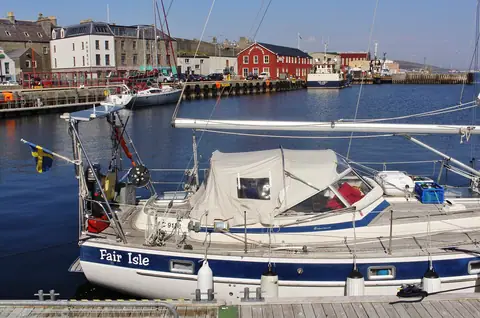
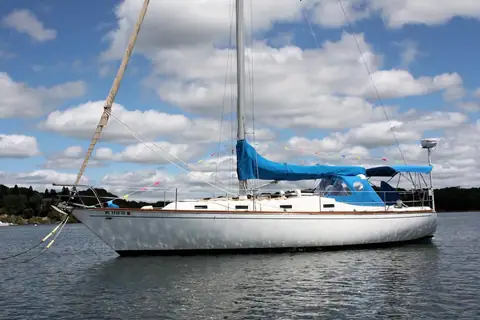
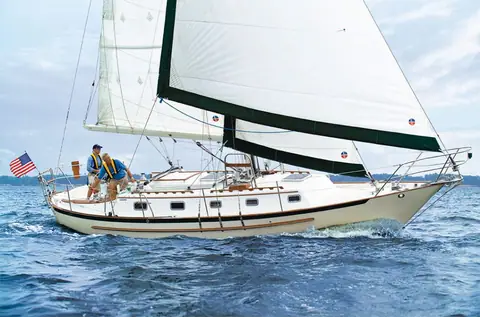
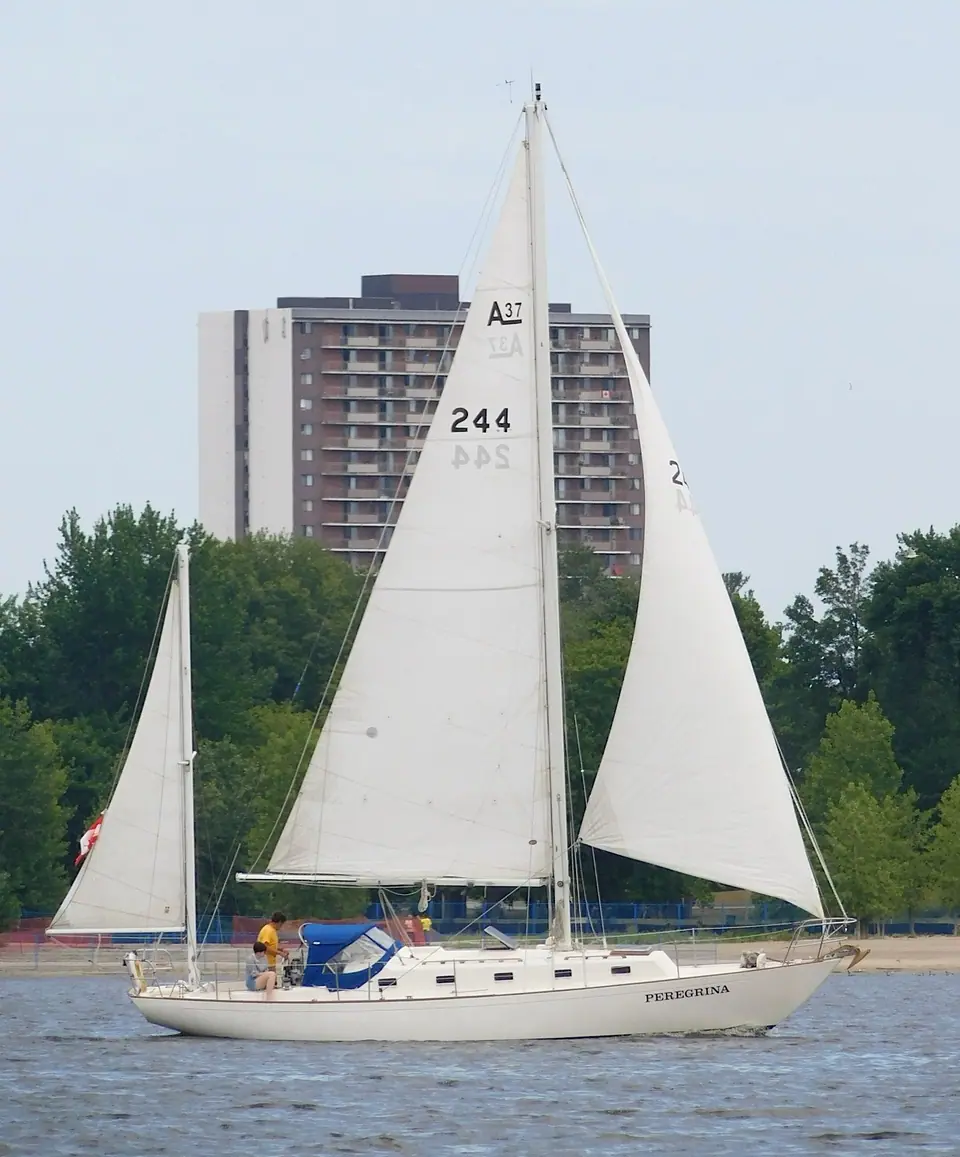
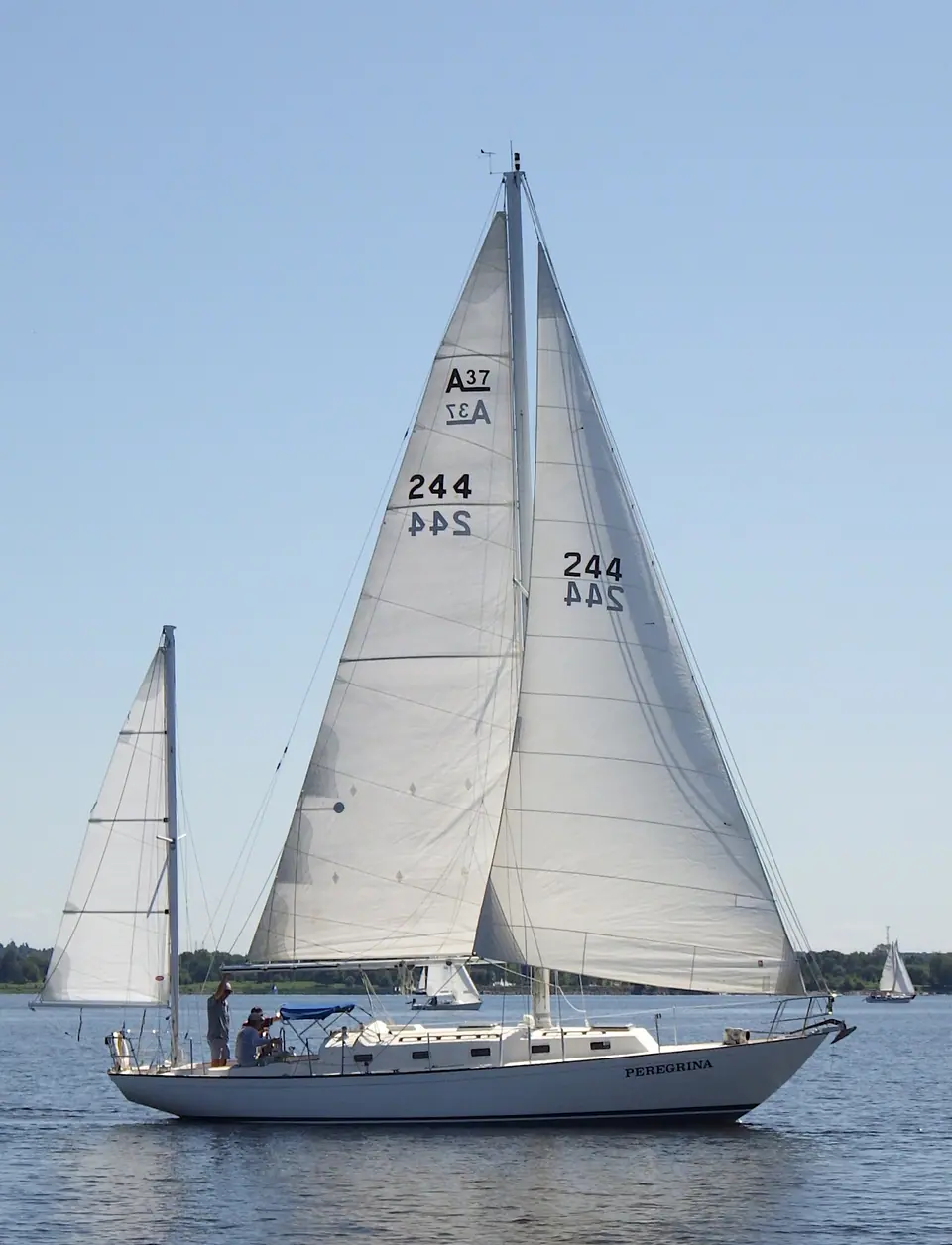
Below the water the 37 has a cut-away forefoot on a relatively short keel, with a large raked rudder hung from the keel's trailing edge and the propeller in an aperture. Above it, low topsides, a long narrow cockpit and a well-proportioned coachroof give the boat its unmistakably classic profile.
The numbers explain both its strengths and its limits. On a 37 ft 2 in hull the waterline is only 26 ft 6 in, and the beam is just 10 ft 2 in, so the boat is heavy for its length, with a displacement to length ratio of about 403. Hull speed is roughly 6.9 knots and light-air performance is modest. In return you get a gentle, predictable motion and a capsize screening value of 1.59, comfortably inside the usual offshore threshold.
Mk I or Mk II, and does it matter?
The Mk I was built from 1967 to 1971 and the Mk II from then until the factory closed in 1988. Doug Stevenson, who sold Whitby boats from 1981 until the end, summarized the changes for Practical Sailor. The Mk II swapped the wooden toerail for fiberglass, molded a dodger splash guard into the cabin top, enlarged the portlights (with fewer opening), and used interior space better for a larger head and galley and longer berths. Structurally, the biggest change was a molded cabin sole support and overhead liner in place of the Mk I's wood, which cut build time and improved durability.
In practice the condition of the individual boat outweighs the version. A Mk I avoids some liner-related access problems; a Mk II is generally drier and roomier. The yawl rig, coveted in the 1970s for its looks, adds a mizzen to maintain but gives a useful balancing sail at anchor and in a blow.
A spartan interior built for sea berths, not parties
Practical Sailor described the interior as modest, almost spartan, with square corners and little fancy joinery. Past the offset companionway you find an L-shaped galley to starboard tucked under the step, a forward-facing folding chart table to port with the quarter berth's leading edge doubling as its seat, facing saloon settees with a drop-leaf table beside the keel-stepped mast, a small head to port with lockers opposite, and a V-berth with well-finished storage bins along the overhead.
It is small by modern standards, but it works at sea. The quarter berth and a settee with a lee cloth make genuine sea berths, and nothing is so wide that you get thrown across it.
- Fuel 35 gallons and water 60 gallons per sailboatdata, enough for coastal hops but light for long passages
- Usable cockpit locker aft for deck gear
- Deep cockpit with high backrests for long watches
Repower first, then decks and rigging
Whitby fitted the 23 hp Volvo MD2B or, on most Mk II boats, the 27 hp Volvo MD11C, with a 40 hp Westerbeke 4-107 as an option. Practical Sailor's verdict on the original Volvos is that they are aged out, and access behind the companionway steps is tight. Many owners have repowered with a 28 hp Beta Marine diesel, which Practical Sailor calls a popular and sensible upgrade. If the boat still has its original engine, price a repower into your offer.
Practical Sailor suggests budgeting anywhere from $10,000 up to $50,000 for a full refit. The usual list: bulkhead and cabin sole tabbing that has separated from the hull, delamination in the balsa-cored decks, crazing and leaks around stanchion bases, and hatches, hardware and portlights that need rebedding. Standing rigging of unknown age should be replaced before any offshore passage.
The wheel pedestal sits hard against the bridge deck, which keeps the helmsman dry behind a dodger but hides the engine instruments and makes fitting a modern chartplotter awkward. Plan where electronics will go before you buy.
What it costs to keep one sailing
A 37 ft slip is the largest line item. Outside premium Northeast and South Florida marinas, budget roughly $7,000 to $16,000 a year for slip or mooring, insurance, haul-out and bottom paint, engine service and a sinking fund for sails and rigging. Insurers may ask for a recent survey on a boat this age, and some want proof of rewired electrics or a repowered engine before writing an offshore policy.
The good news is that nothing on an Alberg 37 is exotic. Rigging, sails and hardware are standard sizes, and the owners association and online community have decades of fixes documented.
Who should buy one, and who should not
The Alberg 37 suits a sailor who wants an offshore-capable hull for under $100,000 and is willing to put in time and money to bring the systems up to date. It is a strong choice for a couple heading to the Bahamas, the Caribbean or across an ocean on a modest budget, and for anyone who values motion comfort over marina speed.
It is a poor fit for families who want space, sailors who expect to win club races in light air, or anyone hoping to buy a turnkey boat cheaply. A cheap Alberg 37 is rarely a cheap Alberg 37 a year later.
Alberg 37 specifications
| Length overall | 37.2 ft11.33 m |
|---|---|
| Waterline length | 26.5 ft8.08 m |
| Beam | 10.2 ft3.1 m |
| Draft | 5.5 ft1.68 m |
| Displacement | 16,8 lbs7,62 kg |
| Ballast | 6,5 lbs2,948 kg |
| Sail area | 646 sq ft60 m² |
| Fuel capacity | 35 gal132 L |
| Fresh water | 6 gal227 L |
| Cabins | 1 (V-berth cabin forward) plus open saloon |
| Berths | V-berth, two saloon settees and a quarter berth |
| Heads | 1 |
| Standard engines | Volvo MD2B (23 hp) diesel; Volvo MD11C (27 hp) on most Mk II boats |
| Optional engines | Westerbeke 4-107 (40 hp) diesel |
| Maximum power | 40 hp |
| Hull type | Heavy displacement long-keel monohull with cutaway forefoot and long overhangs |
| Keel | Long keel with encapsulated lead ballast and keel-hung rudder, propeller in an aperture |
| Rig | Masthead sloop, or optional yawl with about 686 sq ft working sail area |
| Hull construction | Solid hand-laid fiberglass hull with encapsulated lead ballast; balsa-cored deck |
| Builder | Whitby Boat Works Ltd., Canada |
| Naval architect | Carl Alberg |
| Production | 1967 to 1988 |
| Status | Discontinued |
Figures come from builder documentation and independent tests where available. Displacement is usually quoted light, so a loaded cruising boat will weigh more. Compare these specs with another model.
How much does a Alberg 37 cost?
Alberg 37 prices are driven by refit history, not model year. Practical Sailor's 2025 review put structurally sound but cosmetically rough boats under $40,000 and well-kept, upgraded examples above $60,000, and its market scan showed a 1987 boat at $24,900 and a 1969 boat at $57,000. A recent Beta or Yanmar repower, new standing rigging and sound decks matter far more than whether the boat is a Mk I or Mk II.
Estimate your yearly cost
A planning estimate using common rules of thumb: insurance near 1.5 percent of value, maintenance near 3 percent, haul out and bottom paint by length. Your marina, region and use will move these numbers. Open the full cost calculator.
Versions and options
- Mk I (1967 to 1971)
- Wooden toerail and more interior wood structure, smaller portlights.
- Mk II (1971 to 1988)
- Fiberglass toerail, molded sole support and overhead liner, larger head and galley, molded dodger splash guard.
- Yawl rig
- Adds a mizzen for about 686 sq ft of working sail; prized for its looks in the 1970s.
Alberg 37 timeline
- 1967Whitby Boat Works launches Carl Alberg's 37 in Ajax, Ontario
- 1971Mk II replaces the Mk I with a molded sole support and liner
- 1979The Alberg 37 Arion rides out the Fastnet storm in winds reported to 76 knots
- 1988Whitby Boat Works closes after building 248 Alberg 37s
Strengths and weaknesses
What owners like
- Massively built solid fiberglass hull
- Proven in heavy weather and on circumnavigations
- Kindly, predictable motion offshore
- Classic Alberg looks that hold attention in any harbor
- Low purchase price for an ocean-capable 37 footer
What to weigh up
- Narrow, dated interior with modest storage
- Slow in light air with a short waterline
- Original Volvo engines are past their life
- Cored decks and bulkhead tabbing often need work
- Helm position crowds engine instruments and electronics
Used Alberg 37 buyer checklist
Take this list to a viewing. Your ticks are saved in this browser so you can come back to it.
Always commission an independent marine survey and an engine survey before you buy. How a marine survey works.
Rivals to consider
Cape Dory 36
Another Alberg long-keeler, slightly beamier and more refined below, usually priced higher.
Compare side by sideTartan 37
A Sparkman and Stephens centerboard or keel design that is faster and roomier but less heavily built.
Compare side by sideBristol 40
A longer, more elegant classic with similar overhangs and a bigger interior.
Compare side by sideTayana 37
A Taiwanese double-ender with more volume, more teak and more maintenance.
Compare side by sideOur verdict on the Alberg 37
The Alberg 37 is one of the best values in used ocean-capable sailboats, provided you buy it for the hull and treat everything else as consumable. Whitby built them with scantlings that would be uneconomic today, and the long-keel shape gives a motion that tired crews appreciate at 3 a.m. Pay for a boat that has already been repowered and had its decks sorted, or pay a lot less and do the work yourself, but do not pay a refit-done price for a boat that still needs one.
Alberg 37 questions answered
How much is an Alberg 37 for sale worth in 2026?
Most ask between about $20,000 and $65,000. Practical Sailor puts rough but sound boats under $40,000 and well-upgraded examples above $60,000.
How many Alberg 37s were built?
Whitby Boat Works built 248 between 1967 and 1988.
What is the difference between the Alberg 37 Mk I and Mk II?
The Mk II (from 1971) added a fiberglass toerail, larger portlights, a molded sole support and liner, and a larger head and galley.
Is the Alberg 37 a bluewater boat?
Yes. It has crossed oceans, circled the globe and rode out the 1979 Fastnet storm, and its capsize screening value of 1.59 is well within offshore norms.
What engine does an Alberg 37 have?
Originally a 23 hp Volvo MD2B or 27 hp MD11C, with a 40 hp Westerbeke 4-107 optional. Many have been repowered with a 28 hp Beta Marine.
Should I buy an Alberg 30 or Alberg 37?
The 30 is cheaper and easier to handle; the 37 gives more waterline, tankage and interior for passages. Both share the same build philosophy.