Hinckley Yachts Bluewater Sailboats
Hinckley Bermuda 40 History, Specs and Used Values
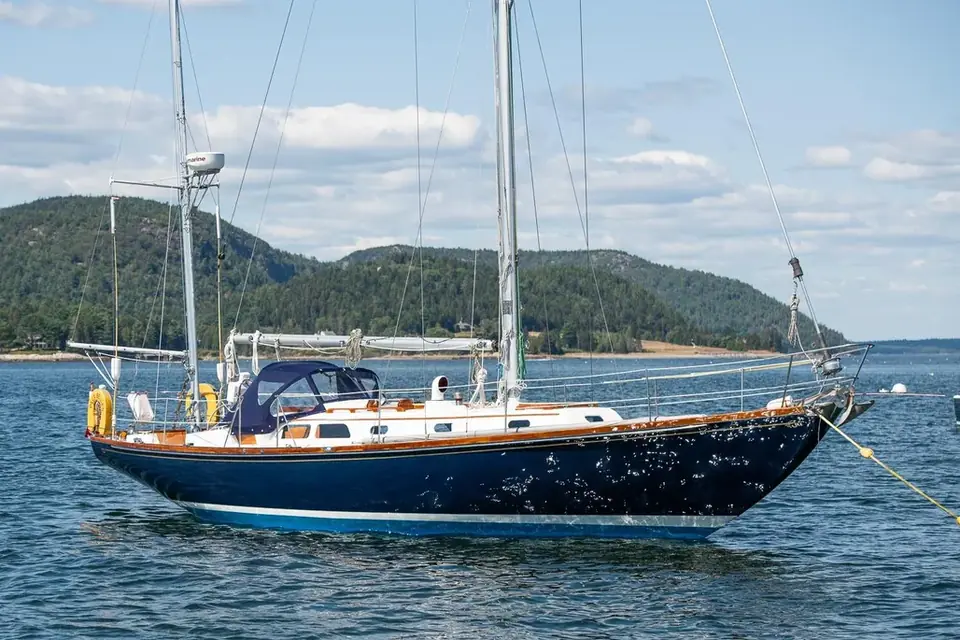
Bill Tripp's centerboard yawl stayed in production for 32 years, and many sailors still call it the most beautiful fiberglass boat ever built.
- Length
- 40.8 ft12.42 m
- Beam
- 11.8 ft3.58 m
- Draft
- 4.3 ft1.31 m
- Cabins
- 2
- Used price
- $60K to $260K
On this page
- Overview
- The boat show deal that launched the Bermuda 40
- Custom, Mark II and Mark III explained
- Four feet of draft, then eight and a half
- Tender at first, then steady, and often wet
- Hinckley construction and the wooden boat inside
- Below decks, small by design
- The Monel tank under the engine and other big jobs
- Why Bermuda 40 values never collapsed
- Specifications
- Price and value
- Strengths and weaknesses
- Used buyer checklist
- Rivals
- Our verdict
- FAQ
Hinckley's first fiberglass sailboat, a 40-foot Bill Tripp keel-centerboard yawl or sloop built in Maine from 1959 to 1991. 203 hulls, superb joinery, and prices that never really fell.
- New England and Mid-Atlantic coastal cruising
- Classic yacht enthusiasts
- Couples who sail more than they entertain
- Shoal-water cruising grounds like Maine and the Bahamas
Hinckley Bermuda 40 by the numbers
- Sail area to displacement
- 14.3A cruising rig sized for comfort, so expect to motor in very light air.
- Displacement to length
- 373Heavy displacement. Slow to accelerate but steady and sea kindly with a full load.
- Theoretical hull speed
- 7.2 knThe practical top speed of a displacement monohull under normal sailing, based on waterline length.
- Ballast ratio
- 33%A typical ballast ratio for a cruising monohull.
- Capsize screening
- 1.73Below 2.0, the traditional threshold for offshore suitability.
- Motion comfort ratio
- 35.8A slow, easy motion in a seaway, kind to crews on long passages.
- Length to beam ratio
- 3.47 : 1Moderate proportions.
The boat show deal that launched the Bermuda 40
At the 1959 New York Boat Show, a group from the Knickerbocker Yacht Club approached Hinckley with a proposal: build a fiberglass yacht based on Bill Tripp's Block Island 40 and they would guarantee the first ten sales. Hinckley, then known for wooden boats in Southwest Harbor, Maine, agreed. Hull number 1, Huntress, launched in time for the 1960 Bermuda Race.
The Hinckley Bermuda 40 stayed in production until 1991, when hull number 203 left the shed. That 32-year run is among the longest of any fiberglass auxiliary sailboat, and it happened because buyers kept asking for the same boat. The B-40 became the yardstick for East Coast yachting style and the reason Hinckley's name still means quality to American sailors.
Custom, Mark II and Mark III explained
Buyers will see three versions in listings. The original Custom, built from 1959, displaced about 19,000 pounds with 6,500 pounds of lead ballast on a waterline of about 27 feet 10 inches, and was rigged as a masthead yawl. The Mark II of about 1968 got an airfoil centerboard in place of the flat plate and a slightly taller mainmast, adding roughly 20 square feet of sail.
The Mark III, introduced in 1972 in response to the IOR, made bigger changes. The mainmast went up about 4 feet 3 inches and moved aft almost 2 feet, giving a higher-aspect mainsail and a larger foretriangle, and about 1,000 pounds went into the keel to carry it, which put the boat lower on her marks and added about a foot of waterline. A sloop rig became an option. Mark III decks were cored, first with balsa and later with vacuum-bagged 3/4 inch PVC foam, and the last hulls used a Kevlar and E-glass hybrid laminate.
Which to buy? For a sailor who wants the purest classic, a well-kept Custom is lovely and cheaper. For practical cruising, a Mark III with a modern repower is the best combination of sailing performance, construction and comfort.
- Custom (1959): about 19,000 lb, yawl rig, solid glass deck
- Mark II (around 1968): airfoil centerboard, slightly taller mast
- Mark III (1972): taller mast moved aft, about 1,000 lb more ballast, sloop option
- Late hulls: foam-cored decks and Kevlar hybrid laminate
Four feet of draft, then eight and a half
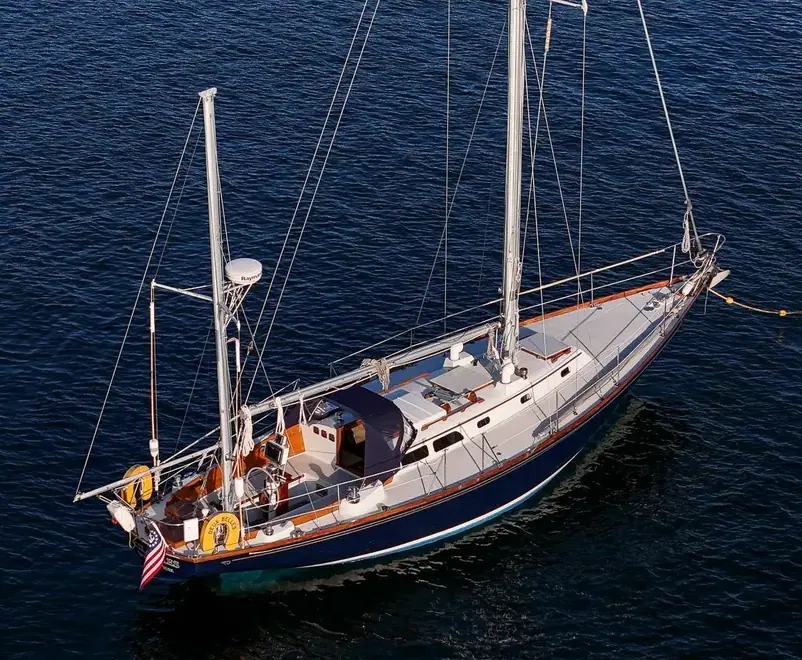
The bronze centerboard is the feature that made the Bermuda 40 so useful. With the board raised the boat draws about 4 feet 1 inch to 4 feet 3 inches depending on the source, enough to explore Maine's coves, Buzzards Bay or the Bahamas. Lowered, draft reaches about 8 feet 7 inches and the boat tracks and points far better.
Hinckley operated the cast bronze board with a worm gear rather than a simple wire pennant, with an override that lets the board kick up in a grounding. It is reliable but requires periodic service, and the long keel still makes the boat difficult to back down under power.
Tender at first, then steady, and often wet
By modern standards the Bermuda 40 is sedate. It heels quickly to 15 or 20 degrees before firming up, a function of its narrow waterline and a ballast ratio of about one third. Once it settles, the motion is smooth and the helm is light. Owners say weather helm can be nearly eliminated with good sail trim, and the yawl's mizzen makes balancing the boat easier still.
Upwind performance is moderate. The boat does not tack as briskly as a fin-keel design and loses speed through the tack. Off the wind it comes alive, and its PHRF rating of around 163 reflects that profile. The long overhangs and low freeboard make it a wet boat in a seaway, which is why one well-known review called it everybody's wet dream boat. Under power, an aging original diesel loses some of its ability to punch through a head sea and strong current.
Hinckley construction and the wooden boat inside
Inside the solid fiberglass hull is a hand-fitted wooden interior, with bulkheads tabbed to both hull and deck. The hull-to-deck joint is a half-inch thick, six-inch wide inward flange, laminated and through-bolted, and Hinckley crews reportedly spent about two days fitting each deck to its hull before bonding them.
Hinckley made most of its own hardware, including stanchions, stainless castings, masts and steering pedestals. Ballast is external lead on stainless steel bolts, deck hardware is screwed into tapped holes over backing plates to limit leaks, and the cutaway forefoot is designed to minimize grounding damage. Owners describe the boats as bulletproof and over-engineered, and the survey record largely agrees.
Below decks, small by design
The trade-off of wide side decks and narrow beam is interior volume. The B-40 sleeps six, with a V-berth forward, a head to port, a saloon with a centerline drop-leaf table, extension settees and pilot berths outboard, an L-shaped galley to port at the companionway with a three-burner propane stove, and a navigation station opposite that uses the icebox top as its chart table. Some later Mark IIIs have dinettes, dedicated nav stations or a Pullman double forward.
Owners accept the compact interior as part of the deal. A modern 34-footer has more room below. What the B-40 offers instead is a seaworthy, well-ventilated layout with secure berths and handholds, and finish quality that still embarrasses many new yachts.
The Monel tank under the engine and other big jobs
The single most expensive surprise on a Bermuda 40 is the fuel tank. The 48-gallon Monel tank sits beneath the engine, so replacing it usually means pulling the engine. Monel lasts a long time, but by now many tanks are original, and a leak can turn a modest repower into a major project. Water capacity is about 110 gallons.
Until the early 1990s boats got Westerbeke diesels of 35 to 46 hp, commonly the 4-107, and the last boats a 51 hp Yanmar 4JH2. Most surviving boats have been repowered or need to be. The engine space is cramped, service is from the front, and the shaft and stuffing box are hard to reach. When comparing listings, a recent repower that included the fuel tank is worth a lot of money.
Why Bermuda 40 values never collapsed
The B-40 was always expensive for a 40-footer. Today used Bermuda 40s generally ask between about $60,000 and $260,000, a range that reflects condition and refit history more than year. Hinckley-maintained boats with full records sit at the top. Annual costs typically run $10,000 to $25,000 because of brightwork, a 40-foot slip and the higher labor rates of yards that know these boats.
Hinckley still runs a service and brokerage network, and many B-40s have spent their lives in Hinckley yards. That support, along with the boat's beauty and reputation, is why values have held so well. These boats rarely sell cheaply, and good ones often change hands between people who already know each other.
Hinckley Bermuda 40 specifications
| Length overall | 40.8 ft12.42 m |
|---|---|
| Waterline length | 28.8 ft8.79 m |
| Beam | 11.8 ft3.58 m |
| Draft | 4.3 ft1.31 m |
| Displacement | 20, lbs9,072 kg |
| Ballast | 6,5 lbs2,948 kg |
| Sail area | 657 sq ft61 m² |
| Fuel capacity | 48 gal182 L |
| Fresh water | 11 gal416 L |
| Cabins | 2 |
| Berths | 6 |
| Heads | 1 |
| Standard engines | Westerbeke diesels of 35 to 46 hp (commonly the 4-107); a few very early boats had gasoline engines |
| Optional engines | 51 hp Yanmar 4JH2 on late boats |
| Hull type | Long-keel monohull with long overhangs |
| Keel | Long keel with external lead ballast and worm-gear bronze centerboard, about 4 ft 1 in to 4 ft 3 in up and 8 ft 7 in down |
| Rig | Masthead yawl (standard until the Mark III) or masthead sloop (Mark III option) |
| Hull construction | Solid fiberglass hull (Kevlar and E-glass hybrid on late hulls), deck evolving from solid glass to balsa and then PVC foam core |
| Builder | The Hinckley Company, United States |
| Naval architect | William H. Tripp Jr. |
| Production | 1959 to 1991 |
| Status | Discontinued |
Figures come from builder documentation and independent tests where available. Displacement is usually quoted light, so a loaded cruising boat will weigh more. Compare these specs with another model.
How much does a Hinckley Bermuda 40 cost?
Bermuda 40 prices follow refit history and Hinckley service records more than age. A 1960s Custom with an original engine and tired brightwork can ask around $60,000, while a Mark III repowered, rewired and maintained by a Hinckley yard can command well over $200,000. Yawls and sloops trade at similar levels, and boats with documented centerboard and fuel tank work sell first.
Estimate your yearly cost
A planning estimate using common rules of thumb: insurance near 1.5 percent of value, maintenance near 3 percent, haul out and bottom paint by length. Your marina, region and use will move these numbers. Open the full cost calculator.
Versions and options
- Bermuda 40 Custom
- The original 1959 version, about 19,000 lb with a solid glass deck and masthead yawl rig, the purest expression of the Tripp design.
- Bermuda 40 Mark II
- Introduced around 1968 with an airfoil centerboard and a slightly taller mainmast, adding roughly 20 sq ft of sail.
- Bermuda 40 Mark III
- Introduced in 1972, with the mainmast raised about 4 ft 3 in and moved aft almost 2 ft, about 1,000 lb more ballast, a foot more waterline and a sloop option.
Hinckley Bermuda 40 timeline
- 1959Knickerbocker Yacht Club group commits to ten boats at the New York Boat Show
- 1960Hull number 1, Huntress, sails in the Bermuda Race and finishes in the top third
- 1968Mark II introduced with an airfoil centerboard and slightly taller mast
- 1972Mark III raises and moves the mast aft, adds about 1,000 lb of ballast and offers a sloop rig
- 1991Hull number 203 completes a 32-year production run
Strengths and weaknesses
What owners like
- Timeless Tripp lines and outstanding beauty
- Shoal draft with the board up, good upwind with it down
- Exceptional build quality and in-house Hinckley hardware
- Strong resale and an active Hinckley service network
- Seakindly motion and a light, balanced helm
- Yawl rig makes balancing easy
What to weigh up
- Small interior for a 40-footer
- Tender initially and wet in a seaway
- Fuel tank under the engine is a costly replacement
- Aging original engines struggle against a head sea
- Brightwork and maintenance costs are high
Used Hinckley Bermuda 40 buyer checklist
Take this list to a viewing. Your ticks are saved in this browser so you can come back to it.
Always commission an independent marine survey and an engine survey before you buy. How a marine survey works.
Rivals to consider
Tartan 37
Another S&S-era keel-centerboarder with more interior room at a fraction of the price.
Compare side by sideCape Dory 36
A full-keel Alberg design with traditional looks and a far lower budget.
Compare side by sidePacific Seacraft 37
A deeper-draft offshore boat with more modern underbody and similar quality reputation.
Compare side by sideSwan 48
The S&S Swan 48 of 1971 won the Bermuda Race and offers more speed and size for classic buyers.
Compare side by sideOur verdict on the Hinckley Bermuda 40
The Hinckley Bermuda 40 is not the most practical 40-footer you can buy, and it never pretended to be. It is a small-interior, wet, slightly tender yacht that happens to be one of the loveliest and best-built boats in American sailing. Buy it for the way it looks at anchor, the way it moves through the water and the shoal-draft freedom of its centerboard. Pick a boat with a recent repower that included the fuel tank and Hinckley service records, and it will likely sell for close to what you paid.
Hinckley Bermuda 40 questions answered
How much is a Hinckley Bermuda 40 worth?
Used Bermuda 40s generally list from about $60,000 to $260,000. Repowered Mark III boats with Hinckley service records sit at the top.
How many Bermuda 40s were built?
Hinckley built 203 Bermuda 40s between 1959 and 1991.
What is the draft of a Bermuda 40?
About 4 feet 1 inch to 4 feet 3 inches with the centerboard up, depending on the source, and around 8 feet 7 inches with it down.
Who designed the Bermuda 40?
William H. Tripp Jr., adapting his Block Island 40 for Hinckley's first fiberglass production yacht.
Is the Bermuda 40 a yawl or a sloop?
The yawl was the rig of choice until the Mark III of 1972, which was also offered as a sloop.
Is the Bermuda 40 a bluewater boat?
It is a proven offshore racer with many Bermuda Race starts, but its small interior and wet decks suit coastal and short offshore passages better than long trade-wind crossings.
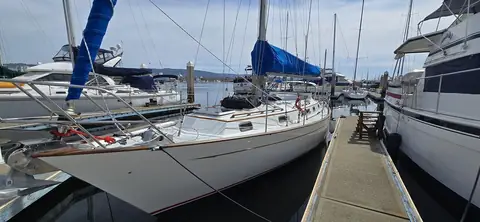
Hinckley Bermuda 40 photos
More bluewater sailboats to explore

Island Packet 38
Bluewater Sailboats, 42 ft
Used $75K to $135K
Valiant 40
Bluewater Sailboats, 40 ft
Used $45K to $200K
Island Packet 380
Bluewater Sailboats, 40 ft
Used $125K to $215K
Passport 40
Bluewater Sailboats, 39 ft
Used $70K to $170K