Hinckley Yachts Downeast Yachts
Hinckley Picnic Boat, From the 1994 Original to Today's 37 and 40
The jet-driven Maine launch that invented a category, made varnish fashionable on power boats and still sets the resale benchmark for Downeast yachts.
- Length
- 38.7 ft11.79 m
- Beam
- 11.3 ft3.43 m
- Cruise
- 32 kn
- Cabins
- 1
- Used price
- $180K to $1.95M
On this page
- Overview
- How the Hinckley Picnic Boat started a category
- Why Hinckley chose a waterjet, and what that means to an owner
- JetStick, the joystick that changed docking
- Classic, EP, MKIII 37, 40 and beyond, a generation guide
- Carbon, Kevlar and twelve coats of varnish
- Life aboard, a dayboat that can weekend
- What it costs to keep a Picnic Boat looking like a Picnic Boat
- Why Picnic Boats hold value like no other
- Specifications
- Price and value
- Strengths and weaknesses
- Used buyer checklist
- Rivals
- Our verdict
- FAQ
Hinckley's Picnic Boat launched in 1994 as a Bruce King-designed, jet-driven Downeast day cruiser and grew into a family that now runs from the 37 to the 45. It is the most imitated and best-holding power boat on the East Coast.
- Day cruising and island hopping in Maine
- Shallow water cruising in Florida and the Bahamas
- Owners who value design and finish
- Buyers who want a boat that holds value
Hinckley Picnic Boat by the numbers
- Speed to length ratio at cruise
- 5.50A planing cruise. Fast passages in exchange for much higher fuel burn per mile.
- Horsepower per ton
- 93 hpVery high power to weight, built for speed.
- Length to beam ratio
- 3.44 : 1Moderate proportions.
How the Hinckley Picnic Boat started a category
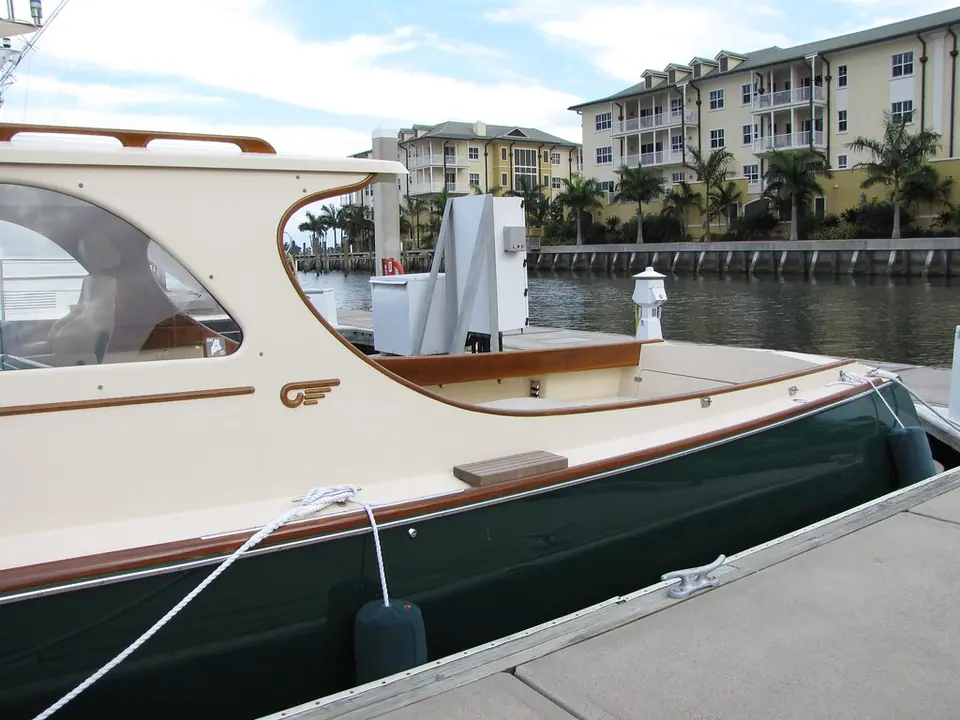
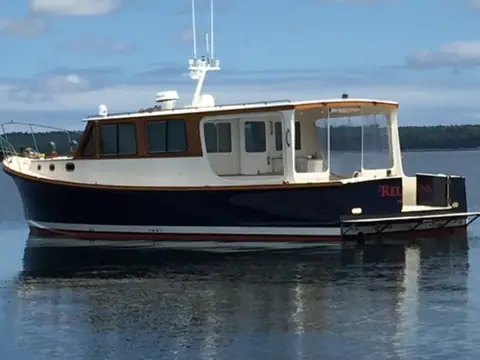
In 1994 Hinckley, a Southwest Harbor, Maine, builder founded in 1928 and known almost entirely for sailboats, put out a small power boat meant for one simple job: running a couple across Frenchman Bay to a picnic on an island beach. The Hinckley Picnic Boat was 36 feet long, drew just 18 inches with its Hamilton waterjet, and wore a sheer line that blended the working Maine lobster boat with the varnished launches of the old summer colonies. The lines came from designer Bruce King, the third naval architect that Hinckley chief executive Shep McKenney approached, and two King underbodies were tank-tested at the Webb Institute before the boat was built.
It was a hit from the first season. The boat looked right in every harbor from Nantucket to Palm Beach, it was easy to drive and it carried the Hinckley name, which already meant something to the people who could afford one. The style was so widely copied that Hinckley registered Picnic Boat as a trademark. Three decades later the term picnic boat is used generically for any small Downeast day cruiser, which is the clearest sign of how completely the original defined the type.
Why Hinckley chose a waterjet, and what that means to an owner
The waterjet is the Picnic Boat's defining technical choice, although McKenney later called it something of an afterthought. Standard power on the first boats was a single Yanmar diesel with a dual-prop outdrive, and the Hamilton jet was the shallow-draft option that buyers quickly made the norm. A jet draws water through an intake grate in the bottom of the hull and fires it out of a steerable nozzle at the transom. There is no propeller, shaft or rudder under the boat. The benefits for a Maine or Florida owner are large. Draft stays around 2 feet, so the boat can slide into gunkholes, over ledges and up to beaches. There is nothing to wrap a lobster pot warp around, nothing to bend on a sandbar and no propeller near swimmers.
Jets have costs too. They are less efficient than propellers at low and medium speeds, so a jet boat burns more fuel idling around a harbor than a comparable prop boat. Early single-jet Picnic Boats could be awkward at very low speed because the nozzle steers only when water is flowing. Weed and eelgrass can clog the intake, and owners learn to use the cleanout port. On balance most owners consider the trade worth it, and Hinckley has never abandoned jets on the Picnic Boat.
- Draft around 2 feet on all generations
- No exposed propellers, shafts or rudders
- Less efficient than props at slow speed
- Intake grate needs periodic clearing of weed and debris
JetStick, the joystick that changed docking
Hinckley's answer to jet handling was the JetStick, developed with Control Engineering Inc. and first used in 1998. It integrates the jet nozzles, reversing buckets and bow thruster through a single joystick, so the boat can be walked sideways or spun in place. It was one of the first joystick systems on any recreational boat, years before pod drives made joysticks common, and it is one reason older Picnic Boats remain easy for older owners to handle.
The current Picnic Boat 37 carries JetStick 4, which adds virtual anchoring to hold position, fly-by-wire dynamic steering, a Dockhold feature that keeps the boat pinned to a dock while the skipper steps off the helm, and an improved heading and position hold. When looking at an older boat, ask which JetStick generation it carries. Upgrading controls on older hulls is a common refit and has a noticeable effect on value.
Classic, EP, MKIII 37, 40 and beyond, a generation guide
Brokers group Picnic Boats into generations. The original or Classic 36 of 1994 carried a single Yanmar six-cylinder diesel and a single Hamilton jet, and Yachting's first test recorded a 25-knot cruise and a 29-knot top speed. In 2001 Hinckley extended the pilothouse to create the EP (Extended Pilothouse) 36, still one engine and one jet, which by the end of its run carried a single 480 hp diesel and cruised around 24 knots. Production of the 36 stopped in October 2008, when Hinckley said it had sold 370 Picnic Boats.
The bigger shift came with the Picnic Boat 37, shown at the 2008 Newport show as a 2009 model and sold as the MKIII. Michael Peters drew a new bottom with 19 degrees of transom deadrise in place of 15, and twin 300 hp Volvo Penta D4 diesels drove twin Hamilton 274 jets, with 370 hp Volvo D6s optional. Today's 37 measures 38 feet 8 inches overall with an 11-foot-3 beam and 19,000 pounds cruising displacement. Twin 440 hp Volvo Penta D6 diesels drive twin Hamilton HTx jets for a cruising speed Hinckley quotes in the 32 to 35 knot range and a 37-knot top end.
The Picnic Boat 40 was announced at Newport in 2017 and launched in 2018 as the flagship, at 42 feet overall, 12 feet 10 inches of beam and 25,000 pounds, powered by twin 480 hp Cummins QSB 6.7 diesels with Hamilton jets, 375 gallons of fuel and a quoted 35-knot cruise and 38-knot top speed with optional power. Hinckley also built a smaller Picnic Boat 34 for a time. The current range adds the Picnic Boat 39, introduced in 2025 with twin 480 hp Volvo D6s, and the Picnic Boat 45, announced in 2026 with twin 725 hp Volvo D11s.
Carbon, Kevlar and twelve coats of varnish
Current Picnic Boats are built with what Hinckley calls DualGuard construction, a SCRIMP-infused laminate of carbon fiber and E-glass in epoxy resin. On the 40, carbon is laid bow to stern under an outer layer of Kevlar for puncture resistance, and the original 36 was already a SCRIMP-infused Kevlar and E-glass boat. Epoxy resists osmotic blistering far better than polyester, and a tough outer skin makes the hull tolerant of the rocky ledges that are part of cruising in Maine. The result is a light, stiff hull that helps the boat reach its speeds on relatively modest power.
The finish is what owners pay for. Hinckley uses Burmese teak trim and says it puts twelve coats of varnish on the toe rails of its newest Picnic Boat. The cabin joinery, the hardware and the paint are all of a level that few production builders attempt. That finish also defines the maintenance budget, because varnish on a Picnic Boat is not optional if you care about resale.
Life aboard, a dayboat that can weekend
The Picnic Boat is laid out primarily as a dayboat. The helm sits under a hardtop with the classic raked windshield, with seating for the skipper and companion and a cockpit aft sized for lunch for four to six people. Many owners order canvas side curtains to extend the season into the cold Maine fall.
Below, the cabin has a V-berth or convertible settee forward, a small galley and an enclosed head. Two people can spend a few nights aboard comfortably, but the boat is not a long-range cruiser. Water capacity on the 37 is 40 gallons. Owners who cruise for a week tend to plan around marinas or move up to the 40 or a larger Hinckley Talaria.
What it costs to keep a Picnic Boat looking like a Picnic Boat
Budget $40,000 to $95,000 a year to own a Picnic Boat well, excluding depreciation. The range is wide because the gap between owners who keep the boat in Hinckley yard condition and owners who do not is large. Varnish, Awlgrip touch-ups, canvas, jet service and engine maintenance add up, and the company's own yards charge premium rates.
Hinckley runs a network of service yards along the East Coast from Southwest Harbor, Maine, to Florida, and many Picnic Boats rotate between Maine summers and Florida winters through those yards. Jets need periodic inspection of the impeller, wear ring and nozzle, but with proper care they are very durable.
Why Picnic Boats hold value like no other
Picnic Boats are the resale benchmark for Downeast power boats. In 2016 Yachting counted 31 Picnic Boat 36s for sale at $179,000 to $389,000, remarkable money for boats up to 22 years old, and twin-engine 37s hold value just as stubbornly. The demand is driven by a loyal buyer base, a recognizable look that never goes out of style, and a steady flow of buyers trading up from other Downeast boats.
The market rewards documented Hinckley yard maintenance, recent repowers, updated JetStick controls and fresh varnish. Boats with deferred maintenance can be costly to bring back up to standard, so a thorough survey with a jet-familiar mechanic is essential before purchase.
Hinckley Picnic Boat specifications
| Length overall | 38.7 ft11.79 m |
|---|---|
| Waterline length | 33.8 ft10.31 m |
| Beam | 11.3 ft3.43 m |
| Draft | 2.1 ft0.64 m |
| Displacement | 19, lbs8,618 kg |
| Fuel capacity | 22 gal833 L |
| Fresh water | 4 gal151 L |
| Cabins | 1 |
| Berths | 2 |
| Heads | 1 |
| Standard engines | Picnic Boat 37, twin Volvo Penta D6 440 hp diesels with twin Hamilton HTx waterjets |
| Optional engines | Earlier Picnic Boat 37 (MKIII) builds: twin Volvo Penta D4 300 hp, with twin Volvo D6 370 hp optional. Original Picnic Boat 36: single Yanmar diesel driving a single Hamilton waterjet |
| Maximum power | 880 hp |
| Cruise speed | 32 knots |
| Top speed | 37 knots |
| Hull type | Modified-V planing hull with 19 degree transom deadrise, waterjet propulsion |
| Hull construction | DualGuard SCRIMP-infused carbon and E-glass composite with epoxy resin (current 37); the original 36 used SCRIMP-infused Kevlar and E-glass over foam core |
| Builder | Hinckley Yachts, USA |
| Naval architect | Bruce King (original 1994 Picnic Boat 36); Michael Peters (hull of the twin-engine Picnic Boat 37 from 2008 and the later 40 and 45) |
| Other design credits | Shep McKenney, Hinckley CEO, conceived the original Picnic Boat |
| Production | 1994 to present |
| Status | In production |
Figures come from builder documentation and independent tests where available. Displacement is usually quoted light, so a loaded cruising boat will weigh more. Compare these specs with another model.
How much does a Hinckley Picnic Boat cost?
Price is driven first by generation, single-engine 36 versus twin-engine 37 and later, and then by the Hinckley service history, because a boat maintained in a Hinckley yard sells faster and for more. Repowered original boats with updated JetStick controls can trade well above unrestored ones of the same year. Specs on this page refer to the current Picnic Boat 37 unless noted; the 40 is larger and pricier.
Estimate your yearly cost
A planning estimate using common rules of thumb: insurance near 1.5 percent of value, maintenance near 3 percent, haul out and bottom paint by length. Your marina, region and use will move these numbers. Open the full cost calculator.
Versions and options
- Original Picnic Boat 36 (Classic)
- Launched in 1994 to a Bruce King design, 36 feet, single Yanmar diesel and single Hamilton waterjet, about 25 knots cruise and 29 knots top.
- Picnic Boat EP 36
- Extended Pilothouse version from 2001 to 2008, still single engine and single jet, later with a 480 hp diesel.
- Picnic Boat 37 (MKIII)
- Michael Peters hull from 2008 with twin engines and twin Hamilton jets. Early boats have twin 300 hp Volvo D4s; current boats use twin Volvo Penta D6 440 hp, HTx jets and JetStick 4, with a 32 to 35 knot cruise and 37-knot top speed.
- Picnic Boat 40
- Flagship launched in 2018, 42 feet overall, twin Cummins QSB 6.7 480 hp with Hamilton jets and optional SilentJet hybrid drive for about an hour of silent running at 7 knots.
- Picnic Boat 39 and 45
- Newest additions, the 39 from 2025 on twin 480 hp Volvo D6s and the 45 announced in 2026 on twin 725 hp Volvo D11s with Hamilton HTX30 jets.
Hinckley Picnic Boat timeline
- 1928Benjamin Hinckley founds the company in Southwest Harbor, Maine
- 1994The first Hinckley Picnic Boat, a 36-footer designed by Bruce King, is launched
- 1998JetStick joystick control, developed with Control Engineering Inc., is first used
- 2001The EP 36 adds an extended pilothouse, and Monitor Clipper Partners takes a controlling stake in Hinckley
- 2008The twin-engine Picnic Boat 37 (MKIII) with a Michael Peters hull replaces the 36
- 2018The Picnic Boat 40 launches as the new flagship, later offered with SilentJet hybrid drive
- 2025The Picnic Boat 39 joins the range, followed by the Picnic Boat 45 announced in 2026
Strengths and weaknesses
What owners like
- Iconic design that still defines the Downeast dayboat
- Waterjet propulsion with about 2 feet of draft
- JetStick makes docking easy for any skipper
- Exceptional finish and construction quality
- Best resale values of any Downeast power boat
- Company-owned East Coast service network
What to weigh up
- Very high price per foot new and used
- Jets burn more fuel at slow speeds than props
- Limited accommodation for extended cruising
- Varnish and maintenance costs are high
- Hinckley yard rates are among the highest in the industry
Used Hinckley Picnic Boat buyer checklist
Take this list to a viewing. Your ticks are saved in this browser so you can come back to it.
Always commission an independent marine survey and an engine survey before you buy. How a marine survey works.
Rivals to consider
Back Cove 34O
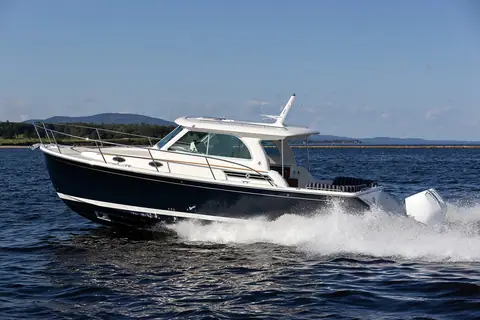
Outboard Downeast cruiser with similar speed and draft at roughly half the price, but without the Hinckley finish or name.
Compare side by sideSabre 38 Salon Express
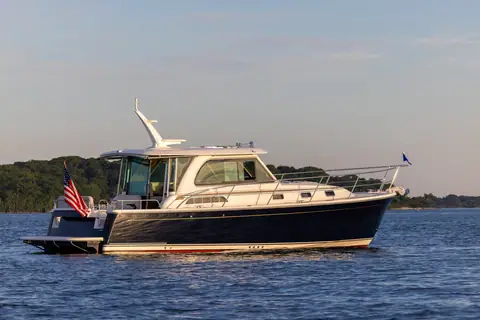
More interior and enclosed helm for real cruising, with props or pods rather than jets.
Compare side by sideMJM 35z
Bob Johnstone's lighter, more efficient Zurn-designed express with prop or pod drives and a strong following.
Back Cove 37
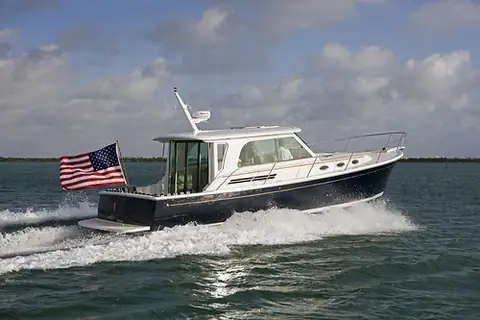
Single-diesel cruiser with more accommodation and range at a lower price.
Compare side by sideOur verdict on the Hinckley Picnic Boat
The Hinckley Picnic Boat is the original and still the reference point for the Downeast dayboat. It is not the most efficient, roomiest or cheapest boat in its class, but it is the best finished, the easiest to love and the one most likely to be worth something when you sell. Buy a Classic or EP 36 for single-engine charm and lower entry cost, or a 37 (MKIII) or 40 for twin-engine speed and modern controls, and in every case insist on a jet-savvy survey and a clean service record.
Hinckley Picnic Boat questions answered
How much does a Hinckley Picnic Boat cost?
Used Picnic Boats range from about $180,000 for 1990s originals to nearly $2 million for recent Picnic Boat 40s. New boats run roughly $1.5 to $2.5 million depending on model and options.
How fast is a Hinckley Picnic Boat?
The current Picnic Boat 37 cruises at 32 to 35 knots with a 37-knot top speed. The original single-jet 36 cruised at about 25 knots and topped out near 29.
Why does the Picnic Boat use jet drive?
Waterjets keep draft to about 2 feet and remove propellers and rudders from under the boat, which suits shallow water, rocky coasts and swimming.
What is the Hinckley Picnic Boat 40 price?
A new Picnic Boat 40 is typically around $2 million or more equipped, and recent used examples list in the $1.5 to $1.95 million range.
What is a JetStick?
JetStick is Hinckley's joystick control system for waterjet boats, first used in 1998, that lets the skipper move the boat sideways, spin it and hold position.
Who designed the Hinckley Picnic Boat?
Bruce King drew the 1994 original for Hinckley chief executive Shep McKenney. Michael Peters designed the hull of the twin-engine Picnic Boat 37 that replaced it in 2008, and of the later 40 and 45.
More downeast yachts to explore
Back Cove 34O
Downeast Yachts, 40 ft
Used $440K to $760K
Sabre 38 Salon Express
Downeast Yachts, 42 ft
Used $330K to $675K
Back Cove 37
Downeast Yachts, 42 ft
Used $300K to $700K
Wesmac 42
Downeast Yachts, 42 ft
Used $150K to $750K