Back Cove Yachts Downeast Yachts
Back Cove 34O Review, the Downeast Cruiser That Went Outboard
Rockland's answer to the outboard revolution, with a lobster-yacht profile, a 2-foot draft and twin Mercurys that push it past 40 knots.
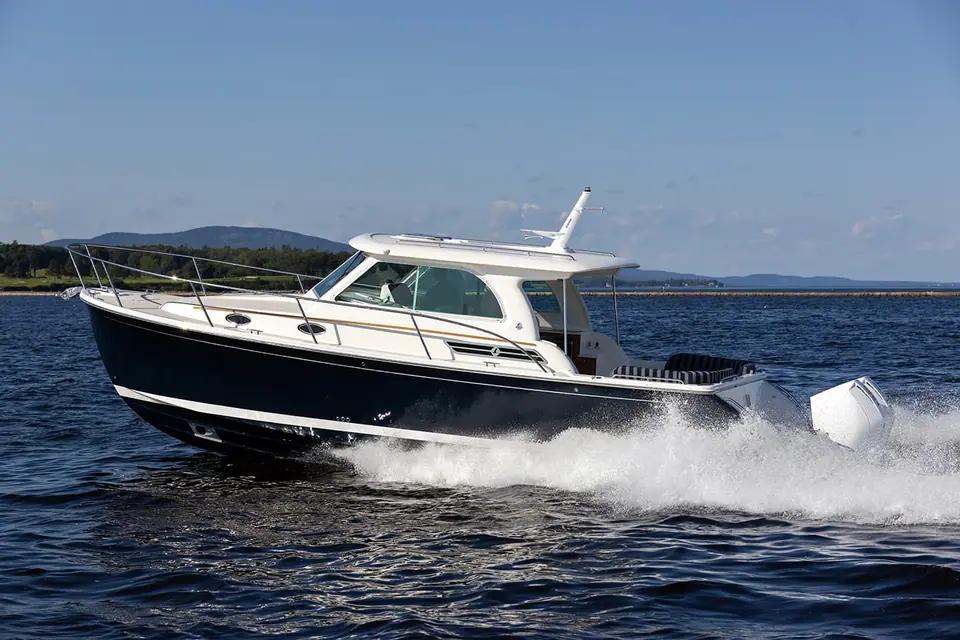
- Length
- 39.6 ft12.06 m
- Beam
- 11.9 ft3.63 m
- Cruise
- 30 kn
- Cabins
- 1
- Used price
- $440K to $760K
On this page
- Overview
- Why a Back Cove 34 for sale now usually means the 34O
- TRELIS, or how Back Cove keeps a heavy boat on plane
- V8 300 or V10 400, and why the bigger pair is worth it
- A helm deck that converts for guests
- The cabin, sized for a long weekend
- Two fuel tanks, a generator and the systems question
- What a season costs
- How the 34O holds value
- Specifications
- Price and value
- Strengths and weaknesses
- Used buyer checklist
- Rivals
- Our verdict
- FAQ
The Back Cove 34O pairs a classic Downeast hardtop with twin Mercury outboards and the patented TRELIS hull. It cruises near 30 knots, draws about 2 feet and keeps a queen berth and separate shower below.
- Couples who want speed and shallow draft
- Chesapeake and Florida cruising
- Owners keeping the boat on a lift
- Downsizers from larger inboard yachts
Why a Back Cove 34 for sale now usually means the 34O
Search for a Back Cove 34 for sale and you will find two very different boats. The older Back Cove 34 is a single diesel inboard in the mold of the 37. The 34O, with the letter O for outboard, pairs the deck mold and interior layout of the single-diesel Back Cove 32 with an all-new hull drawn for twin outboards, and it is the boat Back Cove has put its marketing weight behind. Hull No. 1 debuted at the Newport International Boat Show in September 2018. The builder's own literature is clear about the trade: cruising comfortably at 30 knots with top speeds over 40, from a boat that still looks like it belongs in a Maine harbor.
That is a big shift for a company whose reputation was built on single-diesel thrift. Back Cove began in 2003 as a sister brand to Sabre, and both build in Maine, with Back Cove's 240,000-square-foot infusion plant in Rockland. The decision to go outboard reflected what buyers were doing elsewhere. Owners wanted the speed, the shallow draft, the quiet and the easy maintenance of modern four-stroke outboards, and they no longer saw engines hung on the transom as a fishing-boat compromise. The 34O was Back Cove's way of keeping those customers in the family.
Back Cove 34O by the numbers
- Speed to length ratio at cruise
- 5.11A planing cruise. Fast passages in exchange for much higher fuel burn per mile.
- Horsepower per ton
- 94 hpVery high power to weight, built for speed.
- Length to beam ratio
- 3.32 : 1Moderate proportions.
TRELIS, or how Back Cove keeps a heavy boat on plane
The hull uses Back Cove's patented Trailing Edge Lifting Surface, branded TRELIS. Outboard boats carry a lot of weight far aft, which tends to make them squat coming onto plane and run bow-high at low planing speeds. TRELIS is a shaped lifting surface at the aft edge of the running bottom that generates lift right where the engine weight sits, helping the boat plane at lower speed and run flatter.
The practical result is a boat that holds a comfortable plane in the high teens, which matters in fog or a short head chop when you do not want to run at 30 knots. Draft is only 2 feet 1 inch with the engines tilted down, and with them trimmed up the boat can creep into shallow coves and up rivers that would worry an inboard owner. On the Chesapeake, the Gulf Coast and Florida's west coast that draft opens up anchorages a diesel 34 cannot use.
- Draft 2 feet 1 inch, engines down
- Air draft 11 feet 9 inches with the mast
- No running gear below the hull to damage on a grounding
- Designed to ABYC, NMMA, USCG and CE Category B standards
V8 300 or V10 400, and why the bigger pair is worth it
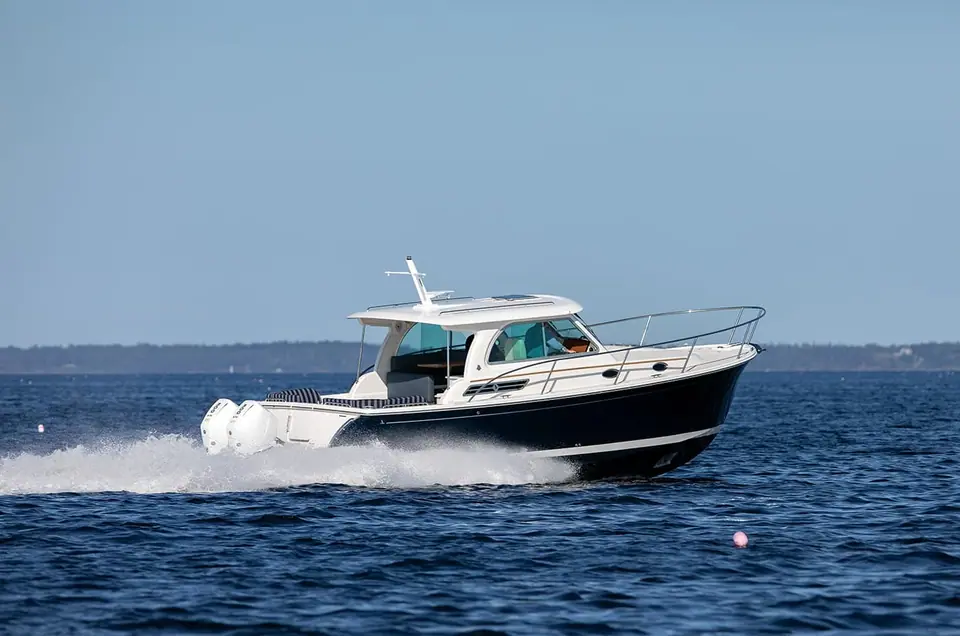
Back Cove now offers twin Mercury V8 300 hp or twin Mercury V10 400 hp Verado outboards. The 400s are the ones to buy. They give the boat its 40-plus knot top end and let it hold a 30-knot cruise without running the engines hard, which helps both fuel burn and longevity. The V8 300 boats are still quick, but they cruise in the mid 20s and lose more performance when loaded with fuel, water and guests.
Early boats were different. At launch in 2018 the standard engines were twin Yamaha 300s, with Yamaha 350s or Suzuki 350s optional. On the standard Yamahas Power and Motoryacht saw 37 knots wide open and a comfortable 30-knot cruise, and Yachting recorded 37.5 knots. They are good engines with wide dealer support, but buyers should price them as the older generation they are. Whatever the package, insist on Mercury's joystick piloting. Twin outboards with joystick control turn a 39-foot boat into one a single person can dock in a crosswind, which is the whole point of a boat like this for many couples.
Fuel burn at a 30-knot cruise is far higher than on a single-diesel Back Cove. Exact numbers vary with load and engine generation, so a sea trial with the engines' own fuel flow readout is the only way to know a specific boat. As a planning figure, Yachting quoted an effective range of 214 nautical miles at 24 knots on the original 250-gallon tank of a Yamaha-powered boat.
A helm deck that converts for guests
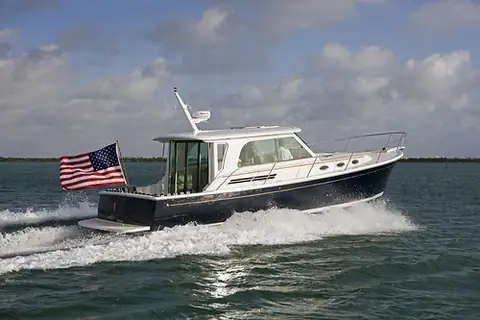
The deck plan is classic Downeast with a modern twist. The hardtop is well forward, giving 360-degree visibility from the helm, and large opening windows let the breeze through on warm days. The mate's seat slides and converts into a U-shaped settee, so the same space works for a passage and for lunch at anchor. An on-deck galley keeps the cook with the party rather than below.
The cockpit is compact because the outboards take up the transom. A convertible transom seat flips to face aft or forward, and boarding is around the engines rather than over a full-width platform, which owners who swim a lot should check in person. For fishing, the engines make backing down on a fish easy but the cockpit is not set up for it. Under the one-level deck, where the 32 keeps its diesel, the 34O has a large compartment on an electric lift for bikes, paddleboards and gear.
The cabin, sized for a long weekend
Below is a single stateroom forward with a queen-sized island berth, a split head with a separate shower stall and smart storage throughout. A second couple can sleep aboard on the converted settee in a pinch, but this is a two-person cruiser. Interior joinery is in the Back Cove tradition, warm wood with clean panels, a clear step up from mass-market express boats.
The galley being on deck frees up the cabin for sleeping and storage, which is the right call on a boat this size. Fresh water is 60 gallons and holding is 36 gallons, and headroom in the cabin is 6 feet 7 inches according to Yachting,, enough for two people over three or four days with sensible use.
Two fuel tanks, a generator and the systems question
The 34O carries 242 gallons of gasoline for the outboards and a separate 25-gallon diesel tank for the generator. That arrangement surprises some buyers, but it lets owners run air conditioning overnight on a diesel generator rather than a gasoline unit, which is quieter, safer and more efficient. The downside is two fuel docks, or at least two nozzles, and remembering to keep the diesel tank topped up.
With outboards there is no engine room to service, no shaft seals, no raw water strainers for the mains and no exhaust elbows. Annual service is done from the dock or on a lift, and a Mercury dealer can handle it anywhere along the coast. That is a real cost saving against an inboard and a big part of the 34O's appeal to owners who keep the boat far from home.
What a season costs
Expect $24,000 to $45,000 a year to run a 34O, excluding depreciation. Fuel is the largest variable, because outboard owners tend to use the speed. Insurance is comparable to an inboard boat of the same value. A lift or dry-stack berth, where available, cuts bottom paint costs and keeps the hull and lower units cleaner, though at nearly 40 feet overall the boat needs a large lift.
Plan on routine outboard service every 100 hours or annually, water pump impellers every two to three seasons and lower unit oil each year. Repowering a pair of V10s in the future will be a five-figure job, but it is a dockside swap rather than a rebuild of an engine room.
How the 34O holds value
Back Cove resale has always been strong, and the 34O has so far followed the pattern. Demand for Downeast-styled outboard boats remains high, and the 34O is one of very few built by an established Maine yard. Boats with the V10 400s, joystick, generator and air conditioning sell fastest.
The catch is that outboard boats are judged on engine hours more harshly than diesels. A diesel 37 with 1,500 hours is mid-life. A 34O with 1,500 hours per engine is approaching repower territory, and the market prices that in. Buyers planning to keep the boat for a decade should budget for one set of new engines along the way.
Back Cove 34O specifications
| Length overall | 39.6 ft12.06 m |
|---|---|
| Beam | 11.9 ft3.63 m |
| Draft | 2.1 ft0.64 m |
| Air draft | 11.8 ft3.58 m |
| Displacement | 17, lbs7,711 kg |
| Fuel capacity | 242 gal916 L |
| Fresh water | 6 gal227 L |
| Cabins | 1 |
| Berths | 2 to 4 |
| Heads | 1 |
| Standard engines | Twin Mercury V8 300 hp outboards (current boats); early boats had twin Yamaha 300 hp outboards as standard |
| Optional engines | Twin Mercury V10 400 hp Verado outboards (current); early boats offered twin Yamaha 350 or Suzuki 350 outboards |
| Maximum power | 800 hp |
| Cruise speed | 30 knots |
| Top speed | 40 knots |
| Hull type | Modified-V planing hull with TRELIS trailing edge lifting surface |
| Hull construction | Vacuum-infused fiberglass composite |
| CE design category | B |
| Builder | Back Cove Yachts (sister company of Sabre Yachts), USA |
| Naval architect | Back Cove and Sabre in-house design team |
| Production | 2018 to present |
| Status | In production |
Figures come from builder documentation and independent tests where available. Displacement is usually quoted light, so a loaded cruising boat will weigh more. Compare these specs with another model.
How much does a Back Cove 34O cost?
The V10 400 hp package adds meaningfully to both new price and resale value and is what most buyers want. Generator, air conditioning, joystick piloting and a gyro stabilizer push boats to the top of the range, while early hulls on twin Yamaha 300s trade at a discount. Outboard hours matter more here than on a diesel boat, so expect a sharp price drop past roughly 800 hours per engine.
Estimate your yearly cost
A planning estimate using common rules of thumb: insurance near 1.5 percent of value, maintenance near 3 percent, haul out and bottom paint by length. Your marina, region and use will move these numbers. Open the full cost calculator.
Versions and options
- Early 34O with twin Yamaha 300s
- The 2018 launch package, good for about 37 knots wide open. Yamaha 350s and Suzuki 350s were the options. Good value if the engines are healthy and well documented.
- 34O with twin Mercury V8 300
- The current entry package, cruising in the mid 20s. Cheaper to buy, less in demand on resale.
- 34O with twin Mercury V10 400 Verado
- The current preferred package, which Back Cove quotes at a 30-knot cruise and a top speed over 40.
Back Cove 34O timeline
- 2003Back Cove Yachts founded as Sabre's sister brand
- 2018The 34O, Back Cove's first outboard boat, debuts at the Newport International Boat Show on twin Yamaha 300s
- 2019Magazine tests record about 37 knots wide open and a 30-knot cruise on the standard Yamahas
- 2020sBack Cove moves the 34O to Mercury power, with twin V8 300s or V10 400 Verados
- 2026The 34O sits in the Back Cove range alongside the larger 39O and the inboard 372 and 412
Strengths and weaknesses
What owners like
- Cruises near 30 knots and tops 40 with the V10s
- Draft of about 2 feet opens shallow anchorages
- No engine room, so maintenance is simple and cheap
- Joystick docking makes it a genuine single-hander
- Downeast looks with Back Cove finish quality
- Diesel generator for quiet overnight air conditioning
What to weigh up
- Fuel burn far higher than a single-diesel Back Cove
- Engines crowd the transom and limit swim access
- Single cabin and one head
- Outboard hours hit resale harder than diesel hours
- Two fuel types to manage
Used Back Cove 34O buyer checklist
Take this list to a viewing. Your ticks are saved in this browser so you can come back to it.
Always commission an independent marine survey and an engine survey before you buy. How a marine survey works.
Rivals to consider
Back Cove 37
Single-diesel sister with far better fuel economy and more range, but slower and with deeper draft.
Compare side by sideHinckley Picnic Boat
Jet-driven Downeast icon with more prestige and finish, at roughly double the price.
Compare side by sideAxopar 37
European outboard cruiser that is lighter and cheaper, but with a very different, more utilitarian character.
Compare side by sideHunt Surfhunter 32
Outboard deep-V from a Downeast-styled builder with a sharper offshore ride and less interior.
Our verdict on the Back Cove 34O
The Back Cove 34O is the boat that proves a Downeast cruiser does not need a diesel to feel right. It keeps the hardtop, the visibility and the joinery that made Back Cove's name, then adds 30-knot cruising, a 2-foot draft and outboard simplicity. Buy one with the V10 400s and joystick, budget for fuel and an eventual repower, and you get a fast, easy, good-looking coastal boat that will still sell quickly when you are done with it.
Back Cove 34O questions answered
How much is a Back Cove 34 for sale?
Used Back Cove 34O outboard boats generally list between about $440,000 and $760,000. A new 34O typically runs about $720,000 to $880,000 equipped.
How fast is the Back Cove 34O?
Back Cove quotes a comfortable 30-knot cruise and a top speed over 40 knots with twin Mercury V10 400s. Early boats on twin Yamaha 300s tested at about 37 knots.
What does the O in Back Cove 34O mean?
It stands for outboard. The 34O uses a new hull designed for twin outboards, combined with the deck and interior layout of the single-diesel Back Cove 32.
Is the Back Cove 340 the same boat as the 34O?
Yes. Many listings write it as 340 with a zero, but the official name is 34O for outboard.
What is the TRELIS hull?
TRELIS stands for Trailing Edge Lifting Surface, Back Cove's patented hull feature that adds lift aft to help the boat plane early and run flat with heavy outboards on the transom.
How shallow can a Back Cove 34O go?
Draft is about 2 feet 1 inch with the engines down, and less with them trimmed up at very slow speed.
Back Cove 34O photos
More downeast yachts to explore
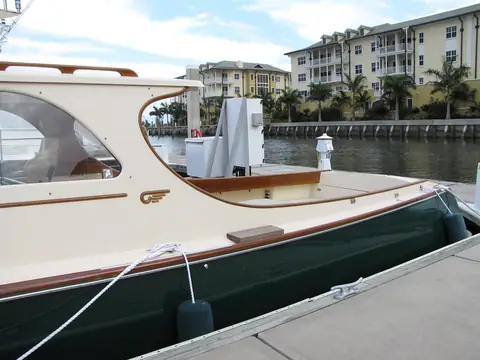
Hinckley Picnic Boat
Downeast Yachts, 39 ft
Used $180K to $1.95M
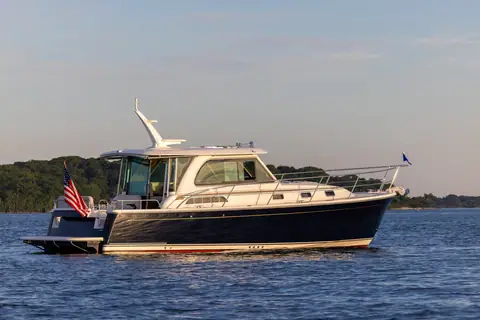
Sabre 38 Salon Express
Downeast Yachts, 42 ft
Used $330K to $675K
Back Cove 37
Downeast Yachts, 42 ft
Used $300K to $700K
Wesmac 42
Downeast Yachts, 42 ft
Used $150K to $750K