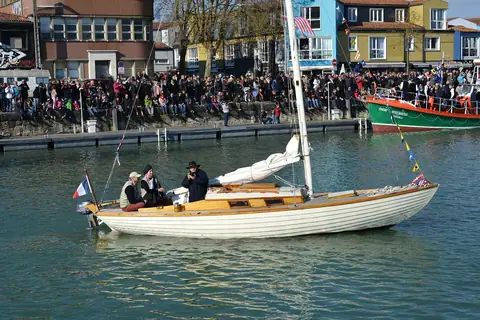
Nordic Folkboat
Performance Sailboats, 25 ft
Used $5K to $45K
A Scandinavian people's keelboat with no single maker, built by dozens of yards since the 1940s and still raced as a strict one-design on both sides of the Atlantic.
Nordic Folkboat is a class and a design rather than a company. Since 1942 many yards have built more than 4,000 of these 25-foot keelboats, and Germany's Haubold Yachting supplies new ones today.
Every other name in our brand directory is a boatbuilder. The Folkboat is different: it is a design owned by no one company and governed by its sailors. It was born during World War II, when Sweden was neutral but cut off, and Scandinavian racing authorities wanted an inexpensive, sturdy family keelboat. Sven Salén, a shipping owner and Olympic sailor, championed a public design competition. It attracted dozens of proposals, none clearly best, so Tord Sundén, then a young designer, was asked to blend the strongest ideas into a single drawing. The prototype was built in Gothenburg at the Arendals yard and went into the water in the spring of 1942.
Credit for the design has been argued over ever since, because the plans were issued without a name and Sundén later claimed them as his own.
Because the plans were public, yards across Scandinavia and beyond built Folkboats, first in overlapping wooden planks. By the 1970s the cost of good timber was pushing buyers away. Erik Andreasen and Sven Svendsen solved that by producing fiberglass hulls that copy the lapstrake shape and the weight distribution of the wooden boats, which let both materials compete as equals; Andreasen is often credited with keeping the class alive. Production totals passed 4,000 boats overall, and by 2001 fiberglass hulls alone numbered over 950.
Folkebådcentralen in Denmark was building them in the mid-2000s, and Haubold Yachting in Germany is the source for new boats today. The Nordic Folkboat International Association coordinates national class groups in Scandinavia, Germany and Australia.
Our Nordic Folkboat review covers the boat itself: its heavy iron keel, modest rig, rough-weather manners, tiny cabin and famous voyages, including Blondie Hasler's Jester in the 1960 solo transatlantic race and Sharon Sites Adams's 1965 crossing to Hawaii. From a class point of view, it is worth knowing which boats are not Folkboats. Sundén's later International Folkboat, sold in Europe as the Marieholm IF, was a separate fiberglass design from the late 1960s, and the British Contessa 26 of 1965 drew heavily on Folkboat lines.
In the US the Folkboat's stronghold is San Francisco Bay, where a fleet has been organized since 1957 and runs an International Cup that brings European sailors over; there are also boats around Puget Sound. Nobody builds them in America, so a buyer either finds a local used boat or imports one, and some European visitors sell their boats after the regatta. Fiberglass boats are the easy choice, while wooden ones are cheaper to buy and costlier to keep.
Before buying:
No single company. Numerous yards have built it since 1942, and Haubold Yachting in Germany currently supplies new boats.
Tord Sundén combined the best entries from a wartime Scandinavian competition backed by Sven Salén, although authorship has long been debated.
Yes. Fiberglass hulls reproduce the wooden shape and weight, so the class races them together without handicap.
Mainly on San Francisco Bay, whose fleet dates from 1957, with a smaller presence around Puget Sound.