Azimut Yachts Sport Yachts & Express Cruisers
Azimut S7 Review, Price and Specs Across Two Generations
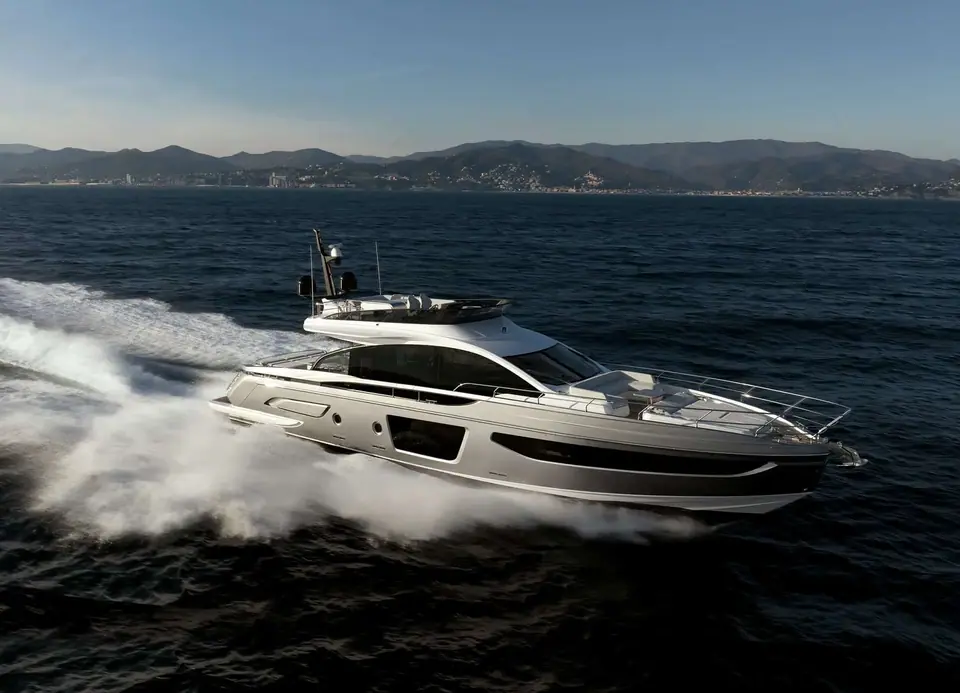
A 71-foot Italian sport-fly with a carbon fiber superstructure, triple Volvo IPS pods and four staterooms where rivals offer three.
- Length
- 71.2 ft21.68 m
- Beam
- 16.9 ft5.15 m
- Cruise
- 27 kn
- Cabins
- 4 plus 1 crew
- Used price
- $2.2M to $4.4M
On this page
- Overview
- The Azimut S7 is really two different yachts
- Carbon fiber where it counts, above the waterline
- Sport-fly profile, two helms and three outdoor lounges
- Four staterooms plus crew in 71 feet
- Triple IPS1050 performance and real fuel numbers
- Owning three pods, the maintenance reality
- Azimut S7 price, new and used
- Who the S7 is right for
- Specifications
- Price and value
- Strengths and weaknesses
- Used buyer checklist
- Rivals
- Our verdict
- FAQ
Azimut's S7 is a 70 to 71 foot sport-fly yacht on triple Volvo IPS1050 pods, built in two generations since 2017, with carbon fiber topsides, 35-knot speed and a four-cabin layout plus crew.
- Owner-operator families
- Florida and Bahamas cruising
- Med-style stern-to marinas
- Buyers stepping up from a 55 to 60 foot express
The Azimut S7 is really two different yachts
The Azimut S7 name covers two distinct designs, and anyone researching an Azimut S7 for sale needs to know which one they are looking at. The original S7 was announced in 2017 to fill the gap between the 55S and 77S, made its world premiere at the Cannes Yachting Festival that September before heading to the US market. Its exterior was drawn by Stefano Righini and its interior by Francesco Guida, and it measured about 70 feet with a 17 foot 5 inch beam.
The current S7 is a new boat from the ground up in styling terms. Its lines come from Alberto Mancini, the interior from Yachtique (a studio known for superyacht work, including for sister company Benetti), and it sits in a refreshed S range alongside the S6, S8 and S10. Azimut's current spec sheet gives it a 21.68 meter (71 foot 2 inch) length and a 5.15 meter (16 foot 11 inch) beam. Both generations share the core recipe: a planing hull by P.L. Ausonio and Azimut, generous carbon fiber above the waterline, and three Volvo Penta IPS1050 pods.
Azimut S7 by the numbers
- Speed to length ratio at cruise
- 3.43A planing cruise. Fast passages in exchange for much higher fuel burn per mile.
- Estimated range at cruise
- 283 nmUsing 90 percent of tank capacity at the cruise speed and fuel burn listed on this page.
- Fuel economy at cruise
- 0.31 nmpgNautical miles per gallon at cruise, both engines combined.
- Horsepower per ton
- 47 hpStrong power to weight for a planing hull.
- Length to beam ratio
- 4.21 : 1A slim, easily driven hull.
Carbon fiber where it counts, above the waterline
Azimut was one of the first volume builders to use carbon fiber structurally on production yachts of this size, and the S7 is the clearest example. On the current boat the superstructure, flybridge, mast, transom, swim platform and the aft section of the deck are carbon. Azimut says this cuts top weight by about 30 percent and reduces roll momentum by up to 15 percent, and the lower center of gravity is noticeable in hard turns.
Power and Motoryacht made the same point about the original: carbon from the garage door and superstructure up to the radar arch, used so freely that designers left it visible as a decorative finish. The tester quoted a fully loaded weight of about 89,000 pounds, compared with 109,000 pounds for a Ferretti 70. Less weight up high also bought more interior volume, which is why the S7 manages four staterooms in a size where three is normal.
Sport-fly profile, two helms and three outdoor lounges
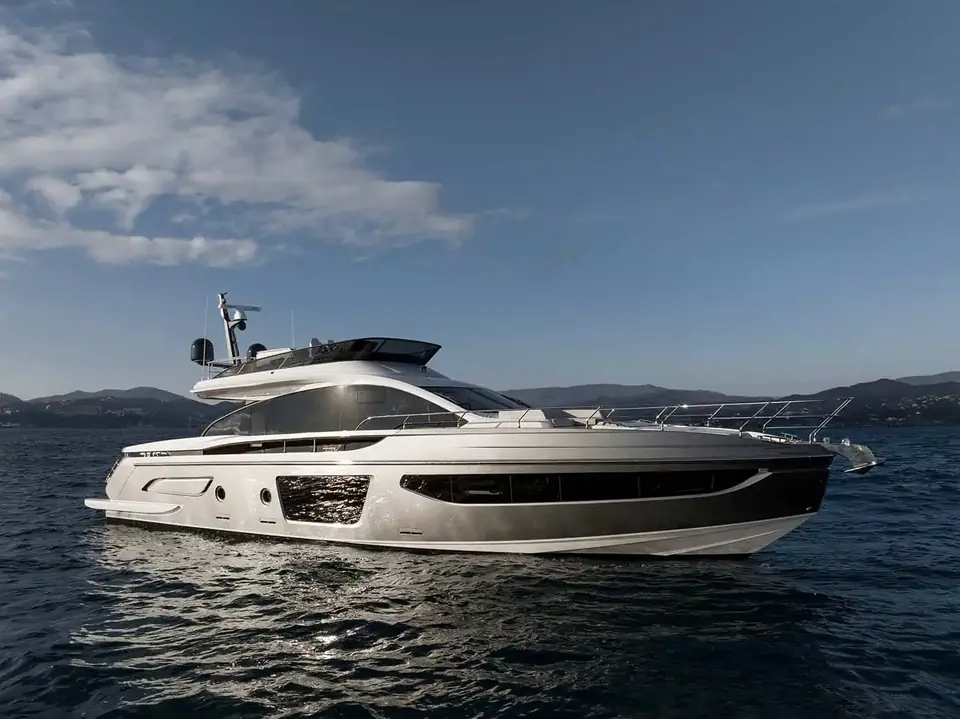
At a glance the S7 reads as a coupe. Look again and there is a compact flybridge integrated into the raked superstructure, what Azimut calls a sport-fly. You get two helm stations, one forward on the main deck to starboard and one on the flybridge, each with Volvo Penta controls, a joystick and Garmin displays on the current boat.
There are three main outdoor zones. A sunpad over the tender garage is reached from the hydraulic swim platform, the flybridge has U-shaped seating aft and a lounge beside the helm, and the foredeck has its own lounge and sunpad. The garage on the original boat took a 10.5-foot tender and a PWC side by side, each on its own slide, which is unusual flexibility at this length. The swim platform lowers to form a beach area that feels large for a 70-footer.
- Main deck and flybridge helm stations with joysticks
- Garage for tender and personal watercraft
- Hydraulic swim platform doubles as a beach area
- Large sunroof and glass to brighten the saloon
Four staterooms plus crew in 71 feet
Below, the full-beam master is amidships with an athwartships berth on the current boat, a true walk-in closet, a vanity and an en suite head with a rain shower. The original S7 had a more unusual master, with the berth set in the forward port quarter and a partition housing a curved TV, sink and head door. A VIP sits in the bow, and two smaller guest cabins share the space between them: one with side-by-side singles whose head also serves as the day head, and one with bunks.
A single crew cabin is fitted aft. Yachting expects most US owners to run the boat themselves, with the crew cabin used by a mate or captain on longer trips. For families with three or four kids, the extra stateroom is the reason to choose an S7 over a three-cabin rival.
Triple IPS1050 performance and real fuel numbers
Every S7 runs three 800 hp Volvo Penta D13 IPS1050 diesels on pod drives, with Volvo's active trim interceptors and joystick docking. Azimut says the setup cuts fuel use and CO2 by 20 to 30 percent compared with similar shaft-driven yachts. The current spec sheet claims up to 35 knots and a 27 knot cruise, with 8.8 liters per nautical mile at 18.6 knots for a 387 nm range and 10.4 liters per nm at 27 knots for 328 nm.
Independent tests agree. Power and Motoryacht saw 35.1 knots at wide open throttle on the original boat off Cannes, with just 69 decibels in the saloon. Yachting tested the new boat at an average 36.3 knots and recorded 86.1 gph at 2,000 rpm and 28.9 knots, about 304 nm of range with reserve, dropping to 64.7 gph at 24.8 knots for about 347 nm. At full speed the burn rises to 123.1 gph.
The 13.8 degree transom deadrise is modest by sportboat standards, chosen for stability at rest and efficient planing rather than slamming through big head seas. Yachting described moderate inboard heel in hard turns with clear views from both helms.
Owning three pods, the maintenance reality
Three engines are the S7's signature and its main ownership cost. Each IPS unit needs its own oil changes, anodes, propeller inspection and periodic bellows and seal service, and pod work is dealer work. Budget roughly 4 to 6 percent of the boat's value per year for running costs, which for a 71-foot yacht typically means $280,000 to $480,000 including a part-time or full-time captain, dockage, insurance and service.
The upside is maneuverability. With three pods and a joystick, an owner-operator can put an S7 into a Med-style berth without bow thruster theatrics, and the Volvo Penta system is supported by a large dealer network in Florida and the Northeast. Look for boats with documented 500 and 1,000 hour services and a Volvo extended warranty where available.
Azimut S7 price, new and used
Expect a new S7 to land between about $4.4 million and $5.3 million delivered in the US in 2026, depending on the exchange rate, gyro stabilizers, tender, electronics and interior choices. That is competitive against British and other Italian sport yachts of similar length, especially given the fourth cabin.
First-generation boats are where the value lies. In 2026 a 2018 or 2019 S7 typically asks $2.2 million to $2.9 million, and the latest originals from 2021 and 2022 sit in the low to mid $3 millions. Second-generation boats are still scarce on the brokerage market and trade not far below new.
Who the S7 is right for
The S7 suits an owner-operator family that wants 30-knot cruising, four private cabins and a modern Italian interior without moving up to an 80-foot yacht with full-time crew. It is less ideal for buyers who want a full flybridge for entertaining or long passages at displacement speeds, where a conventional flybridge Azimut would be more comfortable.
Azimut S7 specifications
| Length overall | 71.2 ft21.68 m |
|---|---|
| Beam | 16.9 ft5.15 m |
| Draft | 5.6 ft1.69 m |
| Displacement | 101,412 lbs46, kg |
| Fuel capacity | 1,004 gal3,8 L |
| Fresh water | 264 gal1, L |
| Cabins | 4 plus 1 crew |
| Berths | 8 plus 2 crew |
| Heads | 3 plus 1 crew |
| Standard engines | 3 x Volvo Penta D13 IPS1050 (800 hp each) |
| Maximum power | 2,400 hp |
| Cruise speed | 27 knots |
| Top speed | 35 knots |
| Range | 328 nm |
| Hull type | Planing hull, 13.8 degrees deadrise at the transom, about 18 degrees amidships |
| Hull construction | GRP hull with carbon fiber superstructure, flybridge and aft deck components |
| CE design category | A |
| Builder | Azimut Yachts (Azimut Benetti Group), Italy |
| Naval architect | P.L. Ausonio Naval Architecture with Azimut R&D |
| Other design credits | Original S7 (2017) exterior by Stefano Righini, interior by Francesco Guida. Current S7 exterior by Alberto Mancini, interior by Yachtique |
| Production | 2017 to present |
| Status | In production |
Figures come from builder documentation and independent tests where available. Displacement is usually quoted light, so a loaded cruising boat will weigh more. Compare these specs with another model.
Performance data
| RPM | Speed (kn) | Fuel (gph) | Range (nm) |
|---|---|---|---|
| 1800 | 24.8 | 64.7 | 347 |
| 2000 | 28.9 | 86.1 | 304 |
| WOT | 36.3 | 123.1 | 266 |
Yachting magazine test of the current S7 off Cannes, triple Volvo Penta D13 IPS1050. Range with a 10 percent reserve on 1,004 gallons.
How much does a Azimut S7 cost?
First-generation S7s from 2018 to 2022 make up most of the US brokerage fleet and trade well below the current model. Euro pricing, US commissioning (generator upgrade, US electrics, electronics) and import costs drive the new price, while used values move with IPS service history, gyro stabilizers and whether the boat has had a professional interior refresh.
Estimate your yearly cost
A planning estimate using common rules of thumb: insurance near 1.5 percent of value, maintenance near 3 percent, haul out and bottom paint by length. Your marina, region and use will move these numbers. Open the full cost calculator.
Versions and options
- Original S7 (2017 to about 2022)
- Exterior by Stefano Righini, interior by Francesco Guida, about 70 feet with a 17 foot 5 inch beam. Triple IPS1050, tested at 35.1 knots by Power and Motoryacht.
- Current S7
- Exterior by Alberto Mancini, interior by Yachtique, 21.68 meters with a 5.15 meter beam, 3,800 liters of fuel. Triple IPS1050, tested at 36.3 knots by Yachting.
Azimut S7 timeline
- 1969Paolo Vitelli founds Azimut, starting with sailboat charters
- 2017Original S7 premieres at the Cannes Yachting Festival in September
- 2018Power and Motoryacht publishes its Cannes test of the original S7, 35.1 knots at wide open throttle
- 2023All-new S7 by Alberto Mancini joins the refreshed S range
- 2023Yachting tests the new S7 off Cannes at an average 36.3 knots, published in its December 2023 issue
Strengths and weaknesses
What owners like
- Four staterooms plus crew in 71 feet
- Carbon superstructure lowers weight and roll
- 35-knot top speed with efficient triple IPS
- Excellent joystick docking for owner-operators
- Garage takes a tender and a PWC
- Two helm stations
What to weigh up
- Three pods mean three sets of maintenance
- Sport-fly is smaller than a true flybridge
- Two smaller guest cabins are compact
- Two generations under one name complicate comparisons
Used Azimut S7 buyer checklist
Take this list to a viewing. Your ticks are saved in this browser so you can come back to it.
Always commission an independent marine survey and an engine survey before you buy. How a marine survey works.
Rivals to consider
Princess S72
British sport-fly with a similar mission, typically on shaft drives rather than pods.
Sunseeker 74 Predator
A sharper coupe without the flybridge, faster but with less outdoor social space.
Pershing 7X
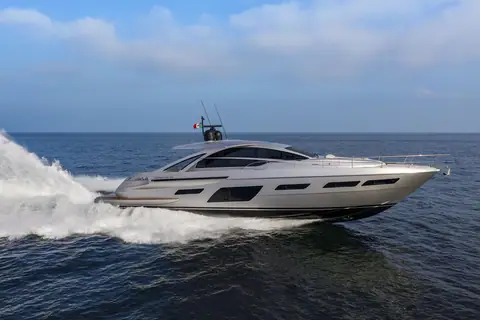
Ferretti Group's carbon performance yacht with surface drives and far higher speeds.
Compare side by sideAzimut 68
The flybridge sibling for buyers who want more upper deck and less sportiness.
Compare side by sideOur verdict on the Azimut S7
The Azimut S7 is a clever piece of packaging. Carbon fiber topsides keep it light and stable, triple IPS pods make it fast and easy to dock, and the four-cabin layout gives families something rivals cannot match at 71 feet. The original Righini boats are the value buys on the US brokerage market, while the Mancini-styled current boat is the more polished and modern yacht. Either way, buy on the strength of the IPS service records.
Azimut S7 questions answered
How much does an Azimut S7 cost?
A new S7 typically lands between about $4.4 and $5.3 million delivered in the US. Used first-generation boats ask roughly $2.2 to $3.5 million.
How fast is the Azimut S7?
Azimut quotes up to 35 knots and a 27 knot cruise. Independent tests recorded 35.1 knots on the original boat and 36.3 knots on the current one.
What engines does the Azimut S7 have?
Three 800 hp Volvo Penta D13 IPS1050 diesels on pod drives, with joystick control and active trim.
How many cabins does the Azimut S7 have?
Four guest staterooms, including a full-beam master and forward VIP, plus a crew cabin.
Is the Azimut S7 made of carbon fiber?
The hull is fiberglass, but the superstructure, flybridge and several aft deck components are carbon fiber to save weight and lower the center of gravity.
Who designed the Azimut S7?
The original 2017 boat was styled by Stefano Righini with a Francesco Guida interior. The current S7 is by Alberto Mancini with an interior by Yachtique.
Azimut S7 photos
More sport yachts & express cruisers to explore
Pershing 7X
Sport Yachts & Express Cruisers, 69 ft
Used $3.3M to $4.5M
Azimut 72S
Sport Yachts & Express Cruisers, 73 ft
Used $1.1M to $1.8M
Azimut 77S
Sport Yachts & Express Cruisers, 79 ft
Used $1.6M to $2.7M
Azimut 62S
Sport Yachts & Express Cruisers, 62 ft
Used $450K to $1.05M
Other Azimut Yachts models
- Azimut 38
- Azimut 39
- Azimut 40
- Azimut 40S
- Azimut 42
- Azimut 43
- Azimut 43S
- Azimut 45
- Azimut 46
- Azimut 47
- Azimut 48
- Azimut 50 Fly
- Azimut 52 Fly
- Azimut 54
- Azimut 55 Evolution
- Azimut 55 Fly
- Azimut 55S
- Azimut 58 Flybridge
- Azimut 60 Flybridge
- Azimut 62 Flybridge
- Azimut 62S
- Azimut 64 Flybridge
- Azimut 66 Flybridge
- Azimut 68
- Azimut 70 Flybridge
- Azimut 72S
- Azimut 75
- Azimut 77S
- Azimut 80
- Azimut 82
- Azimut 84
- Azimut 85
- Azimut 86S
- Azimut 88
- Azimut 95
- Azimut 98 Leonardo
- Azimut 100 Jumbo
- Azimut 103S
- Azimut 105
- Azimut 116
- Azimut Atlantis 34
- Azimut Atlantis 43
- Azimut Atlantis 44
- Azimut Atlantis 45
- Azimut Atlantis 48
- Azimut Atlantis 50
- Azimut Atlantis 51
- Azimut Atlantis 55
- Azimut Atlantis 58
- Azimut Fly 53
- Azimut Fly 62
- Azimut Fly 72
- Azimut Fly 78
- Azimut Grande 25 Metri
- Azimut Grande 26M
- Azimut Grande 27 Metri
- Azimut Grande 30 Metri
- Azimut Grande 32 Metri
- Azimut Grande 35 Metri
- Azimut Grande 36M
- Azimut Grande S10
- Azimut Magellano 43
- Azimut Magellano 53
- Azimut Magellano 66
- Azimut Magellano 76
- Azimut S6
- Azimut S8
- Azimut Verve 42
- Azimut Verve 47
- All Azimut Yachts models