Fairline Yachts Sport Yachts & Express Cruisers
Fairline Targa 48 Buyer's Guide, Open and GT from 2013 to 2020
The 2013 sport cruiser that put Fairline back on its feet, a resin-infused IPS boat with a full-beam master, sold as an Open or an enclosed GT until 2020.
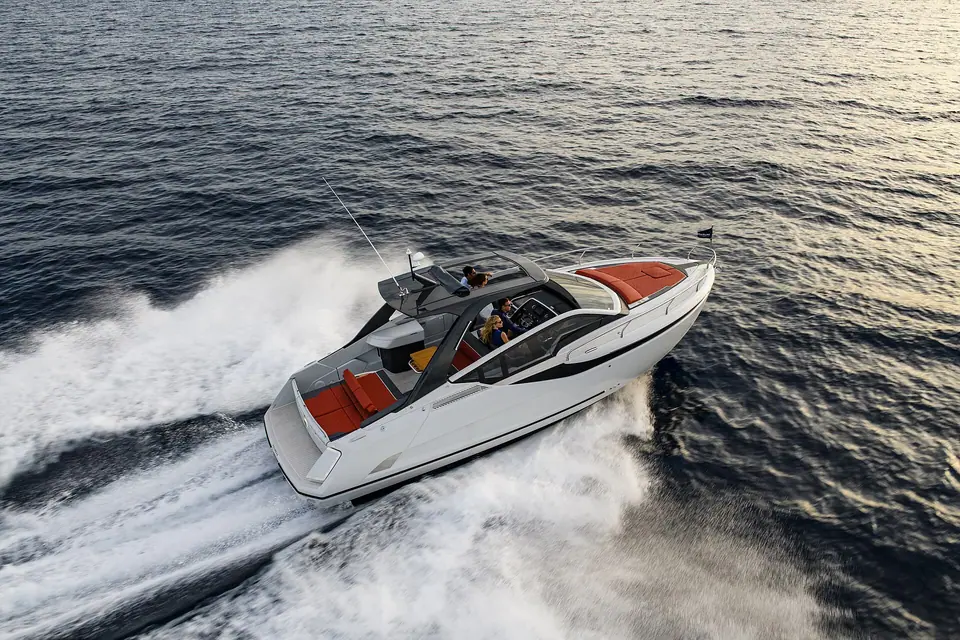
- Length
- 48.3 ft14.73 m
- Beam
- 14.2 ft4.32 m
- Cruise
- 26.7 kn
- Cabins
- 2 (3 optional)
- Used price
- $420K to $800K
On this page
- Overview
- The Fairline Targa 48 and the boat that rebooted Fairline
- A Slovenian hull and the resin-infusion gamble
- Jackshafts, pods and a genuinely full-beam master
- Open cockpit or GT saloon
- Two cabins, a lower lounge and a galley you can cook in
- Test speeds and fuel burn from Cannes
- What changed with the 2017 update
- Living with a ten-year-old Targa 48
- Specifications
- Price and value
- Strengths and weaknesses
- Used buyer checklist
- Rivals
- Our verdict
- FAQ
The Fairline Targa 48 is a 48 to 51-foot IPS sport cruiser built in England from 2013 to 2020 in Open and GT forms, with a J&J Design hull, two or three cabins and a 30 to 34 knot top end.
- Couples who want a large owner's cabin in a sub-50-foot boat
- Owner-operators comfortable with IPS joystick handling
- Buyers seeking Fairline quality below new-boat prices
- Weekend and coastal cruising with occasional guests
Fairline Targa 48 by the numbers
- Speed to length ratio at cruise
- 4.12A planing cruise. Fast passages in exchange for much higher fuel burn per mile.
- Estimated range at cruise
- 235 nmUsing 90 percent of tank capacity at the cruise speed and fuel burn listed on this page.
- Fuel economy at cruise
- 0.73 nmpgNautical miles per gallon at cruise, both engines combined.
- Horsepower per ton
- 77 hpStrong power to weight for a planing hull.
- Length to beam ratio
- 3.41 : 1Moderate proportions.
The Fairline Targa 48 and the boat that rebooted Fairline
The Fairline Targa 48 arrived at a delicate moment for the Oundle builder. After the recession, Fairline had cut its production lines from eight to three, and at the January 2013 London Boat Show CEO Alistair Schofield presented the new 48 as the model to lead the company's recovery, available in Open, GT and Squadron flybridge layouts on one shared hull. MBY later put the development spend at almost £3 million and called it the first all-new Fairline in two years. The company, in its words, was betting the farm.
Fairline launched the Targa 48 Open in an unusual place, the Goodwood Festival of Speed car event in July 2013, then showed it at Southampton and Cannes that September. The Targa 48 GT, with an enclosed saloon behind the windshield, followed on the same platform, as did the Squadron 48 flybridge. YachtBuyer dates the first generation Open from 2013 to 2017 and the GT from 2013 to 2016, with an updated second generation of both built from 2017 to 2020.
Do not confuse it with an older Fairline Targa 48 from the 1990s that still appears in European listings. That is an earlier, unrelated design; American searches for a Targa 48 almost always mean the 2013 to 2020 boat.
A Slovenian hull and the resin-infusion gamble
Fairline had relied for years on Bernard Olesinski in Cowes for its hull shapes. For the 48 it went instead to J&J Design, part of the Seaway group in Slovenia, which drew the hull and engineered its construction. Power and Motoryacht's Alan Harper described it as the first Fairline designed specifically around Volvo Penta IPS drives and the first built with resin-infusion lamination, with deck and superstructure moldings carrying their own internal monocoque structure. Even the hull windows are acrylic rather than glass, and the boat is built on load cells so weight can be tracked during construction. Fairline claimed the result was about 25 percent lighter than conventional construction would have produced.
The common-hull approach had a cost. Yachting reported that the hull was given wider chines and a broader beam so that the taller Squadron would stay stable, and the Open ended up about 2,000 pounds lighter than its flybridge sister. The visible upshot is a beam of 14 feet 2 inches, more than a foot wider than Fairline's own Targa 47 of the previous decade, which shows up as volume below.
Jackshafts, pods and a genuinely full-beam master
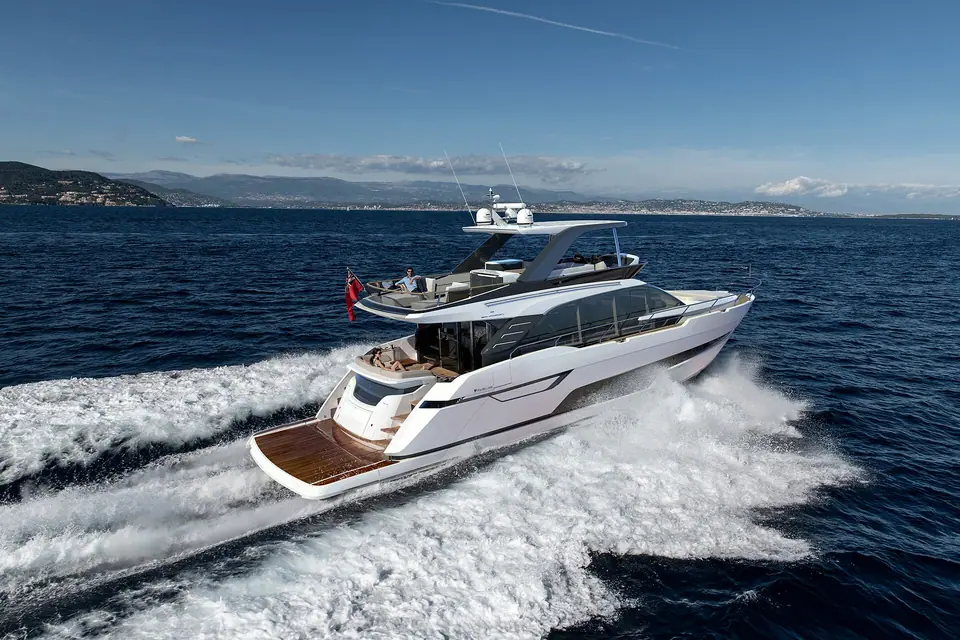
Most IPS boats bolt the engine straight onto the pod at the transom. Fairline did not. Chief designer Andrew Pope told Yachting the team decoupled the drives, moved the engines forward and fitted roughly 3-foot shafts between engine and pod. That shifts the center of gravity forward, so the boat drives more like a shaft boat while keeping joystick docking and pod efficiency.
It also explains the cabin that sells this boat. With the engines further forward but compact, Fairline could fit a full-beam midships master with 6 feet 7 inches of headroom, opposing banks of hull windows Pope said were three times larger than on earlier models, long dressers on both sides and an en suite with a big shower. For a boat under 50 feet in 2013, it was a striking owner's cabin.
Open cockpit or GT saloon
The Open's hardtop covers the cockpit but is open at the back, and about 70 percent of the roof is a retractable Sunbrella panel. Yachting measured the U-shaped lounge at about 7 feet 6 inches by 7 feet 9 inches, enough for six at the teak table, which folds into the sofa on a single leg. Aft, a three-person sunpad over the garage is more than 6 feet each way. The helm uses a pair of Recaro bucket seats built to Fairline's specification, with the skipper on the left-hand seat.
The GT closes the forward half of the main deck with saloon doors and an electrically opening hard roof with glazed panels. MBY's Nick Burnham described it as a seagoing coupe cabriolet that can be sealed and climate controlled, while the Open relies on canvas covers that are never quite as weatherproof. The trade is space: the GT gives up the Open's big sunpad over the garage, using J-shaped cockpit seating and a table that converts to a sunbed instead.
Two cabins, a lower lounge and a galley you can cook in
The standard lower deck puts the master amidships, an en suite VIP forward with scissor berths that convert between double and twin, and a lower saloon with an L-shaped settee between them. The galley sits to port with a full-height fridge freezer. PMY measured headroom of at least 6 feet 4 inches throughout, even in the showers.
Owners who need a third cabin can swap the lower saloon for a small twin, though the galley stays. PMY noted that Fairline expected most Open buyers to keep the two-cabin plan, while the three-cabin version was aimed at GT and Squadron owners. Joinery was walnut or white oak with several sole choices, and Yachting's tester heard a rival builder say it was aiming for Fairline standards of finish.
Test speeds and fuel burn from Cannes
Both American magazines tested early Opens off Cannes with twin 435 hp IPS600s, and both came in below Fairline's claims. PMY recorded 30.4 knots at 3,400 rpm burning 38.9 gph, with a fast cruise of 26.7 knots at 3,250 rpm and 36.5 gph. Yachting averaged 29.5 knots at 3,350 rpm with an 880-pound Williams 285 in the garage. Fairline's own figure was 33.6 knots at 3,622 rpm with different propellers.
PMY's Fairline hosts blamed the shortfall partly on the heavy tender aft and an empty water tank amidships, which upset the designed trim, and noted the trim tabs could add up to a knot. The lesson for an owner is simple: keep the water tank topped up when you want speed.
Handling earned praise in both tests. PMY found the helm lively without being skittish and the foam-cored bottom quiet when punching into chop. Yachting's boat turned 180 degrees in about three boat lengths and planed in roughly 15 seconds.
What changed with the 2017 update
The second-generation Targa 48 Open and GT, built from 2017 to 2020, kept the J&J hull and layout concept but picked up new Alberto Mancini designed hull windows that sweep along the topsides, the same styling language Fairline used on its later Targa models. Builder data published on YachtBuyer shows the GT gaining a galley-up option on the main deck, an IPS650 alternative and a 550 hp Volvo D8 with IPS700 at the top of the range, with listed top speeds of 33.4 knots on IPS600 and 34 knots on IPS700.
Overall length grew on paper, to 50 feet 8 inches for the Open and 51 feet 5 inches for the GT including pulpit, against 48 feet 4 inches for an early Open. Listed fuel is about 346 US gallons and water 127 gallons on the later boats. When shopping, check the build year and the window shape; the Mancini glazing is the quickest visual tell for a later boat.
Living with a ten-year-old Targa 48
These boats are now 6 to 13 years old, which puts many at their first major round of maintenance: IPS bellows and seals, generator overhauls, canvas, teak and 2013-era electronics. Keeping one in the United States typically runs $50,000 to $90,000 a year, more in a premium Florida or Northeast slip.
Most hulls were sold in Europe, so US buyers will often be importing. Look for boats with the generator, tropical air conditioning and appliance package, which PMY listed as a $75,520 option in 2013, because retrofitting air conditioning to a European-spec boat is expensive. A hydraulic platform and fitted jet tender, also costly options when new, add real value.
Fairline Targa 48 specifications
| Length overall | 48.3 ft14.73 m |
|---|---|
| Beam | 14.2 ft4.32 m |
| Draft | 3.8 ft1.17 m |
| Air draft | 15.1 ft4.6 m |
| Displacement | 28,65 lbs12,995 kg |
| Fuel capacity | 357 gal1,351 L |
| Fresh water | 116 gal439 L |
| Cabins | 2 (3 optional) |
| Berths | 4 to 7 |
| Heads | 2 |
| Maximum persons | 16 |
| Standard engines | 2 x Volvo Penta IPS600, 435 hp (2013 boats) or 440 hp (2017 update) |
| Optional engines | 2 x Volvo Penta IPS650 (480 hp) or IPS700 (D8, 550 hp) on the 2017 update |
| Maximum power | 1,100 hp |
| Cruise speed | 26.7 knots |
| Top speed | 30.4 knots |
| Range | 250 nm |
| Hull type | Resin-infused modified-V planing hull designed for Volvo IPS, engines forward on jackshafts |
| Hull construction | Resin-infused GRP with foam-cored bottom |
| CE design category | B |
| Builder | Fairline Yachts, United Kingdom |
| Naval architect | J&J Design (Seaway group, Slovenia) |
| Other design credits | Fairline in-house team under chief designer Andrew Pope; Alberto Mancini hull windows on the 2017 update |
| Production | 2013 to 2020 |
| Status | Discontinued |
Figures come from builder documentation and independent tests where available. Displacement is usually quoted light, so a loaded cruising boat will weigh more. Compare these specs with another model.
Performance data
| RPM | Speed (kn) | Fuel (gph) | Range (nm) |
|---|---|---|---|
| 2500 | 15 | 21.7 | 221 |
| 2750 | 17.8 | 28.4 | 202 |
| 3000 | 22.3 | 32.1 | 221 |
| 3250 | 26.7 | 36.5 | 234 |
| 3400 | 30.4 | 38.9 | 250 |
Power and Motoryacht test of a 2013 Targa 48 Open, 2 x 435 hp Volvo Penta IPS600, 310 gallons of fuel, no water, seven persons and 700 pounds of gear, 2 to 3 foot seas off Cannes. Range as published by PMY.
How much does a Fairline Targa 48 cost?
Power and Motoryacht's 2013 test boat was priced at $1,201,406 as tested, and the magazine noted that options made up more than 35 percent of that figure, so equipment varies widely between boats. In 2026, Fairline's European brokerage pages listed 2014 Targa 48 Opens at roughly €470,000 to €530,000 and 2016 boats near €600,000. GTs, the 2017 to 2020 update with Mancini windows, IPS650 or IPS700 power, a hydraulic platform and a fitted Williams tender bring the higher numbers.
Estimate your yearly cost
A planning estimate using common rules of thumb: insurance near 1.5 percent of value, maintenance near 3 percent, haul out and bottom paint by length. Your marina, region and use will move these numbers. Open the full cost calculator.
Versions and options
- Targa 48 Open, first generation (2013 to 2017)
- Open-backed hardtop with a large Sunbrella roof panel, sunpad over the garage, twin 435 hp IPS600. About 48 feet 4 inches overall.
- Targa 48 GT, first generation (2013 to 2016)
- Enclosed saloon with doors and an electric glazed hard roof, J-shaped cockpit seating, two or three cabins.
- Second generation Open and GT (2017 to 2020)
- Alberto Mancini hull windows, galley-up option on the GT, IPS650 and IPS700 engine choices, longer listed overall length.
- Squadron 48
- Flybridge sister on the same hull, about 2,000 pounds heavier than the Open according to Yachting.
Fairline Targa 48 timeline
- 2013New 48 announced at the London Boat Show in January as Fairline's recovery model
- 2013Targa 48 Open launched at the Goodwood Festival of Speed in July, then shown at Southampton and Cannes
- 2013Targa 48 GT and Squadron 48 follow on the shared hull
- 2017Second generation Open and GT introduced with Mancini windows and more engine choices
- 2020Production ends; the Targa 45 and Targa 50 cover the range either side
Strengths and weaknesses
What owners like
- Full-beam master with 6 feet 7 inches of headroom and big hull windows
- Lighter, stiff resin-infused construction
- Jackshaft IPS layout gives shaft-boat handling with joystick docking
- Quiet, well-mannered ride in chop
- Fairline joinery quality
- Choice of open-air Open or enclosed GT
What to weigh up
- Real-world top speed about 30 knots, short of Fairline's claims
- Sensitive to trim and load, including an empty water tank
- Long and expensive options list means wide variation between boats
- Jackshafts add service items most IPS boats do not have
- Most examples are European-spec imports
Used Fairline Targa 48 buyer checklist
Take this list to a viewing. Your ticks are saved in this browser so you can come back to it.
Always commission an independent marine survey and an engine survey before you buy. How a marine survey works.
Rivals to consider
Princess V48
The British rival launched the same year with the same IPS600 power, offered in Open and enclosed versions.
Azimut Atlantis 48
Italian open sport cruiser with flashier styling and a similar two-cabin plan.
Compare side by sideSunseeker Predator 50
Sportier hardtop from Poole, faster on shafts but with less volume in the master.
Princess V50
Slightly larger British alternative that buyers often compare on the used market.
Compare side by sideOur verdict on the Fairline Targa 48
The Fairline Targa 48 is the boat that proved post-recession Fairline could still engineer a class-leading sport cruiser. Its resin-infused J&J hull, clever jackshaft IPS installation and full-beam master gave buyers more room and a better ride than most 48-footers of 2013, and the finish still looks expensive a decade on. Real speeds sit nearer 30 knots than the brochure promised, and the options list makes every boat different, so judge each one on equipment and maintenance rather than year alone. A well-kept second-generation GT with air conditioning and a fitted tender is the pick for American waters.
Fairline Targa 48 questions answered
What years was the Fairline Targa 48 built?
The current Targa 48 was built from 2013 to 2020, with a first generation from 2013 to about 2017 and an updated second generation from 2017 to 2020.
What is the difference between the Targa 48 Open and Targa 48 GT?
The Open has an open-backed hardtop with a fabric roof panel and a sunpad over the garage. The GT has an enclosed saloon with doors and a glazed opening roof.
What top speed does a Targa 48 Open reach in independent tests?
Power and Motoryacht recorded 30.4 knots with twin IPS600s and a 26.7-knot fast cruise at 36.5 gph. Fairline claimed up to 33.6 knots.
What should I expect to pay for a Targa 48 today?
Expect about $420,000 for an early, average-spec boat to around $800,000 for a late second-generation GT. European listings in 2026 showed 2014 Opens near €470,000 to €530,000.
Who designed the Fairline Targa 48 hull?
The hull was drawn and engineered by J&J Design of the Seaway group in Slovenia, with Fairline's in-house team under Andrew Pope handling the yacht's design.
Photos from the Fairline Yachts range
We have not found a freely licensed photo of the Fairline Targa 48 yet, so these show other Fairline Yachts boats, each captioned with the boat pictured.
More sport yachts & express cruisers to explore
Formula 45 Yacht
Sport Yachts & Express Cruisers, 48 ft
Used $190K to $780K
Beneteau Gran Turismo 45
Sport Yachts & Express Cruisers, 49 ft
Used $520K to $760K
Azimut Atlantis 45
Sport Yachts & Express Cruisers, 48 ft
Used $650K to $1M
Azimut Verve 47
Sport Yachts & Express Cruisers, 48 ft
Used $1.05M to $1.8M
Other Fairline Yachts models
- Fairline F//Line 33
- Fairline Phantom 40
- Fairline Phantom 48
- Fairline Phantom 50
- Fairline Squadron 50
- Fairline Squadron 55
- Fairline Squadron 58
- Fairline Squadron 68
- Fairline Targa 29
- Fairline Targa 31
- Fairline Targa 33
- Fairline Targa 34
- Fairline Targa 37
- Fairline Targa 38
- Fairline Targa 40
- Fairline Targa 43
- Fairline Targa 44
- Fairline Targa 45 GT
- Fairline Targa 52
- Fairline Targa 58 Gran Turismo
- All Fairline Yachts models