Fairline 40 Phantom, a Used Flybridge Buyer's Guide
The last of the classic 40 foot Fairline flybridges: shaft drives, an Olesinski hull, galley-down layout and joinery that still looks expensive.
- Length
- 41.2 ft12.53 m
- Beam
- 13 ft4 m
- Cruise
- 25 kn
- Cabins
- 2
- Used price
- $170K to $320K
On this page
- Overview
- Which Fairline 40 Phantom are you looking at?
- Built in what owners call Fairline's golden era
- An Olesinski bottom with tunnelled props
- TAMD63, Caterpillar or D6: engines and what they deliver
- A galley-down layout that still works
- The 1994 to 1999 Phantom 40 and Phantom 42
- Phantom 40 for sale: pricing and what to expect
- Specifications
- Price and value
- Strengths and weaknesses
- Used buyer checklist
- Rivals
- Our verdict
- FAQ
The second-generation Fairline Phantom 40 (about 2003 to 2010) is a 41 ft 2 in shaft-drive flybridge with two cabins, two heads and 30 knots from twin Volvo D6s. A different Phantom 40 was built from 1994 to 1999.
- Couples or small families cruising coastally
- First flybridge buyers on a budget
- Owners who value build quality over modern styling
- Weekend and short-vacation boating
Fairline Phantom 40 by the numbers
- Speed to length ratio at cruise
- 4.18A planing cruise. Fast passages in exchange for much higher fuel burn per mile.
- Horsepower per ton
- 68 hpStrong power to weight for a planing hull.
- Length to beam ratio
- 3.17 : 1Moderate proportions.
Which Fairline 40 Phantom are you looking at?
Search for a Fairline 40 Phantom and you will find two quite different boats. The one most listings refer to is the second-generation Phantom 40, launched in the early 2000s (MBY dates its arrival to 2002 in one report and 2003 in another) and built until Fairline retired the Phantom name around 2010. That is the boat this guide is about: a 41 foot 2 inch shaft-drive flybridge cruiser on a Bernard Olesinski hull.
The first Phantom 40 was built from 1994 to 1999, ending with a stretched derivative called the Phantom 42, of which Fairline built 116 between 1997 and 1999. It is a heavier, rounder 1990s design. If a listing shows a build year before 2000, it is the older boat, and our section on telling them apart below explains what changes.
Built in what owners call Fairline's golden era
Motor Boat & Yachting describes the early 2000s as a golden era for Fairline, when the build quality that went into the Squadron 78 flagship trickled all the way down the range. On the Phantom 40 that shows in high-gloss cherry joinery finished to a near-superyacht standard, a sturdy handrail recessed into the saloon headliner, teak on the cockpit and bathing platform as standard, and strong high rails along 10 inch side decks.
It also came at a turbulent time for the company. Fairline was owned by investment bank 3i when the 2009 recession hit, was sold to Better Capital and the Royal Bank of Scotland in 2011, entered administration in December 2015 and was reborn as Fairline Yachts in 2016. The Phantom 40 belongs firmly to the pre-recession era, which is part of why well-kept examples still look and feel expensive.
An Olesinski bottom with tunnelled props
Bernard Olesinski drew the hull, as he did for most Fairlines of the period. MBY notes that the running surface extends beneath the bathing platform to maximize planing area aft, and the propellers sit in semi-tunnels so the shafts run at a flatter, more efficient angle with the engines mounted lower. The result is predictable, well-balanced handling rather than anything exotic: the shafts push weight forward for a level ride and keep the props under the hull where they give good leverage in tight marinas.
Fairline experimented with Volvo Penta IPS pods on a Phantom 40 after the system appeared in 2005, but production Phantom 40s stayed on conventional shafts. Fairline did not put IPS into a production model until the Targa 44 in 2007.
TAMD63, Caterpillar or D6: engines and what they deliver
At launch Fairline offered twin Volvo Penta TAMD63 diesels in L (316 hp) or P (370 hp) tune, with Caterpillar 3126 engines of 355 or 385 hp as a rarer alternative; MBY says these gave top speeds in the high 20s. From 2005 Volvo's common-rail D-series replaced the TAMDs, with electronic controls and lower emissions. The D6-370 gives close to 30 knots and the D6-435 lifts top speed beyond 30 knots.
MBY's data for a 2007 boat with twin D6-370s quotes a 30 knot top speed, a 25 knot cruise and a range of about 300 nautical miles from roughly 990 liters (262 US gallons) of fuel. That range is the main practical limit: comfortable for coastal hops or a Bahamas crossing, but planning long legs at fast cruise needs care.
- LOA 41 ft 2 in (12.53 m), beam 13 ft 0 in (4.0 m), draft 3 ft 3 in (1.0 m)
- Dry displacement 11,599 kg (25,571 lb)
- Fuel about 990 L (262 US gal)
- D6-370: about 30 knots top, 25 knots cruise, 300 nm range per MBY
A galley-down layout that still works
Inside, the Phantom 40 follows the 40 foot flybridge formula that Princess, Sealine and Fairline all used through the 1990s and 2000s. The main deck holds the saloon and a double-seat lower helm. Down a few steps are the galley, an owner's cabin forward with a double berth and its own bathroom, and a twin-berth guest cabin to starboard that shares the second bathroom, which doubles as the day head. A sofa bed hidden under the saloon settee takes the occasional count to six.
Up top, chunky molded steps lead to a flybridge with a triple helm seat and a big dinette aft. Many boats were optioned with a wet bar, barbecue and fridge, which is unusual at this size and well worth having. The tender usually rides on the bathing platform.
The 1994 to 1999 Phantom 40 and Phantom 42
The first Phantom 40 was a product of the early 1990s Phantom range, which MBY traces back half a century to the original Phantom 32. When MBY tested a 1994 Phantom 40 on a delivery to Jersey, it had twin 355 hp Caterpillar 3116 TA diesels and reached 30.6 knots, but the reviewer complained about restricted visibility from the lower helm. Owners also found boarding from an alongside berth awkward; one fitted brackets for a boarding ladder.
The Phantom 42 that ended the series added an extended bathing platform that fixed the boarding issue and offered Volvo TAMD63L (318 hp) or TAMD63P (370 hp) engines. To tell the generations apart in listings, look at the build year, the engine type, and the profile: the 1990s boats have softer, rounder superstructure lines and no extended platform on the original 40.
Phantom 40 for sale: pricing and what to expect
The Fairline 40 Phantom for sale is mostly a European boat. MBY has featured a 2007 example in Torquay at 190,000 pounds, another 2007 boat with D6-370s and stern thruster at 184,950 pounds, and a 2009 boat with D6-435s at 229,000 pounds. Translated, a good second-generation boat costs roughly $235,000 to $295,000 before any import costs, and early TAMD63 boats can dip below $200,000.
Annual running costs for a twin-diesel 41 footer are moderate: allow $20,000 to $38,000 a year for a slip, insurance, a haul and antifouling, and engine and generator service. Because Fairline was replaced by the Squadron range, parts for hull fittings and trim are less easy to source than engine parts, which Volvo and Caterpillar dealers stock worldwide.
Fairline Phantom 40 specifications
| Length overall | 41.2 ft12.53 m |
|---|---|
| Beam | 13 ft4 m |
| Draft | 3.3 ft1 m |
| Displacement | 25,571 lbs11,599 kg |
| Fuel capacity | 262 gal99 L |
| Cabins | 2 |
| Berths | 4, occasional 6 with saloon sofa bed |
| Heads | 2 |
| Standard engines | 2 x Volvo Penta TAMD63L 316 hp or TAMD63P 370 hp (early boats); 2 x Volvo Penta D6-370 from about 2005 |
| Optional engines | 2 x Caterpillar 3126 355 or 385 hp; 2 x Volvo Penta D6-435 |
| Maximum power | 870 hp |
| Cruise speed | 25 knots |
| Top speed | 30 knots |
| Range | 300 nm |
| Hull type | Modified deep-V planing hull with semi-tunnelled propellers, shaft drive |
| Hull construction | GRP |
| Builder | Fairline Boats, United Kingdom |
| Naval architect | Bernard Olesinski |
| Other design credits | Fairline in-house styling and interior team |
| Production | 2003 to 2010 |
| Status | Discontinued |
Figures come from builder documentation and independent tests where available. Displacement is usually quoted light, so a loaded cruising boat will weigh more. Compare these specs with another model.
How much does a Fairline Phantom 40 cost?
Most Phantom 40s trade in the UK and Europe. MBY has featured a 2007 boat with D6-370s at 190,000 pounds and another at 184,950 pounds, and a 2009 boat with D6-435s at 229,000 pounds, roughly $235,000 to $295,000. D-series common-rail engines, the bigger 435 hp option, thrusters and recent canvas or upholstery are the main value drivers; early TAMD63 boats sit at the bottom of the range.
Estimate your yearly cost
A planning estimate using common rules of thumb: insurance near 1.5 percent of value, maintenance near 3 percent, haul out and bottom paint by length. Your marina, region and use will move these numbers. Open the full cost calculator.
Versions and options
- Phantom 40 (1994 to 1999)
- First generation; tested by MBY with twin 355 hp Caterpillar 3116 TA at 30.6 knots.
- Phantom 42 (1997 to 1999)
- Final iteration of the first generation with an extended bathing platform; 116 built.
- Phantom 40 TAMD63 (from about 2003)
- Second generation with Volvo TAMD63L 316 hp or TAMD63P 370 hp, or Caterpillar 3126.
- Phantom 40 D6 (from 2005)
- Common-rail Volvo D6-370 or D6-435 engines, around 30 knots or more.
Fairline Phantom 40 timeline
- 1994First-generation Phantom 40 enters production
- 1997Phantom 42 derivative launched; 116 built by 1999
- 2003Second-generation Phantom 40 on sale with TAMD63 or Caterpillar power
- 2005Volvo D-series common-rail engines replace the TAMD63
- 2009Fairline announces Squadron 41 and the end of the Phantom flybridge name
Strengths and weaknesses
What owners like
- High-gloss joinery and finish from Fairline's best years
- Proven Olesinski hull with shaft drives and tunnelled props
- Two cabins and two heads in a 41 ft boat
- D6-435 boats exceed 30 knots
- Big flybridge with dinette and optional wet bar
- Simple, widely supported Volvo or Caterpillar power
What to weigh up
- Range of about 300 nm limits longer passages
- Galley-down layout feels dated next to modern galley-up boats
- No full-beam midships cabin
- Most boats are in Europe and need importing
- Narrow 10 inch side decks
Used Fairline Phantom 40 buyer checklist
Take this list to a viewing. Your ticks are saved in this browser so you can come back to it.
Always commission an independent marine survey and an engine survey before you buy. How a marine survey works.
Rivals to consider
Princess 42
The Plymouth-built contemporary and Fairline's closest rival, with a comparable two-cabin flybridge layout.
Azimut 42
Italian alternative with more flamboyant styling and a different interior feel.
Compare side by sideSealine F42/5
British rival with a roomier interior and slightly less refined finish.
Fairline Squadron 42
The flybridge that replaced the Phantoms from 2010, roomier but pricier.
Our verdict on the Fairline Phantom 40
The second-generation Fairline Phantom 40 is a conservative boat built with uncommon care. It will not surprise you with clever ideas, but its Olesinski hull runs straight and true, its shaft drives are easy to live with, and its joinery has aged better than most of its rivals. Buy a D6-engined boat with thrusters and a sorted flybridge and you have one of the best-value British flybridges on the market, provided you accept a galley-down layout and a 300 mile range.
Fairline Phantom 40 questions answered
How fast is a Fairline Phantom 40?
With twin Volvo D6-370s it tops out around 30 knots and cruises near 25; D6-435 boats exceed 30 knots, while early TAMD63 boats reach the high 20s.
What years was the Fairline Phantom 40 built?
Two boats share the name: a first generation from 1994 to 1999 and a second generation from the early 2000s until the Phantom name was retired around 2010.
How many cabins does the Phantom 40 have?
Two cabins and two heads, with an owner's cabin forward and a twin guest cabin; a saloon sofa bed sleeps two more.
How much is a used Fairline 40 Phantom?
Recent European examples ask about 185,000 to 229,000 pounds, roughly $235,000 to $295,000, with earlier boats cheaper.
Who designed the Fairline Phantom 40 hull?
Bernard Olesinski, who designed most Fairline and Princess hulls of the period.
What replaced the Phantom 40?
Fairline rebranded its flybridges as Squadrons, and the Squadron 41 announced in 2009 replaced the Phantom 40 at this size.
Photos from the Fairline Yachts range
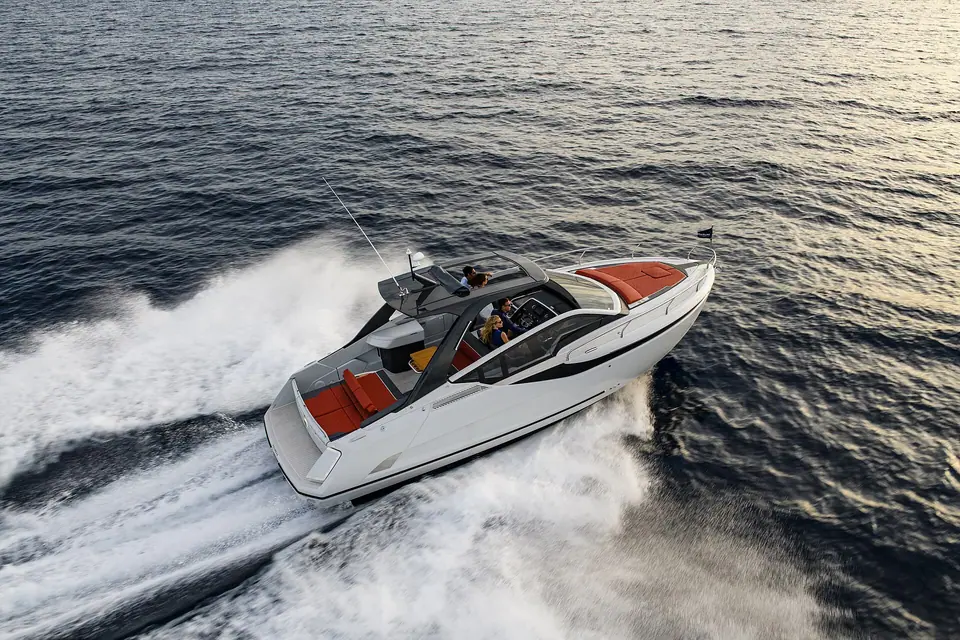
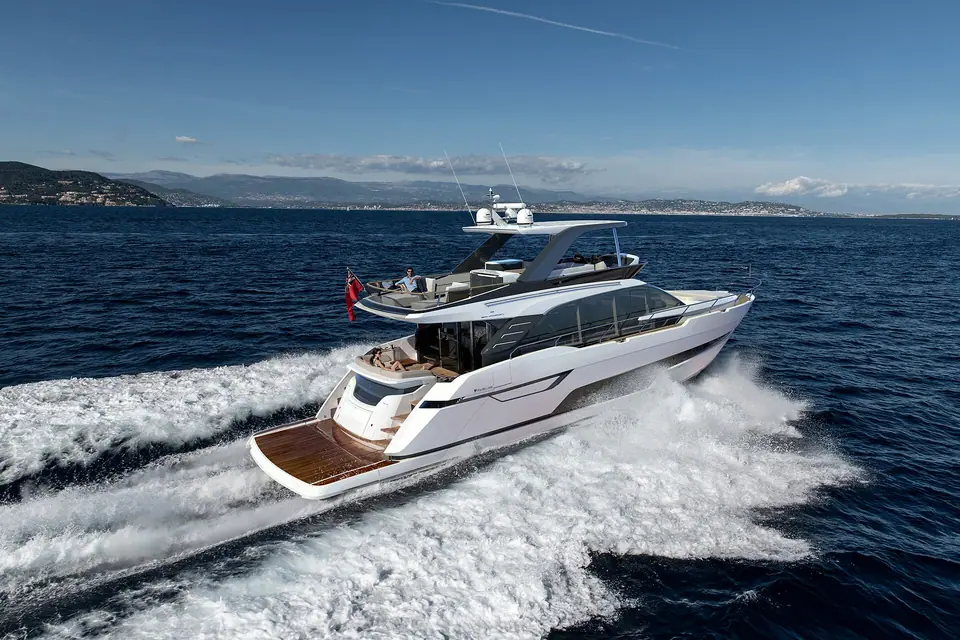
We have not found a freely licensed photo of the Fairline Phantom 40 yet, so these show other Fairline Yachts boats, each captioned with the boat pictured.
More motor yachts to explore
Meridian 391 Sedan
Motor Yachts, 41 ft
Used $165K to $285K
Azimut 40
Motor Yachts, 41 ft
Used $180K to $420K
Carver 396 Motor Yacht
Motor Yachts, 41 ft
Used $95K to $155K
Azimut 43
Motor Yachts, 42 ft
Used $230K to $400K
Other Fairline Yachts models
- Fairline F//Line 33
- Fairline Phantom 48
- Fairline Phantom 50
- Fairline Squadron 50
- Fairline Squadron 55
- Fairline Squadron 58
- Fairline Squadron 68
- Fairline Targa 29
- Fairline Targa 31
- Fairline Targa 33
- Fairline Targa 34
- Fairline Targa 37
- Fairline Targa 38
- Fairline Targa 40
- Fairline Targa 43
- Fairline Targa 44
- Fairline Targa 45 GT
- Fairline Targa 48
- Fairline Targa 52
- Fairline Targa 58 Gran Turismo
- All Fairline Yachts models