Absolute 56 Fly, Specs, Performance and Buying Advice
Two full-beam suites, a glass-fronted cockpit and a range that hardly changes between 16 knots and flat out, on a 57-foot-10-inch Italian flybridge.
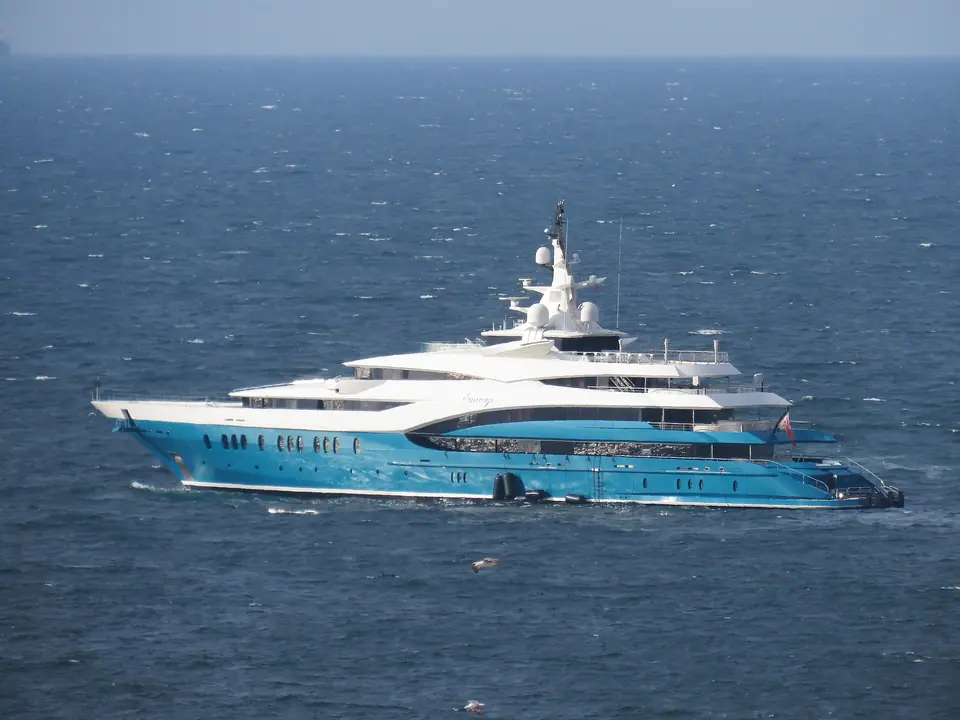
- Length
- 57.8 ft17.64 m
- Beam
- 15.8 ft4.79 m
- Cruise
- 20 kn
- Cabins
- 3 plus crew cabin
- Used price
- $720K to $2.6M
On this page
- Overview
- Why Absolute called it Charisma
- A profile built around structural glass
- Two full-beam suites on a 58-foot hull
- Galley aft, opening picture windows and a starboard helm
- Modular furniture on a bare cockpit and flybridge
- Twenty-eight knots and a nearly flat fuel curve
- IPS800 as standard, and the IPS950 alternative
- The 2013 to 2016 56 Fly and other 56 models
- What a new or nearly new 56 Fly costs
- Specifications
- Price and value
- Strengths and weaknesses
- Used buyer checklist
- Rivals
- Our verdict
- FAQ
The Absolute 56 Fly is a 17.64 m flybridge launched for 2022 with twin 600 hp Volvo IPS800 pods, an owner's suite in the bow, a full-beam VIP amidships and a crew cabin. 27.7 knots on test, about 240 nm at fast cruise.
- Two couples cruising together with equal cabins
- Owner-operators stepping into the 55 to 60 foot class
- Long weekends at anchor with minimal generator use
- Buyers who value range flexibility over top speed
Why Absolute called it Charisma
Absolute now gives each model a project name, and the absolute 56 fly is "The Absolute Charisma." Presented in September 2021 and shown at the Cannes Yachting Festival the following year, it slotted between the 60 Fly that launched the yard's new flybridge generation and the 52 Fly that followed. The name even turns up aboard: a motif of five stylized origami boats is laminated into one bottom corner of a saloon window, with no lettering at all.
MBY described the 56 as built on an all-new hull, albeit one that evolves Absolute's earlier designs, and it carries the same recipe as its siblings. The owner sleeps in the bow, the cockpit is a blank terrace for loose furniture, structural glass replaces much of the usual white fiberglass, and twin helms make shorthanded handling realistic. Yachting's verdict was that it gives more light, space and volume without the usual penalty in weight and range.
If you are researching an absolute 56 on the brokerage market, note that Absolute also built an earlier 56 Fly from 2013 to 2016 plus sport-style 56 models before that. They are covered at the end of this guide.
Absolute 56 Fly by the numbers
- Speed to length ratio at cruise
- 2.93A planing cruise. Fast passages in exchange for much higher fuel burn per mile.
- Estimated range at cruise
- 281 nmUsing 90 percent of tank capacity at the cruise speed and fuel burn listed on this page.
- Fuel economy at cruise
- 0.45 nmpgNautical miles per gallon at cruise, both engines combined.
- Horsepower per ton
- 41 hpStrong power to weight for a planing hull.
- Length to beam ratio
- 3.67 : 1A slim, easily driven hull.
A profile built around structural glass
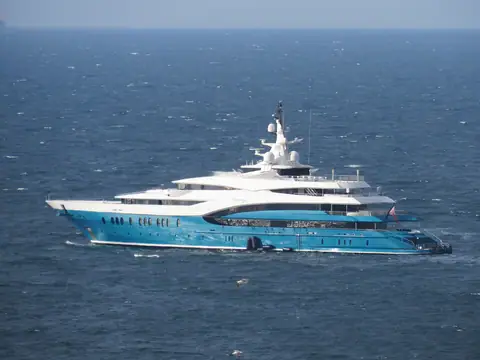
Yachting's reviewer likened the big forward hull windows to the eyes of a sea turtle, and they are the giveaway that the owner's suite is up front. Full-height side windows in the superstructure benefit from notched, cut-down bulwarks, and the aft deck has a fretted quarter rail. At the stern the hull appears to finish in a raked transom but does not; there is only a low transom to deck height, topped by a stainless rail and a glazed balustrade that separates the cockpit from the hydraulic platform.
The effect from inside is that seated guests look straight through the rail at the water, something conventional transoms block. From the dock the boat looks long and low for a flybridge, although a high foredeck is the price of the interior volume below it.
Two full-beam suites on a 58-foot hull
Absolute calls the VIP "as spacious as a second owner's cabin," and for once the brochure undersells it. The owner's suite occupies the full beam in the bow, with a forward-facing king, a walk-in closet and elevated windows, and it sits where engine noise is lowest and where Mediterranean-style stern-to neighbors cannot see in. The VIP, meanwhile, takes the full beam amidships with its own head, and Yachting noted some owners might choose it as their cabin.
The third cabin to starboard has two single berths and the same ceiling height as the others, with a full head across the companionway that doubles as the day head. A door in the back of that cabin's closet leads to a crawl space running over the keel from amidships to the bow thruster, a handy home for spares and long-term stores. Average headroom is a little over 6 feet 4 inches almost everywhere below.
Aft, the transom houses an en suite crew cabin with two transverse berths, reached through a pantograph door and half-hatch. It also gives access to the engine room through a watertight door, and on an owner-run boat it serves as a fourth cabin or a lazarette.
Galley aft, opening picture windows and a starboard helm
The saloon follows Absolute's aft-galley plan, with views out to port between the overhead cupboards and the worktop. Ahead of it, an amidships lounge with dinette leads to a pair of bucket seats at the starboard helm, where a side-deck door gives the skipper direct access to the deck. The center sections of the big picture windows open electrically, which lets fresh air through on mild days and reduces dependence on air conditioning at anchor.
Decor mixes light and dark stained oak in matte and satin finishes over an oak sole with a non-slip lacquer, and owners can extend the oak floors into the cabins in place of carpet. MBY rated both helm stations highly for ergonomics, with excellent visibility from the upper station despite the tall foredeck.
Modular furniture on a bare cockpit and flybridge
The cockpit terrace and most of the flybridge are left deliberately empty so owners can choose from Terraforma modular furniture designed for Absolute or bring their own, and the pieces can be rearranged into dining, lounging or sunbathing setups. The flybridge has a helm to port, a dinette, a wet bar and an open area aft. Solar panels on the optional hardtop deliver about 1.5 kW peak, enough to run TVs, fridges and freezers during the day without the generator, though not the air conditioning.
The raised foredeck adds a large sunpad and bench seating, and MBY found it the best spot aboard for breakfast at anchor.
Twenty-eight knots and a nearly flat fuel curve
Standard power is a pair of Volvo Penta D8 diesels on IPS800 pods at 600 hp each. Yachting reached 27 to 28 knots at half load with trim assist engaged; MBY recorded 27.7 knots in slight seas with less than half fuel and no tender. Under acceleration the bow rises to a maximum of about 3.5 degrees before easing back, steering is responsive and the boat heels just enough in turns to feel secure.
The 56's party piece is efficiency across a wide band. MBY found consumption virtually flat at 8 to 9 liters per nautical mile from 16 knots to full throttle. At 20 knots it burned 168 liters per hour, about 44 gph, for 248 nautical miles of range with a 20 percent reserve. At 22 to 23 knots fuel flow rose to about 195 liters per hour, still around 240 nautical miles. Slow to 9.6 knots and consumption falls to 44 liters per hour, roughly 11.6 gph, stretching range to about 454 nautical miles. Noise at 20 knots was 66 dB(A) at the helm.
Absolute rates the boat CE Category B and says it is built for offshore passages in winds up to 40 knots and seas to 13 feet. Neither magazine had rough water on test day, so a sea trial in a real chop is worth asking for.
IPS800 as standard, and the IPS950 alternative
At launch the 56 was offered only with IPS800s, which keeps service simple. Absolute's current specification sheet also lists twin D11 IPS950 pods at 725 hp each, so newer boats may carry the larger package; confirm which is fitted on any listing, because it changes fuel burn, top speed and resale. A Seakeeper 9 is the usual stabilizer. Other common options are Volvo's Dynamic Positioning System, a passerelle, the crew cabin and the hardtop, and Yachting's test boat, bound for Hong Kong, had none of them, which shows how much a 56 can vary in specification.
Absolute does final commissioning and most sea trials in Varazze on the Ligurian coast, about 100 miles from the Podenzano yard. US boats go through an American dealer, so check who commissioned a used boat and whether it got tropical air conditioning and 60 Hz shore power conversion.
The 2013 to 2016 56 Fly and other 56 models
The first 56 Fly ran from 2013 to 2016 and is a different boat: about 54 feet 8 inches long with a 15-foot-3-inch beam, a full-beam master amidships, the VIP in the bow, a side twin cabin with round portholes and a cockpit with a second table. YachtBuyer lists IPS600 pods as standard with D11 IPS800s optional, the latter good for up to 37 knots, and 449 gallons of fuel. Before that, Absolute sold sport-style 56 STY and 56 STC models, which are hardtop sport cruisers rather than flybridges.
Those older boats trade in a much lower bracket and appeal to a different buyer. If the listing year is before 2022, you are not looking at the boat reviewed here.
What a new or nearly new 56 Fly costs
Expect a US-delivered 56 Fly to cost roughly $2.4 million to $3 million new depending on options, and expect current-generation used boats from 2022 to 2025 to ask about $1.8 million to $2.6 million as they appear. Annual running costs typically fall between $90,000 and $150,000 for a 60-foot slip, insurance, IPS service, gyro, generator and air conditioning upkeep, bottom work and fuel, more if a captain is hired.
Absolute 56 Fly specifications
| Length overall | 57.8 ft17.64 m |
|---|---|
| Waterline length | 46.8 ft14.26 m |
| Beam | 15.8 ft4.79 m |
| Draft | 4.3 ft1.32 m |
| Displacement | 69,887 lbs31,7 kg |
| Fuel capacity | 687 gal2,6 L |
| Fresh water | 172 gal65 L |
| Cabins | 3 plus crew cabin |
| Berths | 6 plus 2 crew |
| Heads | 3 plus crew head |
| Maximum persons | 14 |
| Standard engines | 2 x Volvo Penta D8-IPS800 (600 hp each) |
| Optional engines | 2 x Volvo Penta D11-IPS950 (725 hp each), listed on Absolute's current specification |
| Maximum power | 1,450 hp |
| Cruise speed | 20 knots |
| Top speed | 27.7 knots |
| Range | 248 nm |
| Hull type | All-new planing hull for IPS pod drives |
| Hull construction | GRP (fiberglass) with bonded structural grid |
| CE design category | B |
| Builder | Absolute Yachts, Italy |
| Naval architect | Absolute Yachts in-house design team |
| Production | 2022 to present |
| Status | In production |
Figures come from builder documentation and independent tests where available. Displacement is usually quoted light, so a loaded cruising boat will weigh more. Compare these specs with another model.
How much does a Absolute 56 Fly cost?
Motor Boat & Yachting quoted a base of 1.45 million pounds before VAT at launch and about 1.7 million pounds with Mediterranean-friendly options, which puts a US-commissioned boat with gyro, hardtop, solar, tropical air conditioning and the crew cabin around $2.4 million to $3 million. Few current-generation 56s have reached US brokerage yet, so used values are estimates anchored to new pricing. The 2013 to 2016 boat with the same name is a far cheaper, older design.
Estimate your yearly cost
A planning estimate using common rules of thumb: insurance near 1.5 percent of value, maintenance near 3 percent, haul out and bottom paint by length. Your marina, region and use will move these numbers. Open the full cost calculator.
Absolute 56 Fly timeline
- 2013First-generation 56 Fly launched with a midships master
- 2016First-generation 56 Fly leaves production
- 2021Absolute presents the new 56 Fly, The Absolute Charisma
- 2022Public debut at the Cannes Yachting Festival; Best of Boats finalist
- 2023Motor Boat Awards finalist and European Powerboat of the Year nominee
Strengths and weaknesses
What owners like
- Owner's suite in the bow plus a full-beam VIP amidships
- Range nearly identical from 16 knots to top speed
- Opening saloon windows and solar hardtop for quiet anchoring
- En suite crew cabin with engine room access
- Clever keel crawl space for stores
- Strong helm ergonomics on both stations
What to weigh up
- Not fast for the class at about 28 knots
- Hull slap is more noticeable in a forward owner's cabin
- Tall foredeck and turtle-eye windows divide opinion
- Few US used examples to compare yet
- Engine package may vary on newer boats, complicating comparisons
Used Absolute 56 Fly buyer checklist
Take this list to a viewing. Your ticks are saved in this browser so you can come back to it.
Always commission an independent marine survey and an engine survey before you buy. How a marine survey works.
Rivals to consider
Princess F55
British flybridge with sharper handling and strong resale but a conventional midships master.
Compare side by sideGaleon 560 Fly
Polish rival with fold-out terraces and lots of equipment for the money.
Compare side by sideAzimut 55
Italian flybridge with a sportier profile and a more traditional interior plan.
Compare side by sideFairline Squadron 58
British alternative with shaft drives and a classic three-cabin layout.
Compare side by sideOur verdict on the Absolute 56 Fly
The Absolute 56 Fly is about space and light first, and on both counts it beats most 55- to 60-foot flybridges. Two genuinely equal suites, an en suite crew cabin, a cockpit that opens to the sea through glass and a fuel curve that lets you cruise at 16 or 26 knots for about the same range make it a very easy boat to live with. It is not quick and the styling will not please everyone, but for owners who cruise with another couple and dock their own boat, it is one of the most thoughtfully planned yachts in its size.
Absolute 56 Fly questions answered
How fast is the Absolute 56 Fly?
MBY recorded 27.7 knots and Yachting saw 27 to 28 knots with twin IPS800s. Typical cruise is 20 to 24 knots.
What does an Absolute 56 Fly cost?
A new US-delivered boat runs roughly $2.4 million to $3 million with typical options. The earlier 2013 to 2016 56 Fly sells for far less, usually under $1 million.
What is the range of the Absolute 56 Fly?
About 248 nautical miles at 20 knots and 454 nautical miles at 9.6 knots, both with a 20 percent reserve, from 687 gallons.
Where is the master cabin on the Absolute 56 Fly?
In the bow, full beam, with a full-beam VIP amidships and a twin cabin to starboard.
Does the Absolute 56 Fly have a crew cabin?
Yes. An en suite crew cabin with two berths sits in the transom and connects to the engine room.
What engines are available on the 56 Fly?
Twin 600 hp Volvo D8 IPS800 pods are standard, and Absolute's current spec sheet also lists twin 725 hp D11 IPS950s.
More motor yachts to explore
Princess F55
Motor Yachts, 58 ft
Used $1.35M to $2.7M
Bavaria R55
Motor Yachts, 58 ft
Used $760K to $1.1M
Galeon 550 Fly
Motor Yachts, 58 ft
Used $550K to $1.4M
Hatteras 58 Motor Yacht
Motor Yachts, 58 ft
Used $60K to $380K