Fairline Phantom 48 Review and Secondhand Value Guide
A late-2000s British flybridge with one engine choice, twin 575 hp Volvo D9s, a quiet ride and a galley tucked below the saloon.
- Length
- 47.6 ft14.5 m
- Beam
- 14.7 ft4.46 m
- Cruise
- 3.7 ft1.12 m
- Cabins
- 3
- Used price
- $330K to $520K
On this page
- Overview
- Fairline Phantom 48: the straight-lined Phantom
- How Fairline built it
- On test off South Florida
- Why the galley stayed down
- The flybridge and its one blind spot
- Phantom 48 or Phantom 50?
- Finding and valuing a Phantom 48
- Specifications
- Price and value
- Strengths and weaknesses
- Used buyer checklist
- Rivals
- Our verdict
- FAQ
The Fairline Phantom 48 (2006 to 2010) is a three-cabin shaft-drive flybridge on an Olesinski hull. Power & Motoryacht measured 31.7 knots and 60 gph at full throttle with its only engine option, twin Volvo D9-575s.
- Families wanting three cabins in under 50 feet
- Owners who value build quality and quiet
- Coastal cruisers rather than long-range passagemakers
- Buyers who prefer a galley separate from the saloon
Fairline Phantom 48: the straight-lined Phantom
The Fairline Phantom 48 arrived in the second half of the 2000s as the newest member of Fairline's family flybridge line, slotted below the larger, galley-up Phantom 50. YachtBuyer lists production from 2006 to 2010, which makes it one of the last Phantoms before the builder folded all its flybridges into the Squadron range. It is a three-cabin, two-head, shaft-drive boat with a single engine package, twin 575 hp Volvo Penta D9 diesels.
Power & Motoryacht's tester, who had cut his teeth on a Phantom 43 in 2000, summed up what changed in seven years. The curves and radiuses of the earlier Phantoms gave way to straight lines and right angles in the settees and cabinetry, which frees floor space and makes the saloon feel bigger. The joinery, he thought, was as good as ever and perhaps better.
Fairline Phantom 48 by the numbers
- Displacement hull speed
- 8.6 knThe efficient cruising speed for a displacement hull of this waterline.
- Length to beam ratio
- 3.24 : 1Moderate proportions.
How Fairline built it
The test report gives a rare look at the structure. Fairline started with a hand-laid solid fiberglass bottom, then added a grid of full-length foam-cored stringers and transverse frames spaced about every two and a half feet. The hull and deck were joined chemically and mechanically, then glassed over with a 3 inch overlap of cloth and resin, a structure Fairline called a monocoque and the tester called rock solid.
The bottom is a Bernard Olesinski modified-V with 18 degrees of deadrise at the transom, the designer's standard formula for Fairlines and Princesses of the period. Running gear on the test boat was ZF gearboxes at 1.75 to 1 turning 24 by 34 inch four-blade manganese bronze propellers, with SeaStar power-assisted steering and Clements fin-shaped rudders.
On test off South Florida
Power & Motoryacht ran the boat on flat summer water off South Florida. With the D9s turning 2,520 rpm, within 20 rpm of their rating, the boat reached 36.5 mph, which is 31.7 knots, burning 60 gallons per hour for 0.61 miles per gallon. With 440 gallons of fuel, that works out to about 241 statute miles, roughly 209 nautical miles, at full throttle. The magazine did not publish a cruise-speed fuel curve, so plan on more range at a mid-20s cruise but do not expect long legs.
Handling impressed the tester. The 48 turned within about two boat lengths at wide-open throttle with modest effort, heeled slightly to moderately in hard turns, lost only about 100 rpm and recovered quickly. Sound peaked at 77 dBA at the upper helm, quiet for a twin-diesel flybridge at full power.
- Top speed 31.7 knots (36.5 mph) at 2,520 rpm
- 60 gph at wide open throttle, 0.61 mpg
- Fuel 440 US gal, water 132 US gal
- Max 77 dBA at the upper helm
Why the galley stayed down
In 2007 many builders were moving galleys up onto the main deck. Fairline kept the Phantom 48's galley down, a few steps forward of the saloon, and the tester thought it worked: the space is bathed in light from the overhanging windshield and long side windows, yet within conversational range of the saloon and helm. The Phantom 50 offered the galley-up alternative for buyers who wanted it.
The saloon has an L-shaped settee to port, U-shaped seating with a hi-lo table to starboard, a big stainless and glass sliding door to the cockpit and a raked windshield that gives near 360-degree visibility from the lower helm. Joinery was high-gloss American cherry, with white oak offered and popular on European boats. YachtBuyer lists three cabins sleeping up to seven guests, with two VacuFlush heads in the standard specification.
The flybridge and its one blind spot
The open flybridge, reached by teak steps from the cockpit, is the boat's social space, with a large seating area on the overhang aft of the helm. That seating has a cost: backing into a slip, the tester could not see the starboard aft quarter, and only by craning toward the port steps could he see the port corner of the teak swim platform. A cockpit camera or a crew member calling distances is essential.
Standard equipment for the US market was generous: an 8 hp Side Power bow thruster, a 7 kW Onan generator, Lenco trim tabs, a four-burner electric cooktop, microwave, teak cockpit sole and platform, and even Fairline-crested tableware. Options on the test boat ran to twin Raymarine E120 plotters, autopilots, a flybridge ice maker and grill, a washer-dryer and leather upholstery.
Phantom 48 or Phantom 50?
The two boats overlapped on the market and appeal to different owners. The Phantom 50, built from 2000 to 2008, is longer and heavier with a galley-up main deck and bigger D12 engines; the 48 is newer, more linear in its styling and keeps the galley below. If you want the more modern interior and a later build year, the 48 is the pick. If you entertain on the main deck and want the extra length, look at the 50.
Both are shaft-drive Olesinski hulls with Volvo power, so engine support is straightforward. The 48's single engine package also simplifies the search: every boat should have D9-575s, and any listing claiming otherwise deserves a closer look.
Finding and valuing a Phantom 48
Phantom 48s are scarce. YachtBuyer's market data recorded five listings worldwide in three years, mainly in the UK, with boats spending about 315 days on the market on average. That rarity cuts both ways: there is little competition between sellers, but you may wait to find the right boat. We estimate most will trade between about $330,000 and $520,000, depending on hours, upgrades and whether the boat was built to US specification.
Plan on $30,000 to $55,000 a year to run one, including a 50 foot slip, insurance, haul-out, and service on two D9s and the generator. D9s are well supported by Volvo Penta dealers in the US, which helps a boat whose builder has changed ownership several times since it was built.
Fairline Phantom 48 specifications
| Length overall | 47.6 ft14.5 m |
|---|---|
| Beam | 14.7 ft4.46 m |
| Draft | 3.7 ft1.12 m |
| Fuel capacity | 44 gal1,666 L |
| Fresh water | 132 gal5 L |
| Cabins | 3 |
| Berths | 6, up to 7 |
| Heads | 2 |
| Standard engines | 2 x Volvo Penta D9 575 hp, straight shafts |
| Maximum power | 1,150 hp |
| Top speed | 31.7 knots |
| Range | 209 nm |
| Hull type | Modified-V planing hull, 18 degrees deadrise at the transom |
| Hull construction | Hand-laid solid GRP bottom with foam-cored stringer grid |
| Builder | Fairline Boats, United Kingdom |
| Naval architect | Bernard Olesinski |
| Other design credits | Fairline in-house design team |
| Production | 2006 to 2010 |
| Status | Discontinued |
Figures come from builder documentation and independent tests where available. Displacement is usually quoted light, so a loaded cruising boat will weigh more. Compare these specs with another model.
How much does a Fairline Phantom 48 cost?
Power & Motoryacht's 2007 test boat, the first US hull, was priced at $1,303,515 with $84,565 of options and $18,950 of make-ready. Few Phantom 48s come to market, and YachtBuyer recorded only five listings worldwide over three years, mostly in the UK. US-spec 60 Hz boats with recent engine service, a good bimini and electronics command the top of the range.
Estimate your yearly cost
A planning estimate using common rules of thumb: insurance near 1.5 percent of value, maintenance near 3 percent, haul out and bottom paint by length. Your marina, region and use will move these numbers. Open the full cost calculator.
Fairline Phantom 48 timeline
- 2006Phantom 48 enters production, per YachtBuyer
- 2007Power & Motoryacht tests hull 3, the first US boat
- 2009Fairline announces that future flybridges will carry the Squadron name
- 2010Phantom 48 production ends
Strengths and weaknesses
What owners like
- 31.7 knots measured with twin D9-575s
- Quiet at speed, 77 dBA at the upper helm
- Solid hand-laid bottom and stringer grid
- Three cabins in a 48 footer
- Light-filled galley-down layout with good lower-helm visibility
- Generous standard equipment on US boats
What to weigh up
- Range of only about 209 nm at full throttle
- Blind starboard aft quarter from the flybridge helm
- Single engine option means no economy package
- Rare on the market, especially in the US
- Galley down will not suit every owner
Used Fairline Phantom 48 buyer checklist
Take this list to a viewing. Your ticks are saved in this browser so you can come back to it.
Always commission an independent marine survey and an engine survey before you buy. How a marine survey works.
Rivals to consider
Fairline Phantom 50
Longer, galley-up sibling with D12 power and a longer production run.
Compare side by sidePrincess 50
The obvious British rival with a similar Olesinski hull and three-cabin layout.
Azimut 47
Italian flybridge with more flamboyant styling and a different interior feel.
Compare side by sideSunseeker Manhattan 50
Sportier-looking British flybridge with strong brand recognition.
Our verdict on the Fairline Phantom 48
The Fairline Phantom 48 is a quietly excellent late-2000s flybridge that has slipped under many buyers' radar. Its build is genuinely solid, it runs past 31 knots on its only engine package and it is quiet and nimble for its size. The galley-down plan, modest range and blind aft quarter are real limitations, and finding one takes patience. But a well-kept example offers three cabins and pre-recession Fairline quality at a fraction of a new boat's price.
Fairline Phantom 48 questions answered
How fast is the Fairline Phantom 48?
Power & Motoryacht measured 36.5 mph, which is 31.7 knots, at 2,520 rpm with twin 575 hp Volvo Penta D9s.
What engines does the Fairline Phantom 48 have?
Twin 575 hp Volvo Penta D9 diesels on straight shafts, the only engine package offered.
How many cabins does the Phantom 48 have?
Three cabins with two heads, sleeping six and up to seven guests.
What years was the Fairline Phantom 48 built?
YachtBuyer dates production from 2006 to 2010; the first US boat was tested in 2007.
How much fuel does a Phantom 48 burn?
About 60 gph at wide open throttle; it carries 440 US gallons of fuel for roughly 209 nautical miles at that speed.
Photos from the Fairline Yachts range
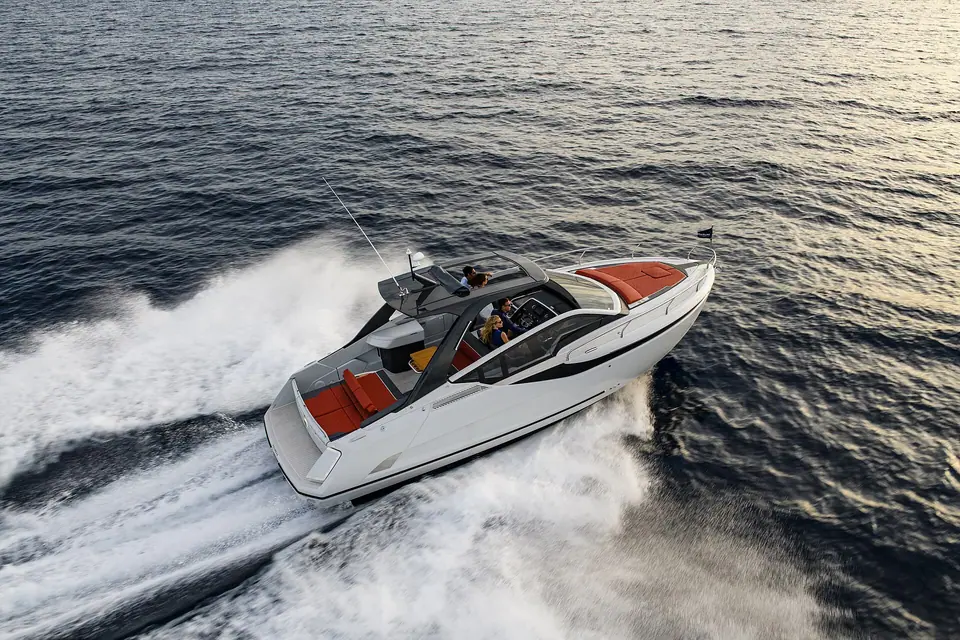
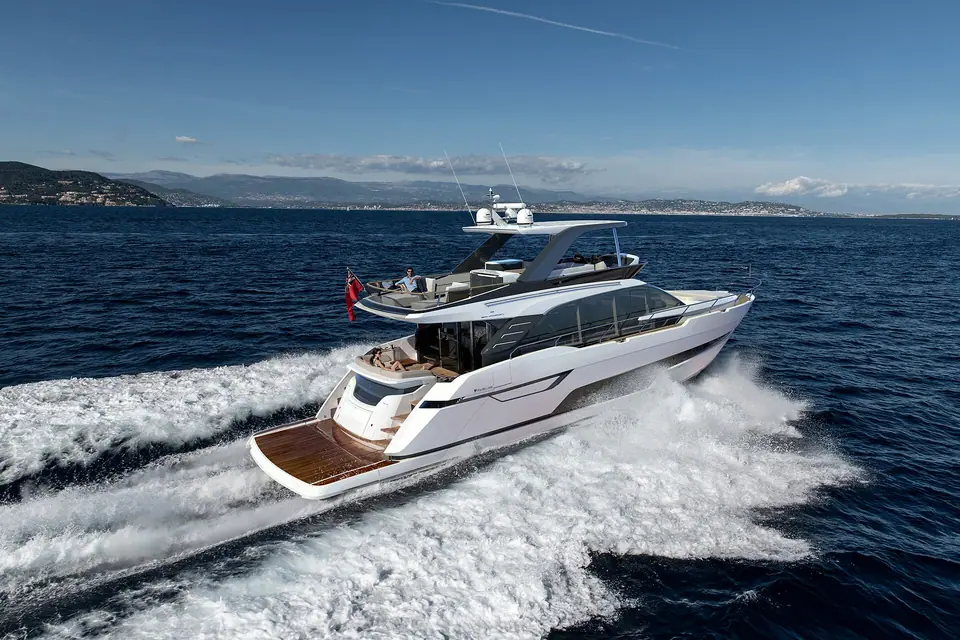
We have not found a freely licensed photo of the Fairline Phantom 48 yet, so these show other Fairline Yachts boats, each captioned with the boat pictured.
More motor yachts to explore
Carver 445 Aft Cabin
Motor Yachts, 48 ft
Used $120K to $190K
Azimut 47
Motor Yachts, 47 ft
Used $330K to $460K
Bayliner 4788 Pilothouse
Motor Yachts, 47 ft
Used $145K to $295K
Meridian 441 Sedan Bridge
Motor Yachts, 47 ft
Used $250K to $600K
Other Fairline Yachts models
- Fairline F//Line 33
- Fairline Phantom 40
- Fairline Phantom 50
- Fairline Squadron 50
- Fairline Squadron 55
- Fairline Squadron 58
- Fairline Squadron 68
- Fairline Targa 29
- Fairline Targa 31
- Fairline Targa 33
- Fairline Targa 34
- Fairline Targa 37
- Fairline Targa 38
- Fairline Targa 40
- Fairline Targa 43
- Fairline Targa 44
- Fairline Targa 45 GT
- Fairline Targa 48
- Fairline Targa 52
- Fairline Targa 58 Gran Turismo
- All Fairline Yachts models