Azimut 39 Review and Used Buying Guide
A 40-foot Righini flybridge with teardrop windows, two en suite cabins and Caterpillar diesels, now one of the cheapest ways into an Italian flybridge.
- Length
- 40 ft12.22 m
- Beam
- 13.3 ft4.06 m
- Cruise
- 28 kn
- Cabins
- 2 (double forward, twin amidships)
- Used price
- $140K to $230K
On this page
- Overview
- The Azimut 39 in brief, a small flybridge built like a bigger one
- Righini's teardrop eyes and that sculpted saloon ceiling
- Two cabins, two heads and a full dinner service in a drawer
- Caterpillar 3126 power and what the prototype really did
- Original 39 or 39 Evolution, how to tell them apart
- Living with a combined engine room and lazarette
- What an Azimut 39 for sale costs in 2026
- Where the 39 fits in Azimut's small flybridge family
- Specifications
- Price and value
- Strengths and weaknesses
- Used buyer checklist
- Rivals
- Our verdict
- FAQ
The Azimut 39 is a two-cabin flybridge built from 1998, later updated as the 39 Evolution with Cummins QSB 5.9 engines. Expect about 28 knots cruise and used prices from roughly $140,000.
- First-time flybridge owners on a budget
- Couples with occasional guests
- Coastal weekend cruising and island hopping
- Buyers who value classic Italian styling over the latest features
Azimut 39 by the numbers
- Speed to length ratio at cruise
- 4.75A planing cruise. Fast passages in exchange for much higher fuel burn per mile.
- Horsepower per ton
- 59 hpStrong power to weight for a planing hull.
- Length to beam ratio
- 3.00 : 1Moderate proportions.
The Azimut 39 in brief, a small flybridge built like a bigger one
The Azimut 39 was the entry ticket to the Azimut flybridge range at the turn of the millennium. YachtBuyer dates the first generation from 1998, and Motor Boat & Yachting's test of the prototype was written while British buyers were still converting sterling into lire, which places it right at the start of that run. Azimut kept the boat going until a revised 39 Evolution arrived in 2006, and the company's website still listed a 39E page as late as 2012.
What made the 39 stand out then, and what still makes it worth a look now, is that Azimut refused to shrink everything when it shrank the boat. MBY's tester, who had the whole range from the 39 to the 58 lined up at Lavagna, noted side decks wide enough to walk past the superstructure without turning sideways, deep toerails, a cockpit as deep as the bigger models and oversized cleats feeding stern lines through stainless fairleads lifted straight from the Quarantasei 46.
For a US buyer in 2026, an Azimut 39 is a 25-year-old Italian 40-footer that typically costs less than a new 30-foot express. That can be a bargain or a trap, and most of this guide is about telling the two apart.
Righini's teardrop eyes and that sculpted saloon ceiling
Stefano Righini styled the exterior around the eye motif Azimut had introduced on the AZ54 in 1994: two small teardrop windows that seem to look out from behind the main saloon glass. It is the easiest way to spot a 39 across a marina, and it also lets a lot of light into the saloon. Azimut bonded the tempered glass directly into the GRP and fitted electrically operated side windows, which were a genuine luxury on a boat this size at the time.
Inside, Carlo Galeazzi's trick was the overhead lining. Instead of a flat panel hiding wires, Azimut molded a flowing headliner that integrates the windshield mullions, lighting, pelmets and even the window motors. MBY called it the boat's trump card, and it still makes a 39 feel more expensive than its contemporaries once you are aboard. The weak spot is age: these moldings and their vinyl or fabric facings sag and discolor after two decades, and replacing them properly is fiddly work.
Two cabins, two heads and a full dinner service in a drawer
Below decks the 39 follows the classic formula for its size: an owner's double in the bow and a twin cabin amidships, each with its own head compartment. MBY singled out the length of the forward berth for tall owners and the big rooflight in the heads, though it found the head itself plain, with a blue basin as the only splash of color. Azimut's brochure lists four berths and a maximum capacity of 12 persons.
The saloon combines a dinette, galley and lower helm on one level. A neat touch on new boats was a drawer holding a full set of crockery, cutlery and glasses for six. Stowage is adequate for weekends rather than long cruises; the tester suggested adding shelves to the shallow lockers under the galley sinks. The lower helm sits high and close to the bow with good sightlines, and the electric side windows are low enough that the skipper does not feel boxed in, but the helm seat is fixed and only the wheel adjusts.
- Forward double with en suite head and a long berth
- Amidships twin with its own head
- Open saloon with dinette, galley and lower helm
- Flybridge with crescent seating for four and a large sunpad
Caterpillar 3126 power and what the prototype really did
Azimut's 2002 specification lists twin 355 mhp Caterpillar 3126 DITA diesels as the standard installation, with a claimed 32 knots maximum and 28 knots cruising at half load. The hull is a deep V with variable deadrise, 17 degrees at the transom according to the brochure, with longitudinal strakes and four-blade propellers set in semi-tunnels to keep draft to about 3 feet 7 inches.
Real numbers are a little lower. MBY's prototype ran the smaller Caterpillar 3116TA engines at their 325 hp rating and reached 28.8 knots, and the magazine estimated that the 350 hp option would deliver about 30 knots. Range with a 20 percent reserve hovered around 200 miles whatever the speed, because the 264-gallon tank is modest. In a choppy Force 4 the 39 handled head, following and beam seas with reasonable ease, and the steering took six turns lock to lock, which is normal for the period.
On the used market you will find both Caterpillar families. The 3126 is the better engine to own today because parts and technicians are easier to find, but any Cat of this age needs its aftercoolers, heat exchangers and turbochargers checked rather than assumed.
Original 39 or 39 Evolution, how to tell them apart
YachtBuyer splits the model into two generations: the original 39 from 1998 to 2006 and the 39 Evolution from 2006 to 2008. Azimut's later 39E specification gives 39 feet 10 inches overall, a 13-foot 2-inch beam, 14.6 tonnes at full load and twin Cummins QSB 5.9 engines of 355 mhp, with 30 knots maximum and 27 knots cruising. Tankage stayed at 1,000 liters of fuel and 500 liters of water.
The quickest check is the engine room. Caterpillar blocks mean an original boat or an early repower; common-rail Cummins QSB 5.9 engines mean an Evolution. Ask for the hull identification number, because the model year on a listing and the build year are not always the same on Italian boats sold through dealers. In our estimate, Evolution boats ask a premium of 15 to 25 percent over comparable originals, which is fair if the engines have low hours, since the Cummins are lighter and simpler to service in the US.
What an Azimut 39 for sale costs in 2026
Azimut 39s are relatively scarce in the US, and most of the few listings we found were in Europe. A recent Mediterranean listing for a 2001 boat with twin Caterpillars asked about $168,000, and that is a fair mid-point for a tidy first-generation example. Expect roughly $140,000 to $190,000 for originals and $185,000 to $230,000 for a well-kept 39 Evolution. Importing a European boat adds shipping, duty and a US electrical review, so a slightly dearer boat already in Florida can be the cheaper buy.
Running costs are those of any twin-diesel 40-footer: dockage, insurance, haul-out and antifouling, engine service and the occasional canvas or upholstery job. Budget around $28,000 to $50,000 a year before fuel and depreciation, more if you keep the boat in a premium Northeast or South Florida marina.
Where the 39 fits in Azimut's small flybridge family
The 39 sat below the Azimut 42 of 1999, which shared its Righini styling and Caterpillar power. It was followed by a beamier Azimut 40 tested in 2005, then by the Azimut 43 and, from 2009, the narrower Azimut 38 and its 40S sport sister. If you want the 39's look with more room, the 42 is the natural step up; if you want something newer and smaller, the 38 is the modern equivalent.
Azimut 39 specifications
| Length overall | 40 ft12.22 m |
|---|---|
| Beam | 13.3 ft4.06 m |
| Draft | 3.6 ft1.1 m |
| Air draft | 14.4 ft4.4 m |
| Displacement | 24,251 lbs11, kg |
| Fuel capacity | 264 gal1, L |
| Fresh water | 132 gal5 L |
| Cabins | 2 (double forward, twin amidships) |
| Berths | 4 |
| Heads | 2 |
| Maximum persons | 12 |
| Standard engines | 2 x Caterpillar 3126 DITA, 355 mhp each (original 39) |
| Optional engines | Caterpillar 3116TA at 325 or 350 hp on early boats; 2 x Cummins QSB 5.9 355 mhp on the 39 Evolution |
| Maximum power | 710 hp |
| Cruise speed | 28 knots |
| Top speed | 32 knots |
| Hull type | Deep-V planing hull, variable deadrise, 17 degrees at the transom, props in semi-tunnels |
| Hull construction | GRP with PVC foam-cored hull supports and superstructure |
| Builder | Azimut Yachts (Azimut Benetti Group), Italy |
| Naval architect | Azimut in-house, exterior styling and concept by Stefano Righini |
| Other design credits | Carlo Galeazzi (interior) |
| Production | 1998 to 2008 |
| Status | Discontinued |
Figures come from builder documentation and independent tests where available. Displacement is usually quoted light, so a loaded cruising boat will weigh more. Compare these specs with another model.
How much does a Azimut 39 cost?
Most Azimut 39s on the market are first-generation boats with Caterpillar 3126 engines, and a 2001 example was recently asked at about $168,000 in Spain. The Cummins-powered 39 Evolution of 2006 onward sits at the top of the range. Engine hours, the condition of the teak and flybridge upholstery, and whether the boat has had its electronics renewed move prices far more than the model year does.
Estimate your yearly cost
A planning estimate using common rules of thumb: insurance near 1.5 percent of value, maintenance near 3 percent, haul out and bottom paint by length. Your marina, region and use will move these numbers. Open the full cost calculator.
Versions and options
- Azimut 39 (1998 to 2006)
- 40 feet overall including pulpit, 13-foot 4-inch beam, twin Caterpillar 3126 DITA at 355 mhp (early boats Caterpillar 3116TA), 32 knots maximum and 28 knots cruise claimed, 264 gallons fuel.
- Azimut 39 Evolution or 39E (2006 to 2008, still listed in 2012)
- 39 feet 10 inches overall, 13-foot 2-inch beam, 14.6 tonnes at full load, twin Cummins QSB 5.9 at 355 mhp, 30 knots maximum and 27 knots cruise, same tankage.
Azimut 39 timeline
- 1998Azimut 39 introduced as the smallest model of the flybridge range (YachtBuyer)
- Late 1990sMotor Boat & Yachting tests the prototype at Lavagna, 28.8 knots on 325 hp Caterpillar 3116TA engines
- 2002Azimut's specification lists twin 355 mhp Caterpillar 3126 DITA as standard
- 200639 Evolution arrives with Cummins QSB 5.9 engines
- 2012Azimut's website still carries a 39E specification page
Strengths and weaknesses
What owners like
- Wide side decks, deep toerails and big-boat deck hardware
- Distinctive Righini styling with the teardrop window motif
- Two cabins, each with its own head
- Shallow 3-foot 7-inch draft suits the Bahamas and Chesapeake
- Among the cheapest Italian flybridges on the market
- Cockpit access to a well-laid-out machinery space
What to weigh up
- No separate lazarette, stowage shares space with the engines
- Fixed lower helm seat and an upright flybridge seat back
- Small 264-gallon fuel tank limits range to around 200 miles
- Original Caterpillar boats are now 20 to 28 years old
- Relatively few examples in US waters
Used Azimut 39 buyer checklist
Take this list to a viewing. Your ticks are saved in this browser so you can come back to it.
Always commission an independent marine survey and an engine survey before you buy. How a marine survey works.
Rivals to consider
Fairline Phantom 40
Slimmer British flybridge with a separate lazarette and sharper handling.
Compare side by sidePrincess 40
Deeper-V British alternative with a strong UK and US dealer network.
Sealine F37
Cheaper British flybridge of the same era, usually on Volvo diesels.
Azimut 42
The next Azimut up, launched in 1999 with the same styling and more room.
Compare side by sideOur verdict on the Azimut 39
Buy an Azimut 39 for the way it is put together rather than for its spec sheet. Twenty-five years on, the wide decks, proper cleats, bonded glass and that sculpted saloon still feel a cut above most 40-footers of its age, and the shallow draft makes it an easy boat to use on the East Coast. The catch is that you are buying old Caterpillars, an aging foam-cored structure and a headliner that will eventually need attention, all on a boat with limited range. Pay for a good survey and an engine specialist, favor a 39 Evolution if the budget stretches, and walk away from cheap boats with vague service records.
Azimut 39 questions answered
How much is an Azimut 39 worth?
Most Azimut 39s ask between about $140,000 and $230,000 in 2026. Early Caterpillar boats sit at the bottom of that range and well-kept 39 Evolution models with Cummins engines at the top.
What engines does the Azimut 39 have?
The original 39 was fitted with twin 355 mhp Caterpillar 3126 DITA diesels, and early boats ran Caterpillar 3116TA engines. The 39 Evolution switched to twin 355 mhp Cummins QSB 5.9 engines.
How fast is the Azimut 39?
Azimut claimed 32 knots maximum and 28 knots cruise with the Caterpillar 3126 engines. Motor Boat & Yachting reached 28.8 knots on the prototype with 325 hp engines.
Is there an Azimut 39 Fly for sale in the US?
Yes, but they are uncommon, and most current listings are in Europe. Expect to search nationally or consider importing, and allow for shipping, duty and a US electrical review.
How many people can sleep on an Azimut 39?
Four in two cabins, a forward double and an amidships twin, each with its own head. Azimut rated the boat for up to 12 people on board during the day.
What is the difference between the Azimut 39 and 39E?
The 39E, or 39 Evolution, from 2006 has Cummins QSB 5.9 engines in place of Caterpillars and slightly revised dimensions. It is quoted at 30 knots maximum versus 32 for the original.
Photos from the Azimut Yachts range
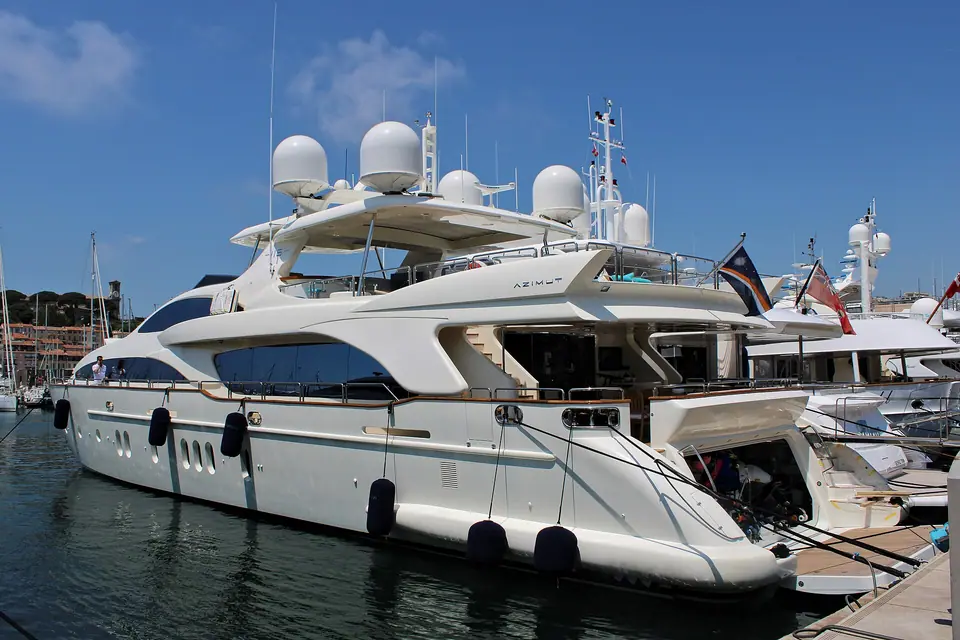
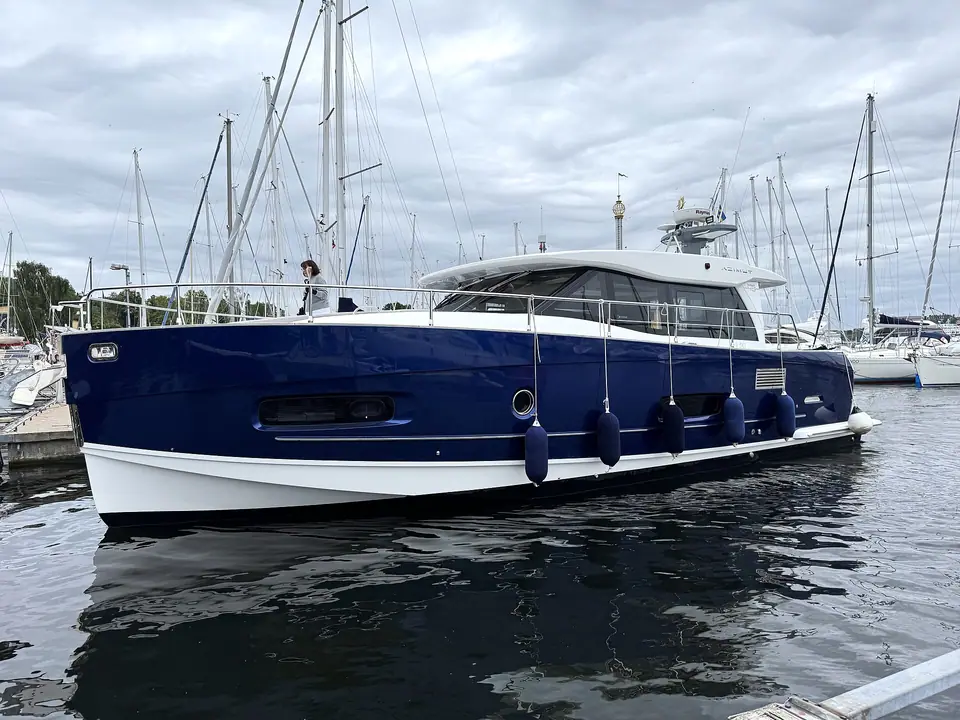
We have not found a freely licensed photo of the Azimut 39 yet, so these show other Azimut Yachts boats, each captioned with the boat pictured.
More motor yachts to explore
Carver 396 Motor Yacht
Motor Yachts, 41 ft
Used $95K to $155K
Azimut 38
Motor Yachts, 39 ft
Used $280K to $450K
Azimut 40
Motor Yachts, 41 ft
Used $180K to $420K
Meridian 391 Sedan
Motor Yachts, 41 ft
Used $165K to $285K
Other Azimut Yachts models
- Azimut 38
- Azimut 40
- Azimut 40S
- Azimut 42
- Azimut 43
- Azimut 43S
- Azimut 45
- Azimut 46
- Azimut 47
- Azimut 48
- Azimut 50 Fly
- Azimut 52 Fly
- Azimut 54
- Azimut 55 Evolution
- Azimut 55 Fly
- Azimut 55S
- Azimut 58 Flybridge
- Azimut 60 Flybridge
- Azimut 62 Flybridge
- Azimut 62S
- Azimut 64 Flybridge
- Azimut 66 Flybridge
- Azimut 68
- Azimut 70 Flybridge
- Azimut 72S
- Azimut 75
- Azimut 77S
- Azimut 80
- Azimut 82
- Azimut 84
- Azimut 85
- Azimut 86S
- Azimut 88
- Azimut 95
- Azimut 98 Leonardo
- Azimut 100 Jumbo
- Azimut 103S
- Azimut 105
- Azimut 116
- Azimut Atlantis 34
- Azimut Atlantis 43
- Azimut Atlantis 44
- Azimut Atlantis 45
- Azimut Atlantis 48
- Azimut Atlantis 50
- Azimut Atlantis 51
- Azimut Atlantis 55
- Azimut Atlantis 58
- Azimut Fly 53
- Azimut Fly 62
- Azimut Fly 72
- Azimut Fly 78
- Azimut Grande 25 Metri
- Azimut Grande 26M
- Azimut Grande 27 Metri
- Azimut Grande 30 Metri
- Azimut Grande 32 Metri
- Azimut Grande 35 Metri
- Azimut Grande 36M
- Azimut Grande S10
- Azimut Magellano 43
- Azimut Magellano 53
- Azimut Magellano 66
- Azimut Magellano 76
- Azimut S6
- Azimut S7
- Azimut S8
- Azimut Verve 42
- Azimut Verve 47
- All Azimut Yachts models