Fairline Phantom 50 Specs, Sea Trial and Used Market
126 boats, eight years, one well-judged formula: galley up, three cabins below and an Olesinski hull that shrugs off a Florida northeaster.
- Length
- 51.8 ft15.8 m
- Beam
- 14.8 ft4.5 m
- Cruise
- 29 kn
- Cabins
- 3 (optional crew cabin aft)
- Used price
- $280K to $420K
On this page
- Overview
- Fairline Phantom 50: the global best seller of its size
- Hand-laid and brush-gelcoated at Weldon
- Sea trial in 4 to 6 foot seas
- A main deck built around the galley
- Three cabins below, and the crew cabin question
- An express-style flybridge reaching far aft
- What Phantom 50s sell for today
- Specifications
- Price and value
- Strengths and weaknesses
- Used buyer checklist
- Rivals
- Our verdict
- FAQ
The Fairline Phantom 50 was built from 2000 to 2008, with 126 hulls sold worldwide. A 51 ft 10 in shaft-drive flybridge with a galley-up main deck, three cabins, two heads and 32 knots from twin Volvo D12s.
- Families wanting galley-up living on a budget
- Bahamas and coastal cruisers who value ride quality
- Buyers who entertain on the flybridge
- Owners comfortable maintaining older diesels
Fairline Phantom 50 by the numbers
- Speed to length ratio at cruise
- 4.32A planing cruise. Fast passages in exchange for much higher fuel burn per mile.
- Horsepower per ton
- 65 hpStrong power to weight for a planing hull.
- Length to beam ratio
- 3.51 : 1Moderate proportions.
Fairline Phantom 50: the global best seller of its size
Yachting magazine called the Fairline Phantom 50 a global citizen, and the numbers back that up: 126 hulls sold between 2000 and 2008, from France to Florida. It was Fairline's mid-size flybridge in the years before the builder folded the Phantom name into its Squadron range, a 51 foot 10 inch shaft-drive boat with the galley up on the main deck and three cabins below.
Its development ran for about 18 months and included full-size mockups, which Fairline's technical manager Adam Greenwood credited for the detailing: a pull-out chart holder hidden at the helm, a heat-proof landing area on the galley counter, and drawers sized for the boat's own tableware. Hulls came out of Fairline's Weldon production plant in England.
Hand-laid and brush-gelcoated at Weldon
Yachting's tester went into the construction in detail. The hull and superstructure laminates combine hand-laid chopped strand mat, stitched multidirectional fabrics and woven roving in polyester resin, and Fairline applied gelcoat by brush rather than spraying it. A closely spaced grid of fiberglass hat-section frames supports the solid fiberglass hull, so the structure relies less on interior bulkheads for stiffness, while the superstructure and decks are cored with closed-cell foam.
The machinery is split into zones. The engine room is reached from the afterdeck and is compact by American standards, though daily checks are easy. The generator lives in a separate space aft and the air conditioning in a forward machinery space with stowage for spares. Fairline expected professionals to handle big jobs and designed in machinery removal hatches.
Sea trial in 4 to 6 foot seas
Yachting tested the boat off Florida in 15 to 20 knots of northeast wind and 4 to 6 foot seas, conditions typical of a winter Bahamas crossing. With twin 675 hp Volvos on electronic controls and power steering, it made 32.5 knots at 2,350 rpm running in a beam sea and cruised at 29 knots at 2,100 rpm. Fairline's own figure was 34 knots, which the tester thought possible in kinder water.
More telling was the ride. The Olesinski hull, with 18 degrees of deadrise at the transom and a form the tester likened to high-performance American convertibles, delivered what he called a surprisingly soft, dry ride with notably low sound levels. Later boats received an uprated D12 and should be at least as quick; Caterpillar 3196 engines of 669 hp were a rare alternative, and MBY reports that none of the 126 boats left with the Cummins engines that appeared on the options list.
- LOA 51 ft 10 in (15.8 m), beam 14 ft 9 in (4.5 m), draft 4 ft 1 in (1.2 m)
- Displacement about 20 tonnes
- Fuel 1,980 L (about 523 US gal)
- 32.5 knots top and 29 knots cruise with twin D12-675 on test
A main deck built around the galley
Step through the stainless-framed sliding door and you find the saloon aft and the galley and inside helm forward, all on one level. A U-shaped settee surrounds a table that converts from cocktail to dining height, the curved starboard settee includes two movable ottomans, and the test boat had a bar with ice maker and a built-in television, features Yachting attributed to American market influence. The galley had a three-burner range, a microwave-convection oven and dual-voltage refrigeration.
Early boats had a bar area directly behind the lower helm. MBY notes that it was dropped on what it calls the Mk2 version, which gained more seating and a galley that opens aft rather than to the side. That is the easiest way to date a boat from photos.
Three cabins below, and the crew cabin question
With the galley upstairs, the lower deck holds three cabins and two heads. The owner's cabin is in the bow with a step-up island berth and a private bathroom. Two guest cabins sit partly under the main deck; the standard layout had twin singles in one of them, though MBY found a boat with doubles in all three. A second head with shower is shared by the passageway and the starboard cabin.
Options included a small air-conditioned crew cabin in the lazarette under the cockpit seating, priced at $16,339 when Yachting tested the boat, and a $17,343 passerelle that doubles as the tender lift on the bathing platform. Most American owners used the crew space as a utility room, and Yachting's tester agreed that was the smarter choice.
An express-style flybridge reaching far aft
Fairline extended the flybridge well aft, creating what Yachting described as an express-cruiser layout on top of the deckhouse. There is a full helm station on the centerline flanked by two seats, and aft of it a lounge with sink, refrigerator and grill around a big table. Access is from the afterdeck.
This is still the Phantom 50's best selling point against newer boats. The flybridge feels generous for a 50 footer of its era, and with a bimini or hardtop it becomes the main living space in warm climates.
What Phantom 50s sell for today
Yachting found 18 Phantom 50s for sale in 2017, priced from $291,732 to $595,000. Recent UK listings tracked by MBY and YachtBuyer include a 2002 boat at 279,950 pounds, a 2006 boat at 264,950 pounds, another 2006 boat at 294,950 pounds and a 2008 boat at 299,950 pounds. In dollars that is roughly $335,000 to $380,000, and we expect most good boats to trade between about $280,000 and $420,000.
Running a 52 foot twin-diesel flybridge is not cheap. Budget $32,000 to $60,000 a year for slip, insurance, haul-out, D12 and generator service, and the inevitable canvas and upholstery refresh. When new, Fairline Boats of North America shipped US boats with 60-cycle power and largely American components, so a US-delivered boat is preferable to a European import.
Fairline Phantom 50 specifications
| Length overall | 51.8 ft15.8 m |
|---|---|
| Beam | 14.8 ft4.5 m |
| Draft | 4.1 ft1.2 m |
| Displacement | 44,092 lbs20, kg |
| Fuel capacity | 523 gal1,98 L |
| Cabins | 3 (optional crew cabin aft) |
| Berths | 6 |
| Heads | 2 |
| Standard engines | 2 x Volvo Penta D12 675 hp (early boats); uprated D12 of about 715 hp on later boats |
| Optional engines | 2 x Caterpillar 3196 669 hp (rare) |
| Maximum power | 1,430 hp |
| Cruise speed | 29 knots |
| Top speed | 32.5 knots |
| Hull type | Modified deep-V planing hull, 18 degrees deadrise at the transom, shaft drive |
| Hull construction | Solid hand-laid GRP hull with hat-section frames; foam-cored deck and superstructure |
| Builder | Fairline Boats, United Kingdom |
| Naval architect | Bernard Olesinski |
| Other design credits | Adam Greenwood (Fairline technical manager, development) |
| Production | 2000 to 2008 |
| Status | Discontinued |
Figures come from builder documentation and independent tests where available. Displacement is usually quoted light, so a loaded cruising boat will weigh more. Compare these specs with another model.
How much does a Fairline Phantom 50 cost?
In 2017 Yachting counted 18 Phantom 50s for sale between $291,732 and $595,000. Recent UK listings have been lower in real terms: a 2002 boat at 279,950 pounds, a 2006 boat at 264,950 to 294,950 pounds and a 2008 boat at 299,950 pounds, about $335,000 to $380,000. Later Mk2 boats with the uprated D12s, stabilizers or a crew cabin sit at the top, and engine hours matter more than year.
Estimate your yearly cost
A planning estimate using common rules of thumb: insurance near 1.5 percent of value, maintenance near 3 percent, haul out and bottom paint by length. Your marina, region and use will move these numbers. Open the full cost calculator.
Versions and options
- Phantom 50 Mk1 (from 2000)
- Bar area behind the lower helm, twin Volvo D12-675 standard.
- Phantom 50 Mk2
- Bar dropped for extra seating, galley opening aft, uprated D12 engines on later boats.
- Caterpillar option
- Twin Caterpillar 3196 669 hp, rarely ordered.
Fairline Phantom 50 timeline
- 2000Phantom 50 launched after an 18-month development program
- 2006Phantom 48 joins the range below it with a galley-down layout
- 2008Production ends after 126 hulls
- 2009Fairline announces all future flybridges will be Squadrons
Strengths and weaknesses
What owners like
- Soft, dry ride from an 18 degree Olesinski hull
- Galley-up main deck with three cabins below
- Large, express-style flybridge
- Solid hand-laid hull with hat-section framing
- 126 built, so parts knowledge and comparables exist
- Over 30 knots with the standard D12s
What to weigh up
- Compact engine room by American standards
- Guest cabins tucked partly under the main deck
- Early Mk1 interior with the helm bar feels dated
- Aging D12s need careful survey
- Crew cabin is very small
Used Fairline Phantom 50 buyer checklist
Take this list to a viewing. Your ticks are saved in this browser so you can come back to it.
Always commission an independent marine survey and an engine survey before you buy. How a marine survey works.
Rivals to consider
Fairline Phantom 48
Newer and slightly smaller sibling with a galley-down layout and D9 power.
Compare side by sidePrincess 50
Its closest British rival, also on an Olesinski hull with a similar three-cabin plan.
Azimut 50
Italian flybridge with sleeker styling and a different interior approach.
Compare side by sideSunseeker Manhattan 50
Sportier British alternative with strong resale recognition.
Our verdict on the Fairline Phantom 50
The Fairline Phantom 50 earned its sales success honestly. It rides softly in rough water, its galley-up main deck and long flybridge still work for families today, and its structure is old-school solid. At current prices it buys a lot of boat, but the money you save goes into keeping two aging D12s and the systems healthy. Choose a later Mk2 boat with documented engine work and you get a proven, comfortable 50 footer for the price of a new 35 foot express.
Fairline Phantom 50 questions answered
How many Fairline Phantom 50s were built?
Fairline sold 126 Phantom 50s during an eight-year run from 2000 to 2008.
How fast is a Fairline Phantom 50?
Yachting recorded 32.5 knots at 2,350 rpm and a 29 knot cruise with twin 675 hp Volvo D12s; Fairline quoted 34 knots.
Does the Fairline Phantom 50 have a galley up?
Yes. The galley and inside helm are on the main deck, leaving room for three cabins and two heads below.
How much is a used Fairline Phantom 50?
Recent listings run roughly 265,000 to 300,000 pounds in the UK, about $335,000 to $380,000; most boats should trade between $280,000 and $420,000.
What is the difference between the Phantom 50 Mk1 and Mk2?
Mk2 boats dropped the bar behind the lower helm for more seating and changed the galley to open aft, and later boats received uprated D12 engines.
Photos from the Fairline Yachts range
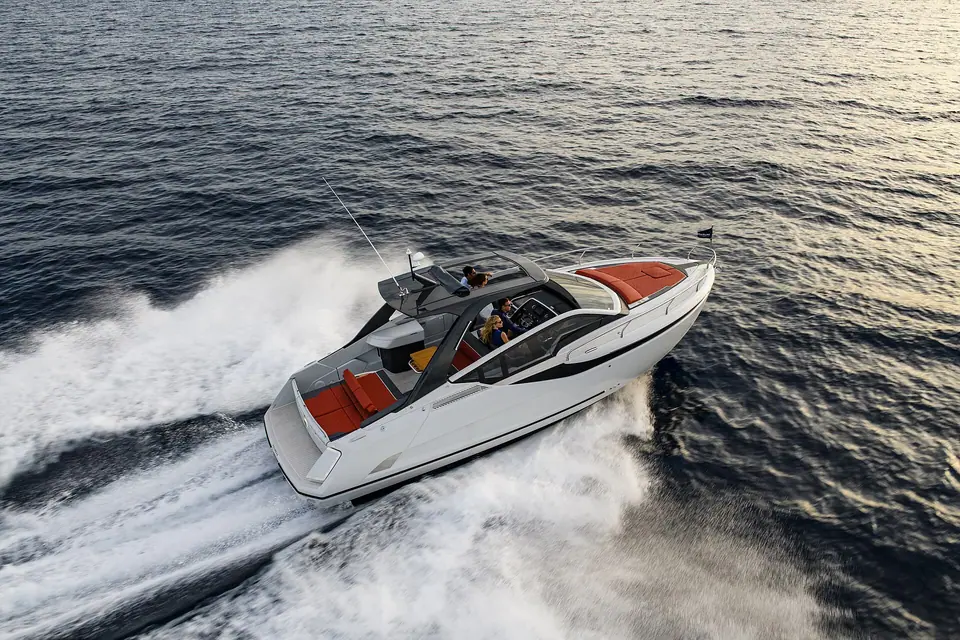
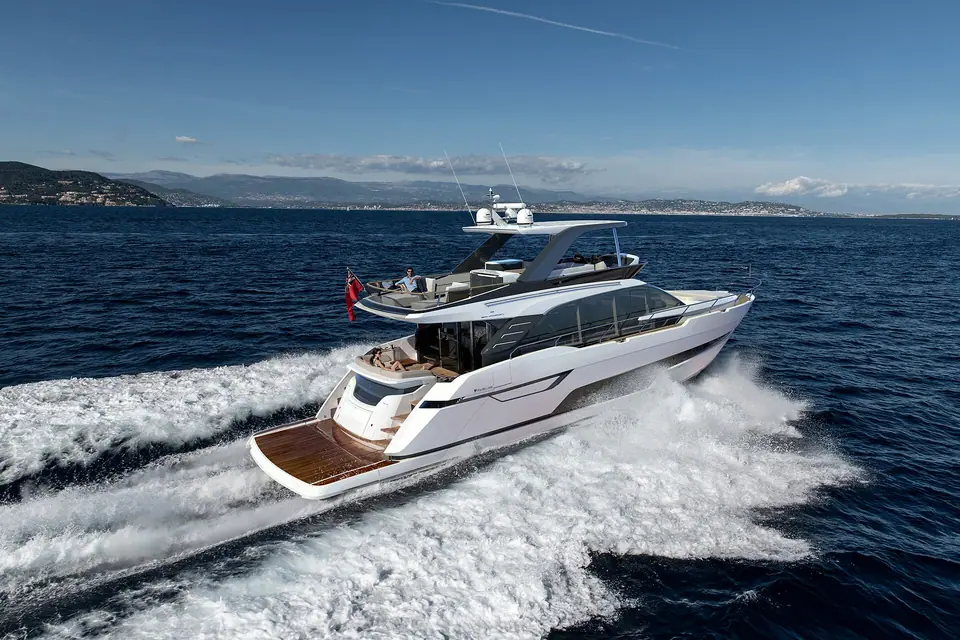
We have not found a freely licensed photo of the Fairline Phantom 50 yet, so these show other Fairline Yachts boats, each captioned with the boat pictured.
More motor yachts to explore
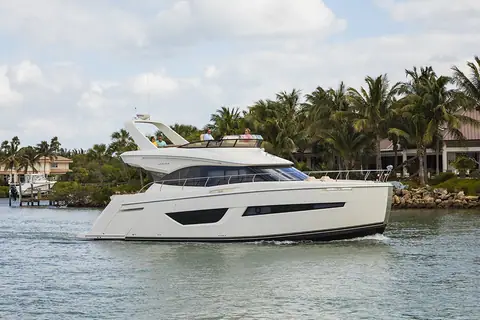
Carver C50 / C52 Command Bridge
Motor Yachts, 52 ft
Used $800K to $1.25M
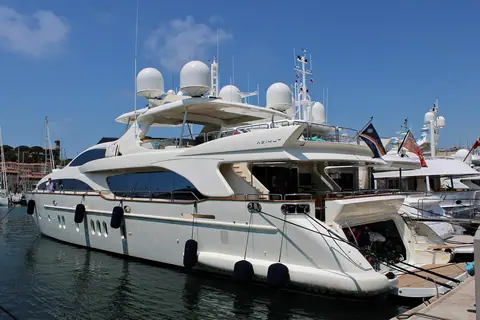
Azimut 50 Fly
Motor Yachts, 52 ft
Used $650K to $1.3M
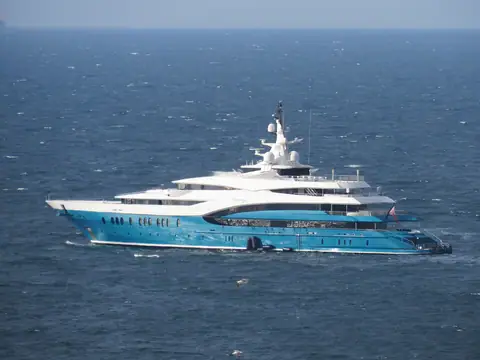
Carver 506 Motor Yacht
Motor Yachts, 52 ft
Used $200K to $330K
Absolute Navetta 52
Motor Yachts, 52 ft
Used $800K to $2.05M
Other Fairline Yachts models
- Fairline F//Line 33
- Fairline Phantom 40
- Fairline Phantom 48
- Fairline Squadron 50
- Fairline Squadron 55
- Fairline Squadron 58
- Fairline Squadron 68
- Fairline Targa 29
- Fairline Targa 31
- Fairline Targa 33
- Fairline Targa 34
- Fairline Targa 37
- Fairline Targa 38
- Fairline Targa 40
- Fairline Targa 43
- Fairline Targa 44
- Fairline Targa 45 GT
- Fairline Targa 48
- Fairline Targa 52
- Fairline Targa 58 Gran Turismo
- All Fairline Yachts models