Catana 471 Buyer's Guide, From Factory Spec Sheet to Survey
The daggerboard cruising cat that won Cruising World's multihull title for 1999 and still turns up on the US market with ocean miles behind it.
- Length
- 46.9 ft14.3 m
- Beam
- 25.3 ft7.7 m
- Draft
- 7.6 ft2.3 m
- Cabins
- 3 in the common owner's version (other arrangements were built)
- Used price
- $260K to $420K
On this page
- Overview
- Why a 1997 design still draws serious offers
- Bulb bows, tulip sections and boards you can lift
- Telling a 471 from a 472 on the listing sheet
- A boat delivered ready to cross oceans
- Sandwich, aramid and the questions a surveyor should ask
- Owner's hull, guest hull and a 3.6 ft bridgedeck clearance
- Repowers, lithium banks and the refit that sets the price
- The 47 and the 50 that followed
- Specifications
- Price and value
- Strengths and weaknesses
- Used buyer checklist
- Rivals
- Our verdict
- FAQ
The Catana 471 is a 47 ft Christophe Barreau daggerboard catamaran built in France from 1997 to 2003, about 68 hulls. Well refitted examples ask around $345,000 to $350,000 in the US today.
- Couples planning a Pacific or trade wind circuit on a budget
- Sailors moving from performance monohulls who want a cat that points
- Buyers comfortable managing a refit or verifying one
- Cruisers who want shallow draft with boards raised
Catana 471 by the numbers
- Sail area to displacement
- 33.1Racing level power, needs active reefing as the breeze builds.
- Displacement to length
- 106Ultralight. Built for speed, keep payload to a minimum.
- Theoretical hull speed
- 9.0 knDisplacement hull speed for the waterline. Light catamarans regularly sail faster than this because their slim hulls do not make a large bow wave.
- Length to beam ratio
- 1.86 : 1Catamaran overall proportions. Wider platforms resist pitching and heel.
Why a 1997 design still draws serious offers
Most cruising catamarans from the late 1990s are sold today as cheap platforms for a first season in the Bahamas. The Catana 471 is different. It was designed by Christophe Barreau as a long-range cruiser with daggerboards, aft helms and a carbon mast, and it was sold with an equipment list that already assumed you were leaving. Cruising World named it Best Cruising Multihull in its 1999 Boat of the Year contest, and Yachting World later described the 471 and its sister 472 as the optimum in ocean-going catamarans at the start of the millennium.
Sailboatdata records about 68 hulls built between 1997 and 2003. That makes the Catana 471 rare enough that a buyer usually chooses between one or two boats in North America at any moment, and common enough that owners, surveyors and parts suppliers know where the weak spots are. When a buyer searches for a Catana 471 for sale, the useful question is not whether the design is good. It is how much of the original boat has already been renewed.
Bulb bows, tulip sections and boards you can lift
The hull form follows a line Catana had developed since the 1980s, one that brokers still describe as Lock Crowther influenced; sailboatdata credits the earlier Catana 48 to Crowther and Barreau together. Below the waterline the bows carry a bulb that adds buoyancy forward and damps pitching; above it the sections flare into the tulip shape that keeps green water off the deck. The factory quoted a 45 ft 4 in waterline on a 47 ft hull, so almost the whole length works for speed.
Lateral resistance comes from two daggerboards rather than fixed keels. The factory listed draft at about 3 ft with the boards raised and 7 ft 7 in with them down. Boards down, the boat points like a performance cat; boards up, it slips sideways in a breaking sea instead of tripping, and it can reach anchorages that keel cats cannot. Brokers describe the trunks as molded separately and laminated to be stronger than the boards themselves, so a grounding should cost a board rather than a hull.
Telling a 471 from a 472 on the listing sheet
Catana sold the hull in two specifications, and the factory website of 2001 and 2002 kept them side by side. Both shared the 14.30 m hull, the 7.70 m beam, the 10,000 kg empty weight, the 19.50 m carbon mast and twin 50 hp engines. The differences were in sail power, materials and equipment, and they still affect value today.
- Sail area to windward: 151 m2 (1,625 sq ft) on the 471, 171 m2 (1,840 sq ft) on the 472
- Sails: polyester composite on the 471, first-choice Spectra on the 472
- Deck trim: solid teak handholds and footrails on the 471, varnished mahogany on the 472
- Watermaker: 60 liters per hour on the 471, 120 liters per hour on the 472
- Generator: an 8 kVA unit listed as standard on the 472
- Tanks: the 472 sheet lists 2 x 400 liters of fuel and 2 x 350 liters of water; the 471 sheet lists 800 liters of fuel and 2 x 400 liters of water
A boat delivered ready to cross oceans
The 471 equipment list from the factory reads like a modern refit list. It included a full-batten main with lazy jacks and a battened lazy bag, Vectran halyard and reefing lines, an automatic reefing system worked from the cockpit on an electric winch, Harken self-tailing winches and Spinlock stoppers. On deck came two helm seats with leather-covered wheels, balanced spade rudders in self-aligning bushings, carbon davits, a rigid bimini with a windscreen, an electric windlass with remote, a teak cockpit table and an inflatable with outboard.
Below, Catana fitted a 200 liter refrigerator, a 100 liter freezer, a three-burner stove with oven, two water heaters, a 16 gallon per hour watermaker, six to twelve 115 Ah service batteries, a 100 amp charger, a 2,000 W inverter and four 55 W solar panels. Navigation came as a Brookes and Gatehouse Hydra pack with a Raytheon ST7000 autopilot, GPS, radar and Navtex. Almost every one of those items has reached the end of its life on a boat built before 2004, which is why the refit history matters more than the build year.
Sandwich, aramid and the questions a surveyor should ask
Catana built the 471 to CE category A with vacuum-bagged sandwich construction throughout and Twaron aramid used for impact protection. A broker description of one 1998 boat adds detail: hull molds laminated with isophthalic polyester over closed-cell PVC foam with unidirectional glass outside and Twaron inside, a one-piece deck cored with Nidacore honeycomb, and a bonded deck-to-hull joint. That is a light, stiff structure, and it rewards a careful moisture survey, especially around deck fittings, the trampoline frame, the davits and the chainplates.
Do not assume every 471 still has a carbon mast. The factory specified a carbon spar, yet the 1998 boat listed in Florida in 2026 carries a white Sparcraft aluminum triple-spreader mast and boom. Find out what is standing, when it was last unstepped and when the rigging was renewed; the same listing shows shrouds, diamonds and headstay replaced in 2018.
Owner's hull, guest hull and a 3.6 ft bridgedeck clearance
The Rhode Island boat listed in 2026 is a typical owner's version with three cabins and two heads: one hull given to the owner, the other split into two guest cabins. Others were finished differently; the Florida boat has a Prestige layout with a separate shower stall in the guest head and a built-in backrest behind the forward-facing settee. Listings quote about 6 ft 9 in of headroom in the saloon and cabins and a bridgedeck clearance of 1.10 m (3.6 ft), which is generous for the period and one reason the boat is quieter in a head sea than many contemporaries.
The helms sit aft on each hull, open to the weather and with a clear view of the sails. That is ideal on a trade wind passage and less comfortable in a cold rain, so a well-made enclosure or bimini extension is worth paying for if you plan to cruise north of the Carolinas.
Repowers, lithium banks and the refit that sets the price
Engines on the surviving fleet vary. The factory specified twin 50 hp diesels on saildrives with folding three-blade props; a 2001 Catana 472 in Tahiti still lists Volvo MD22 engines, the 2001 boat in Rhode Island runs Yanmar 4JH3E 56 hp units on SD31 saildrives, and the 1998 Florida boat was repowered in 2008 with Volvo D2-55 engines on 130S saildrives. One listing quotes about 7.5 knots cruising and 8.5 knots maximum under power, a reasonable expectation for a clean bottom.
The two US listings in 2026 also show what buyers now pay for. The 2001 boat had a 2022 refit aimed at running without a generator: a 1,200 Ah lithium bank, 3,080 W of solar, a full Victron system, 24,000 BTU DC air conditioning units, a new windlass, a 40 kg Rocna anchor and new Marelon seacocks. The 1998 boat has a 2021 Victron lithium system, a 6 kW generator, a 17 gallon per hour watermaker and North laminate sails from 2020. Expect to pay close to the top of the range only for that kind of evidence.
The 47 and the 50 that followed
Catana went through hard years after the 2000s market downturn, and the 471 ended in 2003. Cruising World described the Catana 50 of 2008 as designed to replace the 471, and Catana's own 2011 site introduced the later Catana 47 as the successor to the now legendary 471. Neither shares the 471's molds. The later 47 is a new carbon-reinforced boat on a 14.03 m hull with 40 hp engines, so check the year and hull length on any listing that simply says Catana 47.
Catana 471 specifications
| Length overall | 46.9 ft14.3 m |
|---|---|
| Waterline length | 45.3 ft13.8 m |
| Beam | 25.3 ft7.7 m |
| Draft | 7.6 ft2.3 m |
| Air draft | 70.6 ft21.52 m |
| Displacement | 22,046 lbs10, kg |
| Sail area | 1,625 sq ft151 m² |
| Fuel capacity | 211 gal8 L |
| Fresh water | 211 gal8 L |
| Cabins | 3 in the common owner's version (other arrangements were built) |
| Heads | 2 in the owner's version |
| Standard engines | 2 x 50 hp diesels with saildrives and folding three-blade propellers |
| Maximum power | 100 hp |
| Hull type | Cruising catamaran with daggerboards, bulbous bow sections and tulip-shaped bows |
| Keel | Twin daggerboards, about 3 ft boards up and 7 ft 7 in boards down (factory figures) |
| Rig | Fractional sloop, carbon mast as standard on factory boats, full-batten main with lazy jacks |
| Hull construction | Vacuum-bagged foam sandwich with Twaron (aramid) impact layers |
| CE design category | A |
| Builder | Catana, France |
| Naval architect | Christophe Barreau |
| Production | 1997 to 2003 |
| Status | Discontinued |
Figures come from builder documentation and independent tests where available. Displacement is usually quoted light, so a loaded cruising boat will weigh more. Compare these specs with another model.
How much does a Catana 471 cost?
Price on a 471 follows the refit, not the model year. Two US boats listed in 2026 show the ceiling for the type: a 2001 owner's version with a 2022 energy refit at $349,000 and a 1998 Prestige layout cut from $395,000 to $345,000. A 2001 Catana 472 in French Polynesia asks around 339,000 euros. Boats with original engines, tired saildrives or an unknown mast history sell well below those numbers.
Estimate your yearly cost
A planning estimate using common rules of thumb: insurance near 1.5 percent of value, maintenance near 3 percent, haul out and bottom paint by length. Your marina, region and use will move these numbers. Open the full cost calculator.
Catana 471 timeline
- 1997Catana 471 launched, designed by Christophe Barreau
- 1999Named Best Cruising Multihull in Cruising World's Boat of the Year contest
- 2000Higher specification Catana 472 appears on the factory site alongside the 471
- 2003Production ends after about 68 hulls
- 2008Catana 50 introduced as the boat to replace the 471
- 2010New Catana 47 launched and presented as the 471's successor
Strengths and weaknesses
What owners like
- Daggerboards give real windward ability and a shallow boards-up draft
- Fast, light hull with ratios closer to a performance cat than a charter cat
- Generous bridgedeck clearance for its age
- Factory built for ocean use, CE category A
- Proven fleet with many owners who have crossed oceans
- Asking prices far below a new performance cat of similar length
What to weigh up
- Most boats need or have had expensive refits of engines, saildrives, rig and electrics
- Exposed aft helms are uncomfortable in cold or wet weather
- Light sandwich structure needs a careful moisture survey
- Small fleet, so choice in the US is limited
- Spec varies widely between 471, 472 and refitted boats
Used Catana 471 buyer checklist
Take this list to a viewing. Your ticks are saved in this browser so you can come back to it.
Always commission an independent marine survey and an engine survey before you buy. How a marine survey works.
Rivals to consider
Lagoon 470
A contemporary with more volume and a fixed-keel, charter-friendly brief; slower and less weatherly, easier to find.
Fountaine Pajot Bahia 46
Similar size and era, mini keels and a lower price, aimed at the charter and family market.
Privilege 435
A heavier French cruising cat with fixed keels, prized for build quality and liveaboard comfort rather than speed.
Catana 50
The direct successor, larger and newer with a cantilevered hardtop, at roughly half again the price.
Compare side by sideOur verdict on the Catana 471
The Catana 471 is a genuine ocean catamaran from a period when most builders were chasing charter fleets, and it still sails like it. The design is not the risk; age is. A 471 or 472 that has had its engines, saildrives, rigging, electrics and deck core sorted in the last few years is one of the most capable bluewater cats you can buy for well under $400,000. One that has not is a project, and should be priced like one.
Catana 471 questions answered
How much is a Catana 471 for sale in the US?
Recently refitted boats have been asking about $345,000 to $349,000 in 2026. Boats needing engines, rigging or electrical work should sell well below that.
What is the difference between the Catana 471 and 472?
They share the hull and engines. The 472 had more sail area (171 versus 151 m2), Spectra sails, mahogany trim, a bigger watermaker and a standard 8 kVA generator.
How many Catana 471s were built?
Sailboatdata lists about 68 hulls built between 1997 and 2003.
Who designed the Catana 471?
Christophe Barreau, the naval architect behind most Catana designs of the period.
What is the draft of a Catana 471?
Catana quoted about 3 ft with the daggerboards raised and 7 ft 7 in with them lowered.
Is the Catana 471 a bluewater boat?
Yes. It was built to CE category A, won Cruising World's 1999 multihull award and many have crossed oceans, though any example now needs a thorough survey.
More sailing catamarans to explore
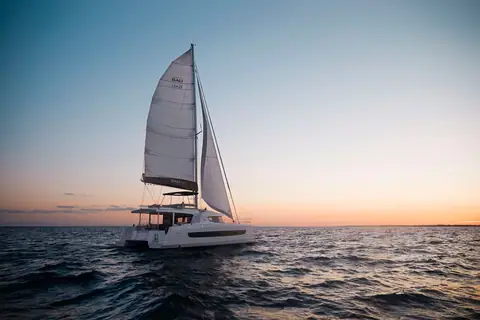
Bali 4.6
Sailing Catamarans, 47 ft
Used $620K to $850K
Fountaine Pajot FP48
Sailing Catamarans, 47 ft
Used $850K to $1.2M
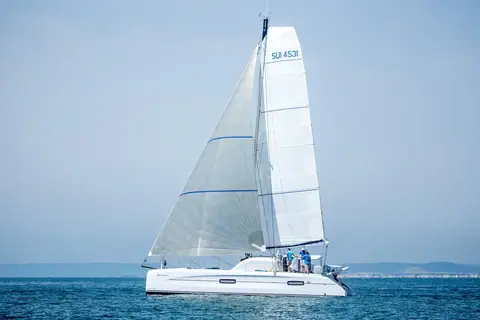
Outremer 45
Sailing Catamarans, 48 ft
Used $300K to $1.1M
Catana 47
Sailing Catamarans, 46 ft
Used $450K to $720K