Excess Catamarans Sailing Catamarans
Excess 15 Catamaran, Specs, Prices and Used Buyer's Guide
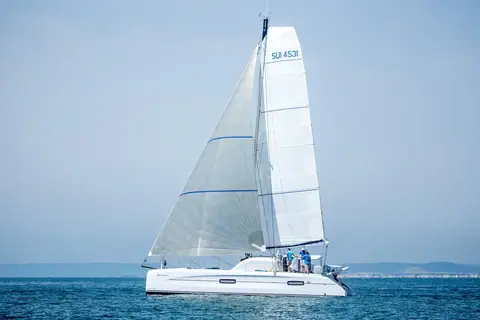
Lagoon 50 underpinnings, a ton less weight, no flybridge and wheels on the transoms: the big cat that launched Beneteau's Excess brand.
- Length
- 48.4 ft14.76 m
- Beam
- 26.3 ft8.03 m
- Draft
- 4.6 ft1.4 m
- Cabins
- 3, 4 or 6
- Used price
- $580K to $850K
On this page
- Overview
- Where the Excess 15 sits in the Excess story
- A Lagoon 50 put on a diet
- Standard rig versus Pulse: the option that defines resale
- Two Fort Lauderdale test sails, two happy testers
- Twin helms on the transoms, with real shade
- Owner's version, four cabins or a six-cabin charter boat
- The Torqeedo hybrid prototype
- Buying an Excess 15 secondhand
- Specifications
- Price and value
- Strengths and weaknesses
- Used buyer checklist
- Rivals
- Our verdict
- FAQ
The Excess 15 is a 48 ft 5 in VPLP catamaran from Groupe Beneteau's Excess brand, introduced in 2019 and since replaced by the Excess 14. 42,018 lb light, 3, 4 or 6 cabins and a 1,716 sq ft upwind rig.
- Experienced couples wanting a big, sailable cat
- Families needing three en-suite cabins
- Monohull sailors moving up to multihull space
- Owners planning Caribbean seasons
Excess 15 by the numbers
- Sail area to displacement
- 22.7Plenty of sail for the weight, the boat should feel lively in light air.
- Displacement to length
- 182Light displacement for its length, quick but sensitive to added cruising weight.
- Theoretical hull speed
- 9.2 knDisplacement hull speed for the waterline. Light catamarans regularly sail faster than this because their slim hulls do not make a large bow wave.
- Length to beam ratio
- 1.84 : 1Catamaran overall proportions. Wider platforms resist pitching and heel.
Where the Excess 15 sits in the Excess story
The Excess 15 was the larger of the two catamarans Groupe Beneteau used to launch its Excess brand at boot Dusseldorf, alongside the Excess 12. Both were deliberately sportier reinterpretations of existing Lagoons: the 12 came from the Lagoon 40 and the 15 from the Lagoon 50. The idea was to win back sailors who felt Lagoon had stopped catering to people who enjoy trimming sails, and the 15 delivered on that brief well enough to be voted Multihull of the Year at the 2019 British Yachting Awards by readers of Sailing Today and Yachts & Yachting.
Today the Excess 15 appears under Excess Origins on the builder's site, a label for its first-generation boats, and the clean-sheet Excess 14 has taken its place at the top of the range. That makes the 15 a used-market proposition, and an interesting one: a 48 foot cat with sport-cruiser handling and Lagoon 50 volume underneath.
A Lagoon 50 put on a diet
SAIL explains the construction in detail. The Excess 15 is built in three vacuum-infused sections with balsa coring in the deck and above the waterline. It shares the Lagoon 50's bridgedeck and the inner halves of the hulls below the waterline, but uses new outer hull halves. VPLP and the Excess team took about a ton out of the Lagoon by lightening interior fixtures and deleting the flybridge, and Excess committed to never building a flybridge model.
The numbers that result are 48 feet 5 inches overall, 46 feet 11 inches on the hull, 26 feet 4 inches of beam and 4 feet 7 inches of draft, with a light displacement of 19.05 tonnes (42,018 pounds). SAIL calculated a sail area to displacement ratio of 22 and a displacement to length ratio of 182, which puts it on the lively side of big cruising cats rather than among the heavy charter boxes.
- LOA 48 ft 5 in (14.76 m), hull 46 ft 11 in (14.31 m), beam 26 ft 4 in (8.03 m)
- Draft 4 ft 7 in (1.40 m), light displacement 42,018 lb
- Fuel 2 x 520 L (about 275 US gal); water 2 x 240 L plus optional 2 x 175 L
- Mast height 91 ft 6 in above the waterline on the builder sheet
- CE category A for 14 people
Standard rig versus Pulse: the option that defines resale
Standard sails were a 104.5 square meter (1,124 sq ft) square-top main and a 55 square meter (592 sq ft) self-tacking jib, 159.5 square meters (1,716 sq ft) upwind. The Pulse Line package added a taller mast, about 3 feet more according to Cruising World, a bowsprit and a 117 square meter Code 0 on a continuous-line furler, lifting upwind area to 171.6 square meters (1,846 sq ft).
Both magazine testers sailed Pulse boats and both would buy that version. With a self-tacker for upwind work and a big furling reacher for everything else, the 15 is easy for two people despite its size. The tall rig, however, means fixed bridges are out of the question, so East Coast owners will be taking the outside route between harbors.
Two Fort Lauderdale test sails, two happy testers
SAIL tested off Fort Lauderdale in 12 to 18 knots of wind and a 3 foot chop. Under main and jib the boat made around 8 knots within 60 degrees of the true wind, and with the Code 0 on a broad reach it peaked at 10.5 knots. Cruising World's Boat of the Year crew saw high 7s upwind in 10 to 12 knots, lost about a knot bearing away under jib, then jumped to 10 and change when the reacher was unrolled.
Under power, SAIL's boat had the optional 80 hp Yanmars in place of the standard 57s and folding props, making 7.5 knots flat out and about 6.5 knots at cruise. Conditions were too mild to judge bridgedeck slamming, so a sea trial in a real head sea is worth arranging before you buy.
Twin helms on the transoms, with real shade
Each hull ends in a helm pod with a folding double seat. On the test boat the starboard pod carried the Raymarine display and engine controls, and the port side wind instruments and a tablet mount; duplicate engine controls were optional and SAIL thought them a worthwhile investment for docking. Small hard biminis over each helm give shade and rain cover without cluttering the profile.
Excess claimed that vertical saloon windows solved the classic aft-helm problem of not seeing the bows, and SAIL agreed that you can see right through the saloon to both bow tips. Cruising World liked how the aft wheels keep the helmsman in conversation range of the cockpit rather than isolated on a flybridge.
Owner's version, four cabins or a six-cabin charter boat
The owner's layout gives the whole starboard hull to a master suite with a desk, an outboard sofa and a large forward bathroom with twin sinks, with two en-suite guest cabins to port. The four-cabin version has four en-suite cabins, and a six-cabin, six-head version plus forepeak crew berths was offered for charter operators. Check which layout you are viewing, because charter boats carry very different wear and resale value.
The saloon is lighter and more modern than the Lagoon 50's, with an L-shaped settee slightly raised to see out, a bench facing it and a galley in the aft port corner. SAIL's main interior gripe was a lack of overhead hatches, which can make the saloon warm in the tropics. Outside, a forward cockpit lounge and an aft cockpit with an accordion sunroof give two good places to sit at anchor.
The Torqeedo hybrid prototype
Excess used the 15 as its first hybrid test bed. Through its Excess Lab program the brand showed an Excess 15 with Torqeedo Deep Blue Hybrid propulsion at the Cannes Yachting Festival, using two 50 kW electric motors with ZF technology and two large BMW i3 lithium batteries. The builder reported that hydrogeneration under sail supplied all onboard equipment at a 7 to 8 knot cruising speed.
This was a showcase rather than a common production option, so almost every used Excess 15 you will find has conventional twin Yanmar diesels. If you do find the hybrid boat, treat battery condition and system support as the key questions.
Buying an Excess 15 secondhand
When new, Cruising World put the US base price at $737,000, with a heavily optioned boat at about $950,000, and SAIL's Pulse test boat was priced at $1.1 million. Production was short, so the market is thin; we expect most boats to trade between about $580,000 and $850,000 depending on layout, rig and equipment. Owner's versions with the Pulse rig and 80 hp engines command the premium.
Running costs resemble any 48 foot catamaran: a wide slip for 26 feet 4 inches of beam, twin saildrive service, a big rig to maintain and sails that are expensive to replace. Budget $40,000 to $75,000 a year. The upside of the Lagoon 50 connection is that many structural and hardware parts are shared with a large, well-supported fleet.
Excess 15 specifications
| Length overall | 48.4 ft14.76 m |
|---|---|
| Waterline length | 46.9 ft14.3 m |
| Beam | 26.3 ft8.03 m |
| Draft | 4.6 ft1.4 m |
| Air draft | 91.5 ft27.89 m |
| Displacement | 42,018 lbs19,05 kg |
| Sail area | 1,716 sq ft159.5 m² |
| Fuel capacity | 275 gal1,04 L |
| Fresh water | 127 gal48 L |
| Cabins | 3, 4 or 6 |
| Berths | 6 to 12 plus forepeak crew berths |
| Heads | 3, 4 or 6 |
| Maximum persons | 14 |
| Standard engines | 2 x 57 hp Yanmar diesels with saildrives |
| Optional engines | 2 x 80 hp Yanmar diesels |
| Maximum power | 160 hp |
| Cruise speed | 6.5 knots |
| Top speed | 7.5 knots |
| Hull type | Catamaran with Lagoon 50-derived bridgedeck and inner hulls and new outer hull halves |
| Keel | Twin fixed low-aspect keels |
| Rig | Fractional sloop, square-top main and self-tacking jib; Pulse Line rig with taller mast and bowsprit optional |
| Hull construction | Vacuum-infused polyester with balsa core above the waterline |
| CE design category | A |
| Builder | Excess Catamarans (Construction Navale Bordeaux, Groupe Beneteau), France |
| Naval architect | VPLP Design |
| Other design credits | Patrick Le Quement (exterior styling), Nauta Design (interior) |
| Production | 2019 to present |
| Status | Discontinued |
Figures come from builder documentation and independent tests where available. Displacement is usually quoted light, so a loaded cruising boat will weigh more. Compare these specs with another model.
How much does a Excess 15 cost?
Cruising World quoted a US base price of $737,000 in 2021, with a well-optioned boat delivered to the US at about $950,000; SAIL's Pulse Line test boat with 80 hp engines was $1.1 million as tested. Used values depend heavily on owner's version versus four or six-cabin charter layouts, the Pulse rig and engine size. Few boats were built, so expect long searches and wide asking-price spreads.
Estimate your yearly cost
A planning estimate using common rules of thumb: insurance near 1.5 percent of value, maintenance near 3 percent, haul out and bottom paint by length. Your marina, region and use will move these numbers. Open the full cost calculator.
Versions and options
- Standard rig
- Square-top main and self-tacking jib, 1,716 sq ft upwind.
- Pulse Line
- Taller mast, bowsprit and Code 0 on a continuous-line furler, 1,846 sq ft upwind.
- Engines
- Twin 57 hp Yanmar standard, twin 80 hp optional.
- Layouts
- Three-cabin owner's version, four cabins with four heads, or six cabins with six heads for charter.
Excess 15 timeline
- 2019Excess brand launched at boot Dusseldorf with the Excess 12 and 15
- 2019Excess 15 voted Multihull of the Year at the British Yachting Awards in December
- 2021Cruising World tests the 15; Torqeedo hybrid prototype shown at Cannes
- 2022Clean-sheet Excess 14 premieres and takes over the top of the range
Strengths and weaknesses
What owners like
- About a ton lighter than the Lagoon 50 it is based on
- Self-tacking jib makes a 48 ft cat easy for two
- Pulse rig delivers 10 knots plus under Code 0
- Good forward visibility from the aft helms
- Owner's version has a full-hull master suite
- Shares structure and parts with the large Lagoon 50 fleet
What to weigh up
- Discontinued, with a thin used market
- Few overhead hatches in the saloon
- Tall rig rules out fixed bridges
- Charter-layout boats can be heavily used
- Bridgedeck behavior in steep head seas unproven in published tests
Used Excess 15 buyer checklist
Take this list to a viewing. Your ticks are saved in this browser so you can come back to it.
Always commission an independent marine survey and an engine survey before you buy. How a marine survey works.
Rivals to consider
Excess 14
Its replacement, a clean-sheet VPLP 46 footer that is lighter but carries less volume.
Compare side by sideLagoon 50
The donor platform, with a flybridge and more weight, a cruising apartment rather than a sailing cat.
Compare side by sideNautitech 46 Open
Another aft-helm, sail-first design with an open saloon and slightly smaller size.
Compare side by sideFountaine Pajot Saona 47
Bulkhead-helm cruising cat with a flybridge and strong charter following.
Compare side by sideLeopard 50
Roomy South African cat with a forward cockpit, built for charter and liveaboard volume.
Compare side by sideOur verdict on the Excess 15
The Excess 15 is a clever piece of product engineering: Lagoon 50 volume with a ton shaved off, the flybridge removed and the wheels moved to where a sailor wants them. With the Pulse rig it sails genuinely well for a 48 foot cruising cat and remains easy for a couple. Its weaknesses are mostly about rarity, a thin used market and a few interior details, and its replacement by the Excess 14 does not make it obsolete. A well-kept owner's version is one of the more rewarding big cats you can buy on the secondhand market.
Excess 15 questions answered
Is the Excess 15 still in production?
No. It now sits in the builder's Excess Origins section, and the Excess 14 launched in 2022 has taken over the top of the range.
What was the Excess 15 catamaran price?
Cruising World quoted a $737,000 US base price in 2021 and about $950,000 well optioned; used boats now ask roughly $580,000 to $850,000.
Is the Excess 15 based on the Lagoon 50?
Yes. It shares the Lagoon 50's bridgedeck and inner hulls below the waterline but has new outer hull halves, no flybridge and about a ton less weight.
How fast does the Excess 15 sail?
SAIL saw about 8 knots within 60 degrees of the true wind and 10.5 knots with the Code 0 in 12 to 18 knots of breeze.
How many cabins does the Excess 15 have?
Three, four or six cabins, each with its own head, plus optional forepeak crew berths.
More sailing catamarans to explore
Lagoon 50
Sailing Catamarans, 48 ft
Used $540K to $1.17M
Dufour Catamarans 48
Sailing Catamarans, 48 ft
Used $430K to $700K
Bali 4.8
Sailing Catamarans, 49 ft
Used $780K to $1.15M
Outremer 45
Sailing Catamarans, 48 ft
Used $300K to $1.1M