Catana 47 Review, the Carbon Infusion Cat and How to Buy One
A 46 ft daggerboard cruiser that Catana rebuilt in carbon infused sandwich, made lighter and quicker, then sold to owners who actually go somewhere.
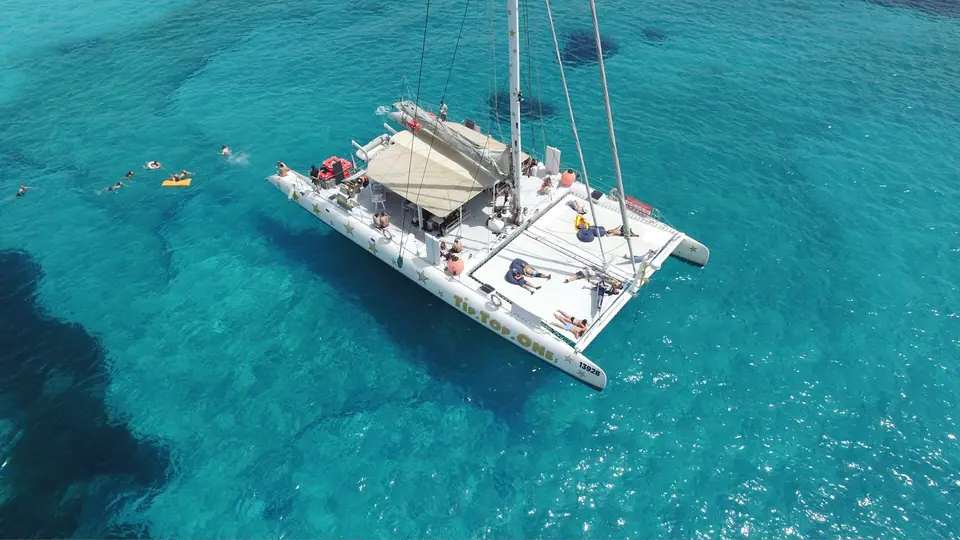
- Length
- 46 ft14.03 m
- Beam
- 25.1 ft7.64 m
- Draft
- 8.2 ft2.5 m
- Cabins
- 3 in the owner's version, 4 in the charter version
- Used price
- $450K to $720K
On this page
- Overview
- Which Catana 47 is in front of you
- What the carbon infusion rebuild changed
- Nine knots in twelve knots of breeze
- Under power, and why one helm has the throttles
- A tweaker's deck with a single central winch
- Owner's hull or four cabins
- Repowers, Starlink and what a 2026 listing looks like
- Ownership costs on a 25 ft wide performance cat
- Specifications
- Price and value
- Strengths and weaknesses
- Used buyer checklist
- Rivals
- Our verdict
- FAQ
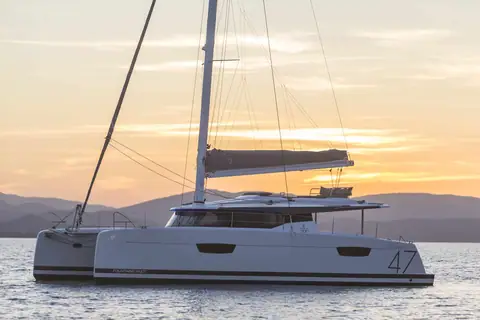
The Catana 47 is a Christophe Barreau daggerboard catamaran launched in 2010 to succeed the 471. After six glass boats Catana switched to carbon infusion, saving about 1,500 lb. Used boats ask roughly $500,000 to $650,000.
- Couples planning long passages who enjoy trimming
- Monohull racers moving to two hulls
- Buyers who want a light, stiff cat at a midsize price
- Owners who plan to cruise the Bahamas with boards raised
Catana 47 by the numbers
- Sail area to displacement
- 30.7Racing level power, needs active reefing as the breeze builds.
- Displacement to length
- 103Ultralight. Built for speed, keep payload to a minimum.
- Theoretical hull speed
- 9.0 knDisplacement hull speed for the waterline. Light catamarans regularly sail faster than this because their slim hulls do not make a large bow wave.
- Length to beam ratio
- 1.83 : 1Catamaran overall proportions. Wider platforms resist pitching and heel.
Which Catana 47 is in front of you
Search for a Catana 47 and three different boats come back. The first is the Catana 471, a 1997 to 2003 design that sellers often shorten to 47. The second is the new Catana 47 that Christophe Barreau drew to replace it, introduced on Catana's website around 2010 with the line that it would be worthy of its now legendary predecessor. The third is the same model after Catana changed how it was built: Cruising World reported that six non-carbon boats left the yard before Catana began infusing carbon fiber into the laminate, cutting roughly 1,500 lb from the earlier hulls.
This page is about the second and third boats, the 14.03 m (46 ft) Catana 47 sold from 2010. The fastest way to tell them apart from the 471 is the hull length and the engines: the newer boat lists 40 hp engines and a 14.03 m hull, the 471 had 50 hp engines on a 14.30 m hull. Later brokers often add the word Carbon to the name, which is a useful clue but not proof, so ask for the hull number and build date.
What the carbon infusion rebuild changed
Catana always built light, but the 47's second iteration took it further. According to Cruising World's 2013 review, the hulls are an infused sandwich of Airex closed-cell foam and glass with polyester and vinylester resins, the vinylester there for osmosis protection. Twaron aramid goes forward for collision resistance and below the waterline for strength, and carbon fiber is placed where chainplate and structural loads arrive. The deck is also an infused foam sandwich, and the bimini top's inner skin, the cabin top and the structural bulkheads are carbon and foam to keep weight out of the upper boat.
SAIL's 2012 test described the same idea from the inside: even the joinery that looks like solid maple is a cored laminate, and the weight saving allowed 40 hp engines instead of the twin 50s of the earlier 47 footers. The practical result is more payload for the same performance, which matters on a cruising cat that will carry a watermaker, a generator, dinghy and stores.
Nine knots in twelve knots of breeze
Two American magazines sailed the carbon boat and recorded similar numbers. SAIL's tester, off Miami in a light ship condition, saw 7 knots on a close reach in 9 knots of wind and 9 knots when a 12 knot gust arrived, tacking through about 90 degrees as long as the turn was brisk. Cruising World's Boat of the Year team on Chesapeake Bay logged nearly 9 knots on a beam reach in just over 12 knots of breeze and speeds in the high 7s close-hauled. Catana told SAIL the boat had exceeded 20 knots in ideal conditions with plenty of wind.
The sail plan does the work: a square-top main and a 145 percent genoa per Cruising World, with factory figures of 86 m2 (926 sq ft) of main, 53 m2 (571 sq ft) of genoa and an 84 m2 (904 sq ft) gennaker. The tulip bows give a fine entry upwind and buoyancy when running. The daggerboards draw about 8 ft 2 in down and 3 ft 7 in up, and SAIL notes they are normally sailed half down, then raised for running in the trades.
The trade-off is motion. SAIL found the boat quick and lively in a seaway, especially in the cockpit, and rated a quick motion as one of its cons. Anyone coming from a heavy charter cat should expect a boat that rewards trimming and responds sharply to waves.
Under power, and why one helm has the throttles
Under power the 47 is economical with its small engines. SAIL measured 7.4 knots at 2,200 rpm with a saloon sound level of 66 dBA, and a little over 9 knots at 3,000 rpm wide open. The boat turned in about one and a half lengths with both engines ahead and spun in its own water on opposed throttles.
Both reviews flagged the same ergonomic issue. The engine controls sit only on the starboard binnacle, and the cabin house creates a blind spot to the opposite bow, so docking to port needs a crew member on watch. Cruising World's judges also wanted controls at both helms and noted an exposed electrical panel. Check whether a boat you are viewing has had a second set of controls added, and look at the electrical installation critically.
A tweaker's deck with a single central winch
The helms are set outboard on each hull with good seats and engine instruments in plain view, and Cruising World praised the smooth Lewmar rack-and-pinion steering. Control lines lead aft through a bank of clutches to winches amidships. SAIL found the lines grouped closely enough that you must clear the winch and then hunt for the right tail, and the main is trimmed through a bridle with two separate sheets, both of which have to be adjusted for a course change. Owners who race or simply enjoy trim love it; couples who want push-button cruising should budget for labeling, electric winches and practice.
Owner's hull or four cabins
Catana's 2011 site showed two arrangements, an owner version and a charter version, with interior design by Linea Concept, wenge floors and pale paneling. In the owner's boat SAIL tested, the entire starboard hull belongs to the owner, with a double berth aft, a vanity, generous lockers and a large head with a separate shower forward behind a curved sliding door. The port hull has a single berth forward and twin berths aft that are easy to make up from the central passage; those two guest heads have no showers.
Four-cabin boats exist too. A 2010 example listed in South Carolina in 2026 has four cabins and four heads, with two double guest cabins and two cabins in the owner's hull. Headroom is about 6 ft 11 in throughout according to SAIL. One complaint worth checking on any boat: the open saloon needs more grab points at sea, and shorter crew may struggle to reach the overhead rails.
Repowers, Starlink and what a 2026 listing looks like
The original engines were Volvo Penta 40 hp units on saildrives, with 158 gallons of fuel and 177 gallons of water per SAIL. Many boats are now at the age where repowering makes sense. The South Carolina boat shows what a fully sorted example looks like: new 2025 Yanmar 4JH57 57 hp engines and SD-60 saildrives, new thru-hulls, a 2019 Cummins Onan 7.5 kW generator, 800 W of solar, an Aqua-Base watermaker, Starlink, new radar and more than $200,000 of recent upgrades, at an asking price of $549,000.
That number is a useful anchor. A carbon infusion boat with original engines, original electrics and no major refit should be priced below it, while a late boat in owner's layout with a recent engine and electrical refit can ask more. European prices for comparable years run from roughly 495,000 to 595,000 euros before shipping or VAT considerations.
Ownership costs on a 25 ft wide performance cat
The biggest single cost in North America is space. A 25 ft beam limits marina choices and pushes slip fees toward the catamaran rate in most of Florida and the Caribbean. Budget also for saildrive diaphragm replacement on schedule, sail replacement for a boat that is meant to be trimmed, and the electronics and battery upgrades most 2010s boats now need. A realistic annual budget for a US-based owner runs from about $35,000 to $70,000 before depreciation, depending on dockage and how much sailing you do.
Catana 47 specifications
| Length overall | 46 ft14.03 m |
|---|---|
| Waterline length | 45.5 ft13.87 m |
| Beam | 25.1 ft7.64 m |
| Draft | 8.2 ft2.5 m |
| Air draft | 70.5 ft21.49 m |
| Displacement | 21,8 lbs9,888 kg |
| Sail area | 1,496 sq ft139 m² |
| Fuel capacity | 158 gal6 L |
| Fresh water | 177 gal67 L |
| Cabins | 3 in the owner's version, 4 in the charter version |
| Heads | 3 in the owner's version as tested by SAIL, 4 in four-cabin boats |
| Standard engines | 2 x Volvo Penta 40 hp diesels with saildrives |
| Maximum power | 80 hp |
| Cruise speed | 7.4 knots |
| Top speed | 9 knots |
| Hull type | Daggerboard cruising catamaran with tulip-shaped bows |
| Keel | Twin daggerboards, 3 ft 7 in up and 8 ft 2 in down |
| Rig | Fractional sloop with square-top main, genoa and gennaker; 19.5 m mast |
| Hull construction | Infused foam sandwich with glass, Twaron and carbon reinforcement (carbon infusion from the seventh hull) |
| Builder | Catana, France |
| Naval architect | Christophe Barreau |
| Other design credits | Interior by Linea Concept |
| Production | 2010 to present |
| Status | Discontinued |
Figures come from builder documentation and independent tests where available. Displacement is usually quoted light, so a loaded cruising boat will weigh more. Compare these specs with another model.
How much does a Catana 47 cost?
SAIL quoted a $761,000 base price in 2012 and Cruising World described its equipped test boat as a $900,000-plus cat in 2013. On the brokerage market a 2010 boat with brand new 2025 Yanmar engines and saildrives asks $549,000 in South Carolina, while European listings include a 2014 boat at about 495,000 euros and a 2017 Catana 47 Carbon at about 595,000 euros. Carbon infusion hulls, recent repowers and owner's layouts command the top of the range.
Estimate your yearly cost
A planning estimate using common rules of thumb: insurance near 1.5 percent of value, maintenance near 3 percent, haul out and bottom paint by length. Your marina, region and use will move these numbers. Open the full cost calculator.
Catana 47 timeline
- 2010New Catana 47 by Christophe Barreau replaces the 471 in the range
- 2012Carbon infusion version tested by SAIL, base price $761,000
- 2013Sailed by Cruising World's Boat of the Year judges on Chesapeake Bay
- 2017Catana 53 launched with a new angular style; the 47 keeps its traditional look
- 2020Catana Ocean Class arrives and becomes the focus of the range
Strengths and weaknesses
What owners like
- Genuinely quick, close to 9 knots in 12 knots of wind
- Carbon infusion hulls about 1,500 lb lighter than the first boats
- Daggerboards for pointing and a shallow 3 ft 7 in boards-up draft
- Spacious owner's hull with a separate shower
- Economical 40 hp engines, 7.4 knots at 2,200 rpm
- Asks well under the price of a new performance catamaran
What to weigh up
- Engine controls only at the starboard helm
- Blind spot to the opposite bow when docking
- Busy line handling with a single central winch and a two-sheet main bridle
- Quick motion in a seaway
- Guest heads in the owner's version have no showers
Used Catana 47 buyer checklist
Take this list to a viewing. Your ticks are saved in this browser so you can come back to it.
Always commission an independent marine survey and an engine survey before you buy. How a marine survey works.
Rivals to consider
Outremer 51
Longer and lighter-feeling, with a strong owner community and resale, usually at a higher price.
Compare side by sideNautitech 47
A French cruising cat with more volume and fixed keels, easier to sail casually, slower upwind.
Lagoon 450
The volume benchmark of the same years, with flybridge helm and far more boats on the market.
Compare side by sideCatana 50
Catana's larger sister with a cantilevered hardtop and more tankage for long passages.
Compare side by sideOur verdict on the Catana 47
The Catana 47 is what happens when a cruising catamaran builder decides weight is the enemy and does something about it. The carbon infusion boats are quick, stiff and still comfortable to live on, with an owner's hull that compares well with bigger cats. You have to accept a lively motion, busy sail handling and engine controls on one side, and you should buy on refit history rather than year. For a couple who want to sail rather than motor between islands, a well kept 47 is one of the most rewarding cats in its price band.
Catana 47 questions answered
Is the Catana 47 the same boat as the Catana 471?
No. The 471 was built from 1997 to 2003 on a 14.30 m hull with 50 hp engines. The Catana 47 is a 2010 Barreau design on a 14.03 m hull with 40 hp engines.
How much does a Catana 47 cost?
SAIL quoted a $761,000 base price in 2012. Used boats in 2026 ask roughly $450,000 to $720,000, with a refitted 2010 boat listed at $549,000.
How fast is a Catana 47?
Testers recorded about 9 knots in 12 knots of wind and 7.4 knots under power at 2,200 rpm, with a little over 9 knots at full throttle.
What does Catana 47 Carbon mean?
After six glass boats Catana began infusing carbon fiber into the laminate, saving about 1,500 lb. Brokers often label those boats Catana 47 Carbon.
How many cabins does the Catana 47 have?
Three in the owner's version with a full owner's hull, or four in the charter version.
What is the draft of the Catana 47?
About 3 ft 7 in with the daggerboards up and 8 ft 2 in with them down.
More sailing catamarans to explore
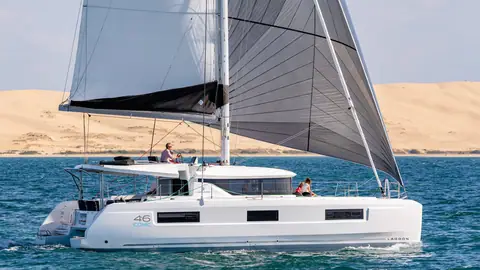
Lagoon 46
Sailing Catamarans, 46 ft
Used $620K to $950K
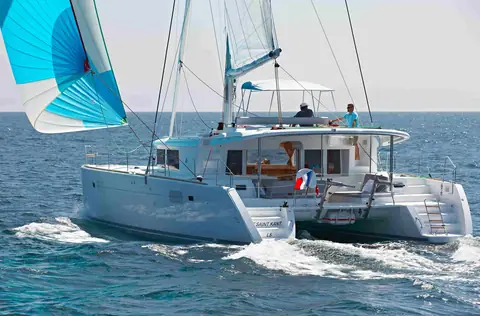
Lagoon 450
Sailing Catamarans, 46 ft
Used $250K to $580K
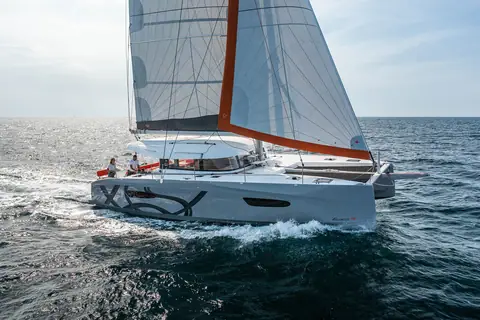
Excess 14
Sailing Catamarans, 46 ft
Used $540K to $800K
Fountaine Pajot Saona 47
Sailing Catamarans, 46 ft
Used $560K to $800K