Nautitech 46 Open Review, Specs and Used Buying Guide
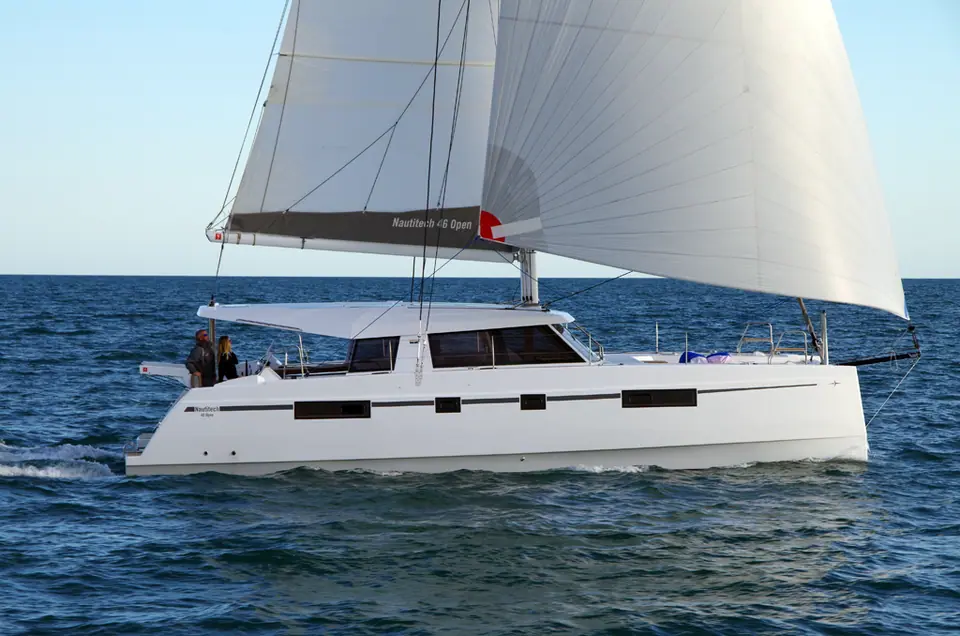
A Marc Lombard catamaran that put the helms at the stern and the crew at one level, for sailors who would rather feel the boat than look down on it.
- Length
- 45.2 ft13.79 m
- Beam
- 24.7 ft7.54 m
- Draft
- 4.8 ft1.45 m
- Cabins
- 3 or 4
- Used price
- $420K to $700K
On this page
- Overview
- The Nautitech 46 Open and the case for helming from the stern
- Lombard's slim hulls and what 10.8 tonnes buys you
- Living with twin aft helms and a rigid bimini
- One floor from transom to galley
- Three cabin owner's hull or four cabin charter layout
- Sailing performance in real test conditions
- Volvo saildrives, tankage and motoring range
- What a Nautitech 46 Open costs to keep
- Nautitech 46 Open versus the 46 Fly
- Specifications
- Price and value
- Strengths and weaknesses
- Used buyer checklist
- Rivals
- Our verdict
- FAQ
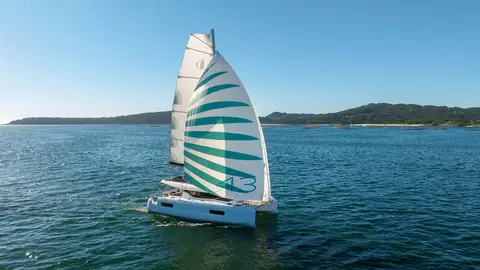
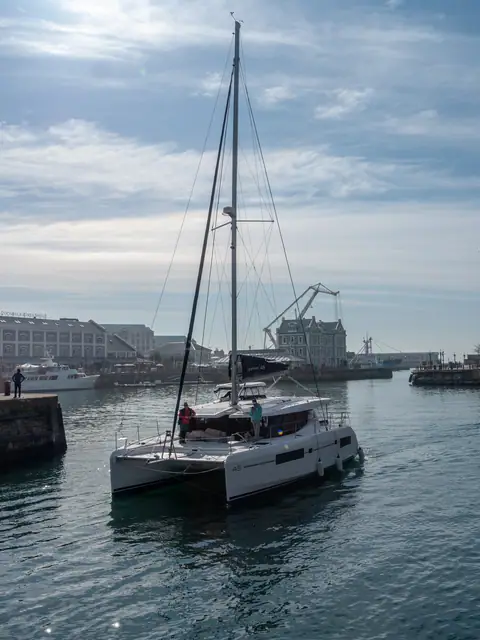
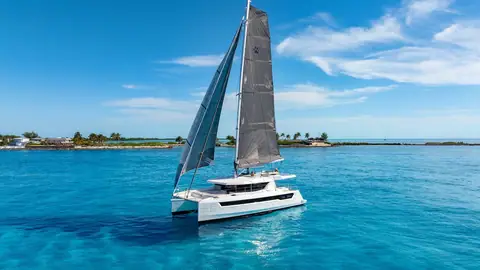
The Nautitech 46 Open is a 45-foot French cruising catamaran built in Rochefort from 2016, with twin aft helms, a single-level cockpit and saloon, and light Marc Lombard hulls that sail noticeably quicker than flybridge rivals.
- Monohull sailors moving to their first catamaran
- Couples who sail more than they motor
- Owners who want speed without Outremer prices
- Mediterranean and Caribbean cruising
The Nautitech 46 Open and the case for helming from the stern
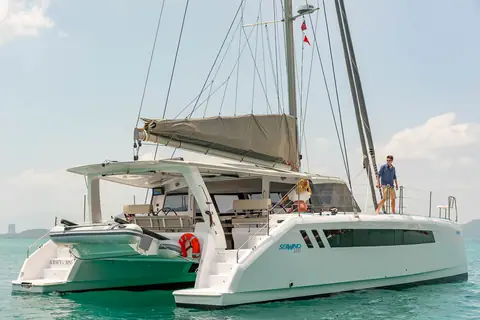
Most 45-foot production catamarans built since 2015 put the skipper on a flybridge, a few feet above everyone else. The Nautitech 46 Open does the opposite. Its two wheels sit at the aft corners of the cockpit, close to the water, where the helmsman can see the sail trim, feel the hulls load up in a gust and talk to the crew without shouting up a ladder. For a certain kind of sailor, the kind who came to catamarans from a monohull and misses the tiller, that single decision is the reason to buy this boat.
Nautitech, the Rochefort yard on the Charente river that has been part of the Bavaria group since the mid 2010s, launched the 46 Open in 2016 with naval architecture from Marc Lombard. A sister Fly version with a raised helm followed for buyers who wanted the conventional layout. In 2019 the Open was refreshed with a slightly larger mainsail (76 square meters against 74) and revised styling, and it was still listed alongside the new 44 Open in 2022 before Nautitech made the larger 48 Open its flagship.
That makes the 46 Open a used-market boat today, priced much closer to the volume charter cats than to the daggerboard performance boats it often keeps up with.
Nautitech 46 Open by the numbers
- Sail area to displacement
- 23.7Plenty of sail for the weight, the boat should feel lively in light air.
- Displacement to length
- 117Ultralight. Built for speed, keep payload to a minimum.
- Theoretical hull speed
- 9.0 knDisplacement hull speed for the waterline. Light catamarans regularly sail faster than this because their slim hulls do not make a large bow wave.
- Length to beam ratio
- 1.83 : 1Catamaran overall proportions. Wider platforms resist pitching and heel.
Lombard's slim hulls and what 10.8 tonnes buys you
The numbers explain the character. The light ship displacement is 10,800 kg (23,810 lb) on a 13.71 meter waterline, which works out to a displacement to length ratio of about 117. A Lagoon 46 is roughly 15.8 tonnes on a similar length. The Nautitech carries about 114 square meters of upwind sail on a rig with a 22.9 meter air draft, giving a sail area to displacement ratio near 24. Those are performance cruiser figures, not charter cat figures.
Lombard drew narrow, fine-entry hulls with a modest amount of flare above the waterline and tall freeboard forward. The bows cut into a short sea instead of slapping it, and the bridgedeck clearance is generous for the class. The price of that efficiency is volume. The hulls are visibly slimmer than a Bali or Leopard of the same length, so cabins are narrower at floor level and storage is tighter.
Construction is resin-infused fiberglass over Divinycell foam core, with solid laminate in high-load areas. Infusion gives a better resin to glass ratio than the hand-laid boats of the 2000s, which is part of how Nautitech kept weight down without exotic materials.
- Displacement to length ratio about 117, very light for a production cruiser
- Sail area to displacement ratio about 24
- Fixed shoal keels, 1.45 m (4 ft 9 in) draft
- Bridgedeck clearance well above the class average
Living with twin aft helms and a rigid bimini
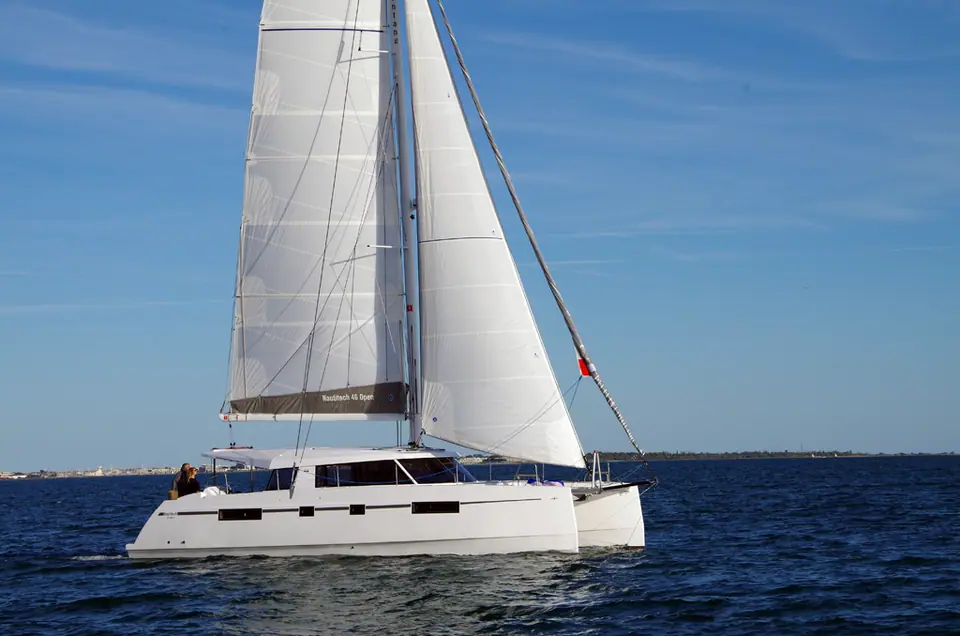
Each helm station has its own winch package, and all the lines lead aft so the boat can be reefed without going forward. In practice, most couples work the main from one side and use the leeward station as a vantage point for docking. Visibility over the opposite bow is the known weakness. From the starboard wheel you cannot see the port bow clearly when coming alongside, which is why many owners fit bow cameras or bring a crew member forward in a tight marina.
Exposure is the other trade-off. An aft helm is wetter and more open than a flybridge under a hardtop, and a helmsman on a long upwind leg in the trade winds will get spray.
Where the layout pays back is at anchor and under way with family. There is no ladder between the helm and the cockpit table, so the person steering is part of the conversation, and the boom is low enough to reach from the coachroof for flaking and covering the main.
One floor from transom to galley
Open the sliding doors and the saloon and cockpit become one long room on a single level, and on the 2019 New 46 Open tested by Giornale della Vela the galley sits just inside the doors to starboard where it can serve both. Descriptions of the earlier boats place a U-shaped galley forward, so check which arrangement a given boat has. The full-glass deckhouse wraps around to the stern, so the interior is bright, and the forward saloon windows give the navigation area a view over the bows.
The interior finish is a step above the charter cats of the same era, with lighter wood tones and tidier joinery. It is not Outremer level carpentry, but it has generally aged well.
Three cabin owner's hull or four cabin charter layout
The three cabin version gives an entire hull, more than 30 feet of it and on the port side according to published layout descriptions, to the owner, with an island-style bunk aft, a desk and settee amidships, large hull windows and a big head and shower forward. The other hull carries two en suite doubles that share a shower stall. In the four cabin layout each hull mirrors the other with two doubles, and on some boats the heads are split so toilets and showers are separate compartments.
Small forepeak cabins with a single berth exist on some hulls, which is how berth counts climb toward ten. They are useful for children or a delivery crew, not for adult guests on a week-long cruise.
If you are buying to cruise as a couple, hold out for the owner's version. Four cabin boats from charter fleets are cheaper, but the owner's hull is the feature that makes a 46-foot cat feel like a home rather than a floating hotel.
Sailing performance in real test conditions
Published trials give a consistent picture. Katamarans.com expects low and even mid teens off the wind in decent conditions, and SAIL reports the delivery crew of the sister 46 Fly briefly saw 16 knots. In very light air off Cannes, around 5 to 8 knots of breeze, the boat made about 4 knots at 50 to 55 degrees to the wind and accelerated to 6 or 7 knots as soon as the sheets were eased. The designer's polars show around 15 knots of boat speed in 25 knots of true wind at 110 degrees.
Upwind it is good for a fixed-keel cat but no match for a daggerboard boat. The self-tacking jib makes short tacking easy, but in under 10 knots of wind a code zero or gennaker is what transforms the boat, and listings without one should be priced accordingly. Reaching in 15 to 20 knots is where the light hulls show their advantage over heavier flybridge cats.
Volvo saildrives, tankage and motoring range
Standard power is twin 40 hp Volvo Penta diesels with saildrives, with a 55 hp option offered on the 46 platform for a modest premium. In calm water one engine at 2,200 rpm gives just over 6 knots and both engines push the boat close to 8 knots. SAIL's trial of the Fly version with the optional 55 hp engines recorded 8.1 knots at 2,300 rpm and 9 knots at full throttle (2,700 rpm), which is effectively the hull's displacement speed under power.
Tankage is 600 liters (159 gallons) of diesel and the same of fresh water. At 7 knots on one engine, fuel burn is low enough to give several hundred miles of range, but the water tanks are modest for a family boat and a watermaker should be considered essential for anyone leaving the US East Coast.
The engine rooms sit under the aft cabins. Access is reasonable for impeller and filter work, but saildrive seal replacement requires a haul-out, and that service interval (typically every seven years on Volvo drives) is something to confirm on any boat built before 2019.
What a Nautitech 46 Open costs to keep
Plan on roughly $35,000 to $65,000 a year for a privately cruised boat, excluding depreciation. The big variables are where you keep it and how much you sail. At 24 ft 9 in of beam the boat needs a catamaran slip or end tie, which in Florida and the Chesapeake often costs 1.5 to 2 times a monohull berth of the same length. Insurance for a 2016 to 2020 cat in the Caribbean hurricane belt has risen sharply and typically runs 1.5 to 2.5 percent of hull value.
Mechanical costs are modest because the systems are simple: two small diesels, saildrives, a fixed rig and fixed keels. Sails are the main capital item. A square-top main and self-tacking jib last about eight to ten seasons of private cruising and far less in charter use. The 75-foot air draft also means the standard rig will not pass under the 65-foot fixed bridges of the Intracoastal Waterway, so East Coast owners go outside or look for the shorter mast option offered on the 46 platform.
Nautitech 46 Open versus the 46 Fly
The Fly shares the hulls and interior but moves the helm to a raised station with three electric winches clustered around the wheel and a small lounge on the upper deck. It is the better choice for owners who want a higher sightline when docking, more weather protection and a social space up top. It is also heavier aloft, and the boom is high enough that flaking the main requires mast steps.
The Open is the purer sailing boat and, in our view, the more distinctive purchase. Fly hulls are a little easier to resell in charter-heavy markets, while the Open tends to appeal to owners who sail more than they entertain.
Nautitech 46 Open specifications
| Length overall | 45.2 ft13.79 m |
|---|---|
| Waterline length | 45 ft13.71 m |
| Beam | 24.7 ft7.54 m |
| Draft | 4.8 ft1.45 m |
| Air draft | 75.1 ft22.89 m |
| Displacement | 23,81 lbs10,8 kg |
| Sail area | 1,227 sq ft114 m² |
| Fuel capacity | 159 gal6 L |
| Fresh water | 159 gal6 L |
| Cabins | 3 or 4 |
| Berths | 6 to 10 |
| Heads | 3 or 4 |
| Standard engines | 2 x Volvo Penta 40 hp diesel with saildrives |
| Optional engines | 2 x 55 hp diesel (offered on the 46 platform) |
| Maximum power | 110 hp |
| Cruise speed | 8 knots |
| Hull type | Catamaran, twin hulls with fine entries and reduced hull flare |
| Keel | Twin fixed shoal keels |
| Rig | Fractional sloop, square-top mainsail, self-tacking jib, gennaker on bowsprit |
| Hull construction | Resin-infused fiberglass sandwich with Divinycell foam core |
| Builder | Nautitech Catamarans (Bavaria Yachts group), France |
| Naval architect | Marc Lombard Design Group |
| Production | 2016 to present |
| Status | Discontinued |
Figures come from builder documentation and independent tests where available. Displacement is usually quoted light, so a loaded cruising boat will weigh more. Compare these specs with another model.
How much does a Nautitech 46 Open cost?
The last ex-works base price quoted in Europe was about 459,550 euros before VAT and options, so most boats left the yard well above that once electronics, a generator and sails were added. In the US, 2018 boats have recently been listed between about $475,000 and $600,000, and the owner's three cabin version carries a premium over four cabin ex-charter hulls. Whether VAT has been paid matters on European boats imported to the US, so read the asking price carefully.
Estimate your yearly cost
A planning estimate using common rules of thumb: insurance near 1.5 percent of value, maintenance near 3 percent, haul out and bottom paint by length. Your marina, region and use will move these numbers. Open the full cost calculator.
Versions and options
- 46 Open (2016 to 2018)
- Original Marc Lombard version with a 74 square meter mainsail, aft twin helms and single-level saloon and cockpit.
- New 46 Open (2019 onward)
- Restyled deckhouse and topsides, mainsail grown to 76 square meters, updated interior finishes.
- 46 Fly
- Same hull platform with a raised helm station and upper lounge, electric winches at the helm and an optional shorter mast.
Nautitech 46 Open timeline
- 2016Nautitech 46 Open launched with Marc Lombard naval architecture and aft twin helms
- 2016Sister 46 Fly launched on the same hulls, later tested by SAIL in Annapolis
- 2019New 46 Open restyled with a larger mainsail and refreshed interior
- 2022Nautitech 44 Open introduced to US buyers at the Miami boat show; Cruising World lists the 46 Open still in the range
- 2024Nautitech 48 Open, the last design of the late Marc Lombard, tested in Miami as the new flagship
Strengths and weaknesses
What owners like
- Light displacement gives genuinely quick reaching speeds for the price
- Aft helms keep the skipper connected to sails, water and crew
- Single-level cockpit and saloon make an excellent social space
- All lines led aft for reefing from the helm
- Interior finish has aged better than most charter-era rivals
- Used prices well below a Lagoon or Fountaine Pajot of the same year
What to weigh up
- Limited visibility over the opposite bow when docking
- Helm stations are exposed in heavy weather
- Slimmer hulls mean less cabin and storage volume
- Standard 75-foot air draft blocks the ICW fixed bridges
- Modest 159-gallon water tankage without a watermaker
Used Nautitech 46 Open buyer checklist
Take this list to a viewing. Your ticks are saved in this browser so you can come back to it.
Always commission an independent marine survey and an engine survey before you buy. How a marine survey works.
Rivals to consider
Excess 14
The closest concept, with twin aft helms and a sporty brief, but built by the Beneteau group with more interior volume and a heavier displacement.
Compare side by sideFountaine Pajot Saona 47
A more conventional flybridge cruiser with more space in the hulls and a stronger charter resale market, at the cost of sailing feel.
Compare side by sideLagoon 46
Heavier, roomier and easier to resell, but several knots slower on a reach and with a flybridge helm far from the water.
Compare side by sideLeopard 45
South African built with a forward cockpit and huge volume, aimed at charter and liveaboard buyers rather than sailors chasing speed.
Compare side by sideOur verdict on the Nautitech 46 Open
The Nautitech 46 Open is the best value way into a catamaran that actually sails. It is lighter, quicker and more involving than the flybridge cats it shares marinas with, and used prices around $450,000 to $650,000 put it well below an Outremer or Catana. The aft helms and slimmer hulls will rule it out for buyers who want maximum volume or a sheltered watch station, and the four cabin charter boats should be surveyed with care. For a couple who measure a good day in miles made under sail, a well kept three cabin Open is one of the smartest buys in the 45-foot class.
Nautitech 46 Open questions answered
How much is a Nautitech 46 Open for sale in the US?
Most Nautitech 46 Open listings fall between about $420,000 and $700,000. Recent 2018 boats in the US have been listed between roughly $475,000 and $600,000, with three cabin owner's versions at the top.
Is the Nautitech 46 still in production?
No. It has left the range, and the current Nautitech line is led by the 44 Open, introduced in 2022, and the larger 48 Open flagship.
What is the difference between the Nautitech 46 Open and the 46 Fly?
Both share hulls and interiors. The Open has twin aft helms and a single-level cockpit, while the Fly moves the helm to a raised flybridge with an upper lounge.
How fast is the Nautitech 46 Open?
In light air off Cannes it made 6 to 7 knots with eased sheets in 5 to 8 knots of breeze, and the designer's polars predict about 15 knots in 25 knots of true wind on a reach. Under power expect close to 8 knots on both 40 hp engines.
Who designed the Nautitech 46?
The naval architecture is by Marc Lombard, and the boat was built by Nautitech Catamarans in Rochefort, France, a yard owned by the Bavaria group.
Can a Nautitech 46 Open cross an ocean?
Yes, many have crossed the Atlantic. Add a watermaker, a proper downwind sail and protection at the helms before committing to a long passage.