Seawind Catamarans Sailing Catamarans
Seawind 1600 Catamaran Review, Price and Ownership Notes
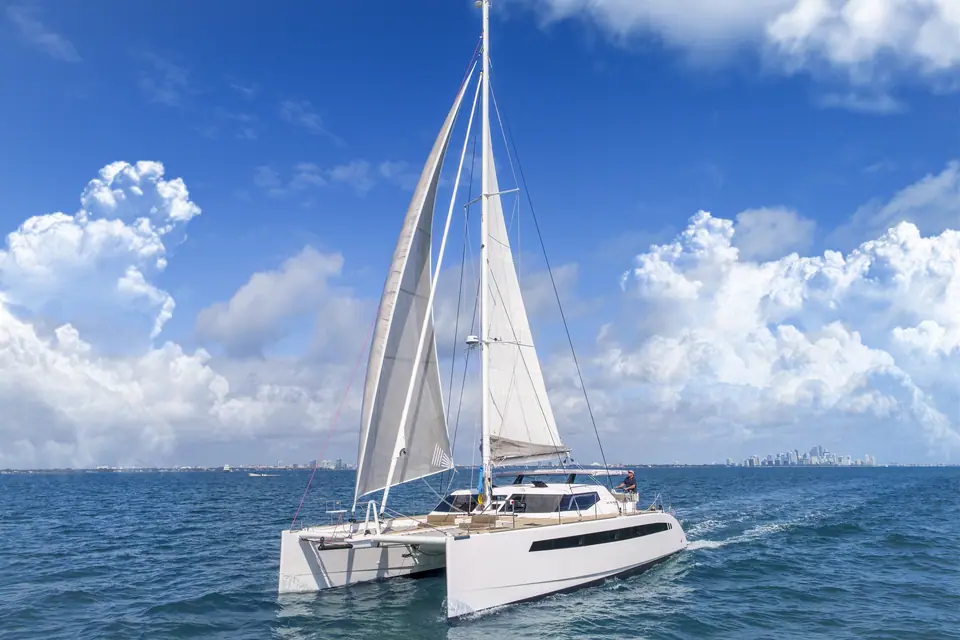
Reichel/Pugh drew a 52-foot daggerboard catamaran with protected inside-the-cockpit helms, and Seawind built it for couples who cross oceans.
- Length
- 51.7 ft15.74 m
- Beam
- 25.9 ft7.9 m
- Draft
- 2.1 ft0.64 m
- Cabins
- 3 or 4
- Used price
- $850K to $1.25M
On this page
- Overview
- How an Australian beach-cat builder ended up with a 52-foot bluewater flagship
- Reichel/Pugh lines, Kevlar hulls and a 13 tonne target
- Captive daggerboards that stay out of the way
- Twin helms under the coachroof, a Seawind signature
- Galley up, owner's hull and the narrow forward cabin
- What the Seawind 1600 does on the water
- Yanmar power, 24 volt systems and tankage
- Ownership costs and the value question
- Specifications
- Price and value
- Strengths and weaknesses
- Used buyer checklist
- Rivals
- Our verdict
- FAQ
The Seawind 1600 is a 52-foot performance cruising catamaran designed by Reichel/Pugh and built by Seawind in Ho Chi Minh City since 2018. Daggerboards, sheltered twin helms and SAIL's 2021 Best Boat award define it.
- Couples planning ocean passages
- Liveaboards who sail long distances
- Owners moving up from a smaller performance cat
- Cruisers wanting shallow-draft access
How an Australian beach-cat builder ended up with a 52-foot bluewater flagship
Seawind began in 1982, when Richard Ward started building off-the-beach catamarans in Australia. The first true cruiser, the 28-foot Seawind 850, arrived in 1991, and for two decades the brand was known for practical, family-sized cats in the 30 to 40 foot range. The turning point came in 2010, when Seawind bought Corsair Marine, the trimaran builder that had already moved its production from San Diego to Ho Chi Minh City. Seawind production followed, along with Australian shipwrights and managers to run the floor.
The Seawind 1600 is the result of that scale. It is the largest boat Seawind has built, with naval architecture by Reichel/Pugh, the San Diego firm better known for maxi racing yachts. The first production hull launched in 2018, and in 2021 SAIL magazine named it Best Boat in the large multihull, 50 feet and over, category.
The Seawind 1600 is aimed squarely at couples planning long passages: fast enough for long daily runs, small enough in systems and sail loads to be handled by two people, and finished well enough to live aboard for years.
Seawind 1600 by the numbers
- Sail area to displacement
- 27.0Racing level power, needs active reefing as the breeze builds.
- Displacement to length
- 92Ultralight. Built for speed, keep payload to a minimum.
- Theoretical hull speed
- 9.6 knDisplacement hull speed for the waterline. Light catamarans regularly sail faster than this because their slim hulls do not make a large bow wave.
- Length to beam ratio
- 2.00 : 1Catamaran overall proportions. Wider platforms resist pitching and heel.
Reichel/Pugh lines, Kevlar hulls and a 13 tonne target
On paper the boat is long, light and narrow-hulled. The hull length is about 51 feet 7 inches (Seawind quotes 52 feet 8 inches overall including fittings), the waterline runs almost the full length, and SAIL lists light ship displacement at about 28,000 lb (12.7 tonnes), although Seawind's current Passagemaker spec quotes 31,700 lb (14,400 kg) as built. Upwind sail area is 144.5 square meters, so the power to weight ratio sits firmly in performance cruiser territory, ahead of any flybridge production cat.
Construction follows Reichel/Pugh's engineering. Hulls, deck and bimini are vinyl ester resin-infused over PVC foam core, a layer of Kevlar is added to the hulls for impact resistance, and carbon reinforces the chainplate areas and main bulkheads. Seawind engineers the boats to CE Category A, and carbon spar options are available for owners who want to save weight aloft.
The bows are fine, and that has a cost inside. Both test crews and owners note that the forward guest cabin is narrow, a direct consequence of the entry that makes the boat quiet and quick in a seaway.
- Light ship about 28,000 lb per SAIL, 31,700 lb in the current Passagemaker spec
- 144.5 m2 upwind sail area, 220 m2 optional spinnaker
- Kevlar layer in hull laminate, carbon at chainplates and bulkheads
- Bridgedeck clearance kept high for offshore comfort
Captive daggerboards that stay out of the way
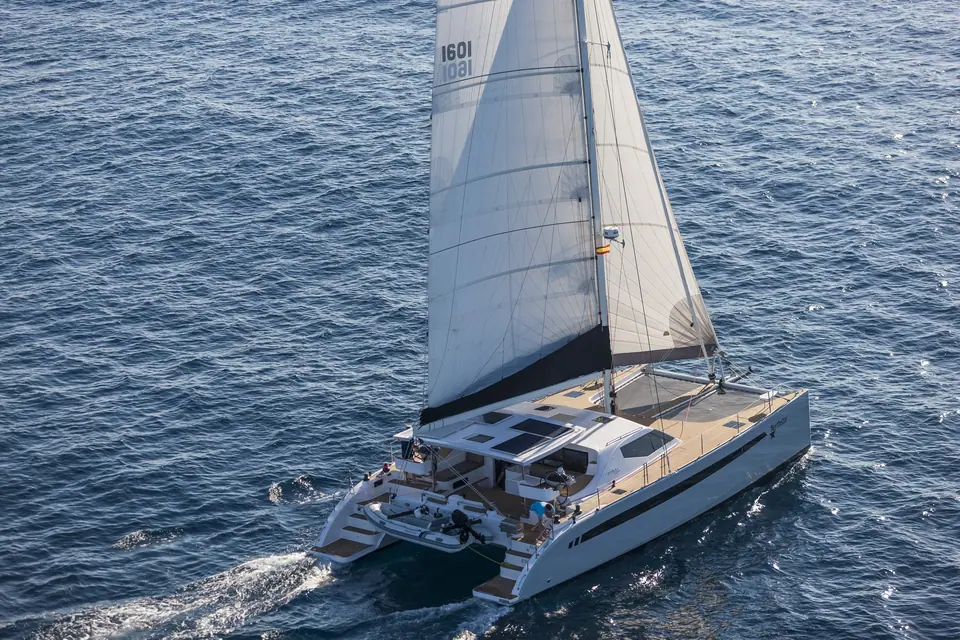
Daggerboards are what separate the 1600 from the fixed-keel cats it shares anchorages with. With boards up, draft is about 2 feet; with boards down it is 8 feet 6 inches. Seawind made them captive, recessed into the deck with flip-up covers, and controlled from the cockpit, so no one goes forward in a seaway to raise or lower them. The rudders retract too, which protects them in a grounding and opens shallow lagoons and river mouths few 52-footers can reach.
Upwind the boards pay off. Cruising World made a respectable 6.6 knots heading home on the self-tacking jib and credited the daggerboards for pointing well. Downwind, lift the boards partway and the boat frees up and tracks well.
Twin helms under the coachroof, a Seawind signature
Seawind has always placed its helms at the aft end of the coachroof rather than on a flybridge or out on the transom, and the 1600 continues the idea. The two wheels sit sheltered under the roof yet outboard enough to see the bows and the sail, and they are raised for visibility over the deckhouse. On a night watch the helmsman is protected from rain and spray but still close to the cockpit, which is a far more social and safer arrangement than a flybridge for a couple doing three-hour watches.
All sail controls lead to the helm area. Most boats carry at least one electric winch, and the self-tacking jib means tacking upwind is a one-person job.
Galley up, owner's hull and the narrow forward cabin
The galley is up on the bridgedeck facing aft, with large sliding windows that open onto the cockpit dining table, and a forward-facing navigation station with a vast work surface gives a clear view through the front windows. The cockpit itself is on a single level, though its outdoor dining area is smaller than on a Lagoon or Leopard of similar length. That reflects the brief: this is a passagemaker first and an entertaining platform second.
The standard three cabin version gives the starboard hull to the owner with a large berth, a long run of storage and a head with separate shower. The port hull holds an aft guest cabin with a queen or twin option and a forward cabin that SAIL described as undersized and Cruising World as a bit narrow. Some layouts have only one head in the port hull to serve both guest cabins, so check the specific boat if you cruise with another couple. A four cabin plan exists but suits occasional guests rather than charter.
The finish is a strong point. Joinery, lighting and hardware are close to the European performance yards, and SAIL noted space in the owner's head for an optional combination washer and dryer.
What the Seawind 1600 does on the water
SAIL's test on Biscayne Bay was hardly a light-ship trial, with full tanks and 14 people aboard. In 12 to 13 knots of breeze with the boards halfway down, the boat made 6.3 knots at 60 degrees apparent and 6.5 knots at 120 degrees, then 8.9 knots on a beam reach when the wind built to 16 knots. Cruising World recorded the high 7s on a beam reach under screecher, 8.5 knots and more under spinnaker, and 6.6 knots upwind on the self-tacking jib.
Those figures understate the boat in open water, since SAIL sailed fully tanked with 14 aboard, and with a light-ship displacement to length ratio SAIL puts at 92 the 1600 has the potential for big daily runs on passage. For a couple, the more important point is that the 1600 is easily driven: you can reef early, sail on the main and jib alone, and still cover distance.
Yanmar power, 24 volt systems and tankage
Standard engines are twin 57 hp Yanmar diesels on saildrives with fixed three-blade propellers. In SAIL's test the boat reached 9.2 knots at 3,200 rpm and cruised at 8.2 knots at 2,200 rpm. Cruising World's boat had the optional 80 hp Yanmars, which give a similar cruise just over 8 knots with more reserve for punching into a headsea. The engine bays are aft and well laid out for service.
The house system is 24 volts, with a 400 Ah battery bank, a Mastervolt 2,500 W inverter charger and two 200 W solar panels as delivered, and many owners add lithium and more solar on the bimini. Seawind currently lists tankage of 750 liters (200 gallons) of diesel and 658 liters (174 gallons) of water, and a watermaker is a sensible addition for long passages.
Ownership costs and the value question
Budget roughly $50,000 to $95,000 a year to run a privately owned 1600, depending on insurance region, slip and how far you sail. The 26-foot beam rules out most standard slips, and Kevlar and carbon structures mean insurers want a surveyor who knows composites. Daggerboard bearings, lifting lines and trunk inspections add a small recurring item that fixed-keel owners never face.
Resale has been firm. Production is limited, and recent US asking prices of about $990,000 to $1.15 million for 2022 and 2023 boats are close to their original sail-away prices. Compared with an Outremer 51 of similar age, a Seawind usually lists a little lower, which is the buyer's opening.
Seawind 1600 specifications
| Length overall | 51.7 ft15.74 m |
|---|---|
| Waterline length | 51.5 ft15.7 m |
| Beam | 25.9 ft7.9 m |
| Draft | 2.1 ft0.64 m |
| Displacement | 28, lbs12,7 kg |
| Sail area | 1,555 sq ft144.5 m² |
| Fuel capacity | 2 gal75 L |
| Fresh water | 174 gal658 L |
| Cabins | 3 or 4 |
| Berths | 6 to 8 |
| Heads | 2 or 3 |
| Standard engines | 2 x Yanmar 57 hp diesel with saildrives |
| Optional engines | 2 x Yanmar 80 hp diesel |
| Maximum power | 160 hp |
| Cruise speed | 8.2 knots |
| Top speed | 9.2 knots |
| Hull type | Catamaran, twin narrow hulls with fine bows |
| Keel | Twin retractable daggerboards (2 ft 1 in up, 8 ft 6 in down) and retractable rudders |
| Rig | Fractional sloop, 100 m2 mainsail, 44.5 m2 self-tacking jib, optional screecher and spinnaker |
| Hull construction | Vinyl ester resin-infused PVC foam sandwich with Kevlar in the hulls and carbon reinforcement at chainplates and bulkheads |
| CE design category | A |
| Builder | Seawind Catamarans (with Corsair Marine), Vietnam |
| Naval architect | Reichel/Pugh Yacht Design |
| Other design credits | Seawind in-house team (interior and deck layout) |
| Production | 2018 to present |
| Status | In production |
Figures come from builder documentation and independent tests where available. Displacement is usually quoted light, so a loaded cruising boat will weigh more. Compare these specs with another model.
How much does a Seawind 1600 cost?
SAIL quoted a $900,000 base price in 2020 with its test boat at $1.2 million, and Cruising World put a delivered East Coast boat at about $1.2 million the same year, so current sail-away pricing sits well above that after five years of yard inflation. The carbon mast, 80 hp engines, the Passagemaker specification and electronics are the big swing items. Recent US listings for 2022 and 2023 boats have asked roughly $990,000 to $1.15 million.
Estimate your yearly cost
A planning estimate using common rules of thumb: insurance near 1.5 percent of value, maintenance near 3 percent, haul out and bottom paint by length. Your marina, region and use will move these numbers. Open the full cost calculator.
Versions and options
- Standard 1600
- Three cabin owner's layout, 57 hp Yanmar diesels, aluminum rig and self-tacking jib.
- Passagemaker edition
- Seawind's offshore specification with extended storage, washing machine option and cruising equipment pack.
- Engine and rig upgrades
- 80 hp Yanmar diesels and carbon spar options, both common on US boats.
Seawind 1600 timeline
- 1982Richard Ward starts building beach catamarans in Australia
- 1991Seawind 850 launched, the brand's first cruising catamaran
- 2010Seawind acquires Corsair Marine and moves production to Ho Chi Minh City
- 2018First production Seawind 1600 launched
- 2021SAIL names the 1600 Best Boat, large multihull 50 feet and over
Strengths and weaknesses
What owners like
- Daggerboards give real upwind ability and 2-foot draft with boards up
- Sheltered twin helms are ideal for couples standing watches
- Light, Kevlar-reinforced hulls sail fast with modest sail loads
- Retractable rudders protect against grounding damage
- High finish quality for the price
- Strong resale with limited supply
What to weigh up
- Forward guest cabin is narrow because of the fine bows
- Only one head serves the two guest cabins in the three cabin layout
- Smaller outdoor dining space than charter-style cats
- Daggerboard systems add maintenance and survey items
- Vietnam build means fewer service points than French brands
Used Seawind 1600 buyer checklist
Take this list to a viewing. Your ticks are saved in this browser so you can come back to it.
Always commission an independent marine survey and an engine survey before you buy. How a marine survey works.
Rivals to consider
Outremer 51
The benchmark French daggerboard cruiser, a little lighter and with stronger resale, usually priced above a Seawind of the same year.
Compare side by sideLagoon 50
Far more volume and a flybridge, but heavier, slower upwind and with fixed keels.
Compare side by sideBalance 526
South African built daggerboard cat with a similar couple-focused brief and a versatile helm.
Catana 53
French daggerboard cat with twin aft helms and a long offshore record, usually lighter on interior finish.
Compare side by sideOur verdict on the Seawind 1600
The Seawind 1600 is one of the most sensible performance cruisers on the market. It gives you daggerboards, protected helms and genuine ocean speed in a package two people can run, at a price below the French benchmark. You give up some cabin width and the social flybridge, and you take on daggerboard maintenance. For couples who will actually cross oceans, that is a trade worth making, and a well-documented boat with the 80 hp engines is the one to find.
Seawind 1600 questions answered
What is the Seawind 1600 price?
SAIL quoted a $900,000 base price in 2020, with typical delivered boats around $1.2 million. New boats today generally land between about $1.25 and $1.7 million, and recent used listings run about $990,000 to $1.15 million.
Where is the Seawind 1600 built?
It is built by Seawind in Ho Chi Minh City, Vietnam, in the factory Seawind took over when it acquired Corsair Marine in 2010.
Who designed the Seawind 1600?
Reichel/Pugh Yacht Design, the US firm known for maxi racing yachts, drew the hulls and structure.
How fast is the Seawind 1600?
Magazine tests recorded 8.9 knots on a beam reach in 16 knots of wind with 14 people aboard, 8.5 knots under spinnaker and 6.6 knots upwind on the self-tacking jib. Under power SAIL logged 8.2 knots at 2,200 rpm and 9.2 knots flat out.
Does the Seawind 1600 have daggerboards?
Yes. Captive daggerboards controlled from the cockpit vary the draft from about 2 feet to 8 feet 6 inches, and the rudders also retract.
Is the Seawind 1600 good for a couple?
It is designed for couples, with sheltered twin helms, all lines led to the helm and a self-tacking jib.
Seawind 1600 photos
More sailing catamarans to explore
Outremer 51
Sailing Catamarans, 51 ft
Used $700K to $1.3M
Leopard 50
Sailing Catamarans, 51 ft
Used $620K to $1.15M
Catana 53
Sailing Catamarans, 53 ft
Used $1M to $1.45M
Catana 50
Sailing Catamarans, 50 ft
Used $430K to $650K