Fountaine Pajot Sailing Catamarans
Fountaine Pajot Isla 40 Review and Used Buying Guide
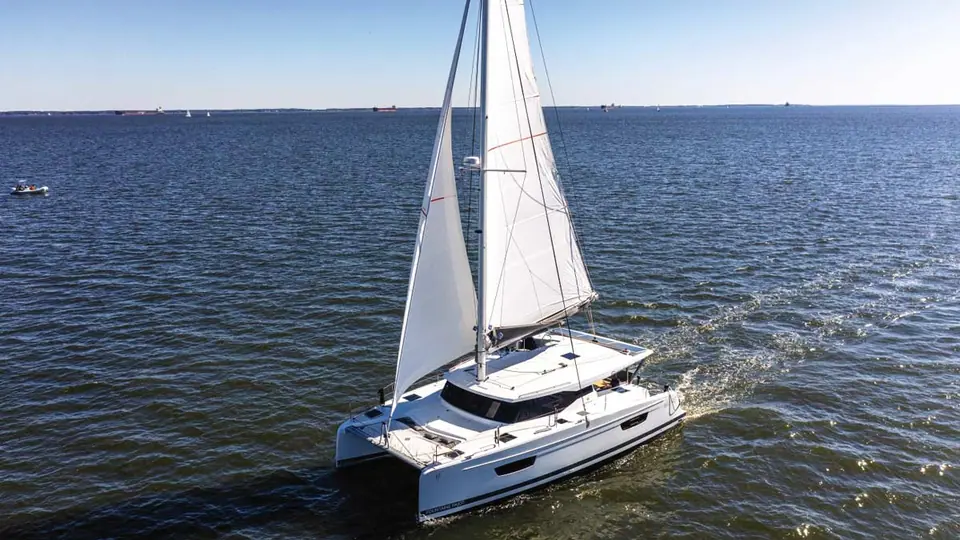
A light, 9.5-ton 40-footer that sails better than most entry-level cats, built from 2020 until the heavier FP 41 replaced it.
- Length
- 39.1 ft11.93 m
- Beam
- 21.8 ft6.63 m
- Draft
- 4 ft1.21 m
- Cabins
- 3 or 4
- Used price
- $360K to $560K
On this page
- Overview
- From Lucia 40 to Isla 40, a careful evolution
- Light displacement and a modest, well-balanced rig
- What testers saw from Lake Ontario to the Bay of Biscay
- Maestro owner's hull or four cabin Quatuor
- Engines, tanks and the case for the 30 hp upgrade
- New prices, used prices and the FP 41 effect
- Costs of owning a 40-foot French cat in the US
- Specifications
- Price and value
- Strengths and weaknesses
- Used buyer checklist
- Rivals
- Our verdict
- FAQ
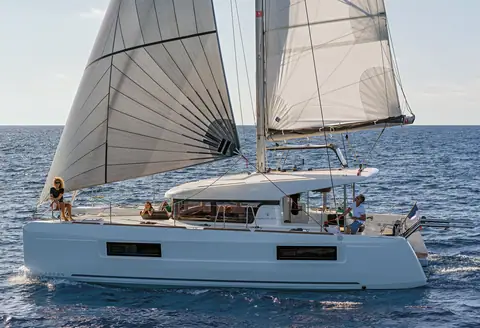
Berret-Racoupeau's 2020 update of the best-selling Lucia 40, with inverted bows, a redesigned interior and twin 20 or 30 hp engines. Replaced by the Fountaine Pajot 41 for 2025.
- Couples buying a first catamaran
- Coastal and Bahamas cruisers
- Sailors who value performance over volume
- Owners with limited slip width
Fountaine Pajot Isla 40 by the numbers
- Sail area to displacement
- 21.5Plenty of sail for the weight, the boat should feel lively in light air.
- Displacement to length
- 182Light displacement for its length, quick but sensitive to added cruising weight.
- Theoretical hull speed
- 8.2 knDisplacement hull speed for the waterline. Light catamarans regularly sail faster than this because their slim hulls do not make a large bow wave.
- Length to beam ratio
- 1.80 : 1Catamaran overall proportions. Wider platforms resist pitching and heel.
From Lucia 40 to Isla 40, a careful evolution
The Fountaine Pajot Isla 40 is the boat the La Rochelle yard built to protect its best seller. The Lucia 40 had been launched in 2016, was built around 300 times and, according to yacht.de, was once regarded as the best-selling multihull in the world. In 2020 Fountaine Pajot presented the Isla 40 as its replacement, with the world premiere in September. The order book proved the strategy right: yacht.de reported 110 orders within six months of launch.
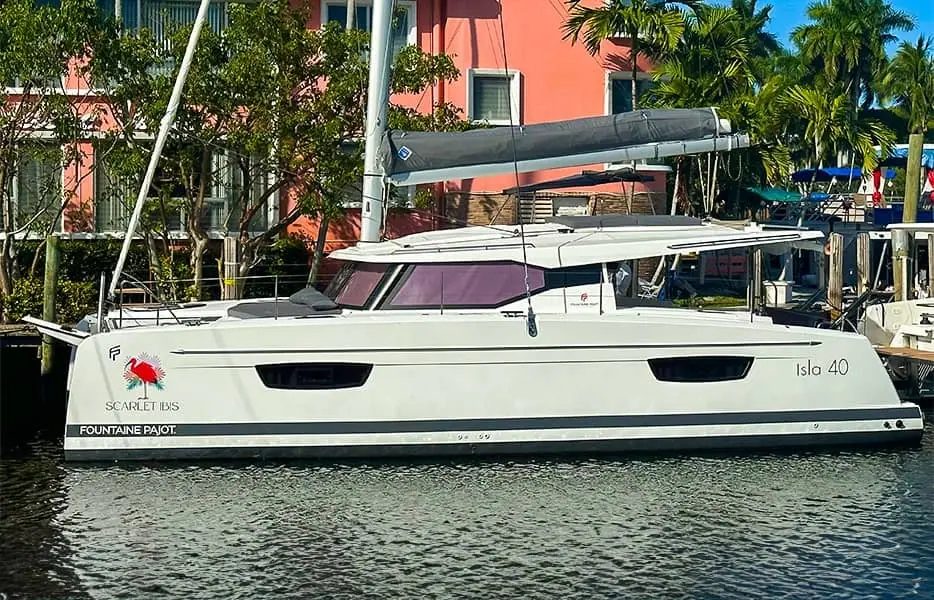
Berret-Racoupeau Yacht Design kept the Lucia's primary hull mold and changed what mattered. The bows became near-vertical inverted stems that stretch the effective waterline and cut pitching, the deck and coachroof were redrawn for a longer, more dynamic profile, and the interior was rebuilt around brighter surfaces, rounded Corian galley counters and a chaise lounge in the saloon where the Lucia had a navigation corner.
Weight climbed from about 8.9 tons on the Lucia to 9.5 tons on the Isla, which is still light for a modern 40-foot cruising cat. That figure is the single best reason to prefer this boat over heavier rivals.
Light displacement and a modest, well-balanced rig
The Isla 40 measures 39 feet 2 inches overall with a 21 foot 9 inch beam and a 4 foot draft. The rig carries a 59 square meter (635 sq ft) mainsail and a 36 square meter (388 sq ft) 105 percent genoa, about 1,023 square feet in total. Yacht.de calculated a sail carrying ratio of 4.6, a touch lower than the Lucia's 4.7 because of the added weight, but still lively for the class.
The narrower beam is a hidden advantage for US owners. At under 22 feet, the Isla fits more marina slips and more boatyard travel lifts than the 24 to 26 foot wide cats in the 45-foot class, and that can save thousands of dollars a year in dockage.
What testers saw from Lake Ontario to the Bay of Biscay
Cruising World sailed close-hauled in about 12 knots of breeze and saw 6.5 to 7 knots on the GPS, then cracked off to a reach and touched 8 knots in puffs. Canadian Boating took a Maestro out of Toronto's Outer Harbour in 20 to 25 knots with a big swell and a short chop and reported 7 to 8 knots upwind under a double-reefed main, with both hulls firmly in the water and a comfortable motion.
Yacht.de tested twice. Its first sail in 5 to 8 knots was too light to judge, but the second, in Force 5 and a short, choppy Biscay sea, saw the boat exceed hull speed on reaching and downwind courses, tack quickly and answer the rudders well. Their criticism was about details: the cockpit helm controls take some getting used to, the 41 centimeter passage forward past the coachroof feels claustrophobically narrow, some squeaking was audible in rough water, and a bimini with side curtains was not standard.
Maestro owner's hull or four cabin Quatuor
Fountaine Pajot sold two layouts. The Maestro gives the owner the entire starboard hull with a walk-in shower, desk and storage, plus two double guest cabins to port sharing one or two heads. The Quatuor has four double cabins with either two or four heads and is the version found in charter fleets. Canadian Boating notes the Maestro with two heads is the most popular private spec.
In the redesign the sit-down navigation corner gave way to a stand-up instrument console with a 16-inch plotter just inside the sliding door, and Canadian Boating notes the mast was placed further forward, ahead of the dinette, both changes that free up saloon space. The galley sits just inside the saloon door to port, close to the cockpit, which works well for the outdoor dining most owners favor.
- Maestro: owner's suite, 2 guest doubles, 2 or 3 heads total
- Quatuor: 4 doubles with 2 or 4 heads
- Water 530 liters (140 gal), diesel 300 liters (80 gal)
- Standard 2 x 20 hp engines with optional 2 x 30 hp
Engines, tanks and the case for the 30 hp upgrade
Standard power is a pair of 20 hp Volvo Penta diesels driving saildrives, with 30 hp units optional. On a 9.5 ton boat the 20s are adequate in calm water, but anyone motoring into chop, running coastal deliveries or fighting a current in an inlet will appreciate the 30s. Canadian Boating's test boat had the larger engines and the crew described them as comfortable.
Tankage is the limitation. With 80 gallons of diesel and 140 gallons of water, the Isla 40 is a coastal and island-hopping cruiser out of the box. Liveaboard owners usually add a watermaker, extra solar on the bimini and lithium batteries, because there is little spare capacity for a generator and air conditioning load.
New prices, used prices and the FP 41 effect
When new, the Isla 40 was not cheap for its length. Cruising World listed it at $411,000 when its Boat of the Year judges sailed it in Annapolis in 2021, yacht.de listed a gross ex-yard price of 511,700 euros in its 2024 test, and Canadian Boating quoted a fully loaded three cabin Maestro at 890,000 Canadian dollars including taxes and duty for 2024 delivery. In September 2024, on the eve of the Cannes Yachting Festival where the Isla was already missing from the lineup, Fountaine Pajot announced the New 41 as its replacement, due about a year later, with more volume, a 5 foot draft and a displacement of 12.7 tons against the Isla's 9.5.
That replacement creates an interesting used market. Buyers who prioritize interior space will drift toward the 41, which should keep Isla 40 prices reasonable. Buyers who care about sailing will see the lighter Isla as the better boat. We expect clean owner's version Islas to hold value well, while four cabin ex-charter boats will trade at a discount of 15 to 20 percent.
Costs of owning a 40-foot French cat in the US
Annual costs run lower than for any 45-foot cat. Budget roughly $28,000 to $55,000 a year for insurance, a catamaran slip, a haul and bottom paint, engine and saildrive service and routine sail and canvas care. Volvo D1 series engines need regular attention to raw water impellers, heat exchangers and exhaust elbows, and Fountaine Pajot's US dealer network is concentrated in Florida, the Chesapeake and the Northeast.
European-built boats may need their shore power converted for US use, a job worth confirming before purchase.
Fountaine Pajot Isla 40 specifications
| Length overall | 39.1 ft11.93 m |
|---|---|
| Beam | 21.8 ft6.63 m |
| Draft | 4 ft1.21 m |
| Displacement | 20,944 lbs9,5 kg |
| Sail area | 1,023 sq ft95 m² |
| Fuel capacity | 8 gal3 L |
| Fresh water | 14 gal53 L |
| Cabins | 3 or 4 |
| Berths | 6 to 8 |
| Heads | 2 to 4 |
| Standard engines | 2 x 20 hp diesel (Volvo Penta) with saildrives |
| Optional engines | 2 x 30 hp diesel |
| Maximum power | 60 hp |
| Hull type | Catamaran with inverted bows and chined hulls |
| Keel | Twin fixed stub keels |
| Rig | Fractional sloop with full-batten mainsail and 105 percent genoa |
| Hull construction | Vacuum-infused polyester sandwich |
| CE design category | A |
| Builder | Fountaine Pajot, France |
| Naval architect | Berret-Racoupeau Yacht Design |
| Production | 2020 to 2024 |
| Status | Discontinued |
Figures come from builder documentation and independent tests where available. Displacement is usually quoted light, so a loaded cruising boat will weigh more. Compare these specs with another model.
How much does a Fountaine Pajot Isla 40 cost?
Owner's Maestro boats that never saw charter command a clear premium over four cabin Quatuor charter boats. Engine size matters on a boat this light, and buyers pay more for the 30 hp option, folding props and a lithium and solar upgrade. European listings run higher because they include VAT.
Estimate your yearly cost
A planning estimate using common rules of thumb: insurance near 1.5 percent of value, maintenance near 3 percent, haul out and bottom paint by length. Your marina, region and use will move these numbers. Open the full cost calculator.
Fountaine Pajot Isla 40 timeline
- 2016Lucia 40 launched as the entry model of the Fountaine Pajot range
- 2020Isla 40 presented as the Lucia replacement, with its world premiere in September
- 2021About 110 orders logged in the first six months; Cruising World Boat of the Year judges sail it in Annapolis that fall
- 2024Fountaine Pajot announces the New 41 at Cannes in September as the Isla 40 replacement
- 2025The New 41 takes over as the entry-level Fountaine Pajot sailing catamaran
Strengths and weaknesses
What owners like
- Light 9.5 ton displacement gives lively sailing for an entry-level cat
- Under 22 feet of beam fits more slips and travel lifts
- Inverted bows reduce pitching compared with the Lucia 40
- Excellent Maestro owner's hull with walk-in shower
- Strong demand from both private and charter buyers
What to weigh up
- Small fuel and water tanks for liveaboard use
- Standard 20 hp engines are marginal in chop
- Narrow passage forward past the coachroof
- Bimini side curtains were not standard
- Expensive new relative to its length
Used Fountaine Pajot Isla 40 buyer checklist
Take this list to a viewing. Your ticks are saved in this browser so you can come back to it.
Always commission an independent marine survey and an engine survey before you buy. How a marine survey works.
Rivals to consider
Lagoon 40
More interior volume and an aft-mast rig with a big Code 0, but heavier than the Isla.
Compare side by sideLeopard 40
Forward saloon door and South African build, with a large used supply from charter fleets.
Compare side by sideBali Catspace
Solid foredeck and garage-style aft door give more living space, but it is slower in light air.
Compare side by sideFountaine Pajot 41
The successor, roomier and deeper-drafted but about three tons heavier.
Our verdict on the Fountaine Pajot Isla 40
The Fountaine Pajot Isla 40 is the sailor's choice among 40-foot production cats. It is light, points well, handles a blow with grace and fits marinas that turn larger cats away, while the Maestro layout gives a couple a genuinely good owner's hull. Its weaknesses are capacity and small engines, so plan on a watermaker, extra solar and preferably the 30 hp option. Now that the heavier FP 41 has taken its place, a well-kept owner's version Isla is one of the best value buys in the class.
Fountaine Pajot Isla 40 questions answered
When was the Fountaine Pajot Isla 40 built?
It premiered in September 2020 as the Lucia 40 replacement and was built until 2024. It was already absent from the Cannes 2024 lineup, and the New 41 replaced it for 2025.
How much does a used Isla 40 cost?
Expect roughly $360,000 to $560,000 depending on year, layout and charter history. Owner's versions that never saw charter sit at the top of that range.
What is the difference between the Isla 40 and Lucia 40?
The Isla keeps the Lucia hull mold but adds inverted bows, wider sterns, a new deck and a fully redesigned interior with larger forward cabins.
How fast is the Isla 40?
Tests recorded 6.5 to 7 knots close-hauled in 12 knots of wind and 7 to 8 knots upwind in 20 to 25 knots with a double reef.
What replaced the Isla 40?
The Fountaine Pajot 41, announced at Cannes in September 2024 and due to launch about a year later.
Is the Isla 40 good for liveaboard cruising?
It works for couples, but its 80 gallon fuel and 140 gallon water tanks mean a watermaker and extra solar are close to essential.
Fountaine Pajot Isla 40 photos
More sailing catamarans to explore
Bali 4.0
Sailing Catamarans, 39 ft
Used $260K to $380K
Leopard 40
Sailing Catamarans, 39 ft
Used $250K to $400K
Broadblue 385
Sailing Catamarans, 39 ft
Used $150K to $330K
Lagoon 40
Sailing Catamarans, 39 ft
Used $280K to $490K