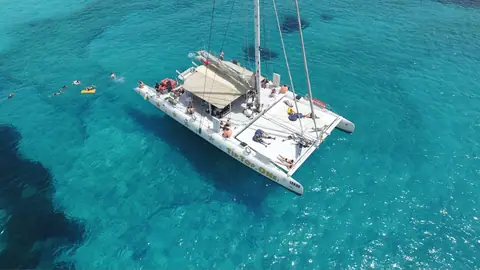
Fountaine Pajot Alegria 67
Sailing Catamarans, 67 ft
Used $2.6M to $4.3M
The La Rochelle catamaran builder founded by two racing sailors, now a group that also owns Dufour.
Sailing Catamarans, 67 ft
Used $2.6M to $4.3M
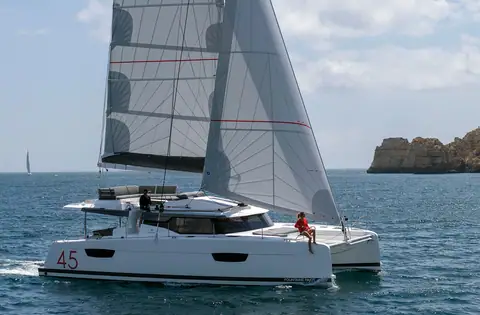
Sailing Catamarans, 44 ft
Used $560K to $880K
Sailing Catamarans, 44 ft
Used $680K to $950K
Sailing Catamarans, 47 ft
Used $850K to $1.2M
Sailing Catamarans, 57 ft
Used $1.65M to $2.2M
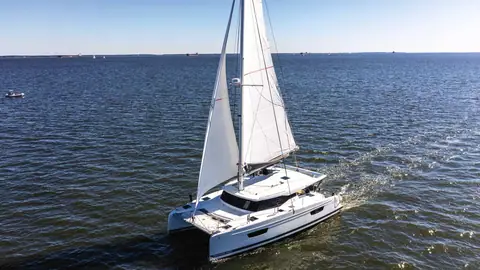
Sailing Catamarans, 39 ft
Used $360K to $560K
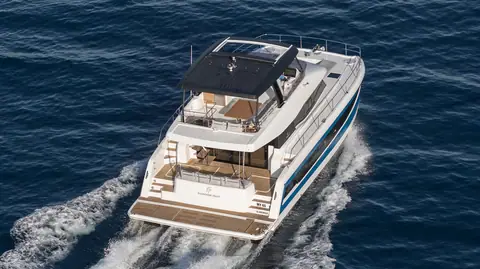
Power Catamarans, 51 ft
Used $620K to $1.25M
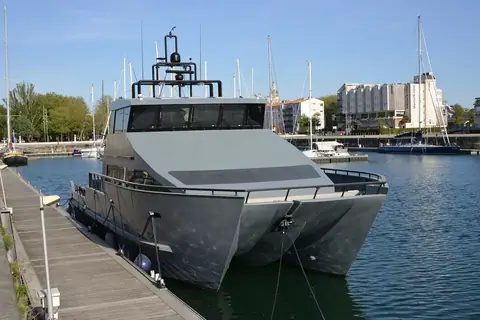
Power Catamarans, 65 ft
Used $2.6M to $3.9M
Power Catamarans, 79 ft
Used $7M to $9M
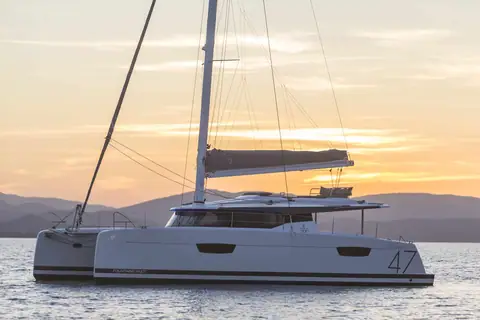
Sailing Catamarans, 46 ft
Used $560K to $800K
Fountaine Pajot has built sailing and power catamarans near La Rochelle since 1976. Its boats sail a little sharper than most charter cats, and a deep pool of ex-charter hulls keeps US prices competitive.
Fountaine Pajot was founded in 1976 by Jean-François Fountaine and Yves Pajot, both serious competition sailors, in the small town of Aigrefeuille-d'Aunis just inland from La Rochelle. That racing DNA still shows in the way the boats are drawn. Fountaine Pajot catamarans typically carry a bit less freeboard, finer bows and a lighter feel at the wheel than the boxiest charter cats, and the company has stuck with that brief even as its boats grew wider and more luxurious.
The company added a second facility at La Rochelle and in 2018 bought Dufour Yachts, giving the group a monohull line. It remains independent and publicly listed rather than part of a larger marine conglomerate, which sets it apart from Lagoon (Groupe Beneteau) and Nautitech (Bavaria).
Our coverage focuses on the boats that dominate US listings. The Saona 47 (2017 to 2022) was the model that pushed Fountaine Pajot into the upper mid-size market with its flybridge-adjacent helm and big aft cockpit. The Elba 45 (2019 to 2025) is arguably the sweet spot of the recent range, offering a 45-foot platform that one couple can handle while still taking four cabins in charter trim. The Isla 40 (2020 to 2024) brought the same Berret-Racoupeau styling to the entry-level size, and it remains the most affordable way into a late-model Fountaine Pajot.
On the power side, the MY6, launched as the MY 44 in 2017 and renamed in 2021, represented the motor yacht catamaran line for buyers who want long range and two-hull stability without a mast. It has since left the range, and Fountaine Pajot's power models are now its FPY yachts. The newest sailing models have moved to simple numerical names such as the FP41, FP48, FP51 and FP55, so expect late-model listings to use that naming.
A large share of the Fountaine Pajot boats that reach US brokerage come out of charter programs in the Caribbean, so the most important question on any listing is who owned it and how it was used. Charter versions usually have four double cabins and four heads, while owner versions, marketed as Maestro, give one hull to a full owner's suite. Maestro boats command a clear premium on the used market, often five to ten percent over an equivalent charter-spec hull, and they sell faster.
Resale is solid but sits slightly below Lagoon and Leopard in liquidity simply because there are fewer boats and fewer dealers. A well-kept Elba 45 or Saona 47 often lists for less than a comparable Lagoon 46 while offering equal quality of finish and slightly better sailing manners. Dealer coverage in the US is concentrated in Florida, Annapolis and the Northeast, and service on the systems side (Yanmar or Volvo saildrives, generators, watermakers) is easy to find anywhere cats are common.
These are infused composite boats that hold up well when maintained, but a heavy charter life leaves predictable marks. Budget for a thorough out-of-water survey and a sea trial in at least 15 knots of breeze.
Yes. Build quality is on par with Lagoon and generally regarded as well finished, and the boats sail somewhat better than the boxiest charter cats. Condition depends more on prior charter use than on the brand.
They are built in France, at the main plant in Aigrefeuille-d'Aunis and a second site at La Rochelle in Charente-Maritime.
They hold value well, slightly behind Lagoon and Leopard for liquidity in the US. Owner's Maestro versions with low engine hours resell best.
Fountaine Pajot is an independent, publicly listed French company. It also owns Dufour Yachts, which it bought in 2018.
Official website: fountaine-pajot.com. Yatch US is independent and not affiliated with Fountaine Pajot.