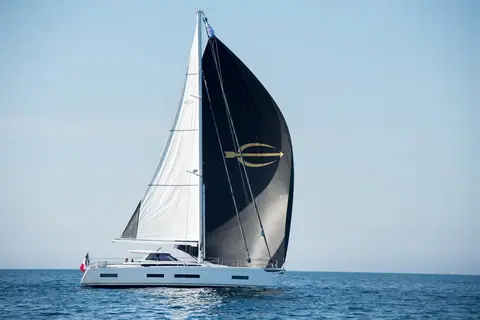
Amel 50
Bluewater Sailboats, 54 ft
Used $850K to $1.35M
A French yard that builds one or two models at a time and delivers them ready to cross oceans.
Bluewater Sailboats, 54 ft
Used $850K to $1.35M
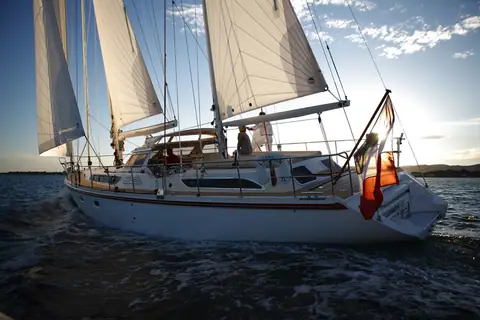
Bluewater Sailboats, 56 ft
Used $425K to $700K
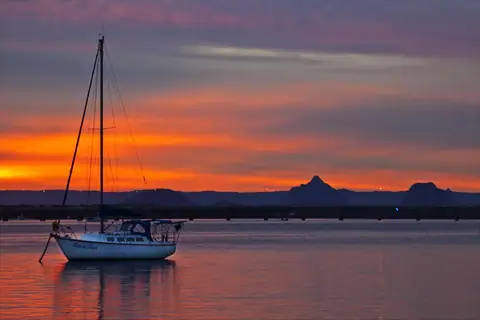
Bluewater Sailboats, 62 ft
Used $1.5M to $2.3M
Bluewater Sailboats, 64 ft
Used $1.1M to $1.9M
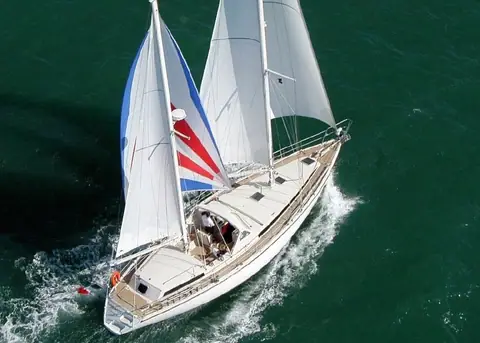
Bluewater Sailboats, 52 ft
Used $150K to $320K
Amel builds fully equipped bluewater cruisers near La Rochelle. The Super Maramu, Amel 54 and Amel 50 are among the most sought-after used ocean boats in the US, with a loyal owner network.
Henri Amel moved to La Rochelle in 1963 after an unsuccessful start in Marseille and founded Chantiers Amel in 1965. A fire destroyed the yard in 1967, but the business recovered and was profitable by 1973. Amel himself was blind for much of his career, which may explain why his boats were designed around touch, simplicity and logical systems rather than fashion.
His defining decision was to build very few models and to build them completely. For decades the yard produced essentially one boat at a time, only moving to two parallel models around 2010. An Amel leaves the factory with sails, electric furling, generator, watermaker and electronics already installed, so there is no long options list and no dealer-assembled spec. When he died, Henri Amel passed the large majority of his shares to the employees, an unusual move that helped preserve the yard's culture.
For most US cruisers, Amel means the Amel Super Maramu. Introduced in 1988 and built until 2005, with roughly 480 examples across the original and Super Maramu 2000 versions, this 53-foot ketch combined a protected center cockpit, a hard dodger, watertight bulkheads and electric furling on every sail. It was named Cruising World's Best Overall Cruising Boat in 2000, and many have completed multiple circumnavigations.
The Amel 54 took over in 2005, the year Henri Amel died, and was the first model to carry nothing but the AMEL name. It stayed with the ketch rig and the push-button philosophy but grew to about 56 feet overall, added a hard windshield around the steering station and gave its two private cabins their own heads. Built until 2011 as a single fully equipped specification, it sold for roughly $965,000 in 2007 and now sits between the Super Maramu and the newer boats on the used market. The Amel 55 succeeded it with more mainstream looks while keeping the mizzen.
The Amel 50, launched at Cannes in 2017 and designed with Berret-Racoupeau, marked the real turning point. It was the yard's first sloop since 1997, ending two decades in which every new Amel was a ketch, and it brought twin rudders, a more modern hull and a third cabin while keeping the fully equipped delivery and system logic. About 140 were built before the Amel 50.2 premiered at Cannes in 2026. The Amel 60 sits above it as the current flagship.
Amel has never built a conventional US dealer network. New boats are sold largely direct from the yard, and many American owners take delivery in France and sail home. Support comes from the factory, independent specialists who know Amel systems, and an exceptionally active owners community that documents nearly every repair. That network matters more than a local dealer, because Amel systems are proprietary in places.
Resale is the brand's strongest argument. A well-kept Super Maramu typically lists between about $150,000 and $320,000, an Amel 54 roughly $425,000 to $700,000, and Amel 50s trade from about $850,000 to $1.35 million, numbers that reflect slow depreciation.
Amel builds its yachts at its yard in Périgny, next to La Rochelle on France's Atlantic coast.
They arrive fully equipped for ocean cruising and are built in small numbers, so demand from bluewater sailors keeps used prices high.
The Super Maramu is the budget route into a proven Amel ketch. The Amel 54 adds space, tankage and a more sheltered helm for the same push-button sailing, and the Amel 50 is the fastest and newest of the three, at roughly double the price of a typical 54.
No. The current Amel 50.2 and Amel 60 are sloops. The ketch line ran through the Super Maramu, the Amel 54 and the Amel 55 before the Amel 50 brought back the sloop rig in 2017.
Amel sells largely direct from the factory, so US owners rely on the yard, independent Amel specialists and the owners community for support.
Official website: amel.fr. Yatch US is independent and not affiliated with Amel.