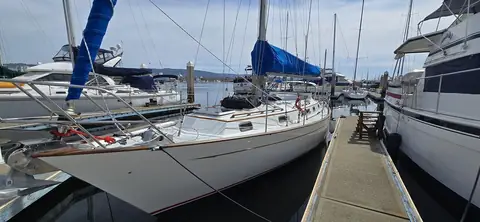
Passport 40
Bluewater Sailboats, 39 ft
Used $70K to $170K
Small-volume, Taiwan-built bluewater sailboats that look traditional but sail like a modern cruiser.
Passport Yachts paired Robert Perry's fin-and-skeg underbodies with Taiwanese joinery. The Passport 40 is the classic, and refitted boats hold value well.
Passport Yachts belongs to the generation of American importers who commissioned boats from Taiwanese yards in the late 1970s and early 1980s, when labor was cheap, teak was plentiful and US sailors wanted serious offshore boats at a price below Hinckley or Swan. What set Passport apart was the design brief. Developer Wendell Renken went to Robert Perry, who had already shaken up the cruising world with the Valiant 40, and asked for a boat that looked traditional but sailed like something newer.
That brief produced the Passport 40. Hull one appeared in 1980, the line ran through 1991, and close to 148 were completed. In 1987 the company stretched the same hull into the Passport 41, of which only about 9 left the yard by 1989. Later Passports between 40 and 47 feet kept the recipe going, yet the 40 is still the boat American buyers type into search bars and the one brokers can talk about from memory.
Production volume was always modest. That is part of the appeal and part of the challenge: you will rarely find more than a handful of Passports listed at once, and each one has been shaped by decades of owner decisions.
Beneath the varnish and the raised doghouse sits an underbody that broke with Taiwan habits. Instead of a long full keel, Perry drew a modified fin with the rudder hung on a skeg. Owners notice it in the way the boat points, in a livelier wheel and in shorter passage times than a Westsail or a similar heavy double-ender would manage. It remains a moderate-heavy cruiser, stiff and easy on the crew when loaded for an ocean crossing, which is exactly what offshore owners want.
Interior joinery is where the Taiwan build shows its strengths. Teak cabinetry, solid trim and well-thought-out sea berths were standard, and owners tend to describe the boats as warm rather than dark. The weak points are the ones shared by nearly every boat from that era and region: teak decks fastened with screws, black iron fuel tanks, and early decks cored with marine plywood before the switch to Airex foam.
With no new boats coming, the brand now exists only on the brokerage market. A Passport 40 that has already received fresh standing rigging, a newer diesel and new tanks usually lists somewhere around $120,000 to $170,000, and boats still waiting for deck and tank work list far lower. That spread is the key to buying well: the purchase price matters less than the refit list behind it.
Service is not brand-specific. Any competent yard that handles older fiberglass cruisers can maintain a Passport, and the owner community shares drawings, part numbers and refit notes freely.
Robert H. Perry designed the Passport 40, the brand's best-known boat. He gave it a fin keel and skeg-hung rudder, which is why it sails better than most traditional Taiwan cruisers.
They were built under contract in Taiwan for the American company, which explains the extensive teak joinery and the typical Taiwan-era maintenance items like black iron tanks.
Most trade between roughly $70,000 and $170,000. The top of the range is reserved for boats with documented deck, tank, rigging and engine refits.
Yes. Plenty of Passports have made ocean passages, and Perry's pairing of moderate-heavy weight with a fin-and-skeg underbody balances comfort against speed. The individual boat's condition matters more than the design.