Buying
Catamaran vs Monohull, Which Should You Buy?
An honest comparison of cruising catamarans and monohull sailboats for US buyers, covering comfort, safety, sailing ability, costs and resale, with clear advice on who should buy which.
On this page
- Catamaran vs monohull at a glance
- How each one moves, underway and at anchor
- The safety question, answered without myths
- Sailing performance, where the brochures get vague
- Space, privacy and how you actually live aboard
- What each one costs to buy and keep
- Resale and the charter-fleet effect
- Who should buy which
- A test plan before you commit
- FAQ
Catamaran vs monohull at a glance
The catamaran vs monohull debate has become the defining question for American cruising buyers over the past two decades, driven by the charter industry and by couples who want a floating home rather than a sporty sailboat. The table compares typical 40 to 46 ft cruising boats from mainstream builders, not race boats or performance cats.
| Factor | Cruising catamaran | Cruising monohull |
|---|---|---|
| Heel under sail | Roughly 5 to 10 degrees at most | 15 to 25 degrees is normal going upwind |
| Living space | Large saloon and cockpit on one level, cabins in separate hulls | Narrower, deeper interior below the waterline |
| Upwind ability | Points lower, often tacks through a wider angle | Points higher and drives through waves |
| Downwind and reaching | Fast and stable with modest sail handling | Can roll downwind; slower on most production designs |
| Draft | Commonly about 4 to 5 ft | Commonly about 5.5 to 7 ft for fin keels |
| Beam | About 22 to 27 ft at this size | About 13 to 15 ft |
| Self-righting | No, relies on huge initial stability | Yes, from ballast keel |
| Engines | Two diesels, excellent maneuverability | One diesel, often with bow thruster |
| Typical new price, 40 to 46 ft | $650,000 to $1,300,000 | $350,000 to $750,000 |
| Dockage | Often 1.5 to 2 times monohull rate | Standard slip rates |
How each one moves, underway and at anchor
This is the factor that converts most people. A catamaran sails flat. You can leave a coffee cup on the saloon table on a beam reach, cook without a harness, and sleep in a level berth. At anchor a cat barely rolls in a swell that would have a monohull swinging its mast like a metronome. For guests, kids and partners who are not dedicated sailors, that difference is enormous.
A monohull heels, and heeling has a purpose. It is how the boat converts wind pressure into a stable platform against a ballasted keel, and it feels alive and connected when the boat is in the groove. The motion is a slow, predictable roll. The cat's motion is quicker and jerkier in a short, steep sea, sometimes described as corkscrewing, and many experienced sailors find that more tiring on long passages even though the boat stays flatter.
Bridgedeck slamming is the catamaran trade-off worth testing. When waves strike the underside of the bridgedeck between the hulls, the bang can be loud and jarring. Designs with more bridgedeck clearance slam less, and loading the boat heavily makes it worse. Ask about clearance and sea-trial in chop if you can.
The safety question, answered without myths
Monohull defenders say a cat can flip and will not come back up. Cat owners say a monohull can sink because of its lead keel and a cat will float even when holed. Both statements are basically true, and neither settles the argument.
A ballasted monohull can be knocked down by a breaking wave and will right itself, assuming hatches and companionway are closed. It can be swamped and, if holed badly, it can sink because the keel weighs thousands of pounds. A cruising catamaran has much higher initial resistance to heeling and carries no heavy ballast; with foam-cored hulls and watertight compartments, many cats are very hard to sink. But if a cat is overpowered and capsizes, it stays upside down.
In practice, capsizes of mainstream cruising cats are rare and almost always involve too much sail up in strong, gusty winds or extreme breaking seas. The cat gives fewer warnings, since it does not heel progressively the way a monohull does, so reefing discipline and conservative reefing charts matter more. Monohull sailors, meanwhile, must manage heavier motion and the risk of injury below decks in a seaway. Either hull is a sound choice when sailed within its limits by a prepared crew.
Sailing performance, where the brochures get vague
Mainstream charter-style catamarans are not slow, but they are not the rocket ships their beam suggests either. On a reach in 15 knots of wind, a loaded 45 ft production cat will commonly sail in the high single digits to low double digits, often a knot or two quicker than a comparable cruising monohull. Downwind, they are fast, stable and easy.
Upwind is the cat's weakness. Most production cats with low aspect keels sail well short of the pointing angle of a fin-keel monohull, and they tend to tack through a wider angle. On a windward passage, a monohull may arrive first despite the catamaran's higher boat speed. Performance cruising cats with daggerboards, such as the Outremer 51, close that gap substantially but cost more and demand more attention.
A modern monohull rewards good trim and feels lively on the helm. If you enjoy sailing as a craft, especially club racing, short tacking and feel through the wheel or tiller, a monohull will usually give you more satisfaction per hour on the water.
Space, privacy and how you actually live aboard
A 45 ft catamaran typically offers three or four cabins, each with its own head in owner or charter versions, separated by the bridgedeck saloon. That separation is the cat's best feature for families and couples who host guests: two groups can sleep and shower in opposite hulls. The saloon and cockpit sit on one level with big windows, so you see the anchorage from the galley instead of looking at a hull side.
Monohull interiors are lower and more enclosed, which some sailors find cozy and secure in rough weather. Handholds are closer, the galley is often safer to use at sea, and the lack of windows is less of a problem when spray is flying. But for the same length, a monohull offers far less floor space and storage, and a three-cabin layout on a 40 footer can feel cramped.
- Load carrying. Cats are sensitive to weight. Overloading with water, dive gear and spares raises the bridgedeck and hurts performance more than it would on a monohull.
- Dinghy handling. Davits between the hulls on a cat make launching and stowing a tender much easier.
- Boarding. Wide transom steps on cats are friendlier for swimming, snorkeling and older crew.
What each one costs to buy and keep
Comparing price per foot makes cats look expensive. Comparing price per square foot of living space makes them look reasonable. Either way, the cash outlay is higher. Below is a representative pair of new boats in the 45 ft range, using editorial estimates.
| Cost item | 45 ft cruising catamaran | 45 ft cruising monohull |
|---|---|---|
| New sail-away price | $800,000 to $1,200,000 | $500,000 to $750,000 |
| Five year old used price | $550,000 to $850,000 | $300,000 to $500,000 |
| Annual dockage, mid-priced marina | $18,000 to $35,000 | $10,000 to $20,000 |
| Haul-out and bottom paint | $5,000 to $10,000 | $3,000 to $6,000 |
| Engine service | Two engines, two saildrives | One engine, one shaft or saildrive |
| Insurance | Similar percentage of a higher hull value | Similar percentage of a lower hull value |
Resale and the charter-fleet effect
Cruising catamarans have held value well over the past decade because demand from couples, families and charter programs outpaced supply. Brands like Lagoon, Leopard, Fountaine Pajot and Bali sell across a deep market, and well-equipped owner versions often command a premium over ex-charter boats.
Ex-charter cats are both an opportunity and a risk. They come with a known maintenance history from a professional fleet but also with hard use, four-cabin layouts and sometimes tired engines and rigging. A thorough survey, including both engines and the saildrives, is essential.
Monohulls offer a much larger used market across a wider price range. Older fiberglass cruisers from the 1980s and 1990s can be bought for a fraction of any cat, which is why monohulls remain the starting point for most budget-minded cruisers.
Who should buy which
Ignoring tribal loyalties, these profiles cover most buyers.
- Choose a catamaran if you plan to live aboard in the Bahamas, Caribbean or Florida Keys, cruise with non-sailing family members or guests, value shallow draft for thin water, or want a stable platform for diving and swimming.
- Choose a monohull if you sail mostly upwind or in places like the Pacific Northwest, Great Lakes or New England with tight marinas, if you plan high-latitude voyages, if you love the act of sailing, or if your budget is under about $200,000.
- Consider a performance cat if you want catamaran space and real sailing ability and can pay for it.
- Consider a power catamaran if you mostly motor and want efficient, stable cruising, especially on the Great Loop or along the ICW.
A test plan before you commit
Book a bareboat or skippered charter on each type, ideally in similar conditions. Spend at least one night at anchor in a rolly spot and one day beating into chop. Pay attention to how you and your crew feel, how easy it is to reef and dock, and how much you used the space. Then sea trial the specific boat you plan to buy, and ask the surveyor to look hard at the areas each type tends to suffer: bridgedeck structure and saildrives on a cat, keel bolts, keel-to-hull joint and rudder on a monohull.
Models mentioned in this guide
Lagoon 42
Sailing Catamarans, 42 ft
Used $340K to $600K
Leopard 45
Sailing Catamarans, 45 ft
Used $380K to $760K
Bali 4.6
Sailing Catamarans, 47 ft
Used $620K to $850K
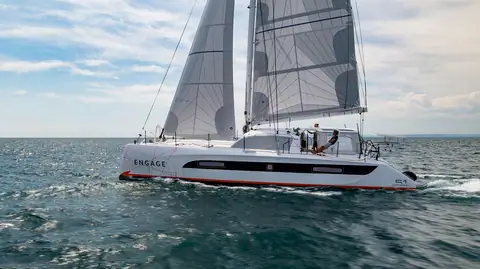
Outremer 51
Sailing Catamarans, 51 ft
Used $700K to $1.3M
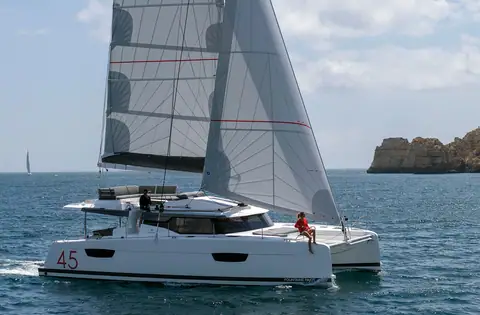
Fountaine Pajot Elba 45
Sailing Catamarans, 44 ft
Used $560K to $880K
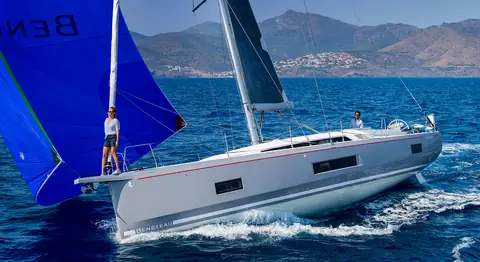
Beneteau Oceanis 46.1
Cruising Sailboats, 48 ft
Used $300K to $640K
Frequently asked questions
Is a catamaran safer than a monohull?
Neither is categorically safer. Monohulls self-right after a knockdown, while catamarans resist heeling and sinking far better but stay inverted if they capsize. Seamanship and sail management matter more than hull count.
Are catamarans faster than monohulls?
Cruising cats are usually faster on reaches and downwind, often by a knot or two. Monohulls typically point higher and can be quicker to windward.
Why are catamarans so expensive?
They contain two hulls, two engines and a large bridgedeck, so there is simply more boat per foot of length. Strong demand from charter companies and liveaboard couples also supports prices.
Do catamarans get seasick less often?
Many people find cats more comfortable because they barely heel or roll at anchor. In short, steep seas the motion can be quick and jerky, so sensitive crew should test both types.
Is it harder to find a slip for a catamaran?
Often yes. Many marinas have limited wide slips and charge a multihull surcharge, and some boatyards cannot haul wide-beam cats. Confirm availability before you buy.
Which is better for living aboard?
For most couples and families in warm-water cruising grounds, a catamaran offers more space, light and privacy. Monohulls remain popular with budget liveaboards and sailors in colder or more upwind regions.
Keep reading
Best Liveaboard Catamarans
Our picks for the best liveaboard catamarans on the US market, judged on tankage, storage, payload, draft and air draft rather…
BuyingBest Bluewater Sailboats for Ocean Crossings
Our shortlist of the best bluewater sailboats for ocean crossings, from $25,000 classics to million-dollar passagemakers, with…
KnowledgeTypes of Sailboats and Rigs Explained
A buyer-focused guide to the types of sailboats, sorted four ways: by rig, by keel, by hull and by purpose, with real models…
OwnershipCatamaran Charter Management Programs Explained
A clear look at catamaran charter management programs, how guaranteed income and revenue-share contracts differ, what owner use…
BuyingHow Much Does a Yacht Cost? Prices by Size and Type
Realistic 2026 price ranges for new and used yachts in the US, from 30 ft sailboats to 130 ft superyachts, with the purchase-day…
KnowledgeBoat Hull Types Explained, Displacement, Planing and More
How the shape of a hull decides a boat's speed, ride, fuel burn and stability. Covers displacement, semi-displacement and…