Ownership
Catamaran Charter Management Programs Explained
A clear look at catamaran charter management programs, how guaranteed income and revenue-share contracts differ, what owner use really looks like, the tax and resale questions to settle first, and how to judge whether a program fits your plans.
On this page
- The deal in one paragraph
- Who runs these programs and which boats they use
- Guaranteed, revenue share and hybrid contracts
- What owner weeks really look like
- The numbers to pin down before signing
- Tax treatment, the part to hand to your CPA
- Risks owners underestimate
- When the contract ends
- Who a charter program suits
- FAQ
The deal in one paragraph
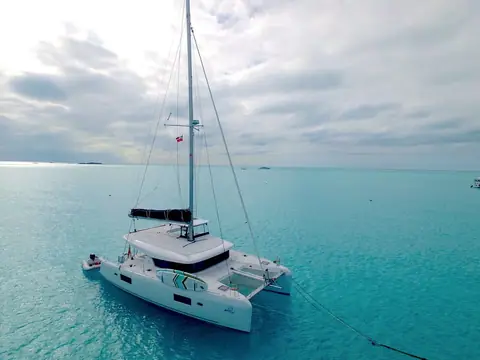
In a catamaran charter management program, you buy a new boat, usually a 40 to 50-foot sailing or power catamaran, and sign a contract that places it in a charter company's fleet for a fixed term. The company markets and books the boat, cleans and maintains it, insures it, pays dockage and handles turnarounds. In exchange it keeps most or all of the charter revenue. You receive either a guaranteed monthly payment or a share of the revenue, plus a set allowance of personal use. When the contract ends, the boat is yours to keep, sell or trade.
The appeal is obvious. A charter-grade catamaran costs well over half a million dollars new in the popular 40 to 50-foot sizes, and the program offsets ownership costs while you are not using it. Many owners treat it as a bridge to retirement cruising, buying the boat years before they plan to move aboard and letting the charter fleet carry it until then.
Who runs these programs and which boats they use
Large global operators such as The Moorings and Sunsail, and companies such as Dream Yacht Charter, run the biggest programs, with bases in the British Virgin Islands, the Bahamas, the wider Caribbean, the Mediterranean and the South Pacific. Smaller regional operators in the BVI, Florida, the Bahamas and Greece offer management too, often with more flexible terms and smaller fleets.
The boats are dominated by a few builders. Robertson and Caine builds Leopard catamarans, and The Moorings program is built around Leopard sailing and power catamarans, some sold under Moorings model names. Lagoon, Bali, Fountaine Pajot and Excess catamarans are widespread across other fleets. Power catamarans such as the Leopard 53 Powercat and Aquila models have grown in charter fleets as more guests want speed and air conditioning without sailing. Charter versions usually have four cabins with four heads, which suits charter groups and later suits large families, but differs from the owner's versions that private buyers often prefer.
Guaranteed, revenue share and hybrid contracts
Every operator words its contracts differently, but almost all programs fall into one of the structures below. The right one depends on whether you value predictable cash, upside or personal use most.
| Program type | How you are paid | Who pays running costs | Owner use | Best for |
|---|---|---|---|---|
| Guaranteed income | Fixed monthly payment for the contract term, usually tied to purchase price | Charter company covers nearly all | Set weeks per year with seasonal limits | Owners who want predictable cash flow and simplicity |
| Revenue share | Percentage of net charter revenue the boat earns | Often shared, details vary by contract | Usually more flexible | Owners willing to accept variable income for potential upside |
| Owner-use focused | Little or no income, costs largely covered | Charter company covers most | More weeks and fewer blackouts | Owners who mainly want to sail their own boat each year |
| Independent management | Revenue from a smaller charter manager or crewed charters | Owner, minus manager's fee | Most control | Experienced owners who want to stay closely involved |
What owner weeks really look like
Owner use is the part buyers most often misread. The Moorings, for example, advertises up to 12 weeks of owner holiday a year in its program. Contracts give a number of weeks a year, but they often split them into high and low season, limit how many can fall during peak holidays, and require booking well ahead. Some programs let you use your weeks on a sister boat at another base, which is a genuine perk if you want to sail Greece one summer and the Grenadines the next.
Turnaround rules apply to you too. You check in and out like a charter guest, pay for provisioning and sometimes a cleaning or turnaround fee, and leave the boat ready for the next client. If you dream of leaving your own gear aboard and treating the boat as a floating vacation home, a charter program is the wrong tool.
- Ask how many weeks fall in peak season and how far ahead you must book them.
- Confirm whether unused weeks roll over or disappear.
- Check whether friends or family can use your weeks without you aboard.
- Find out which bases and boat models you can swap into, and whether swaps cost extra.
The numbers to pin down before signing
The headline figure in any sales presentation is the monthly income or the revenue share percentage. The figures that decide whether the program pays are elsewhere. Use the checklist below to build your own five-year model rather than relying on a brochure.
| Line item | What to ask for | Why it matters |
|---|---|---|
| Purchase price | Sail-away price versus the same boat bought privately from a dealer | Program discounts or premiums change the whole calculation |
| Financing | Loan rate, term and down payment on a boat based abroad | Interest often exceeds program income in early years |
| Monthly income or revenue share | Exact formula, payment dates and what reduces it | Fees, commissions and damage deductions can cut revenue share sharply |
| Excluded costs | Who pays for upgrades, hurricane haul-out and major repairs | Excluded items can surprise owners mid-contract |
| Insurance | Named insured, deductibles and named-storm cover | Charter boats in hurricane zones need specialist cover |
| End-of-term condition | Return standard, sails, engines and survey at handover | Sets how much refit money you spend after the program |
| Exit value | Recent sale prices for the same model leaving the same fleet | The single biggest factor in total return |
Tax treatment, the part to hand to your CPA
Charter programs are often sold on tax benefits, and they can be real, but they depend on facts that differ for every owner. Treating the boat as a business asset can allow depreciation and expense deductions, but US tax law has specific hurdles. Passive activity rules can limit losses unless you materially participate in the business. Personal use of the boat can restrict deductions, because a boat with sleeping, cooking and toilet facilities can count as a dwelling unit under the vacation home rules. Activities run without a genuine profit motive face hobby loss limits.
Location matters too. Property used predominantly outside the United States generally must be depreciated under the slower alternative depreciation system and does not qualify for bonus depreciation, which affects many boats in BVI, Bahamas or Mediterranean fleets. Some programs base boats in US waters partly for this reason. Sales tax, use tax and import duty questions also arise if you later bring a foreign-based boat to a US state.
None of this is a reason to avoid a program. It is a reason to involve a CPA who understands charter yachts before you sign, not after the first tax return.
Risks owners underestimate
Charter is hard on boats. Dozens of different skippers dock, anchor and run systems each season, and while charter companies maintain fleets professionally, wear builds up in engines, sails, upholstery, deck gear and the head plumbing. Catamarans in charter also spend their lives in hurricane-exposed regions. When Hurricanes Irma and Maria struck the Caribbean in 2017, charter fleets in the BVI suffered heavy losses, and owners who went through it learned how much the insurance terms and the operator's recovery plan mattered.
- Counterparty risk. Your income depends on the operator's financial health. Charter companies have changed owners, restructured and closed over the years, so ask about the company's finances and what happens to your contract if it is sold or fails.
- Contract terms. Guaranteed payments are only as good as the contract. Read early termination, force majeure and damage clauses closely.
- Exit market. Many identical ex-charter boats leave fleets at the same time, which can soften resale prices for that model.
- Layout mismatch. A four-cabin charter layout may not be the boat you want to live on in retirement.
- Opportunity cost. The down payment and loan payments could earn returns elsewhere.
When the contract ends
At the end of the term most owners take one of three paths. Some sail away in the boat they bought, often after a refit, and start the cruising life the program was meant to fund. Others sell through the charter company's brokerage arm, which markets ex-fleet boats directly to buyers looking for a lower entry price. A third group trades the boat in for a new one and starts another contract, which some operators encourage with incentives.
If you plan to keep the boat, schedule an independent survey before the handover date and negotiate repairs under the contract's return conditions. Expect to budget for sails, canvas, upholstery, electronics updates and engine service even on a well-maintained boat, and to convert charter-specific features into a setup that works for long-term cruising.
Who a charter program suits
Charter management programs work best for buyers with a clear plan to use the boat later, a timeline that matches the contract length and enough financial cushion to ride out a bad charter season or a hurricane year. They suit owners who like the idea of sailing several weeks a year in different places without the headache of private management.
They suit poorly anyone who expects the program to make money on its own, anyone who wants frequent, spontaneous use of their own boat, and anyone who needs a specific owner's version layout. For those buyers, purchasing a privately owned catamaran or chartering as a guest is often the better path.
Models mentioned in this guide
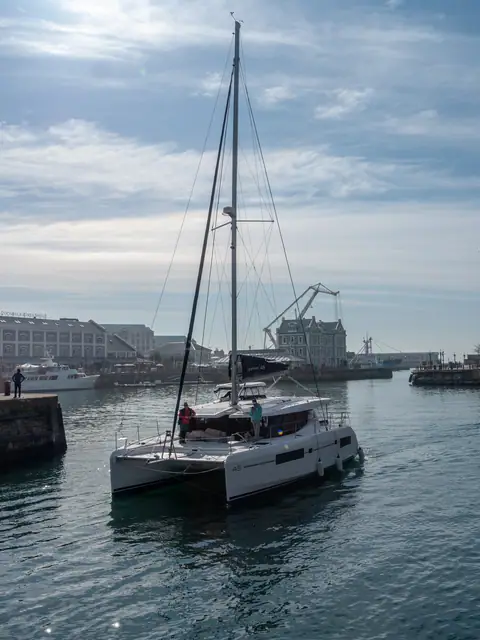
Leopard 45
Sailing Catamarans, 45 ft
Used $380K to $760K
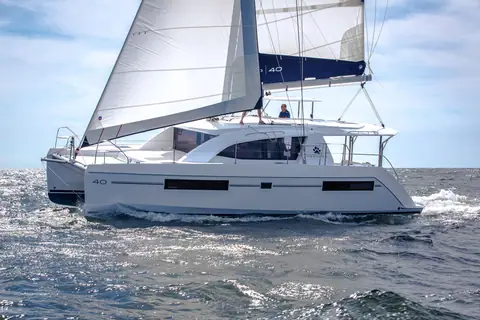
Leopard 40
Sailing Catamarans, 39 ft
Used $250K to $400K
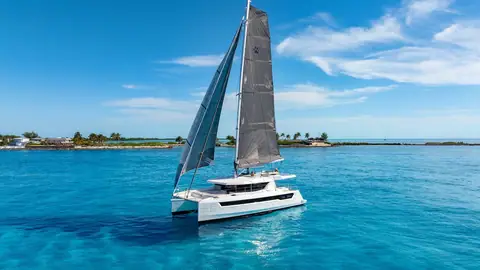
Leopard 46
Sailing Catamarans, 46 ft
Used $300K to $1M

Leopard 50
Sailing Catamarans, 51 ft
Used $620K to $1.15M
Lagoon 42
Sailing Catamarans, 42 ft
Used $340K to $600K

Lagoon 46
Sailing Catamarans, 46 ft
Used $620K to $950K
Frequently asked questions
Do catamaran charter management programs make money?
Usually not on their own. They offset a large share of ownership costs and provide personal use, but total return depends heavily on the purchase price, financing, tax treatment and the boat's resale value at the end.
How long are charter management contracts?
Contracts commonly run for several years, often around five, and the exact length depends on the operator and program type.
What is the difference between guaranteed income and revenue share?
Guaranteed income pays a fixed monthly amount regardless of bookings. Revenue share pays a percentage of what your boat earns, so income varies with demand and costs.
Can I use my boat while it is in a charter program?
Yes, within the contract's owner-use allowance, typically a set number of weeks a year with high-season limits, and some operators let you use weeks at other bases.
Are ex-charter catamarans a good buy?
They can be, because they sell below comparable privately owned boats. Budget for a thorough survey and a refit of sails, upholstery and systems, and expect higher engine hours.
Is there a tax benefit to putting a catamaran in charter?
Possibly, through depreciation and business deductions, but passive activity, personal-use and foreign-use rules can limit it. A CPA with yacht charter experience should review your situation first.
Keep reading
Catamaran vs Monohull, Which Should You Buy?
An honest comparison of cruising catamarans and monohull sailboats for US buyers, covering comfort, safety, sailing ability…
BuyingBest Liveaboard Catamarans
Our picks for the best liveaboard catamarans on the US market, judged on tankage, storage, payload, draft and air draft rather…
OwnershipThe Real Annual Cost of Owning a Yacht
A line-by-line look at annual yacht ownership costs in the US, with worked budgets for four boat sizes and the levers that…
BuyingYacht Loans and Boat Financing Guide
A practical guide to yacht loans and boat financing in the US, covering typical 2026 loan structures, what marine lenders check…
BuyingHow to Buy a Used Yacht, Step by Step
A step-by-step walkthrough of buying a used yacht in the US, from setting a real budget to closing, documentation and the first…