Leopard Catamarans Power Catamarans
Leopard 53 Powercat Review and Used Buying Guide
Robertson and Caine's best-selling big powercat, a Yanmar-powered 53-footer that cruises at 17 knots and stretches past 1,300 miles at trawler speed.
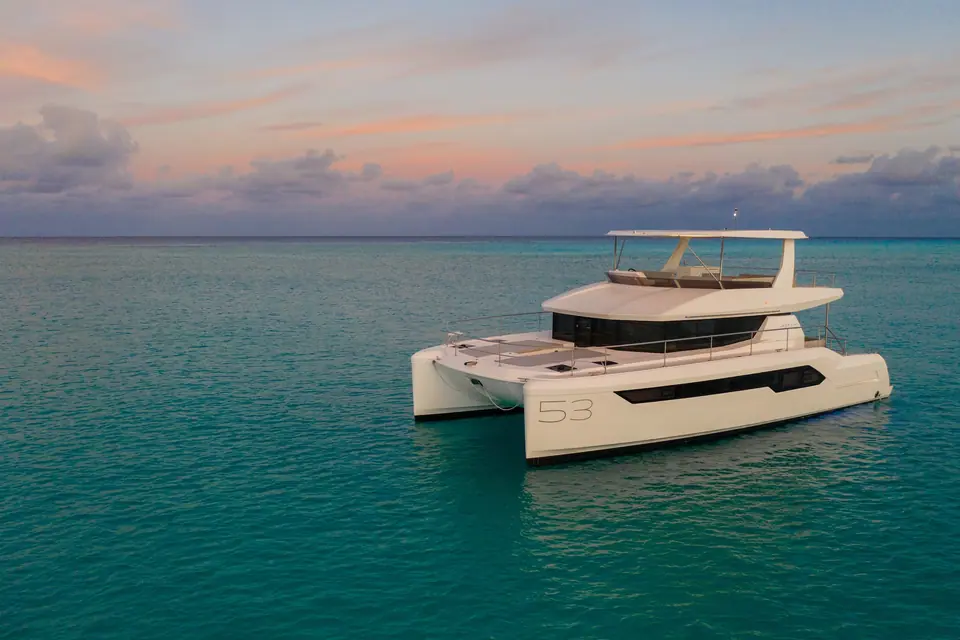
- Length
- 53.1 ft16.18 m
- Beam
- 25.2 ft7.67 m
- Cruise
- 17 kn
- Cabins
- 3 or 4, optional crew cabin
- Used price
- $820K to $1.75M
On this page
- Overview
- How the Leopard 53 Powercat grew out of the 51 PC
- Simonis Voogd's 2-to-1 hull and the claim of half the fuel
- BoatTEST's run in 3 to 5-foot seas
- Yanmar 8LV shafts, tankage and the sealed engine room
- Three cabin owner's boat versus the Moorings 534PC
- What changed for the 2026 model year
- Running costs, resale and what a 51 PC costs instead
- Specifications
- Price and value
- Strengths and weaknesses
- Used buyer checklist
- Rivals
- Our verdict
- FAQ
A Simonis Voogd designed power catamaran built in South Africa since 2020, with more than 140 first-generation hulls delivered before a 2026 refresh added a modular cockpit, new flybridge and electric swim platform.
- Couples cruising the Bahamas and Keys
- Buyers who want a proven, liquid powercat
- Charter management owners
- Long-range cruisers who run at trawler speed
How the Leopard 53 Powercat grew out of the 51 PC
The Leopard 53 Powercat is the boat that turned Robertson and Caine's power program from an interesting sideline into a serious business. Leopard announced it in July 2019 and gave it a public debut at the Miami International Boat Show in February 2020, as the replacement for the Leopard 51 PC. The 51 had arrived in 2013 and passed 100 hulls by 2018, largely on the strength of charter demand from The Moorings, Leopard's long-standing exclusive charter partner.
The 53 keeps the same basic hull proportions as the 51, roughly 50 feet 6 inches of hull with a 50-foot waterline, and adds length aft with extended swim platforms, bringing the overall figure to 53 feet 1 inch on BoatTEST's measurement. The extra length went into the cockpit and platforms rather than the hulls, which is why the boat feels much larger on deck than the 51 while running on a similar footprint.
By the time Leopard announced its refreshed version for the 2026 model year, it had delivered about 142 first-generation 53 PCs in six years. That volume matters to a buyer: there is a deep pool of boats to choose from, parts are well understood, and the charter companies have already found most of the weak points.
Leopard 53 Powercat by the numbers
- Speed to length ratio at cruise
- 2.40Runs in the semi-displacement range, faster than a trawler but thirstier per mile.
- Estimated range at cruise
- 448 nmUsing 90 percent of tank capacity at the cruise speed and fuel burn listed on this page.
- Fuel economy at cruise
- 0.89 nmpgNautical miles per gallon at cruise, both engines combined.
- Horsepower per ton
- 31 hpModest power to weight, efficiency over outright speed.
- Length to beam ratio
- 2.11 : 1Catamaran overall proportions. Wider platforms resist pitching and heel.
Simonis Voogd's 2-to-1 hull and the claim of half the fuel
Simonis Voogd has designed every Leopard since the brand began, and the 53 PC shows the firm's sailing-catamaran DNA. The hulls are slim, with a length-to-beam ratio of about 2 to 1 across the whole boat, and the bridgedeck sits high enough that slamming is far less of an issue than on older powercats. Draft is a remarkably shallow 3 feet 3 inches, which opens up the Bahamas banks and Florida Bay in a way few 50-foot yachts can match.
Leopard claims the 53 is up to 50 percent more fuel efficient than a comparable monohull motor yacht. The test data supports something close to that at displacement and moderate planing speeds. At 1,500 rpm the boat makes 8.2 knots on 2.7 gallons per hour total, and the builder quotes 1,330 nautical miles at 7.9 knots on both engines. Running on one engine at 6.8 knots stretches that to about 1,990 nautical miles, a genuinely useful trick for a long delivery.
BoatTEST's run in 3 to 5-foot seas
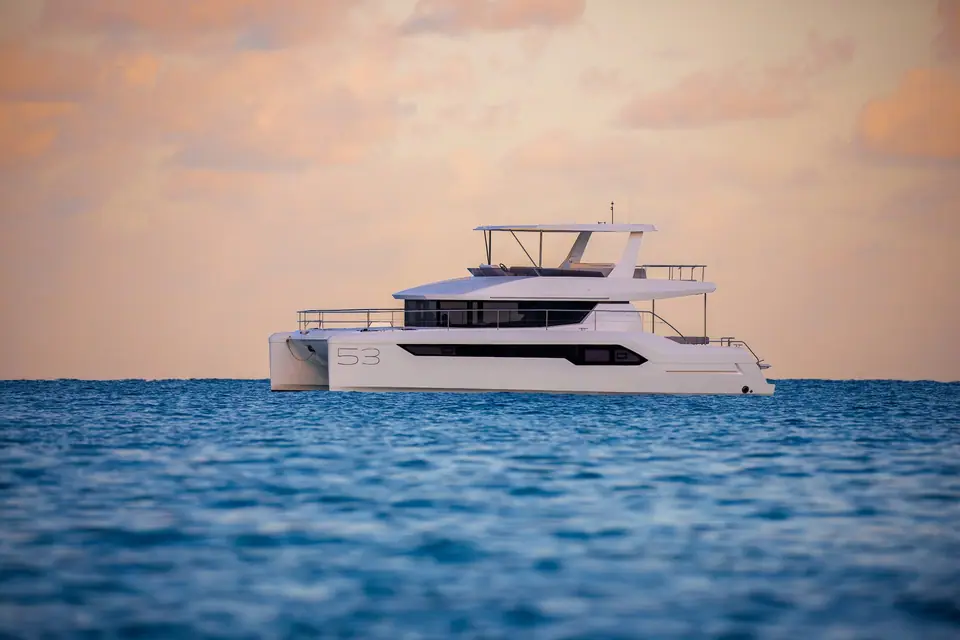
Most builder sea trials happen on glassy water. BoatTEST tested the 53 PC in 25 to 30 mph winds and 3 to 5-foot seas, loaded with half fuel and three people, which makes its numbers more believable than most. The boat topped out at 22.3 knots at 3,740 rpm burning 32.3 gph combined. Leopard's own figure of 24 knots reflects a lighter boat in better conditions.
The most interesting part of the curve is between 2,600 and 3,000 rpm. At 2,600 rpm the boat is still climbing at 12.9 knots on 13.4 gph. At 2,800 rpm it settles onto plane at 16.8 knots for only 14.7 gph, which works out to about 1.1 nautical miles per gallon, and at 3,000 rpm it is doing 17.3 knots on 19.2 gph. That 2,800 rpm setting is the sweet spot most owners end up using. At 17 knots the 562-gallon tanks give a practical range of roughly 500 nautical miles with a sensible reserve.
Yanmar 8LV shafts, tankage and the sealed engine room
Every 53 PC uses a pair of Yanmar 8LV 370 hp diesels on conventional shafts. There is no optional engine package, which keeps the used market simple: every boat performs roughly the same, and the variables are hours, maintenance and options. The 8LV is a compact, high-revving V8 with a good record in charter service, but it rewards strict oil and impeller intervals and dislikes long periods of idling.
Leopard lists 562 gallons of fuel on the current boat and BoatTEST measured 581 gallons on its early test hull, plus 185 gallons of water and a 42-gallon holding tank. The engine rooms are sealed compartments in the aft end of each hull, which keeps noise out of the guest cabins better than many rivals. A watermaker and a larger generator are near universal on private boats, and lithium house banks are a popular retrofit.
- Standard engines: 2 x Yanmar 8LV 370 hp on shafts
- Fuel: 562 gallons (581 on early boats per BoatTEST)
- Water: 185 gallons; holding: 42 gallons
- Light ship displacement: 47,203 lb on current boats; BoatTEST listed 41,070 lb dry for its 2020 test hull
Three cabin owner's boat versus the Moorings 534PC
Leopard offers the 53 PC with three or four cabins, each with an en-suite head and separate shower, plus optional crew quarters. The three cabin owner's version gives one entire hull to the master stateroom, with a large head, a desk and generous hanging storage. It is the version private buyers should hunt for, because it is noticeably more comfortable for a couple living aboard for weeks at a time.
The four cabin layout is the charter boat. The Moorings runs it as the 534PC in the Caribbean and the Bahamas, and those boats return to the brokerage market after their fleet service. They can be good value, but price them as what they are: hard-used boats with high hours and interiors that have seen hundreds of guests.
Upstairs, the original flybridge has a centerline helm, a big hardtop, a dinette and a sunpad. Many owners add full enclosures for Northeast or Pacific Northwest use. The saloon and galley share one level with the aft cockpit, and a forward cockpit with seating gives a sheltered spot at anchor.
What changed for the 2026 model year
Leopard calls the updated boat the 53 PC elevated, and the changes are substantial for a mid-life refresh. The aft cockpit now offers an Alfresco option, a modular, loose-furniture arrangement that owners can rearrange for dining, lounging or open deck space, alongside a traditional fixed-furniture plan. An optional remote-controlled electric swim platform lifts to extend deck space and serves as a tender station.
On the flybridge, a redesigned helm and a wet bar module with sink, optional fridge, ice maker and grill sit beside U-shaped seating under the hardtop. Glass balustrades replace solid barriers to open up the view. Inside, the saloon gets larger windows, a sliding door that stows almost entirely to port, linear LED lighting and pullout galley drawers. Engines, hull and tankage remain as before.
For used buyers, the refresh is mostly a cosmetic and lifestyle upgrade. A well-optioned 2023 or 2024 boat delivers the same performance at several hundred thousand dollars less than a new 2026 boat.
Running costs, resale and what a 51 PC costs instead
Annual ownership typically lands between $90,000 and $170,000 before depreciation. The 25-foot 2-inch beam puts the boat into wide-slip pricing at most US marinas, and insurance for a $1.5 million twin-diesel catamaran with a Bahamas or Caribbean cruising area usually runs $15,000 to $28,000. Fuel stays reasonable for owners who cruise at 8 to 10 knots, and Yanmar service is available throughout Florida and the Caribbean.
Values have been firm. European listings showed 2021 boats around EUR 833,000, 2022 boats from EUR 874,000 to EUR 1.23 million and a 2024 boat at EUR 1.35 million, while a 2023 boat asked $1.8 million in the US in early 2024. Buyers on a tighter budget should consider the Leopard 51 PC, which shares the hull concept and sells for roughly $280,000 for a tired 2015 charter boat up to about $800,000 for a late private 2019 boat.
Leopard 53 Powercat specifications
| Length overall | 53.1 ft16.18 m |
|---|---|
| Waterline length | 50 ft15.24 m |
| Beam | 25.2 ft7.67 m |
| Draft | 3.3 ft1 m |
| Air draft | 18.5 ft5.64 m |
| Displacement | 47,203 lbs21,411 kg |
| Fuel capacity | 562 gal2,13 L |
| Fresh water | 185 gal7 L |
| Cabins | 3 or 4, optional crew cabin |
| Berths | 6 to 8 plus crew |
| Heads | 3 or 4 |
| Standard engines | 2 x Yanmar 8LV 370 hp diesel inboards |
| Maximum power | 740 hp |
| Cruise speed | 17 knots |
| Top speed | 24 knots |
| Range | 1,330 nm |
| Hull type | Twin semi-planing catamaran hulls with 2:1 length-to-beam ratio |
| Hull construction | Vacuum-infused fiberglass sandwich |
| Builder | Robertson and Caine (Leopard Catamarans), South Africa |
| Naval architect | Simonis Voogd Design |
| Other design credits | Robertson and Caine in-house interior team |
| Production | 2020 to present |
| Status | In production |
Figures come from builder documentation and independent tests where available. Displacement is usually quoted light, so a loaded cruising boat will weigh more. Compare these specs with another model.
Performance data
| RPM | Speed (kn) | Fuel (gph) | Range (nm) |
|---|---|---|---|
| 1000 | 5.9 | 1 | |
| 1500 | 8.2 | 2.7 | |
| 2000 | 10.2 | 6.8 | |
| 2600 | 12.9 | 13.4 | |
| 2800 | 16.8 | 14.7 | |
| 3000 | 17.3 | 19.2 | |
| 3400 | 19.9 | 26.4 | |
| 3740 | 22.3 | 32.3 |
BoatTEST, 2020 Leopard 53 Powercat with 2 x Yanmar 8LV 370 hp, 3 people, half fuel, no water, 25 to 30 mph wind and 3 to 5-foot seas. Fuel burn is both engines combined. Range was not published for this test.
How much does a Leopard 53 Powercat cost?
The used Leopard 53 Powercat market splits cleanly between ex-charter boats, most of them Moorings 534PC versions leaving fleets after five or six years, and privately owned three cabin boats. Charter exits sell at a meaningful discount and often carry 4,000 or more engine hours, while owner boats with low hours, a generator upgrade, stabilization and the enclosed flybridge option trade near the top. New prices jumped sharply between the 2020 launch at $949,000 MSRP and the 2026 refreshed boat, which supports values on late first-generation hulls.
Estimate your yearly cost
A planning estimate using common rules of thumb: insurance near 1.5 percent of value, maintenance near 3 percent, haul out and bottom paint by length. Your marina, region and use will move these numbers. Open the full cost calculator.
Leopard 53 Powercat timeline
- 2013Leopard 51 PC launched, passing 100 hulls by 2018
- 2019Leopard 53 Powercat announced in July as the 51 PC replacement
- 2020Public debut at the Miami International Boat Show at $949,000 MSRP; BoatTEST rough-water trial
- 2025About 142 first-generation hulls delivered, many through The Moorings as the 534PC
- 2026Refreshed model year with Alfresco cockpit, new flybridge wet bar and electric lifting platform
Strengths and weaknesses
What owners like
- Excellent efficiency at 8 to 10 knots and a 1,330-mile range
- Only 3 feet 3 inches of draft for shallow Bahamas cruising
- Proven in charter, with a large pool of used boats
- Sealed engine rooms keep cabins quiet
- Single engine package makes used boats easy to compare
- Strong resale supported by rising new prices
What to weigh up
- No engine upgrade option; top speed in the low 20s
- Ex-charter boats can be heavily worn
- Wide beam limits slip choices and raises dockage
- Interior finish is more practical than luxurious
- Shaft drives make docking less intuitive than pod-driven rivals
Used Leopard 53 Powercat buyer checklist
Take this list to a viewing. Your ticks are saved in this browser so you can come back to it.
Always commission an independent marine survey and an engine survey before you buy. How a marine survey works.
Rivals to consider
Aquila 54
Wider choice of engines and a full-beam forward master, but heavier, deeper and thirstier between 10 and 13 knots.
Compare side by sideFountaine Pajot MY6
Narrower 21-foot 8-inch beam and Volvo IPS pods for easier docking, with a sportier top end.
Compare side by sideAquila 44
A cheaper, smaller powercat for owners who do not need four cabins or a 25-foot slip.
Compare side by sideHorizon PC52
Taiwanese build with a more yacht-like finish and price, aimed at private owners rather than charter fleets.
Our verdict on the Leopard 53 Powercat
The Leopard 53 Powercat is the sensible choice in the 50-foot powercat class: shallow, frugal at trawler speed, quick enough to run 17 knots when weather threatens, and backed by more than 140 sisterships and a charter industry that knows every system. It is not the most luxurious boat in its class and the Yanmars are the only option, but for owners who want to cruise far and resell easily it is hard to beat. Favor a privately owned three cabin boat and treat ex-charter four cabin hulls as refit candidates priced accordingly.
Leopard 53 Powercat questions answered
How much does a Leopard 53 Powercat cost?
New refreshed boats run roughly $1.74 million to $1.95 million in 2026. Used first-generation boats generally ask between about $820,000 and $1.75 million depending on year and charter history.
How fast is the Leopard 53 Powercat?
Leopard quotes a 24-knot top speed and a 17-knot cruise. BoatTEST recorded 22.3 knots wide open in 3 to 5-foot seas.
What is the range of the Leopard 53 PC?
About 1,330 nautical miles at 7.9 knots on both engines, or about 1,990 nautical miles at 6.8 knots on one engine, according to Leopard.
What is the difference between the Leopard 51 and 53 powercat?
The 53 replaced the 51 PC in 2020 with a similar hull, more length aft for a bigger cockpit and platforms, and updated interiors. Used 51 PCs are a cheaper alternative at roughly $280,000 to $800,000.
Who builds the Leopard 53 Powercat?
Robertson and Caine builds it in Cape Town, South Africa, to a design by Simonis Voogd. The Moorings charter version is called the 534PC.
How many cabins does the Leopard 53 PC have?
Three or four, each with an en-suite head and separate shower, plus optional crew quarters.
Leopard 53 Powercat photos
More power catamarans to explore
Aquila 50 Yacht
Power Catamarans, 53 ft
Used $1.3M to $1.75M
Aquila 54
Power Catamarans, 54 ft
Used $1.15M to $2.4M
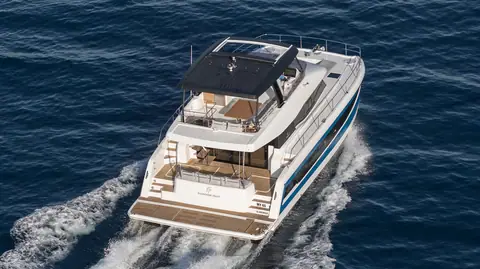
Fountaine Pajot MY6
Power Catamarans, 51 ft
Used $620K to $1.25M
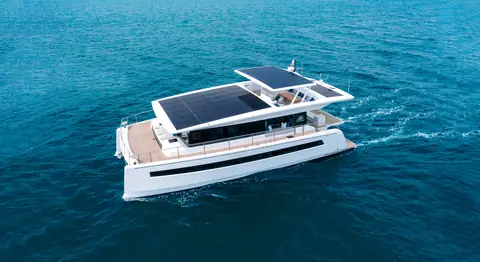
Silent 60
Power Catamarans, 59 ft
Used $1.6M to $2.6M