Silent Yachts Power Catamarans
Silent 60 Review, the Solar Catamaran That Put Silent Yachts on the Map
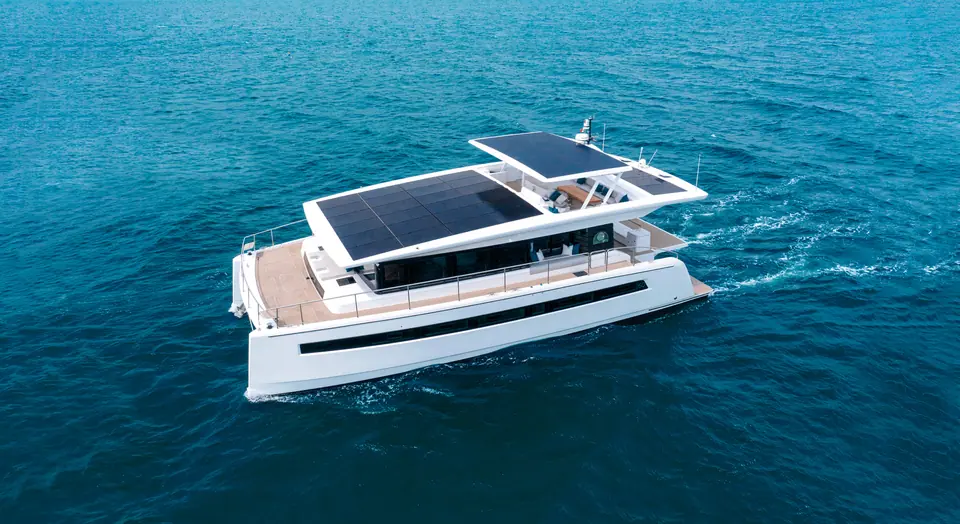
A 59 ft solar-electric power cat that cruises at 6 to 8 knots on sunshine, sleeps up to six cabins and backs it all up with a diesel range extender.
- Length
- 59 ft17.99 m
- Beam
- 29.5 ft8.99 m
- Cruise
- 7 kn
- Cabins
- 4 to 6, each en suite, plus optional crew space; front master or front exit versions
- Used price
- $1.6M to $2.6M
On this page
- Overview
- The Köhlers, the Solar Wave 46 and how Silent Yachts began
- Motors, batteries and a diesel that rarely runs
- Cruising at 6 to 8 knots on sunlight
- Front master or front exit, four to six cabins
- Thailand hulls and the move to Italy
- The SY62 and what it means for 60 owners
- Running costs and the battery question
- Specifications
- Price and value
- Strengths and weaknesses
- Used buyer checklist
- Rivals
- Our verdict
- FAQ
The Silent 60 is a 59 ft solar-electric catamaran from Silent-Yachts, built in Thailand from about 2021 with 42 solar panels, twin electric motors and lithium batteries. Testers saw 6 to 8 knot cruising on mostly solar power. The SY62 replaced it in 2024.
- Liveaboard couples cruising the Bahamas and Caribbean
- Owners who want low-noise, low-emission cruising
- Former sailors used to 6 to 8 knot passages
The Köhlers, the Solar Wave 46 and how Silent Yachts began
Silent Yachts was founded by Michael and Heike Köhler, bluewater sailors who say they have spent more than 6,000 days and 75,000 nautical miles at sea. They disliked depending only on wind in a sailboat or only on diesel in a powerboat, and they noticed that in most cruising grounds the sun is more reliable than the breeze. In 2009 they began building the Solar Wave 46, a prototype that ran its propulsion and household systems, from stove and freezer to air conditioning and watermaker, on solar power.
The couple then ran a four-year trial on the prototype from 2010, crossing Europe by river and cruising the Black, Aegean and Mediterranean seas. Michael Köhler told Power and Motoryacht that the diesel generator was not used at all for the first three years. In 2016 the company launched its first production yacht, the Silent 64, and an owner sailed one across the Atlantic in 2018, the first serially produced solar-powered yacht to do so.
The Silent 60 was the next step: a smaller, more accessible boat for cruising couples and families. It won the Gustave Trouvé Award in 2021 for electric production boats over 8 m, was nominated for Multihull of the Year in 2022 and collected a Best of Boats award in the Best for Travel category.
Silent 60 by the numbers
- Speed to length ratio at cruise
- 0.93Cruises at displacement speed, the most fuel efficient way to cover long distances.
- Length to beam ratio
- 2.00 : 1Catamaran overall proportions. Wider platforms resist pitching and heel.
Motors, batteries and a diesel that rarely runs
Every Silent 60 drives its propellers with twin electric motors fed by a lithium-ion battery bank, charged by 42 rigid solar panels on the coachroof and flybridge hardtop. Power and Motoryacht put peak solar output at about 17 kWp. Three power packages were offered. Per Power and Motoryacht, the Cruiser has two 50 kW motors, a 143 kWh battery bank and a 100 kW generator; the midrange package has two 250 kW motors and a 225 kWh bank; and the top package has two 340 kW motors, a 286 kWh bank and a 145 kW generator. BoatTEST lists slightly different combinations (50, 200 or 340 kW motors with 142, 207 or 286 kWh), so confirm the exact equipment on any boat you inspect.
Every boat also carries a diesel generator, which Silent calls a range extender. Michael Köhler explained it is there for safety, for a run of cloudy days or a forced passage, and Power and Motoryacht noted the boat can carry as much as 500 gallons of diesel for it. Yachting reported the battery pack is rated for about 3,000 charge cycles, which the builder estimates at 35 years of normal use, and BoatTEST lists an 8-year battery warranty, 25 years on the solar panels and a lifetime warranty on the motors.
An optional automatic towing kite, flown up to 120 meters above the boat, can add speed or reduce energy draw. Yachting describes a 140 sq ft kite that the builder says can drive the boat at 6 to 7 knots on its own in 17 to 21 knots of breeze, while Power and Motoryacht's sea trial captain quoted a gain of up to 3 knots.
Cruising at 6 to 8 knots on sunlight
This boat rewards patience. On Power and Motoryacht's sea trial of hull No. 3 in Fort Lauderdale, with the midrange package and a 150 kW Volvo Penta genset, the captain ran the Intracoastal at 5.4 knots drawing a combined 8 kW from the batteries. At just under 7 knots the draw rose to 14 kW, while the solar array was still putting about 3 kW back into the bank. After nearly an hour at an average of 6 knots, with a dozen people aboard and full fuel and water, the boat had used about 9 percent of its battery.
Yachting's tester, on a boat with the 340 kW motors and 286 kWh bank, cruised at 8 knots under a solid cloud layer in South Florida rain and saw the batteries still charging faster than the motors drew. He measured 52 decibels at cruise, about the sound of a dishwasher. Top speed with the big motors is about 20 knots, though at that pace the batteries drain quickly and the generator has to run.
The midrange boat tops out around 13 to 14 knots, and the captain was blunt that running there constantly fights the purpose of the vessel. BoatTEST suggests a power-savvy skipper can cover about 100 miles a day for weeks. Captain Kyle Miller added that a completely flat bank takes about four bright days to recharge from solar alone, so most owners run the generator occasionally, especially with air conditioning on.
Front master or front exit, four to six cabins
Nearly 30 ft of beam gives the Silent 60 the space of a much larger monohull. Yachting reported that buyers could choose up to six staterooms, each en suite with a stall shower and near-king berths, and measured 7 ft 6 in of saloon headroom. Hull No. 3 had four staterooms with the master forward in the starboard hull.
Early boats were Front Master versions, with the owner's cabin forward on the lower deck just below the saloon. In March 2022 the Thailand yard launched the first Front Exit version, which replaces that cabin with a door from the saloon to a foredeck lounge for up to six people and moves the master into a hull. Silent said all later 60s would also get a raised main deck and flush saloon, increasing lower-deck headroom and storage under the cockpit.
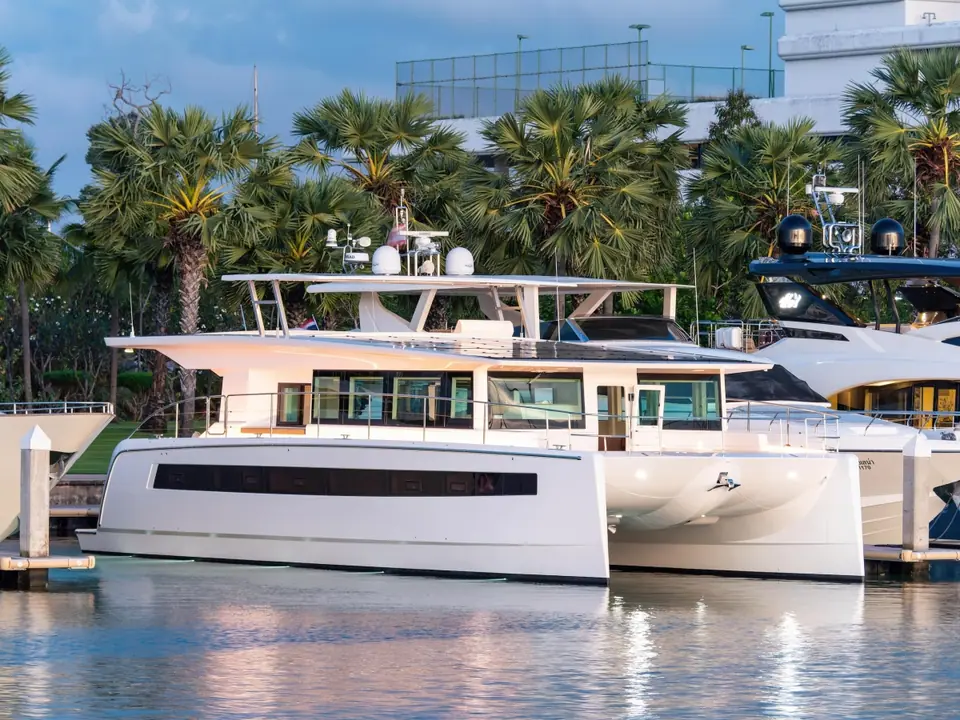
Up top, the flybridge hardtop is hinged and lowers electrically to seal the bridge and keep the solar panels unshaded. A U-shaped galley sits aft to port with a dishwasher, a pass-through window opens to the cockpit, and a hydraulic swim platform was offered in widths that take up to a 13 ft tender.
Thailand hulls and the move to Italy
The first Silent 60s were built in Thailand. Yachting reported in 2022 that production was moving to Italy, where future boats would get fully resin-infused fiberglass sandwich construction with carbon reinforcement in high-stress areas, watertight bulkheads, sealed floors and three collision compartments in each hull. By 2024 the company described itself as a Made in Italy builder under CEO Fabrizio Iarrera, promising 18 new yachts in 18 months.
For a used buyer this matters. A Thailand-built 60 and an Italian-built later boat may differ in laminate, layout and systems, so request the build location, yard records and the full electrical documentation for the specific hull.
The SY62 and what it means for 60 owners
Silent's current 60 Series is built around the SY62, launched in 2024 and offered with a flybridge or a third deck. Power and Motoryacht's test lists it at 61 ft 11 in with a 29 ft 6 in beam, 4 ft 1 in draft and about 102,845 lb displacement, and Silent says the flybridge version is the lightest and most efficient in the series. In late 2025 an owner-led crew took an SY62 across the Atlantic in about five weeks, running on batteries 72 percent of the time.
The arrival of the 62 makes the original 60 a used-market boat. That can be an opportunity: the core technology is similar, and a well-kept 60 offers most of the experience for less money, as long as the battery bank has been looked after.
Running costs and the battery question
We estimate $70,000 to $150,000 a year to keep a Silent 60 in US waters, excluding depreciation. Fuel is minimal compared with a diesel cat of this size, and there is no main engine maintenance, but dockage for a 30 ft beam boat is expensive, insurance underwriters still treat high-voltage lithium systems carefully, and specialist electrical support is scarce outside Florida.
The big long-term risk is the battery bank. Ask for state-of-health reports from the battery management system, charge cycle counts and the remaining warranty, and budget for a specialist survey of the high-voltage system on top of a normal hull survey.
Silent 60 specifications
| Length overall | 59 ft17.99 m |
|---|---|
| Beam | 29.5 ft8.99 m |
| Draft | 3 ft0.93 m |
| Displacement | 63,934 lbs29, kg |
| Cabins | 4 to 6, each en suite, plus optional crew space; front master or front exit versions |
| Berths | 8 to 12 depending on layout |
| Heads | 4 to 6 |
| Standard engines | Twin electric motors with lithium battery bank and diesel generator range extender (Cruiser package 2 x 50 kW, 143 kWh, 100 kW generator per Power and Motoryacht) |
| Optional engines | Midrange 2 x 250 kW with 225 kWh; top 2 x 340 kW with 286 kWh and 145 to 150 kW generator; automatic towing kite |
| Cruise speed | 7 knots |
| Top speed | 20 knots |
| Hull type | Displacement to semi-displacement catamaran with reverse bows |
| Hull construction | Fiberglass sandwich with foam core; later Italian hulls resin infused with carbon reinforcement |
| CE design category | A |
| Builder | Silent-Yachts, Thailand |
| Other design credits | Silent-Yachts design team; founders Michael and Heike Köhler; designer Juliana Miguel quoted on the project |
| Production | 2021 to present |
| Status | Discontinued |
Figures come from builder documentation and independent tests where available. Displacement is usually quoted light, so a loaded cruising boat will weigh more. Compare these specs with another model.
How much does a Silent 60 cost?
When new, Power and Motoryacht reported the Silent 60 starting at $3 million in base configuration, while BoatTEST cited an average price of $2.69 million (2.36 million euros). Used values depend heavily on the power package, since the 340 kW motors and 286 kWh bank add performance and cost, and on battery health, which is the single most expensive component to replace. Front exit boats with the raised main deck introduced in 2022 are the more desirable layout. With so few boats built and the SY62 now the current model, prices are negotiated case by case rather than set by a deep market.
Estimate your yearly cost
A planning estimate using common rules of thumb: insurance near 1.5 percent of value, maintenance near 3 percent, haul out and bottom paint by length. Your marina, region and use will move these numbers. Open the full cost calculator.
Versions and options
- Front Master
- Original layout with the owner's cabin forward on the lower deck below the saloon.
- Front Exit
- Introduced in March 2022, a saloon door to a foredeck lounge with the master moved into a hull, plus a raised main deck.
- Power packages
- Cruiser, midrange and top configurations from 2 x 50 kW to 2 x 340 kW motors, with battery banks of about 143 to 286 kWh.
Silent 60 timeline
- 2009Michael and Heike Köhler start building the Solar Wave 46 prototype
- 2016Silent 64 becomes the company's first production yacht
- 2021Silent 60 wins the Gustave Trouvé Award for electric production boats over 8 m
- 2022First Front Exit Silent 60 launched in Thailand; Power and Motoryacht and Yachting test hull No. 3
- 2024SY62 launches and becomes the core of Silent's 60 Series
Strengths and weaknesses
What owners like
- Near-silent cruising at 6 to 8 knots, 52 dB measured by Yachting
- Solar charging that can match consumption at low speeds
- Huge volume on a nearly 30 ft beam
- Up to six en-suite cabins
- No main diesel engines to service
- CE Category A
What to weigh up
- Slow unless you run the generator
- Battery health is a costly unknown on used boats
- Very wide for most US marinas
- Few specialist service centers
- Small production run and thin resale data
Used Silent 60 buyer checklist
Take this list to a viewing. Your ticks are saved in this browser so you can come back to it.
Always commission an independent marine survey and an engine survey before you buy. How a marine survey works.
Rivals to consider
Silent 62
The current replacement, longer and heavier, with flybridge or three-deck options.
Sunreef 60 Power Eco
Polish-built luxury power cat with integrated solar skin, aimed at the same eco-minded buyer.
Aquila 54
Conventional diesel power cat that is faster and cheaper but far noisier and thirstier.
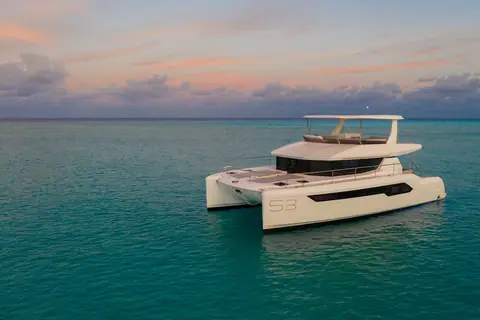
Compare side by sideLeopard 53 Powercat
Proven diesel cat with a deep charter and brokerage market.
Compare side by sideOur verdict on the Silent 60
The Silent 60 is the boat that proved a production solar-electric cruiser could work outside a test tank. At 6 to 8 knots it runs almost silently and largely on sunshine, the interior is enormous, and the engineering impressed every tester who climbed into its engine rooms. It is not a fast boat, and a used one is only as good as its battery bank, so treat the electrical survey as seriously as the hull survey. For a couple who cruises like sailors and wants to leave the fuel dock behind, a well-documented 60 is a smart way into Silent Yachts for less than a new SY62.
Silent 60 questions answered
How much does a Silent 60 cost?
Power and Motoryacht reported a $3 million base price when new and BoatTEST cited an average of $2.69 million. We expect used boats to trade at roughly $1.6 million to $2.6 million depending on power package and battery health.
How fast is the Silent 60?
It cruises most efficiently at 6 to 8 knots. With the top 340 kW motors Yachting quotes about 20 knots, and the midrange package tops out around 13 to 14 knots.
Does the Silent 60 have a diesel engine?
It has no diesel propulsion engines but carries a diesel generator as a range extender to charge the batteries in bad weather or for faster running.
Is the Silent 60 still built?
No. Silent Yachts' current 60 Series is based on the SY62, launched in 2024.
Where are Silent Yachts built?
Early Silent 60s were built in Thailand. Production has since moved to Italy, and Power and Motoryacht reported operations in Italy, Thailand and Turkey in 2022.
Can a Silent 60 cross an ocean?
It is CE Category A and designed for transoceanic passages, and a Silent 64 crossed the Atlantic in 2018 while an SY62 did so in 2025.