Greenline Yachts Trawlers & Explorer Yachts
Greenline 40 Review and Buyer's Guide to Greenline Yachts for Sale
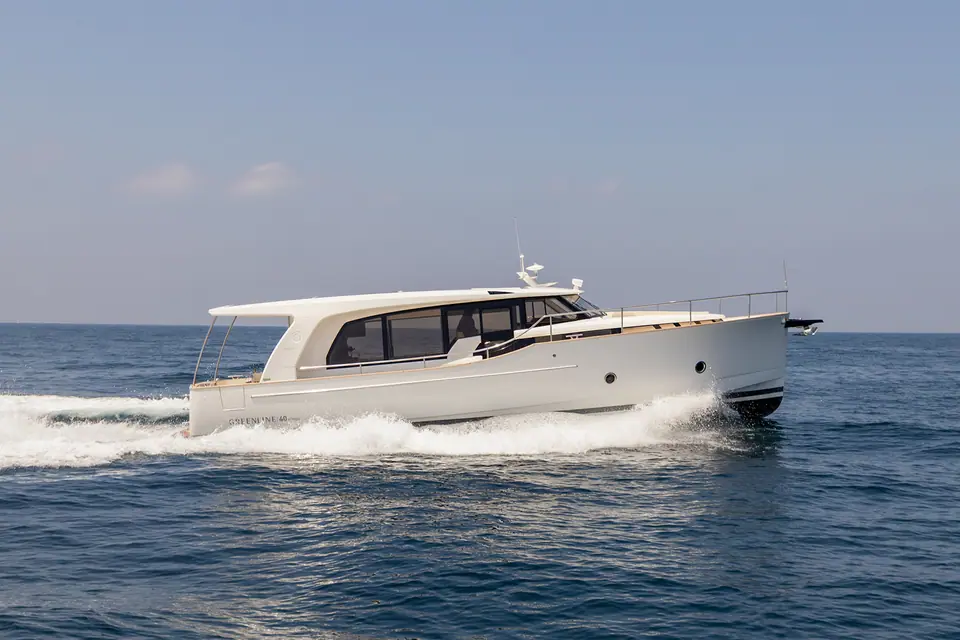
A twin-engine, two-cabin Slovenian cruiser with a solar roof, an aft galley and the choice of diesel, hybrid or fully electric drive.
- Length
- 41.7 ft12.71 m
- Beam
- 13.9 ft4.25 m
- Cruise
- 17 kn
- Cabins
- 2 plus saloon
- Used price
- $260K to $600K
On this page
- Overview
- Why the 40 dominates Greenline yachts for sale
- Three drivetrains, one hull
- On the water: twin skegs, heavy steering and a planted ride
- The aft galley bar and the sliding roof
- Two cabins and one generous head
- Solar power and life off the grid
- What it costs and how the used market behaves
- Specifications
- Price and value
- Strengths and weaknesses
- Used buyer checklist
- Rivals
- Our verdict
- FAQ
The Greenline 40 is a 41-foot 8-inch semi-displacement cruiser built in Slovenia since 2011, offered with twin diesels, a diesel-electric hybrid or full electric drive, two cabins and standard solar panels.
- Couples who host occasional guests
- Great Loop and Intracoastal cruising
- Owners who want generator-free nights at anchor
- Former sailors moving to an efficient powerboat
Greenline 40 by the numbers
- Speed to length ratio at cruise
- 2.82A planing cruise. Fast passages in exchange for much higher fuel burn per mile.
- Horsepower per ton
- 57 hpStrong power to weight for a planing hull.
- Length to beam ratio
- 2.99 : 1A beamy hull with lots of volume for its length.
Why the 40 dominates Greenline yachts for sale
Search Greenline yachts for sale and the 40 shows up more than any other current model, for good reason. It arrived in 2011 as the bigger, twin-engine follow-up to the hit Greenline 33, and it has stayed in the range ever since while the 33 bowed out in 2023. Motor Boat and Yachting's first look at the drawings that March described the essentials that still define the boat: a forward cabin, a second cabin amidships, a separate shower stall in the head, an electrically opening sunroof over the saloon and a dinette for up to eight.
Today Greenline, now part of Slovenia's SVP Yachts, sells the 40 alongside its 39, 42, 45 and 58 models and markets it as the gentleman's cruiser of the range. Every Greenline is offered with conventional diesel, hybrid or fully electric drive, and that choice is the first thing to settle when you shop. One Australian owner who signed for an early boat at the 2012 Sydney show was still cruising it seven years later, and that kind of long-term ownership is typical of the model.
Three drivetrains, one hull
The current standard package is twin 250 hp Yanmar 4LV diesels on straight shafts, which Greenline rates at 22 knots maximum. Many earlier boats, including a 2020 hybrid Motor Boat and Yachting toured, used twin 220 hp Volvo Penta D3s instead, good for around 20 knots.
The hybrid adds an electric motor on each shaft. Running on the diesels, those motors work as generators (Greenline lists two 14 kW generators) and charge a high-voltage lithium bank of up to four 13.3 kWh packs. On batteries alone the builder quotes 7 knots maximum and up to 20 nautical miles at 5 knots. A US owner interviewed by YachtBuyer cruised at 4.5 to 5 knots on electric power, saw about 8 knots flat out, and described the clutch between diesel and electric as an electro-hydraulic actuator any competent marine technician can service.
The full-electric version swaps the diesels for two 50 kW motors, quotes 10 knots maximum and up to 30 nautical miles at 7 knots, and adds a 4 kW diesel range extender that stretches range toward 75 nautical miles. Greenline treats every electric boat as semi-custom, sizing the batteries to the owner's speed, range and marina charging.
Which to choose? The diesel boat is the value play and has the widest service network. The hybrid gives silent marina maneuvering, silent anchorages and generator-free air conditioning, which is the real daily payoff. Full electric suits lakes, rivers and short coastal hops, and almost nothing else.
- Diesel: 2 x Yanmar 4LV 250 hp, up to 22 knots (builder)
- Hybrid: diesels plus twin shaft motors, up to 7 knots and about 20 nm on electric
- Electric: 2 x 50 kW, up to 10 knots, 4 kW range extender
On the water: twin skegs, heavy steering and a planted ride
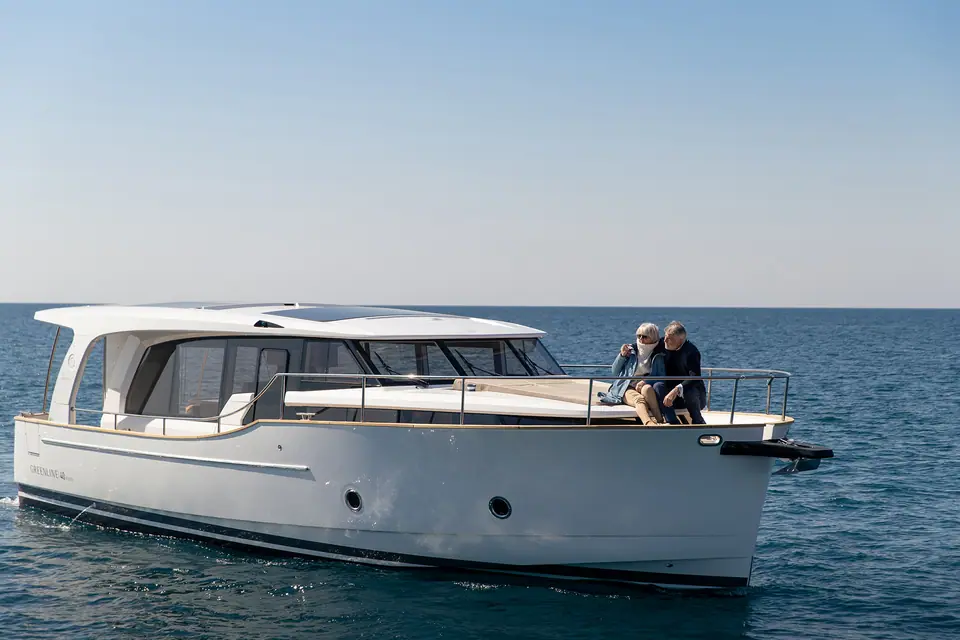
YachtBuyer's sea trial of a pure diesel boat with twin Yanmar 250s found a hull that feels planted and secure rather than sporty. A pair of skegs toward the stern give strong directional stability, and the boat ran with authority through light chop. The steering is on the stiff side and takes some muscle, the tester noted, though it turns back on itself respectably once you are used to it. The boat also benefits from plenty of trim tab, around 75 percent on test, to level the running attitude and improve sightlines.
In real cruising, owners report an efficient diesel cruise between 17 and 19 knots with up to 23 knots available, and a very different, slower rhythm on electric power. The twin shafts, a standard bow thruster in the High Standards Pack, an optional stern thruster and a side door beside the helm make docking unusually easy for a 40-footer, and YachtBuyer judged the boat manageable for a solo skipper.
Greenline has not published a full speed and fuel curve for the 40, so treat any single gallons-per-hour figure with caution. The semi-displacement hull rewards moderate speeds; push to the top end and fuel burn climbs much faster than speed.
The aft galley bar and the sliding roof
Greenline's signature trick is the aft galley, and on the 40 it works brilliantly. A pop-up rear window hinges up to the cockpit overhang and a fold-down splashback extends the counter outside, so the galley becomes a bar that serves the cockpit. The galley carries induction cooking, a deep sink, a microwave and, thanks to the solar roof and inverter, a full-size domestic fridge-freezer. A dishwasher is optional.
The saloon is one level with the cockpit and wrapped in tall windows, with a dinette that can convert into a day bed or berth and a TV that rises from the furniture. An electric sliding roof opens the forward saloon to the sky, and a step below the helm lets you pop your head through it for a clear view while docking. A traditional chart table and storage opposite the helm round out the space.
Testers had a few gripes: limited storage at the helm, trim tab switches placed awkwardly above the throttles, and a single windscreen wiper that leaves the port side spray-streaked.
Two cabins and one generous head
Below, the owner's cabin is forward. Greenline's adaptive layout uses two 80 by 200 centimeter beds that can stay apart or join into a double, and a fixed queen-size island berth is the alternative. Hull and coachroof windows make the cabin unusually bright. The guest cabin to port has full standing headroom beneath the saloon, twin beds of the same size that slide together, and sliding panels that borrow light from the saloon.
There is one head, shared by both cabins and doubling as an en suite for the owners, but it is roomy with good headroom and a separate shower stall, which is rare at this size. The trade-off is narrow internal doorways. For a couple with occasional guests, it is a practical, home-like arrangement; two couples sharing for weeks will want a second head that this boat cannot offer.
Greenline deliberately does not put flybridges on boats below 45 feet, keeping the center of gravity low. The result is a stable boat at rest and a lower air draft of about 9 feet 4 inches with the radar mast arranged for inland waterways.
Solar power and life off the grid
Every 40 now carries roof-mounted solar panels as standard, rated by the builder at about 1.6 to 2 kW depending on panel spec. On a diesel boat they feed the house bank and keep refrigeration and lighting running silently. On a hybrid they become the heart of the boat: Greenline claims up to three days at anchor for four people, including air conditioning, without running an engine or generator.
The US-spec hybrid YachtBuyer covered ran three independent air-conditioning units in Florida heat, a Victron inverter supplying 110 volts from the 60-volt lithium bank, and shore power selectable for 30 or 50 amp service. Its owner had expanded the lithium bank and described running fridge and air conditioning on a mooring indefinitely in good sun. That is the hybrid's real value: not the electric cruising, but never hearing a generator.
What it costs and how the used market behaves
YachtBuyer's test boat started at EUR 366,000 ex VAT with twin Yanmar diesels and the EUR 35,000 High Standards Pack, which bundles the solar panels, a 3,000-watt inverter, bow thruster, induction cooking and domestic fridge-freezer. Eco-teak in the cockpit (EUR 9,200) and diesel heating (EUR 4,700) took it to EUR 401,950. A delivered US hybrid with air conditioning and electronics will realistically land between about $450,000 and $650,000.
Used Greenline 40s hold value well. European listings show roughly EUR 269,000 for a 2013 boat, EUR 310,000 for a 2016, EUR 339,000 to 380,000 for 2020 and 2021 hulls, and EUR 370,000 to 509,000 for 2022 and 2023 boats. US inventory is thin, so many American buyers import. Annual running costs for slip, insurance, service and battery care typically fall around $15,000 to $35,000, with hybrid systems adding specialist service needs.
Expect the engine room inspection to take effort. Full access means unscrewing the dinette table and moving it to the cockpit; a starboard hatch allows quick checks. The space underneath is generous once open.
Greenline 40 specifications
| Length overall | 41.7 ft12.71 m |
|---|---|
| Beam | 13.9 ft4.25 m |
| Draft | 2.8 ft0.85 m |
| Air draft | 9.3 ft2.84 m |
| Displacement | 17,636 lbs8, kg |
| Fuel capacity | 185 gal7 L |
| Fresh water | 106 gal4 L |
| Cabins | 2 plus saloon |
| Berths | 4 plus 2 in the saloon |
| Heads | 1 with separate shower stall |
| Standard engines | 2 x Yanmar 4LV 250 hp diesels on shafts (earlier boats commonly twin Volvo Penta D3-220) |
| Optional engines | Hybrid with twin shaft-mounted electric motors and up to 53.2 kWh of LiPo batteries, or full electric 2 x 50 kW with a 4 kW diesel range extender |
| Maximum power | 500 hp |
| Cruise speed | 17 knots |
| Top speed | 22 knots |
| Hull type | Semi-displacement hull with twin skegs |
| Hull construction | GRP |
| Builder | Greenline Yachts (Seaway, now SVP Yachts), Slovenia |
| Naval architect | J&J Design |
| Other design credits | J&J Design (interior and exterior) |
| Production | 2011 to present |
| Status | In production |
Figures come from builder documentation and independent tests where available. Displacement is usually quoted light, so a loaded cruising boat will weigh more. Compare these specs with another model.
How much does a Greenline 40 cost?
YachtBuyer's test quoted a base of EUR 366,000 ex VAT for twin Yanmar diesels including the EUR 35,000 High Standards Pack, and EUR 401,950 as tested. Hybrid or electric drive, battery capacity, US freight and commissioning push a delivered US boat higher. Used asking prices in Europe run from about EUR 269,000 for a 2013 boat to EUR 370,000 to 509,000 for 2022 and 2023 hulls.
Estimate your yearly cost
A planning estimate using common rules of thumb: insurance near 1.5 percent of value, maintenance near 3 percent, haul out and bottom paint by length. Your marina, region and use will move these numbers. Open the full cost calculator.
Versions and options
- Greenline 40 Diesel
- Twin shaft-drive diesels, currently 2 x Yanmar 4LV 250 hp, earlier commonly 2 x Volvo Penta D3-220.
- Greenline 40 Hybrid
- Diesels plus electric motors on each shaft that double as generators, with up to four 13.3 kWh LiPo packs.
- Greenline 40 Electric
- Two 50 kW electric motors, lithium packs sized per owner and a 4 kW diesel range extender.
Greenline 40 timeline
- 2011Motor Boat and Yachting previews the drawings of the new 40-foot Greenline hybrid
- 2012Early boats sold internationally; the 40 picks up an AIM Marine Group Editor's Choice award
- 2015Builder Seaway faces an insolvency petition; Greenline production continues
- 2020Hybrid boats delivered with twin Volvo Penta D3-220s and electric shaft motors
- 2023YachtBuyer tests a twin Yanmar 250 diesel version priced from EUR 366,000 ex VAT
- 2026Still in the Greenline range under SVP Yachts ownership
Strengths and weaknesses
What owners like
- Choice of diesel, hybrid or full electric drive
- Aft galley with pop-up window creates a true cockpit bar
- Standard solar roof and domestic-size fridge-freezer
- Easy docking with twin shafts, thrusters and helm side door
- Low air draft and shallow draft for inland cruising
- Strong resale in Europe
What to weigh up
- Only one head for two cabins
- Stiff steering and heavy reliance on trim tabs
- Engine room access means removing the dinette table
- Thin US dealer and service network for hybrid systems
Used Greenline 40 buyer checklist
Take this list to a viewing. Your ticks are saved in this browser so you can come back to it.
Always commission an independent marine survey and an engine survey before you buy. How a marine survey works.
Rivals to consider
Beneteau Swift Trawler 41
More volume and a flybridge with three cabins, faster cruise, no hybrid option and higher fuel burn.
Compare side by sideTarga 41
Finnish pilothouse built for rough water, faster and tougher but less homely inside.
Compare side by sideBack Cove 41
Downeast-style single-diesel cruiser with stronger US resale and dealer support.
Compare side by sideGreenline 33
The smaller, single-engine predecessor with one cabin and even lower running costs.
Compare side by sideOur verdict on the Greenline 40
The Greenline 40 is the most complete expression of what Greenline set out to do: a bright, single-level cruiser with a brilliant aft galley, two real cabins and enough solar and battery capacity to make the generator nearly redundant. It is not quick to steer, it has one head and the engine room is a chore to open, but for couples who cruise slowly and value quiet anchorages it remains one of the most practical 40-footers you can buy new or used.
Greenline 40 questions answered
Is the Greenline 40 still in production?
Yes. It has been built since 2011 and remains in the Greenline range alongside the 39, 42, 45 and 58.
How fast is the Greenline 40?
Greenline rates the twin Yanmar 250 hp diesel version at 22 knots, with owners reporting an efficient cruise of 17 to 19 knots. The hybrid reaches about 7 to 8 knots on electric power.
What does a Greenline 40 cost?
A recent test boat started at EUR 366,000 ex VAT with diesel power. Used European listings run from about EUR 269,000 for 2013 boats to around EUR 509,000 for 2022 models.
How many cabins does the Greenline 40 have?
Two cabins, a forward owner's cabin and a guest cabin to port, sharing one large head with a separate shower stall.
Can the Greenline 40 Hybrid run air conditioning without a generator?
Yes. With an expanded lithium bank and solar panels, owners run air conditioning and refrigeration from the batteries, and Greenline claims up to three days at anchor.
Greenline 40 photos
More trawlers & explorer yachts to explore
Nordhavn 41
Trawlers & Explorer Yachts, 41 ft
Used $1.15M to $1.75M
Targa 37
Trawlers & Explorer Yachts, 41 ft
Used $140K to $650K
Kadey-Krogen 42
Trawlers & Explorer Yachts, 42 ft
Used $140K to $380K
President 42
Trawlers & Explorer Yachts, 43 ft
Used $90K to $280K