Grand Banks Yachts Trawlers & Explorer Yachts
Grand Banks 60 Review, Specs and Price
A Grand Banks profile on a carbon and composite long range cruiser that runs 30 knots when you need it and 10 knots when you want to cross an ocean of coastline.
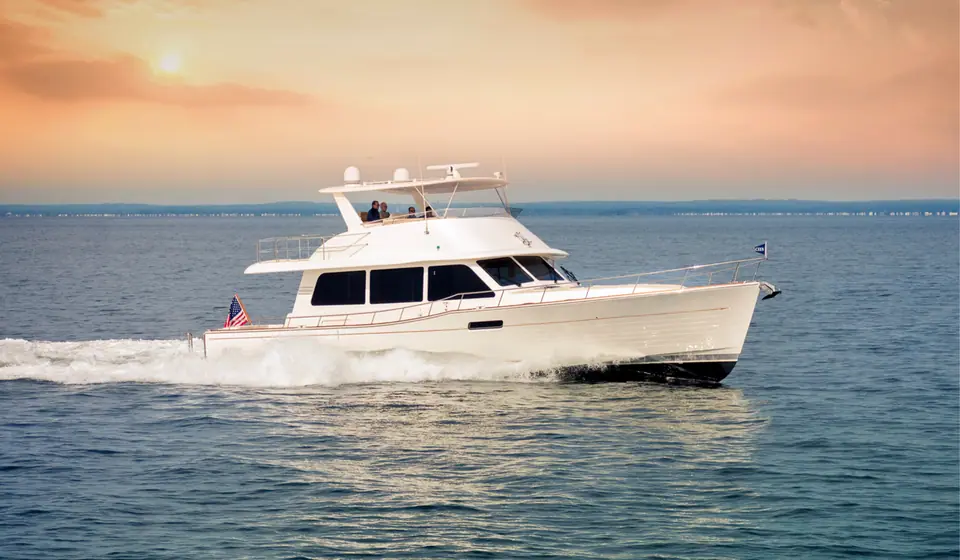
- Length
- 66.8 ft20.37 m
- Beam
- 19.2 ft5.84 m
- Cruise
- 26 kn
- Cabins
- 3 or 4
- Used price
- $2.6M to $4.7M
On this page
- Overview
- The Grand Banks 60 is a different kind of trawler
- V-Warp hull and a carbon superstructure
- Three Volvo packages and what they deliver
- Range at displacement speed
- Stabilizers and motion
- Flybridge or Skylounge
- Great Loop, Bahamas and long coastal runs
- What it costs to own
- Specifications
- Price and value
- Strengths and weaknesses
- Used buyer checklist
- Rivals
- Our verdict
- FAQ
The Grand Banks 60 is Mark Richards' V-Warp hulled long range cruiser, launched in 2017 with Volvo D11 or D13 power and now offered with D13 shafts or IPS, 1,532 gallons of fuel and Flybridge or Skylounge versions.
- Owners who want both speed and range
- East Coast and Bahamas cruisers
- Pacific Northwest and Alaska cruising
Grand Banks 60 by the numbers
- Speed to length ratio at cruise
- 3.41A planing cruise. Fast passages in exchange for much higher fuel burn per mile.
- Estimated range at cruise
- 597 nmUsing 90 percent of tank capacity at the cruise speed and fuel burn listed on this page.
- Fuel economy at cruise
- 0.43 nmpgNautical miles per gallon at cruise, both engines combined.
- Horsepower per ton
- 58 hpStrong power to weight for a planing hull.
- Length to beam ratio
- 3.48 : 1Moderate proportions.
The Grand Banks 60 is a different kind of trawler
If you know Grand Banks from the teak and Lehman diesels of the 42, the Grand Banks 60 will be a surprise. It keeps the classic silhouette and a curved sheer, but under the skin it is a modern, fast cruiser. The builder calls it a long range cruiser, and with a 31 to 33 knot top speed and range numbers that stretch past 2,000 nautical miles at 10 knots, the name fits.
The boat comes from Mark Richards, Grand Banks' CEO and chief designer, an Australian ocean racing skipper who won line honors in the Rolex Sydney Hobart Yacht Race nine times with the super maxi Wild Oats XI. His approach brings racing yacht thinking to a cruising powerboat: light structure where it counts, an efficient hull, and careful weight placement.
Power and Motoryacht ran a first look at the Grand Banks 60 in June 2017, and the model has since become a core part of the brand's Long Range Cruiser series, sitting below the GB62, GB65, GB73 and GB85. It is built at Grand Banks' factory in Malaysia, where the company has built boats since 1995.
V-Warp hull and a carbon superstructure
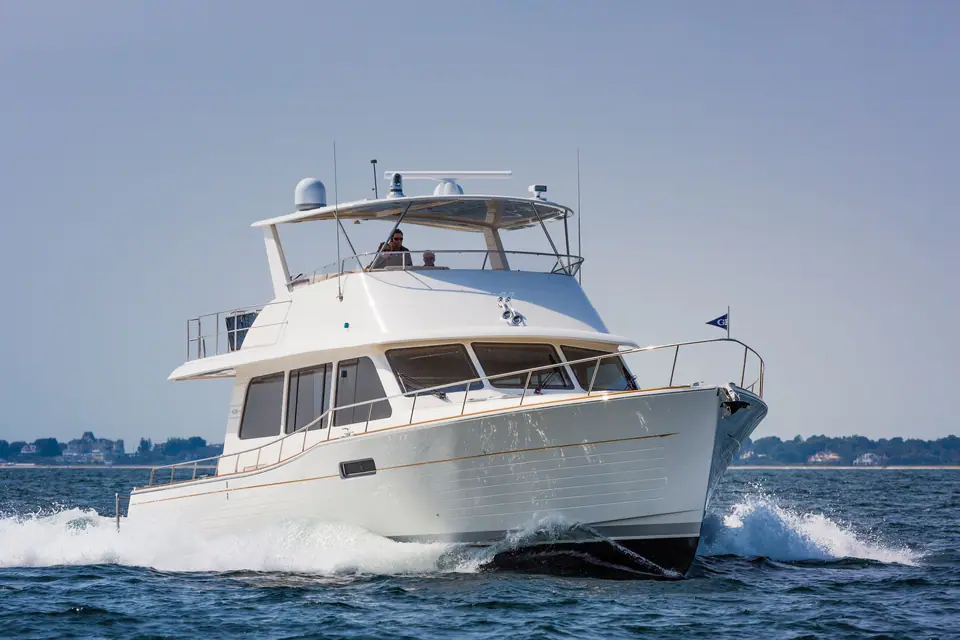
The hull uses what Grand Banks calls V-Warp technology, a variable deadrise shape designed to run efficiently both at slow displacement speeds and at planing speeds. The bow is fine for wave entry, while the aft sections flatten to provide lift at speed. That dual personality is the whole point of the boat.
Weight is the other half. The superstructure is carbon fiber, and the builder bonds bulkheads and fixed furniture to the hull for stiffness. At a listed displacement of 69,445 pounds on a 66 foot 10 inch boat, the GB60 is light for its size. Compare that with a heavy displacement passagemaker such as the shorter Nordhavn 57, and the different philosophies are obvious.
Draft is only 4 feet 3 inches with shafts and 4 feet 2 inches with IPS, which is remarkably shallow for a 67-foot yacht and opens anchorages in the Bahamas and along the ICW that deeper boats have to skip.
Three Volvo packages and what they deliver
The current standard package is a pair of Volvo Penta D13 diesels at 900 hp each on conventional shafts, quoted at 31 knots top and 26 knots cruise. Volvo IPS 1200 pod drives at the same horsepower raise those figures to 33 and 30 knots, while the 1,000 hp D13 shaft option delivers 33 knots top and 28 knots cruise. Early boats were offered with 725 hp Volvo D11s as standard, good for about 27 knots, so check what a used boat carries. Power and Motoryacht's 2017 test boat with 900 hp D13s on shafts reached 30.5 knots and ran 26.3 knots at 2,000 rpm on 60 gph.
At a fast 21 knot cruise, the builder quotes 38 to 42 gallons per hour depending on package, giving 761 to 858 nautical miles of range. Those are the numbers for owners who want to cover ground quickly, for example a run from Florida to the Bahamas and back in a weekend.
Shaft drives are simpler, easier to service in remote places and better protected in shallow water. IPS brings joystick docking and better efficiency at speed but requires Volvo service support. For a boat designed for long range cruising, many owners prefer shafts.
Range at displacement speed
The interesting number is not 33 knots but 10. Power and Motoryacht measured 9.5 knots at 750 rpm on just 4.4 gph, a range of 2,973 nautical miles with a 10 percent reserve, and 7.9 knots on 2.6 gph for over 4,100 miles. At 11.6 knots the burn jumps to 10.4 gph and range falls to about 1,500 miles, so the sweet spot is narrow. Even so, that is genuinely long range: Fort Lauderdale to Nova Scotia, or Seattle to Juneau and back, on a single fill of 1,532 gallons.
That flexibility is why the GB60 appeals to trawler buyers. You can cruise like a trawler most of the time, then run at 25 knots to beat a weather window or make a schedule. Few true displacement trawlers can do that, and few fast motor yachts can match the range at low speed.
Stabilizers and motion
A light, fast hull needs stabilization for comfort at anchor and at low speeds. Grand Banks does not list a standard stabilizer on its public spec sheet, so equipment varies by boat: the 2017 test boat listed a Seakeeper 9 gyro as a $93,500 option, and brokerage boats variously carry a Seakeeper, Side-Power Vector fins with zero speed mode, or Humphree all-speed fins. Ask exactly what is installed and test it at anchor and at 10 knots in a beam sea if possible.
At speed the hull is stable and dry, helped by the fine entry and the flatter aft sections. At low speeds it rolls more than a heavy displacement trawler without stabilization, so do not skip this item.
Flybridge or Skylounge
Grand Banks offers the 60 in Flybridge and Skylounge versions. The Flybridge has an open upper deck that suits warm climates and entertaining. The Skylounge encloses the upper deck in a climate controlled room with a view, which makes the boat much more usable in the Pacific Northwest, New England or for long passages in cold weather.
Below, owners choose three or four staterooms, with handcrafted wood finishes and custom options. The 19 foot 2 inch beam gives a wide saloon and a generous master stateroom.
Great Loop, Bahamas and long coastal runs
With a 4 foot 3 inch draft, the GB60 can run most of the Great Loop by depth, but its size and air draft make the route harder. The fixed 19 foot 1 inch bridge in Chicago is a hard limit, and a flybridge or skylounge boat of this size is unlikely to clear it without significant modification. Check before planning.
Where the GB60 shines is long coastal cruising: the East Coast from Florida to Maine, the Bahamas, the Pacific Northwest and Alaska, and the Caribbean. It is not designed for ocean crossings in the way a Nordhavn is, but its range at 10 knots allows long open water legs with careful weather planning.
What it costs to own
Budget roughly $180,000 to $320,000 a year for slip, insurance, maintenance, fuel and crew if used. A 67-foot slip is expensive in most US markets, and engine service on twin D13s is significant. Fuel costs vary with use; at 10 knots they are modest, at 25 knots they add up fast.
Grand Banks 60 specifications
| Length overall | 66.8 ft20.37 m |
|---|---|
| Beam | 19.2 ft5.84 m |
| Draft | 4.3 ft1.3 m |
| Displacement | 69,445 lbs31,5 kg |
| Fuel capacity | 1,532 gal5,8 L |
| Fresh water | 291 gal1,1 L |
| Cabins | 3 or 4 |
| Standard engines | 2 x Volvo Penta D13, 900 hp each, shaft drive |
| Optional engines | 2 x Volvo Penta IPS 1200 (900 hp), or 2 x Volvo Penta D13 at 1,000 hp on shafts; 2017 launch boats offered 2 x Volvo D11 725 hp as standard |
| Maximum power | 2,000 hp |
| Cruise speed | 26 knots |
| Top speed | 31 knots |
| Range | 602 nm |
| Hull type | Planing hull with V-Warp variable deadrise |
| Hull construction | Composite hull with V-Warp technology and carbon fiber superstructure |
| Builder | Grand Banks Yachts, Malaysia |
| Naval architect | Mark Richards (Grand Banks) |
| Production | 2017 to present |
| Status | In production |
Figures come from builder documentation and independent tests where available. Displacement is usually quoted light, so a loaded cruising boat will weigh more. Compare these specs with another model.
Performance data
| RPM | Speed (kn) | Fuel (gph) | Range (nm) |
|---|---|---|---|
| 600 | 7.9 | 2.6 | 4184 |
| 750 | 9.5 | 4.4 | 2973 |
| 1000 | 11.6 | 10.4 | 1536 |
| 1250 | 13 | 19.4 | 923 |
| 1500 | 18 | 28.1 | 882 |
| 1750 | 22.4 | 42.1 | 733 |
| 2000 | 26.3 | 60.2 | 602 |
| 2350 | 30.5 | 87 | 483 |
Power and Motoryacht test, August 2017, twin 900 hp Volvo Penta D13 on shafts, Twin Disc 2.04:1 gears, 612 gal fuel, 9 persons, 1 to 2 ft seas. Range with 10 percent reserve. Builder figures for current packages at 21 knots: 42 gph and 761 nm (D13 900 shafts), 39 gph and 834 nm (IPS 1200), 38 gph and 858 nm (D13 1,000 shafts).
How much does a Grand Banks 60 cost?
The 60 was priced at $3.28 million base at launch in 2017, and Power and Motoryacht's 900 hp test boat came to $3.36 million. Recent brokerage asks include a 2018 IPS boat at $2.75 million, 2020 boats at $3.495 million and $3.595 million, a 2022 Skylounge at $3.845 million and a 2023 Skylounge at $4.25 million. Flybridge or Skylounge configuration, engine package, three or four stateroom layout and stabilization move values most.
Estimate your yearly cost
A planning estimate using common rules of thumb: insurance near 1.5 percent of value, maintenance near 3 percent, haul out and bottom paint by length. Your marina, region and use will move these numbers. Open the full cost calculator.
Versions and options
- Grand Banks 60 Flybridge
- Open upper deck with helm and entertaining space.
- Grand Banks 60 Skylounge
- Enclosed, climate controlled upper deck for cooler climates and long passages.
Grand Banks 60 timeline
- 1962American Marine, the company behind Grand Banks, moves to Junk Bay in Hong Kong
- 1995Production moves to Malaysia
- 2017Grand Banks 60 launched at $3.28 million base; Power and Motoryacht test records 30.5 knots and 2,973 nm at 9.5 knots
- 2020sGB60 offered in Flybridge and Skylounge versions with three engine packages
Strengths and weaknesses
What owners like
- 31 to 33 knot top speed with long range at 10 knots
- Shallow 4 ft 3 in draft
- Light carbon superstructure
- Flybridge or Skylounge versions
- Classic Grand Banks styling with modern engineering
What to weigh up
- Expensive to buy and run
- Air draft likely too high for the Great Loop
- Needs stabilization at low speed
- Thin used market
Used Grand Banks 60 buyer checklist
Take this list to a viewing. Your ticks are saved in this browser so you can come back to it.
Always commission an independent marine survey and an engine survey before you buy. How a marine survey works.
Rivals to consider
Fleming 65
More traditional semi-displacement design with a strong owner following, slower but heavier.
Compare side by sideFleming 55
Smaller and less expensive, with a reputation for build quality and seakeeping.
Compare side by sideNordhavn 57
A heavy displacement ocean boat with more range but far less speed.
Compare side by sidePrincess F65
A faster, more contemporary flybridge yacht with less long range focus.
Compare side by sideOur verdict on the Grand Banks 60
The Grand Banks 60 is for owners who want a trawler's range and a fast yacht's speed in one hull. It keeps the Grand Banks look, but its V-Warp hull, carbon superstructure and Volvo power make it a modern long range cruiser rather than a classic trawler. It is expensive and not a Great Loop boat, but for long coastal cruising with the option to run fast, few boats do both jobs as well.
Grand Banks 60 questions answered
How fast is the Grand Banks 60?
Top speed is 31 knots with standard 900 hp D13 shafts and 33 knots with IPS 1200 or 1,000 hp D13 engines, according to the builder.
What is the range of the Grand Banks 60?
Power and Motoryacht measured 2,973 nautical miles with a 10 percent reserve at 9.5 knots on 4.4 gph. At 21 knots the builder quotes 761 to 858 nautical miles depending on engines.
How much does a Grand Banks 60 cost?
New boats typically cost about $4.8 million to $6.2 million with options. Used boats generally ask $2.9 million to $4.7 million.
Is the Grand Banks 60 a trawler?
It is a fast long range cruiser with a trawler style profile, not a full displacement trawler. It can cruise efficiently at displacement speeds.
Where is the Grand Banks 60 built?
At Grand Banks' factory in Malaysia, where the company has built boats since 1995.
Grand Banks 60 photos
More trawlers & explorer yachts to explore
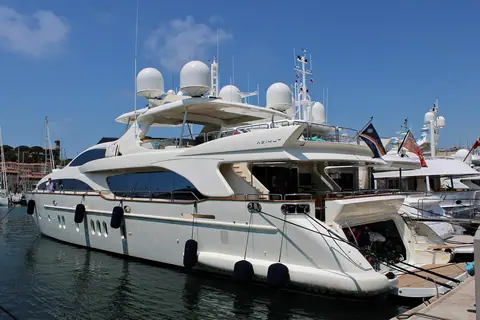
Azimut Magellano 66
Trawlers & Explorer Yachts, 66 ft
Used $1.3M to $3.2M
Elling E6
Trawlers & Explorer Yachts, 65 ft
Used $1.9M to $2.7M
Marlow Explorer 58E
Trawlers & Explorer Yachts, 71 ft
Used $1.3M to $2.5M
Fleming 65
Trawlers & Explorer Yachts, 71 ft
Used $1.8M to $6M