Grand Banks Yachts Trawlers & Explorer Yachts
Grand Banks 36 Sedan, the Single-Level Version of a Trawler Legend
The GB36 hull that launched a brand, reworked with a one-level salon and cockpit for owners who would rather entertain than sleep six.
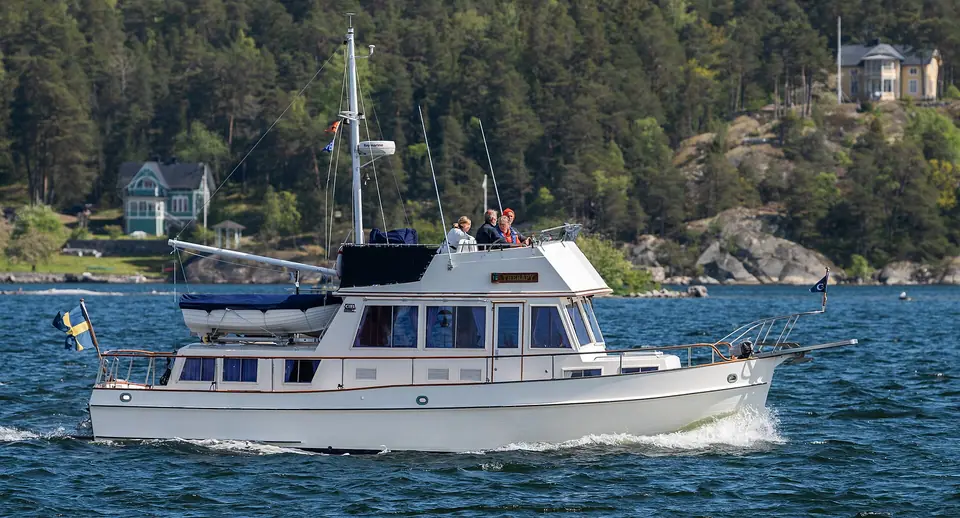
- Length
- 36.8 ft11.23 m
- Beam
- 12.7 ft3.86 m
- Cruise
- 8.5 kn
- Cabins
- 1 or 2 forward (Sedan); Classic has forward and aft cabins
- Used price
- $35K to $220K
On this page
- Overview
- Grand Banks 36 for sale, start by knowing which version you are looking at
- The boat that built Grand Banks
- The Sedan layout, room by room
- Ken Smith's hull, sharp forward and hard aft
- Single Lehman or twin diesels, how the GB36 performs
- Teak decks, tanks and the true cost of a classic
- How GB36 values hold up
- Specifications
- Price and value
- Strengths and weaknesses
- Used buyer checklist
- Rivals
- Our verdict
- FAQ
The Grand Banks 36 Sedan is a variant of the GB36, the Ken Smith-designed trawler American Marine built from 1965 to 2003 (1,141 hulls in all versions). The Sedan trades the Classic's aft cabin for a single-level salon and cockpit with one or two cabins forward.
- Liveaboard couples
- Great Loop and ICW cruising
- Owners who entertain more than they sleep guests
- Buyers who enjoy maintaining a classic
Grand Banks 36 Sedan by the numbers
- Speed to length ratio at cruise
- 1.43Runs in the semi-displacement range, faster than a trawler but thirstier per mile.
- Estimated range at cruise
- 1,020 nmUsing 90 percent of tank capacity at the cruise speed and fuel burn listed on this page.
- Fuel economy at cruise
- 2.83 nmpgNautical miles per gallon at cruise, both engines combined.
- Length to beam ratio
- 2.91 : 1A beamy hull with lots of volume for its length.
Grand Banks 36 for sale, start by knowing which version you are looking at
Search Grand Banks 36 for sale and you will see the same name on boats that live very differently. The GB36 was offered as the Classic, with separate forward and aft cabins, and as the Sedan and Europa, which drop the aft cabin in favor of a single-level salon that opens straight onto the cockpit. There was also a Motor Yacht version. Same hull, different lives.
The Sedan is the right GB36 for people who spend their time in the salon and cockpit rather than in bunks. Soundings, in a 1998 profile republished by Grand Banks, described the Sedan and Europa as offering more usable interior room, with a sedan-like single-level deck for the salon and aft cockpit joined by a large door, and a choice of one large stateroom or two smaller ones forward. The Europa is the version with the flybridge deck extended to overhang the side and aft decks.
In the same piece, a Connecticut broker said the classic two-cabin layout outsold the other versions by as much as five or six to one. That is why Sedans are less common on the brokerage market today, and why you need to read listings carefully: many are titled simply Grand Banks 36.
The boat that built Grand Banks
Grand Banks began life as American Marine in Hong Kong in 1956, founded by Robert J. Newton and his sons John and Whit. Power & Motoryacht's history of the GB36 explains that the first 36, a wooden prototype, was commissioned in 1962 and launched a year later, and its success persuaded the company to abandon custom building and concentrate on a production line of 36s that blended workboat looks, a seaworthy hull, efficient diesel power and yacht-level interiors.
Ken Smith was the designer of record for all the early Grand Banks models from 32 to 42 feet. The first production GB36 came down the ways in 1965, and the hulls were planked in Philippine mahogany until the Singapore yard switched to heavy fiberglass construction in 1973 and 1974. Power & Motoryacht and Soundings both put the final count at 1,141 hulls when the line was retired in 2003.
That run, nearly four decades on essentially one design, is why the GB36 is often called the boat that created the recreational trawler market. It also means parts knowledge, owner forums and experienced surveyors are easy to find.
The Sedan layout, room by room
Step from the cockpit through the large door and the Sedan salon opens up on one level. The interior described by Soundings puts an L-shaped dinette and the galley to port, with two armchairs and built-in storage to starboard. The inside helm stays to starboard, where it has always been on the GB36.
Forward and down, the two-cabin Sedan plan has a forward cabin with a large V-berth, a portside cabin with upper and lower single berths, and a single head to starboard with a separate shower stall. Owners who rarely carry guests often prefer the one-cabin version, which gives a bigger owners' stateroom.
What you give up is the Classic's private aft cabin with its own head and its hatch to the aft deck. What you gain is a cockpit at salon level, a single big living space and easier movement for anyone with bad knees. For liveaboards and couples who host friends for dinner, that is a good trade.
Ken Smith's hull, sharp forward and hard aft
The GB36 rides a semi-displacement hull with a sharp entry, a near-plumb bow with a gently curved upper profile, nicely flared topsides, a full-length keel protecting the propeller and rudder, and hard chines aft that damp pitching and rolling. That combination makes it efficient at trawler speed and willing to go somewhat faster with more power.
Beginning with the 1988 model year, Grand Banks lengthened and widened the GB36 by about 6 inches to add living room. The late specification sheet lists 36 feet 10 inches overall, 35 feet 2 inches on the waterline, a 12-foot-8-inch beam, 4 feet of draft and a displacement of about 26,000 pounds, with 400 gallons of fuel and 140 gallons of water. Earlier boats are slightly smaller, so check the actual dimensions of any boat you are pricing a slip for.
Single Lehman or twin diesels, how the GB36 performs
Single Ford Lehman diesels were the standard power until about 1982, with a sprinkling of John Deere and other makes. Cummins and Caterpillar diesels went into roughly half of Grand Banks built between 1982 and 1989 and became dominant after that. Twin-engine boats were ordered less often but are not rare.
Soundings reported that single-engine boats cruise efficiently at 8 to 9 knots on about 3 gallons per hour, with top speeds of 10 to 11 knots at around 12 gph. A GB36 with twin 210 hp diesels cruises at about 9 to 10 knots on 6 gph and tops out at 14 to 15 knots burning about 22 gph, and the hull runs cleanly at those speeds rather than plowing. A 2024 Yachting brokerage listing for a 1980 Classic with a single 135 hp Lehman quoted a 7-knot cruise and 8.5 knots top.
Which to buy depends on how you cruise. A single Lehman is the definition of simple and frugal, and parts and expertise are everywhere. Twins add redundancy and maneuverability at the dock, and allow a faster passage when weather or tides demand it, at the cost of more maintenance and a more crowded engine room.
- Single engine: 8 to 9 knots at about 3 gph, 10 to 11 knots top at about 12 gph
- Twin 210 hp: 9 to 10 knots at about 6 gph, 14 to 15 knots top at about 22 gph
- Fuel 400 gallons on late fiberglass boats
- Draft about 4 feet, good for the ICW, Bahamas and Great Loop
Teak decks, tanks and the true cost of a classic
Budget roughly $15,000 to $35,000 a year to keep a GB36 Sedan in good order, depending on slip costs, how much teak you maintain yourself and whether the boat has one engine or two. The big swing items are teak deck replacement, varnish, fuel tanks and engine work, and any one of them can cost more than a year of normal maintenance.
Wooden boats from before 1973 are a separate category. Plenty are still cruising, but they need a surveyor who knows wooden hulls and an owner prepared for ongoing woodwork. Most buyers will be happier with a fiberglass boat from 1974 on.
How GB36 values hold up
Grand Banks 36s have always held their value well. In 1998 a broker told Soundings that GB36 prices had risen as much as 10 percent over the previous couple of years and that demand remained strong, quoting typical values from $80,000 for late-1970s fiberglass boats to $250,000 and up for mid-1990s boats at that time. Those figures are a reminder that the best GB36s were never cheap.
Today the market is more spread out. Neglected boats with tired teak, original tanks and high-hour engines can be found cheaply, while refitted Sedans with repowers, new tanks and modern electronics command a strong premium. Our 2026 estimates run from about $35,000 for an early wooden or project boat to about $220,000 for an exceptional late fiberglass example.
Grand Banks 36 Sedan specifications
| Length overall | 36.8 ft11.23 m |
|---|---|
| Waterline length | 35.2 ft10.72 m |
| Beam | 12.7 ft3.86 m |
| Draft | 4 ft1.22 m |
| Displacement | 26, lbs11,793 kg |
| Fuel capacity | 4 gal1,514 L |
| Fresh water | 14 gal53 L |
| Cabins | 1 or 2 forward (Sedan); Classic has forward and aft cabins |
| Berths | Forward V-berth plus upper and lower singles in the two-cabin Sedan plan |
| Heads | 1 with separate shower stall (Sedan) |
| Standard engines | Single Ford Lehman diesel on most boats until about 1982 |
| Optional engines | Twin diesels; Cummins and Caterpillar became dominant after the early 1980s (twin 210 hp Cummins and twin 135 hp Sabre examples documented) |
| Cruise speed | 8.5 knots |
| Top speed | 11 knots |
| Hull type | Semi-displacement with full-length keel, sharp entry and hard chines aft |
| Hull construction | Philippine mahogany planking until 1973 to 1974, fiberglass afterward |
| Builder | American Marine (later Grand Banks Yachts), Hong Kong, then Singapore |
| Naval architect | Ken Smith |
| Production | 1965 to 2003 |
| Status | Discontinued |
Figures come from builder documentation and independent tests where available. Displacement is usually quoted light, so a loaded cruising boat will weigh more. Compare these specs with another model.
How much does a Grand Banks 36 Sedan cost?
Grand Banks 36 values depend on construction (wood before 1973 to 1974, fiberglass after), engine type and hours, and the state of the teak decks and fuel tanks. A 1980 Classic with a single 135 hp Lehman was listed at $75,000 in 2024, which anchors the middle of the market. Sedans are scarcer than Classics because the two-cabin layout outsold other versions by roughly five or six to one, so a well-kept Sedan can find a dedicated buyer, but the pool of shoppers is smaller.
Estimate your yearly cost
A planning estimate using common rules of thumb: insurance near 1.5 percent of value, maintenance near 3 percent, haul out and bottom paint by length. Your marina, region and use will move these numbers. Open the full cost calculator.
Versions and options
- GB36 Classic
- Two-cabin trunk-cabin layout with forward and aft cabins and two heads; the best-selling version by a wide margin.
- GB36 Sedan
- Single-level salon and cockpit with one or two cabins forward and a single head with separate shower.
- GB36 Europa
- Sedan-style interior with the flybridge deck extended to overhang the side and aft decks.
- GB36 Motor Yacht
- Motor yacht variant offered alongside the Classic and Europa in Grand Banks literature of the late 1990s.
Grand Banks 36 Sedan timeline
- 1956Robert J. Newton and sons John and Whit found American Marine in Hong Kong
- 1962Wooden GB36 prototype commissioned, launched a year later
- 1965First production Grand Banks 36 comes down the ways
- 1973Switch from mahogany to fiberglass construction begins at the Singapore yard
- 1988GB36 lengthened and widened by about 6 inches
- 2003GB36 retired after 1,141 hulls
Strengths and weaknesses
What owners like
- Single-level salon and cockpit, easy to live on and entertain
- Proven Ken Smith hull with full keel protection
- Frugal single-engine cruising at about 3 gph
- Huge owner community and surveyor knowledge
- Strong long-term value retention
- 4-foot draft suits the ICW and Bahamas
What to weigh up
- Teak decks and brightwork demand constant care
- Fuel tanks and engines on older boats may need replacement
- Only one head on the Sedan
- Fewer Sedans than Classics on the market
- Pre-1974 boats are wooden and need specialist survey
Used Grand Banks 36 Sedan buyer checklist
Take this list to a viewing. Your ticks are saved in this browser so you can come back to it.
Always commission an independent marine survey and an engine survey before you buy. How a marine survey works.
Rivals to consider
Grand Banks 42 Classic
The bigger sister with more room and twin engines common, at higher prices.
Compare side by sideMainship 34 Trawler
Cheaper American-built single-engine trawler with a sedan-style layout.
Compare side by sideGrand Banks 32
Smaller, simpler single-cabin GB with a single Lehman and lower costs.
Compare side by sideNordic Tug 32
Newer fiberglass tug with faster semi-displacement performance and less teak.
Compare side by sideOur verdict on the Grand Banks 36 Sedan
The Grand Banks 36 Sedan takes the most important small trawler of its era and gives it a more sociable layout. You lose the Classic's aft cabin and second head, but you gain a single-level living space that makes life aboard easier, especially for couples and liveaboards. Buy on condition rather than year: a fiberglass boat with sound decks, new tanks and a documented engine is worth far more than a cheaper boat with deferred maintenance. Find the right one and you get a beautiful, frugal, proven cruiser that will hold its value better than almost anything else in its size range.
Grand Banks 36 Sedan questions answered
How much is a Grand Banks 36 worth?
Our 2026 estimates run from about $35,000 for early or project boats to about $220,000 for the best late fiberglass examples. A 1980 Classic was listed at $75,000 in 2024.
What is the difference between the GB36 Classic and Sedan?
The Classic has separate forward and aft cabins with two heads. The Sedan has a single-level salon and cockpit with one or two cabins and one head forward.
How many Grand Banks 36s were built?
Power & Motoryacht and Soundings put the total at 1,141 hulls across all versions, built from the 1960s until the line was retired in 2003.
How fast is a Grand Banks 36?
Single-engine boats cruise at 8 to 9 knots on about 3 gph and top out at 10 to 11 knots. Twin 210 hp boats can reach 14 to 15 knots.
Are older Grand Banks 36s made of wood?
Yes. Hulls were Philippine mahogany until the switch to fiberglass in 1973 and 1974.
Who designed the Grand Banks 36?
Ken Smith, the designer of record for the early Grand Banks models from 32 to 42 feet.
Photos from the Grand Banks Yachts range
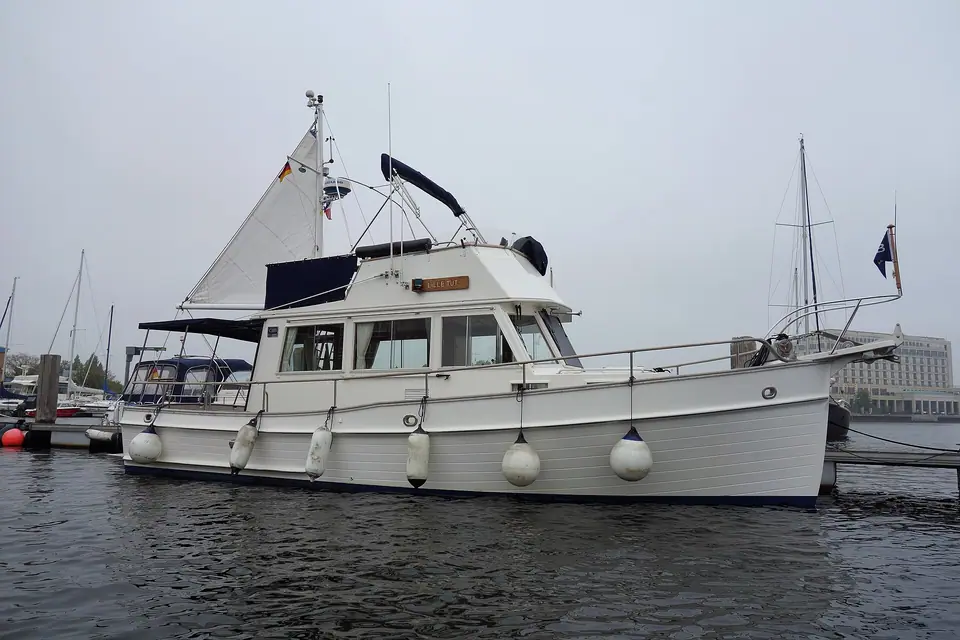
We have not found a freely licensed photo of the Grand Banks 36 Sedan yet, so these show other Grand Banks Yachts boats, each captioned with the boat pictured.
More trawlers & explorer yachts to explore
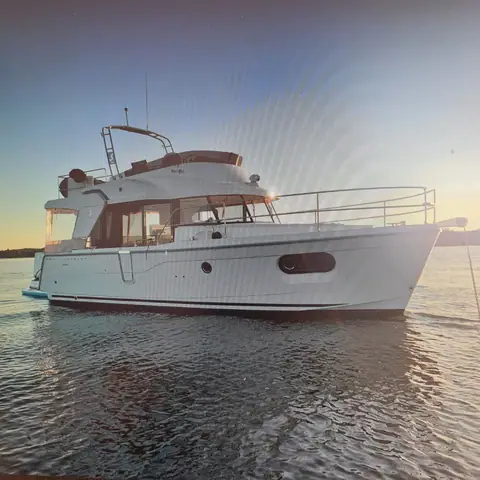
Beneteau Swift Trawler 35
Trawlers & Explorer Yachts, 37 ft
Used $290K to $520K
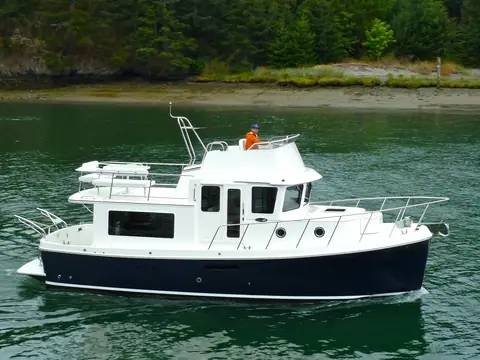
American Tug 34
Trawlers & Explorer Yachts, 37 ft
Used $180K to $500K
Beneteau Swift Trawler 34
Trawlers & Explorer Yachts, 36 ft
Used $150K to $270K
Targa 32
Trawlers & Explorer Yachts, 35 ft
Used $200K to $600K