American Tug Trawlers & Explorer Yachts
American Tug Range Guide, Centered on the Flagship 435
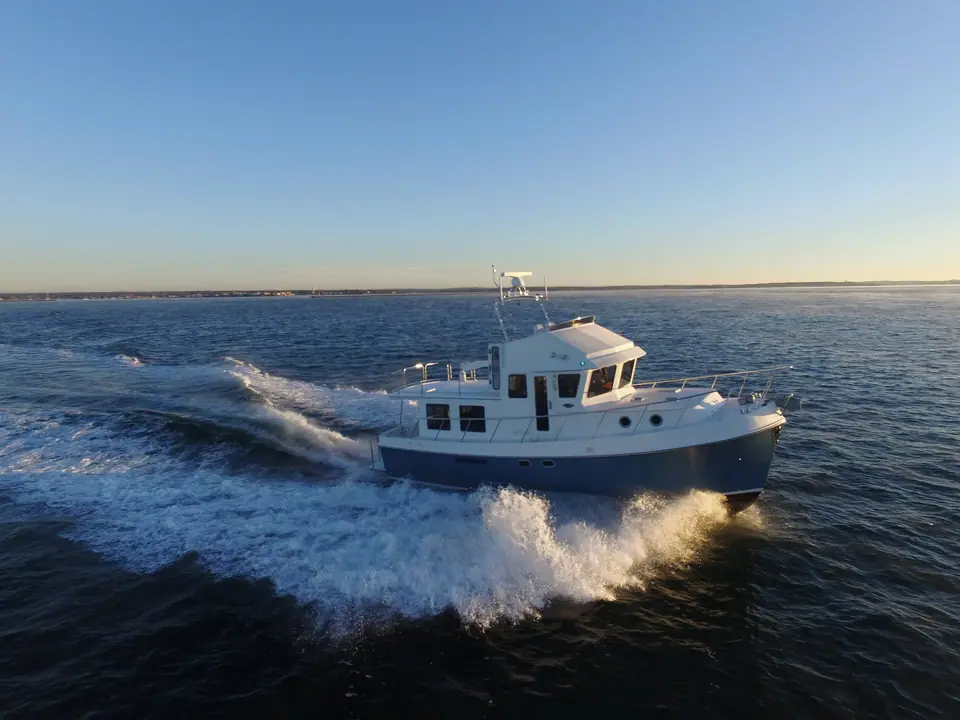
Single-diesel, semi-displacement coastal cruisers from La Conner, Washington, built on Lynn Senour hull thinking, with the 43-foot 435 as the long-running flagship.
- Length
- 43.6 ft13.28 m
- Beam
- 15.8 ft4.83 m
- Cruise
- 8 kn
- Cabins
- 2
- Used price
- $330K to $1M
On this page
American Tug built about 250 semi-displacement coastal cruisers in La Conner, Washington, from 2000, in sizes from the 36-foot 362 and 365 to the 43-foot 7-inch 435 flagship and the larger 485; the 435 carries a single Cummins 550, two staterooms and 640 gallons of fuel.
- Couples cruising the Inside Passage, Great Loop or Bahamas
- Liveaboards who want a 43-foot boat with real tankage
- Owners who do their own maintenance
- Buyers moving up from a smaller tug
American Tug 435 by the numbers
- Speed to length ratio at cruise
- 1.30Cruises at displacement speed, the most fuel efficient way to cover long distances.
- Estimated range at cruise
- 1,317 nmUsing 90 percent of tank capacity at the cruise speed and fuel burn listed on this page.
- Fuel economy at cruise
- 2.29 nmpgNautical miles per gallon at cruise, both engines combined.
- Horsepower per ton
- 38 hpModest power to weight, efficiency over outright speed.
- Length to beam ratio
- 2.75 : 1A beamy hull with lots of volume for its length.
What people mean by an American Tug
Search for american tug and you will find a family of boats rather than a single model. American Tug was founded in 1999 by Kurt Dilworth, Tom Nelson and Mike Schoppert, three managers who left Nordic Tugs, with the Seattle designer Lynn Senour as their partner. Their company, Tomco Marine Group, set up in La Conner, Washington, and launched the first American Tug 34 in 2000. By the time the Kadey-Krogen Group bought it in May 2023, the yard had built about 250 boats and was offering five models from 36 to 48 feet.
Every American Tug follows the same recipe: a semi-displacement hull with hard chines, some rocker from bow to stern and a full keel, one diesel engine, systems that a handy owner can maintain, and no exterior wood. Dilworth told PassageMaker the boats commonly burn about 3.5 gph across the whole range at 7.5 to 8 knots, with 15 to 16 knots available when weather or schedules demand it. This guide uses the 435, the long-running flagship, as its reference boat and explains where the others fit.
The range model by model
Model names are confusing because American Tug renamed boats by overall length. Here is how the range fits together, using builder and magazine figures.
- 34 / 365: the original 2000 boat on Senour's Alaska fishboat hull, 36 ft 6 in overall, 13 ft 3 in beam, one stateroom, single 330 to 380 hp Cummins, 400 gal fuel
- 362: introduced 2020 on the same hull and deck with two staterooms, a 320 hp Volvo D4 and 230 gal fuel
- 395: 41 ft 6 in overall on the same 13 ft 3 in beam, 25,000 lb, Cummins 380, 400 gal fuel, two staterooms and one head; Dilworth calls it a Swiss Army knife, and a 500 hp option is reported to cruise near 20 knots
- 41 / 435: Senour's stretch of the 34 concept, launched 2004 and later called the 435 (a 41-footer by molded length), 43 ft 7 in overall, 15 ft 10 in beam, two staterooms and two heads
- 485: about 45 ft on deck, not a Senour design but built on the same semi-displacement principles
- 49 Limited Edition: two prototypes on a 15 ft 10 in beam, Volvo D9 575 hp and 800 gal fuel, $929,000 base in 2009
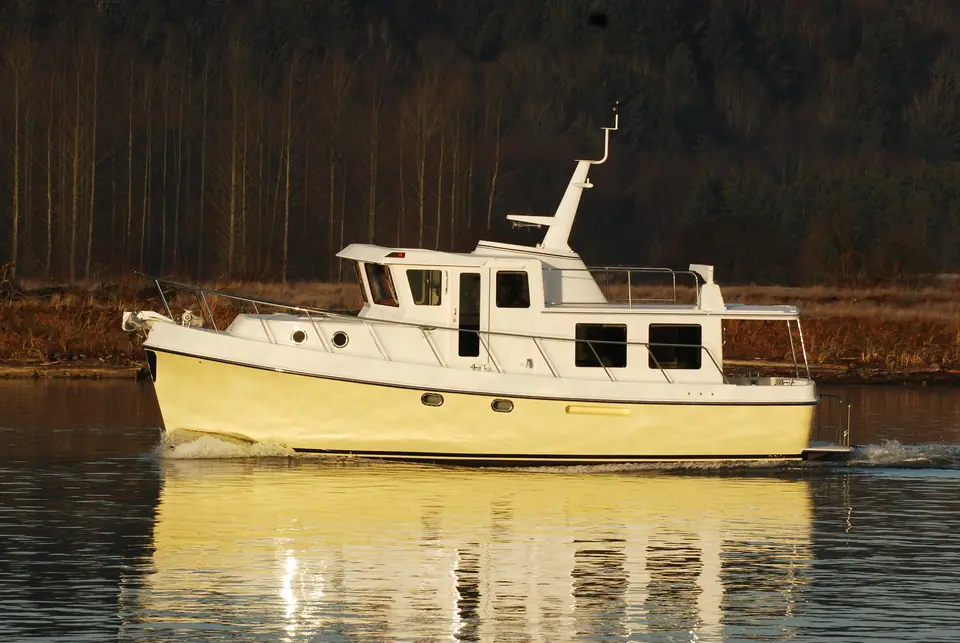
The 435, a couple's cruiser with room for guests
The builder lists the 435 at 43 feet 7 inches overall with a 15-foot 10-inch beam, a 4-foot 10-inch draft and 29,200 pounds dry, carrying 640 gallons of fuel, 200 gallons of water and 60 gallons each of gray and black water. Power is a single Cummins rated at 550 hp. BoatTest reports a range of about 1,070 nautical miles at 8.4 knots, and the original 2004 plan for the 41 was 1,000 miles at 10 knots, a 14-knot cruise and an 18-knot top end.
The interior uses a full-beam master with an en suite head and a guest cabin with a Pullman queen, an optional upper bunk and its own head, so the boat sleeps up to seven with the salon settee. The salon has a large U-shaped galley, an L-shaped settee and room for a loose chair, and the pilothouse has helm and companion seating with doors to both sides. Standard equipment was chosen for two people handling the boat: variable-speed bow and stern thrusters, a hydraulic crane on the upper deck, and a walk-through from the pilothouse to the boat deck instead of a vertical ladder.
Air draft matters to Loopers. The flybridge model is about 18 feet 3 inches with the arch down and up to 22 feet 8 inches with it up, while non-flybridge boats are about 19 feet 4 inches with a fixed mast; hinged masts were available. The Chicago Sanitary and Ship Canal requires 19 feet 6 inches.
How an American Tug runs
Power and Motoryacht's 2007 test of an early 41 with a 500 hp Volvo Penta D9-500 recorded 20.4 mph, about 17.7 knots, wide open, sharp and flat turns from a 33 by 16.5-inch barn-door rudder, and enough stern visibility to see the swim platform from the helm. Docking against an ebb with boats in the way was easy with bow and stern thrusters and a five-blade prop. The tester also liked saddle-style welded aluminum fuel tanks that feed from the bottom through duplex Racors, analog breakers that any chandlery can replace, and a Plexus-bonded stringer grid.
Owners use the speed range rather than living at the top of it. A Seattle owner who bought a 2008 American Tug 41 in 2020 cruised about 22,000 miles in three years, including Alaska, Mexico, Central America, an 800-mile open-water passage from Panama at 7.5 to 8 knots, the Caribbean and the Great Loop. His main lesson was single-engine preparation: he replaced cracked injectors, then every injector, and carried spares for everything he could fix himself.
A small yard through booms and busts
American Tug has always been small. Its record year was 2007, with 23 boats and 60 to 70 employees, before the recession cut it to six employees and one boat in the shop in 2008 and 2009. It survived, rode the pandemic boom, finished seven boats in 2023 and planned ten for 2024 with about 33 staff. Dilworth stressed that every hull got some customization and that he did the final quality check himself. By 2025 the company had switched from dealers to builder-direct sales through Kadey-Krogen's offices, and its site listed models from 36 to 43 feet.
Then the parent ran into trouble. In July 2026 Kadey-Krogen was reported to be filing for Chapter 7, Power and Motoryacht described the company as out of production, and the American Tug website now shows only an archived or suspended notice. We could not confirm what has happened at La Conner, so treat new builds, warranty claims and factory parts as unavailable until proven otherwise.
Buying a used American Tug
The good news for american tugs for sale is that the boats were designed for owner maintenance. Cummins and Volvo Penta diesels, Northern Lights generators, Side-Power thrusters and standard electronics all have national dealer support. Annual costs for a 435 run $30,000 to $55,000 for insurance, a 45 to 50-foot slip, haul-out, engine and generator service and fuel at trawler speeds.
Because every boat was customized, compare equipment lists line by line. Air conditioning versus diesel heat, a stabilizer or gyro retrofit, watermaker, generator size, flybridge versus non-flybridge and davit or crane spec can be worth more than a model year. Dark hulls, which many owners chose, need careful checks for oxidation and repaired gelcoat.
American Tug 435 specifications
| Length overall | 43.6 ft13.28 m |
|---|---|
| Beam | 15.8 ft4.83 m |
| Draft | 4.8 ft1.47 m |
| Air draft | 18.3 ft5.56 m |
| Displacement | 29,2 lbs13,245 kg |
| Fuel capacity | 64 gal2,423 L |
| Fresh water | 2 gal757 L |
| Cabins | 2 |
| Berths | Up to 7 including convertible settee and optional upper bunk |
| Heads | 2 |
| Standard engines | 1 x Cummins 550 hp diesel (435) |
| Optional engines | Earlier 41s used a single Volvo Penta D9-500; a 480 hp Cummins was planned as standard at launch |
| Maximum power | 550 hp |
| Cruise speed | 8 knots |
| Range | 1,070 nm |
| Hull type | Semi-displacement hard-chine hull with rocker and a full keel |
| Hull construction | Hand-laid fiberglass hull with bonded stringer grid; cored decks and superstructure |
| Builder | Tomco Marine Group (American Tug), owned by Kadey-Krogen Group from 2023, United States |
| Naval architect | Lynn Senour (34/365, 41/435); later models developed in house |
| Other design credits | Kurt Dilworth, Tom Nelson and Mike Schoppert (founders and engineering) |
| Production | 2000 to present |
| Status | Discontinued |
Figures come from builder documentation and independent tests where available. Displacement is usually quoted light, so a loaded cruising boat will weigh more. Compare these specs with another model.
How much does a American Tug 435 cost?
When the 41 was announced in 2004, American Tug expected it to sell for about $525,000, and the larger American Tug 49 had a $929,000 base price in 2009. The two-stateroom 395 and 365 sit well below the 435 on the used market, while late 435s and 485s are the most expensive boats in the range. Our bands for the 41 and 435 are estimates anchored to those prices; engine hours, stabilizers, generator and watermaker spec and the condition of dark hull paint make the biggest differences.
Estimate your yearly cost
A planning estimate using common rules of thumb: insurance near 1.5 percent of value, maintenance near 3 percent, haul out and bottom paint by length. Your marina, region and use will move these numbers. Open the full cost calculator.
Versions and options
- American Tug 435 Flybridge
- Upper helm and boat deck with arch; air draft about 18 ft 3 in arch down, 22 ft 8 in arch up.
- American Tug 435 non-flybridge
- Fixed mast version at about 19 ft 4 in, with hinged masts available for Great Loop cruising.
- American Tug 41
- The 2004 to late-2000s name for the same Senour-designed boat, tested by Power and Motoryacht with a Volvo Penta D9-500.
- American Tug 395
- Narrow-beam 41 ft 6 in two-stateroom boat on the 13 ft 3 in beam of the 365; the only twin-engine American Tug was a 395.
American Tug 435 timeline
- 1999Founders leave Nordic Tugs and form Tomco Marine Group with designer Lynn Senour
- 2000First American Tug 34 launched in La Conner
- 2004American Tug 41 launches, later renamed the 435; Senour dies the same year
- 2009American Tug 49 introduced at a $929,000 base price
- 2020Two-stateroom 362 introduced on the original 34 hull
- 2023Kadey-Krogen Group acquires American Tug after about 250 boats
- 2026Parent reported to file for Chapter 7; American Tug website goes offline
Strengths and weaknesses
What owners like
- About 3.5 gph at 7.5 to 8 knots across the range
- 15 to 16 knots available for weather windows
- Roughly 1,000 nm range on the 435
- Two en suite staterooms and a full-beam master
- No exterior wood and owner-serviceable systems
- Thrusters fore and aft and a deck crane as standard
What to weigh up
- Single engine only on almost every boat
- Builder support uncertain after 2026
- Model names are confusing on listings
- Flybridge air draft too high for Chicago without lowering
Used American Tug 435 buyer checklist
Take this list to a viewing. Your ticks are saved in this browser so you can come back to it.
Always commission an independent marine survey and an engine survey before you buy. How a marine survey works.
Rivals to consider
Nordic Tug 42
The closest rival in concept, from the yard the American Tug founders left, with a similar single-diesel semi-displacement approach.
Compare side by sideBeneteau Swift Trawler 41
Twin-engine, faster and lighter, with stronger dealer support but less tankage.
Compare side by sideKadey-Krogen 44
A full displacement ocean trawler from the same parent group, slower but longer legged.
Compare side by sideHelmsman 43E Pilothouse
A Pacific Northwest-sold pilothouse trawler with a similar couple-focused layout.
Compare side by sideOur verdict on the American Tug 435
American Tugs are honest, rugged coastal cruisers built by a small team that cared about details, and the 435 is the best all-rounder in the family: two en suite cabins, about 1,000 miles of range and the ability to run at 15 knots when it has to. The 2026 turmoil at the parent company means you should buy one as an orphan, on survey, engine records and the owner network rather than on factory backing. Do that and it remains one of the most capable boats of its size on the used market.
American Tug 435 questions answered
Who builds American Tug boats?
Tomco Marine Group in La Conner, Washington, founded in 1999 by former Nordic Tugs managers and owned by the Kadey-Krogen Group from 2023.
How much does an American Tug cost?
Used prices range from about $180,000 for an early 34 to around $1 million for a late 435. The 41 was expected to sell for about $525,000 new in 2004 and the 365 listed at $465,500 in 2018.
What is the fuel economy of an American Tug?
Co-founder Kurt Dilworth says the range commonly burns about 3.5 gph at 7.5 to 8 knots, with 15 to 16 knots available at much higher burn.
What is the difference between the American Tug 41 and 435?
They are the same Lynn Senour design; the 41 was renamed the 435 when American Tug started naming models by overall length.
Is American Tug still building boats?
Its parent was reported in July 2026 to be filing for Chapter 7 and the American Tug website is offline; we could not confirm whether the La Conner yard is still building.
How far can an American Tug 435 go?
BoatTest reports about 1,070 nautical miles at 8.4 knots on the 435.
American Tug 435 photos
More trawlers & explorer yachts to explore
Grand Banks 42 Classic
Trawlers & Explorer Yachts, 43 ft
Used $75K to $360K
Beneteau Swift Trawler 41
Trawlers & Explorer Yachts, 44 ft
Used $450K to $760K
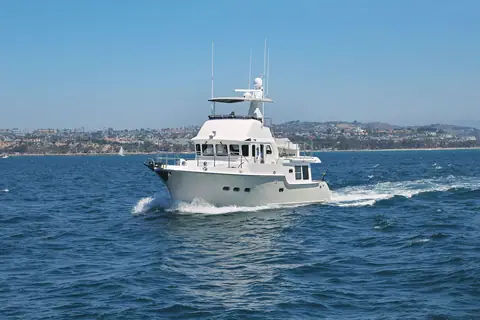
Nordhavn 43
Trawlers & Explorer Yachts, 43 ft
Used $420K to $760K
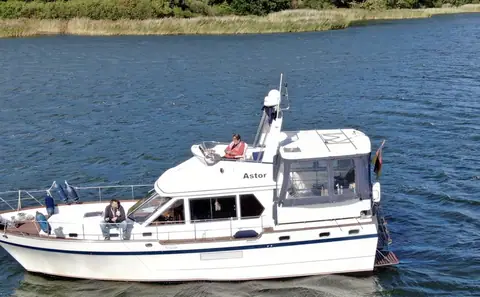
President 42
Trawlers & Explorer Yachts, 43 ft
Used $90K to $280K