Hatteras Yachts Sportfishing Yachts
Hatteras 53 Yacht Fisherman and 53 Motor Yacht Buyer's Guide
Jack Hargrave's solid glass 53-footer gave the motor yacht a fishing cockpit, and decades later it is still one of the best value classic yachts in America.
- Length
- 53.1 ft16.18 m
- Beam
- 15.8 ft4.83 m
- Cruise
- 4 ft1.22 m
- Cabins
- 2 standard, 3 optional
- Used price
- $85K to $300K
On this page
- Overview
- Hatteras 53 explained, from Convertible to Yacht Fisherman
- Jack Hargrave's hull and the solid glass reputation
- Living aboard a Yacht Fisherman
- Detroit Diesel power and the repower question
- What it costs to bring a 53 back to life
- Running costs for a classic Hatteras 53
- Finding the right Hatteras 53 for sale
- Specifications
- Price and value
- Strengths and weaknesses
- Used buyer checklist
- Rivals
- Our verdict
- FAQ
The Hatteras 53 Yacht Fisherman is a classic New Bern built motor yacht with a fishing cockpit, sharing its Jack Hargrave hull family with the 53 Motor Yacht and 53 Convertible, and powered mostly by Detroit Diesels.
- Buyers who want a classic American yacht
- Owners who both cruise and fish
- Hands-on owner-operators
- Refit projects with a clear budget
Hatteras 53 Yacht Fisherman by the numbers
- Displacement hull speed
- 9.1 knThe efficient cruising speed for a displacement hull of this waterline.
- Length to beam ratio
- 3.35 : 1Moderate proportions.
Hatteras 53 explained, from Convertible to Yacht Fisherman
Search for a Hatteras 53 and you will find three related boats. The 53 Convertible was a classic sportfisherman with a large cockpit and flybridge. The 53 Motor Yacht, often listed as the Hatteras 53 MY, had a raised aft deck over a full aft master stateroom. The 53 Yacht Fisherman sat between them, pairing motor yacht style accommodations and living space with a fishing cockpit at the stern.
Hatteras used the Yacht Fisherman name for this hybrid formula on several sizes, including the better known 58 Yacht Fisherman of the early 1970s. The appeal was simple: owners could cruise the Intracoastal Waterway and the Bahamas in motor yacht comfort, then back down on a sailfish or troll for dolphin without needing a separate boat. The 53 YF is much rarer on the market than the 53 MY, and listings sometimes blur the two, so read the layout drawings rather than the headline. Hull-number records compiled by HatterasOwners.com show two production runs: Series I from October 1977 to January 1981 and Series II from March 1987 to March 1990.
All of these boats come from the same era of Hatteras history, when the New Bern and High Point plants were building heavy, hand-laid fiberglass yachts drawn by Jack Hargrave.
Jack Hargrave's hull and the solid glass reputation
Hatteras was founded in 1959 by Willis Slane, who wanted a boat that could fish the rough water off Cape Hatteras, and he hired a young Jack Hargrave to draw it. Hargrave went on to design Hatteras yachts for many years, developing sharp-entry, variable deadrise hulls that became known for their seakeeping. The 53 inherits that DNA: a fine entry that cuts through a head sea and hard chines that keep it relatively dry. Hatteras's brochure says the Yacht Fisherman is based on the 53 Motor Yacht, and Sea magazine's 1973 report on that hull gives 53 feet 1 inch overall, a 15 foot 10 inch beam and a 4 foot draft, with Hatteras describing the bottom as a modified-V planing hull with a sharp entry, a deep forefoot and relatively shallow deadrise at the transom.
The hull is solid hand-laid fiberglass, thick by modern standards. That is the main reason so many 53s are still in service. Unlike cored hulls, the bottoms are rarely the problem on a survey. The weak points on these boats are the parts that were not solid glass: plywood-cored decks and cabin tops, wood framing for the interior, and original fuel tanks.
Living aboard a Yacht Fisherman
Hatteras's Series I brochure shows a standard two-stateroom plan, each cabin with its own head, plus an optional three-stateroom plan, both with twin walk-in engine rooms. The master stateroom with a queen berth sits aft of the engine rooms, a curved staircase leads down from the salon to a U-shaped galley and a four-place dinette, and the guest cabin with over and under berths is forward. French doors open from the salon to the covered aft deck, with wide steps down to the fiberglass cockpit and a standard transom gate for boarding from low docks. The 1987 Series II added a standard extended flybridge and offered either a single master or a two-stateroom aft arrangement.
Interiors were traditionally teak or other real wood, often with a period feel that owners either love or rip out. Well restored boats with original wood, new upholstery and modern lighting have a warmth that modern production yachts rarely match. Boats that have been modernized with light laminates can look newer but lose some of the character buyers of classic Hatteras yachts pay for.
- Motor yacht style salon and accommodations
- Fishing cockpit at the stern
- Flybridge helm with sightlines to the cockpit
- Two to three staterooms depending on layout
Detroit Diesel power and the repower question
Most Hatteras 53s left the factory with Detroit Diesel two-stroke V-8s from the 71 series, naturally aspirated on earlier boats and turbocharged on later ones; the 1973 53 Motor Yacht Sea magazine covered ran twin GM 8V-71N diesels rated at 320 hp each. These engines are simple, rebuildable and well understood by older mechanics, but they are loud, smoky and thirsty by modern standards, and the pool of technicians who know them well is shrinking.
Performance depends heavily on the engines fitted. Original naturally aspirated boats are comfortable at a cruise in the low to mid teens. Turbocharged or repowered examples run faster, and there are owner accounts of 53s running around 16 knots at speed. Because so many boats have been repowered, rebuilt or detuned over the decades, treat any published speed as specific to that boat and verify it on sea trial.
Repowering with modern electronic diesels improves efficiency, noise and reliability, but the cost, typically several hundred thousand dollars with new gears, shafts, exhausts and electronics, can exceed the value of the boat. The best buys are usually boats where a previous owner already paid for the repower.
What it costs to bring a 53 back to life
Plenty of buyers fall in love with a cheap Hatteras 53 and then discover the real price is in the refit. Typical big ticket items include replacing original fuel tanks, rewiring to modern standards, recoring soft decks, new air conditioning, generator replacement, Awlgrip paint, new canvas and enclosure, and electronics. A full cosmetic and systems refit can run $150,000 to $400,000 on top of the purchase price.
The upside is that the result can be a solid, beautiful yacht for a fraction of the price of a modern 50-footer. Many classic Hatteras owners describe their boats as a canvas, and the PMY story of a couple who each owned 1972 Hatteras yachts, a 43 Double Cabin and a 58 Yacht Fisherman, both carefully refit with original wood interiors preserved, shows how much affection these boats inspire.
- Fuel tank replacement: often $25,000 to $60,000 depending on access
- Deck and cabin top recoring: $20,000 to $80,000
- Full rewire and new panels: $30,000 to $80,000
- Awlgrip paint of hull and superstructure: $60,000 to $120,000
Running costs for a classic Hatteras 53
Once sorted, a Hatteras 53 is reasonably affordable to keep. Budget around $35,000 to $75,000 a year for dockage, insurance, haul outs, bottom paint, engine and generator service and routine repairs, excluding major refit projects. Insurance can be harder to place on older boats, and many underwriters will insist on a recent survey and evidence that wiring, fuel systems and fire suppression meet current standards.
Fuel is the variable. Older Detroit Diesels at planing speeds burn heavily, so most owners cruise at moderate speeds and save the throttles for when they need them. Owner-operators handle these boats without paid crew, although a 53-foot yacht with a fishing cockpit benefits from a capable mate on fishing days.
Finding the right Hatteras 53 for sale
Hatteras 53s for sale appear regularly on the East Coast, the Gulf Coast and the Great Lakes, with motor yachts far more common than Yacht Fishermen or Convertibles. Asking prices typically fall between about $85,000 and $300,000. The gap between the cheapest and the best boats is almost entirely explained by engines and refit history.
Buy the best maintained boat you can find, even if it costs twice as much as a project boat. Ask for receipts for engine overhauls, tank replacement and rewiring. Have an independent surveyor who knows classic Hatteras yachts, plus a separate engine survey with oil analysis by a Detroit Diesel specialist. Run the boat at full load for at least 20 minutes and watch temperatures, smoke and oil pressure.
Hatteras 53 Yacht Fisherman specifications
| Length overall | 53.1 ft16.18 m |
|---|---|
| Beam | 15.8 ft4.83 m |
| Draft | 4 ft1.22 m |
| Cabins | 2 standard, 3 optional |
| Berths | 4 to 6 |
| Heads | 2 or 3 (one per stateroom) |
| Standard engines | Twin Detroit Diesel (GM) 71 series V-8 two-stroke diesels; the 1973 53 Motor Yacht hull carried 8V-71N engines rated 320 hp each |
| Optional engines | Turbocharged Detroit Diesel variants on later boats; many have since been repowered |
| Hull type | Modified-V planing hull with sharp entry, deep forefoot and shallow transom deadrise |
| Hull construction | Hand-laid solid fiberglass hull |
| Builder | Hatteras Yachts, United States |
| Naval architect | Jack Hargrave |
| Production | 1977 to 1990 |
| Status | Discontinued |
Figures come from builder documentation and independent tests where available. Displacement is usually quoted light, so a loaded cruising boat will weigh more. Compare these specs with another model.
How much does a Hatteras 53 Yacht Fisherman cost?
Age matters far less than what has been done to the boat. A tired original with high-hour Detroits and soft decks can be bought for well under $100,000, while a refit example with rebuilt or replaced engines, new wiring, modern air conditioning and Awlgrip paint can reach $250,000 to $300,000. Always price the next five years of work into the offer.
Estimate your yearly cost
A planning estimate using common rules of thumb: insurance near 1.5 percent of value, maintenance near 3 percent, haul out and bottom paint by length. Your marina, region and use will move these numbers. Open the full cost calculator.
Hatteras 53 Yacht Fisherman timeline
- 1959Willis Slane founds Hatteras Yachts and hires Jack Hargrave to design the first boat, Knit Wits
- 1967Hatteras opens its New Bern, North Carolina plant
- 1972Hatteras is building Yacht Fisherman models such as the 58, applying the cockpit formula across sizes
- 1976A 53-foot Hatteras convertible draws engineer Bruce Angel to the company
- 1977Series I 53 Yacht Fisherman enters production in October, based on the 53 Motor Yacht
- 1987Series II 53 Yacht Fisherman arrives with an extended flybridge, built until March 1990
- 2021White River Marine Group acquires Hatteras, keeping factory support alive for classic owners
Strengths and weaknesses
What owners like
- Thick hand-laid solid fiberglass hull
- Proven Hargrave seakeeping
- Motor yacht comfort with a usable fishing cockpit
- Low purchase prices compared with modern 50-footers
- Strong owner community and refit knowledge
- Timeless profile and real wood interiors
What to weigh up
- Old Detroit Diesels are loud, smoky and thirsty
- Original fuel tanks and wiring often need replacement
- Cored decks can be soft
- Refit costs can exceed purchase price
- Specs and speeds vary widely boat to boat
Used Hatteras 53 Yacht Fisherman buyer checklist
Take this list to a viewing. Your ticks are saved in this browser so you can come back to it.
Always commission an independent marine survey and an engine survey before you buy. How a marine survey works.
Rivals to consider
Bertram 54 Convertible
A deep-V convertible with a softer ride and more cockpit, but less motor yacht style living space.
Compare side by sideOcean Yachts 48 Super Sport
A later, faster New Jersey sportfisherman with a better interior for families but a lighter build.
Compare side by sideHatteras 58 Yacht Fisherman
The bigger sister with more interior space, also a solid glass Hargrave design.
Hatteras 70 Motor Yacht
For buyers who want to step up to a much larger and more modern Hatteras motor yacht.
Compare side by sideOur verdict on the Hatteras 53 Yacht Fisherman
The Hatteras 53 Yacht Fisherman is a classic American yacht that rewards careful buyers. Its solid glass Hargrave hull will outlast most modern boats, and the blend of motor yacht comfort and a fishing cockpit is still useful today. The catch is that tanks, wiring, decks and old Detroit Diesels decide the real cost of ownership. Buy the best documented boat you can find, budget for systems work, and you can own a handsome, seaworthy 53-footer for far less than any modern equivalent.
Hatteras 53 Yacht Fisherman questions answered
How much is a Hatteras 53 worth?
Most Hatteras 53s ask between about $85,000 and $300,000, depending on engines, refit history and condition rather than model year.
What is the difference between a Hatteras 53 Motor Yacht and Yacht Fisherman?
The 53 Motor Yacht has a raised aft deck over an aft master stateroom, while the Yacht Fisherman pairs motor yacht style accommodations with a fishing cockpit at the stern.
What engines are in a Hatteras 53?
Most were built with twin Detroit Diesel 71 series V-8 diesels, naturally aspirated or turbocharged, and many have since been rebuilt or repowered.
Is a Hatteras 53 a good boat to buy?
Yes, if you buy a well maintained example. The solid glass hull is very durable, but fuel tanks, wiring, decks and engines need careful inspection.
Who designed the Hatteras 53?
The Hatteras 53 family was designed by Jack Hargrave, who drew Hatteras yachts from the company's first boat in 1959.
More sportfishing yachts to explore
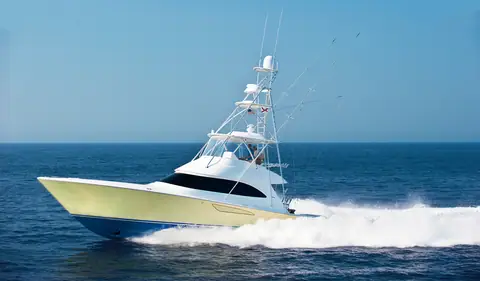
Viking 52 Convertible
Sportfishing Yachts, 53 ft
Used $450K to $1.9M
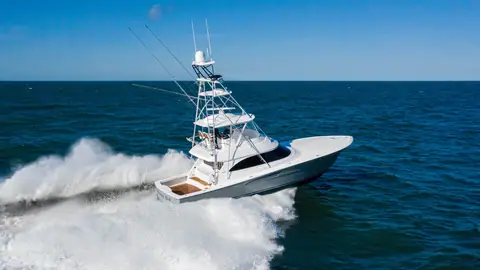
Viking 54 Convertible
Sportfishing Yachts, 55 ft
Used $1.05M to $4M
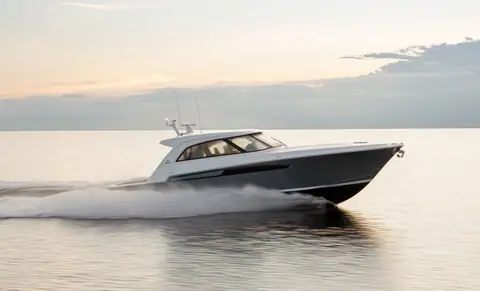
Bertram 50S
Sportfishing Yachts, 52 ft
Used $1.6M to $2.5M
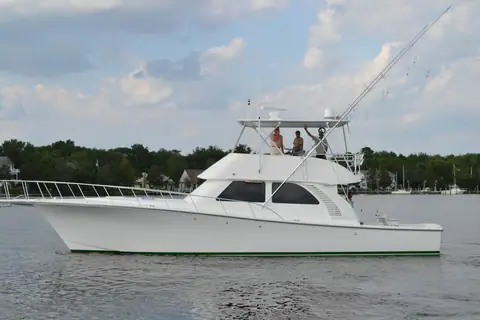
Henriques 50 Sportfisherman
Sportfishing Yachts, 50 ft
Used $1.1M to $2.3M